Pawn Shop Gold Calculator: Estimate a Realistic Pawn Offer
 By Sukie Gao · Updated July 21, 2026
A pawn shop gold calculator has to do two jobs, and most tools online only do the first. Job one is computing your gold's melt value — weight times purity times the going price of gold. The calculator above handles that with live prices. Job two is the part nobody puts on the sign out front: translating that melt number into what a pawn counter will actually put in your hand, which is typically 40–60% of melt and sometimes less. Skip job two and you'll walk in expecting $900, hear $420, and assume you're being robbed — when in fact you've just received a perfectly ordinary pawn offer. This page covers the whole translation: exactly what percentage of melt value to expect and why, how a pawnbroker builds an offer internally, why a pawn *loan* pays even less than an outright sale, what actually moves the number during a negotiation, and the honest cases where the pawn counter beats every other option. We don't buy or sell gold here — we just do the math, which means the numbers below have no thumb on the scale.
Start With Melt, Then Apply the Pawn Discount
Every realistic pawn estimate is a two-step calculation, and the order matters.
Step one: melt value. Weigh your item in grams, multiply by its karat purity (14K = 58.33%, 18K = 75%, 10K = 41.67%, 22K = 91.67%), and multiply by the price of pure gold per gram. With recent prices near $4,300–$4,500 per troy ounce, a gram of pure gold runs roughly $138–$145. The calculator above does this in one pass — pick the karat, enter the weight, and you have your melt number at the live price.
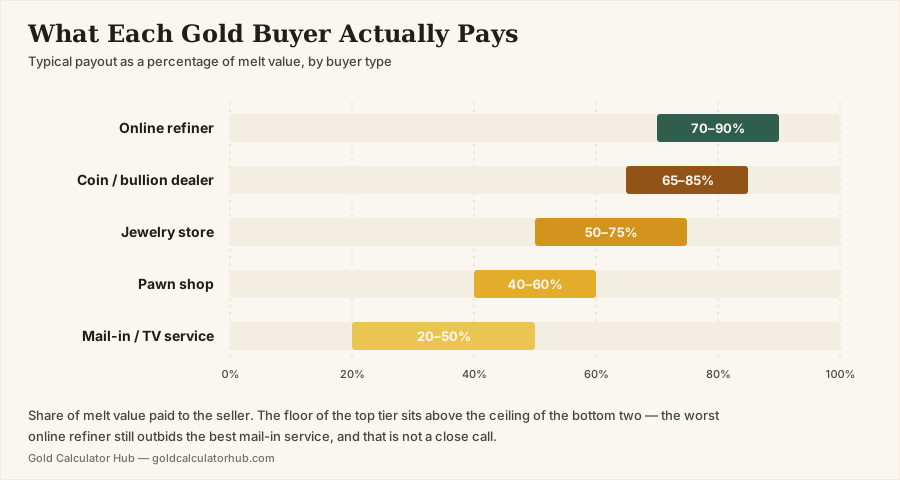
Step two: the pawn discount. A pawn counter buying gold outright pays 40–60% of that melt figure. Well-capitalized shops in competitive areas with quick refiner pipelines sit near 60%; shops with little local competition, or any shop reading a seller who clearly hasn't done step one, drift toward 40% and occasionally below it.
So the realistic formula is simply: melt value × 0.40 to 0.60 = your expected pawn offer. If the calculator says your chain melts at $1,000, walk in expecting $400–$600, hope for the top of the range, and treat anything below $400 as a signal to leave. For the full breakdown of why pawn shops anchor the low end of the market, see how much do pawn shops pay for gold.
What Percent of Melt Value Do Pawn Shops Pay?
It's the question that brings most people here, so here's the direct answer: 40–60% of melt value for gold bought outright, with the great majority of real offers clustering between 45% and 55%. Where a given shop lands inside that band is not random — it tracks five things you can mostly read in advance.
- 40–45% — a shop with no nearby competition, a small or broken lot, an unsorted mixed-karat pile, or a seller who has clearly not done the math. Cash-tight shops at the end of a slow month sit here too.
- 45–55% — the ordinary case. A suburban shop, a clean hallmarked item of a few grams to a few dozen, an unremarkable Tuesday.
- 55–60% — competitive urban markets where four shops sit within a mile, larger lots that amortize handling, and sellers who name their melt figure and produce a competing quote.
- Above 60% — this usually means the item isn't being priced as scrap at all. Showcase-worthy jewelry gets valued off its retail exit, and bullion is a different animal entirely: recognized coins and bars need no refining, so shops that deal in them regularly pay far closer to spot, often 85–95%.
The useful mental model is that the percentage is compensation for the shop's risk and work, not a judgment about your gold. Reduce their work — sorted karats, legible stamps, a lot big enough to bother with — and the percentage tends to move your way.
How a Pawnbroker Builds the Offer Internally
The number you hear at the counter isn't plucked from the air — it's assembled in about ninety seconds from five inputs.
Verification. Hallmarks get checked first, then confirmed with an acid kit or electronic tester, because stamps can lie. Anything that fails verification gets re-priced or refused.
Weight. Grams or pennyweight (1 dwt = 1.555 g). Pay attention to which unit the quote uses — a per-dwt figure sounds about 55% bigger than the same money per gram.
The spot feed. Most shops keep a live gold price open on a screen behind the counter. They know melt to the dollar before you've finished unclasping the chain.
The resale lens. Here's the part sellers miss: the broker is deciding *where your item goes next*. A tangle of broken chain is refiner-bound and gets pure scrap math. An intact designer piece might go in the showcase at a retail markup — and can earn an offer above the standard scrap rate, because the shop's exit price is higher.
The house buy rate. Finally, melt (or estimated resale) gets multiplied by the shop's rate. That rate isn't posted anywhere, it varies by shop and by day, and it quietly flexes based on how informed you appear. Arriving with your own melt number from a gold calculator is the single cheapest way to influence it.
How to Use This as a Free Pawn Value Estimator
The tool on this page is free, needs no account, no email address, and no listing of your items anywhere. That matters more than it sounds: a fair number of "free pawn shop value estimator" pages are lead-capture forms that hand your contact details to a buyer who then calls you with an offer. We don't buy gold, so there's nothing for us to sell you and nobody for us to sell you to.
The four-step routine:
- Weigh each piece separately, in grams, on a scale that reads to 0.1 g. Kitchen scales rounding to whole grams are too coarse for small items — see how to weigh gold.
- Group by karat stamp, not by appearance. A 10K chain and an 18K chain look identical to most eyes and differ by 80% in value.
- Run each group through the calculator above to get melt value at the live gold price.
- Multiply by 0.40 and 0.60 to bracket your realistic offer, and treat the midpoint as your expectation.
One honest limitation: this is a gold estimator, not a general pawn calculator. Pawn shops also lend on tools, instruments, electronics, and firearms, and those are priced off secondhand resale demand rather than a commodity price — there's no formula for them, only comparable sold listings. Gold is the one category where you can genuinely compute the answer before you leave the house, which is exactly why it's worth doing.
Pawn Loan vs. Outright Sale: Two Different Numbers
Ask for a loan instead of a sale and the math changes — downward.
A pawn loan is collateral lending: the shop hands you cash, stores your gold, and returns it when you repay the loan plus interest and fees. Because the shop needs the collateral to comfortably cover the balance if you never come back, loan offers run around 25–50% of what the broker thinks the item would *resell* for — a smaller base than melt, multiplied by a smaller fraction. The same chain that draws a $500 purchase offer might support only a $300 loan.
Then there's the meter. Pawn loan pricing is set state by state, and the spread is enormous — combined interest and fees commonly land anywhere from around 10% to 25% per month depending on where you live. The same $300 loan redeemed after 90 days might cost $90 in one state and $225 in another. There's no national number worth memorizing; the only rate that matters is the one printed on your ticket, which state law requires the shop to disclose before you sign.
Worked math: you borrow $300 against a chain at a 20% monthly rate and redeem in month three. You repay $300 + $180 = $480 to get your own chain back. If the chain was just metal to you, selling outright — at the pawn counter or anywhere else — would have left you ahead. Loans make sense only when the item itself is the point. Not financial advice, but the arithmetic rarely flatters the loan.
The 40/50/60 Table: Melt Value to Expected Offer
Here's the two-step math from above, pre-computed. Assume gold at $4,400 per troy ounce, which makes pure gold $4,400 ÷ 31.103 = $141.46 per gram:
| Item | Melt value | Offer at 40% | Offer at 50% | Offer at 60% |
|---|---|---|---|---|
| 5 g 14K class ring | $413 | $165 | $206 | $248 |
| 8 g 10K bracelet | $472 | $189 | $236 | $283 |
| 10 g 14K chain | $825 | $330 | $413 | $495 |
| 15 g 18K necklace | $1,591 | $636 | $796 | $955 |
| 30 g 22K bangle set | $3,890 | $1,556 | $1,945 | $2,334 |
A full worked example, start to finish. Say you bring in an 18.4-gram 18K Cuban-link bracelet. Fine gold content: 18.4 × 0.75 = 13.8 g. Melt value: 13.8 × $141.46 ≈ $1,952. A shop at a middling 50% buy rate offers $976; a strong shop at 60% offers $1,171. If the first number you hear is $700 — about 36% of melt — you now know it instantly, because you ran the pawn shop gold calculator math before you walked in. That single piece of preparation converts the offer from a mystery into a percentage you can name out loud.
Notice what the table really shows: on bigger items, the spread between a 40% shop and a 60% shop is hundreds of dollars for the identical piece. Quote-shopping two or three counters is worth more per hour than almost anything else you'll do that day.
Negotiating at the Counter: What Moves Them, What Doesn't
First offers carry slack — usually 10–20% — because some sellers push back and most don't. Knowing which levers actually work saves everyone time.
What moves the number: your melt math, stated plainly ("this is $1,950 of melt and you're at 36% — can you get to 55?"); clean hallmarked items that test instantly; bigger lots, which amortize the shop's handling cost; a credible competing quote from another shop or an online buyer; and genuine willingness to walk, which brokers can smell.
What doesn't: the sentimental story; the original retail receipt (retail includes design, brand, and markup the scrap market ignores); an insurance appraisal, which estimates replacement cost, not liquidation value; and theatrical haggling without a number behind it.
The strongest negotiating position at a pawn counter is being the person who can afford to say no — and the cheapest way to become that person is knowing your melt value before you walk in.
One caution from the FTC's guidance on selling gold: get offers from multiple buyers before committing, and understand the karat-and-weight math yourself rather than taking the counter's word for it. The classic counter moves — bundling mixed karats at the lowest karat's rate, or quoting in pennyweight to inflate the figure — only work on sellers who haven't done the arithmetic.
Five Minutes of Prep Before You Walk In
Pawn counters are set up for people who arrive unprepared. Five minutes of homework flips that.
Bring photo ID. Every state requires pawnbrokers to record the seller's identification and report transactions to law enforcement, usually within a day or two. No ID, no deal — this is law, not attitude, and a shop that skips it is one you shouldn't be dealing with anyway.
Expect a holding period. Most states require purchased items to sit untouched for a set number of days before resale. It doesn't affect your payout, but it does explain why shops discount for price risk: their money is parked while gold moves.
Sort and bag by karat, with a written gram weight and your melt figure on each bag. It signals preparation before you say a word, and it prevents the oldest counter move in the trade — weighing everything as one lot at the lowest karat's rate.
Photograph everything next to a ruler before handing it over, and watch the scale and the test yourself.
Ask two questions: "What percentage of melt is this?" and "Are you pricing it as scrap or for the case?" Both answers are worth money, and neither costs anything to ask. Then compare against the venues in selling gold online vs locally before you accept.
When the Pawn Counter Is Genuinely the Right Tool
After all that, an honest word in the pawn shop's favor: sometimes it really is the best option on the menu.
You need bridge cash and want the item back. This is the pawn loan's one unique power — no refiner, dealer, or jeweler offers an undo button. And most borrowers do use it: the National Pawnbrokers Association has long reported that roughly 85% of pawn loans are redeemed, meaning the typical transaction is a short-term loan that ends with the customer reclaiming their gold, not losing it.
Speed is the whole point. Cash in hand in twenty minutes is a service nothing mail-in can match. The 40–60% discount is the price of that speed — steep, but transparent once you know it exists.
The lot is tiny. On a 2-gram 10K earring (about $118 melt), the gap between a pawn offer and a refiner payout is maybe $40 — possibly not worth a week of shipping and tracking.
Now the other side: what forfeiting really costs. If you borrow $400 against the 18K bracelet from earlier ($1,952 melt) and never redeem, you've effectively sold a $1,952 piece for $400 plus whatever interest you paid along the way — a worse outcome than even the weakest outright sale would have produced. If there's real doubt you'll redeem within a month or two, sell instead, and sell at the strongest venue you can find. The complete payout ranking, from online refiners down to TV mail-in operations, is at where to sell gold.
Frequently Asked Questions
How accurate is a pawn shop gold calculator estimate?
The melt-value half is exact — weight × purity × live gold price is just arithmetic, and the calculator runs it on current prices. The offer half is a range, not a point, because every shop sets its own buy rate. Applying 40–60% of melt predicts the great majority of real-world pawn offers; where a specific shop lands inside that band depends on local competition, the item's resale appeal, and how informed you appear. Treat the calculator's melt number as fact and the 40–60% band as the realistic forecast.
Why is the pawn offer so much lower than my gold's melt value?
Because a pawn shop is a loan business with storefront overhead, not a refinery. Between your chain and the refined-gold market sit testing, mandated police reporting and holding periods in most states, refining fees, price risk while inventory sits, plus rent, staff, and security. The 40–60% buy rate covers all of it and the shop's margin. It isn't fraud — it's a business model — but it does mean a pawn counter is usually the place to collect a quote, not the place to sell.
Do pawn shops use the same gold price I see online?
Essentially yes. Most shops keep a live spot feed open behind the counter, drawn from the same global market prices you see on any financial site. The difference is never the reference price — it's the percentage of it they'll pay. That's why doing your own melt math beforehand works: you and the broker are looking at the same spot number, so the only thing left to discuss is the discount, and that's a conversation you can have in percentages.
Should I pawn my gold or sell it outright if I need cash fast?
If the item is replaceable and you just want money, sell — the purchase offer is larger than the loan offer for the same piece, and you escape the interest meter entirely. Pawn only when the item matters to you and you're honestly confident you'll redeem within a month or two. The trap case is pawning metal you don't care about: you receive less cash up front, pay monthly fees, and if you forfeit, you've effectively sold at the worst price available anywhere.
What interest rate will I pay on a pawn loan against gold?
It depends almost entirely on your state. Pawn lending is state-regulated, and combined monthly interest and fees commonly run anywhere from roughly 10% to 25% — a 90-day loan might cost 30% of the principal in one state and 75% in another. The shop must disclose the full terms on your pawn ticket before you sign, so read the ticket, not the sign. Annualized, even the cheap end is expensive money; it's a tool for short bridges, not long borrowing.
What happens to my gold if I don't repay the pawn loan?
The shop keeps it, sells it, and the debt is settled — in most states there's no further collection and no credit-bureau report, which is exactly why pawn loans need no credit check. The real cost is the exchange rate: you typically borrowed 25–50% of the item's resale value, so forfeiting means surrendering the piece for a fraction of what even a mediocre outright sale would have paid. Industry figures suggest most borrowers do redeem, but the forfeit math is brutal when they don't.
Will a pawn shop pay more for jewelry it can resell in the case?
Often, yes. Scrap-bound gold gets scrap math — melt value times the buy rate. But an intact, attractive, currently fashionable piece the shop can showcase gets priced off its retail exit instead, which can lift the offer above the standard 40–60% of melt. Brand-name pieces, matched sets, and clean modern chains benefit most. If your item is showcase-grade, say so and ask whether they're pricing it as scrap or resale; the answer can be worth real money.
Is this a free pawn shop value estimator, or do I have to sign up?
Free, with nothing to sign up for. There's no account, no email capture, and no step where your details get passed to a buyer — we don't purchase gold, so we have no reason to collect them. Enter a karat and a weight, read the melt value at the live price, then apply the 40–60% band yourself to bracket the offer. Be wary of estimator tools that require contact information before showing a number; that pattern usually means the estimate is a lead form wearing a calculator's clothes.
Can I use a pawn calculator for things other than gold?
Not this one, and honestly not any of them reliably. Gold is unusual because its value derives from a public commodity price, so weight × purity × spot gives a hard number anyone can verify. A guitar, a laptop, or a power drill has no spot price — a pawnbroker prices it from recent secondhand sales, current demand, condition, and whether they already have three of them on the shelf. For non-gold items, the closest thing to an estimator is searching completed sold listings on a large resale marketplace and expecting a pawn offer of roughly a quarter to a half of that.
Do pawn shops pay more for gold coins and bars than for jewelry?
Substantially more, when the shop deals in bullion at all. Recognized coins and stamped bars from known mints need no assay and no refining — the shop can resell them as-is to a collector or dealer — so offers commonly reach 85–95% of melt rather than the 40–60% jewelry sees. Two cautions: not every pawn shop is comfortable buying bullion, and pre-1933 or otherwise collectible coins may be worth well above melt, so get a coin dealer's opinion before letting one go at a metal price.
What ID and paperwork do I need to sell gold at a pawn shop?
A valid government photo ID, essentially everywhere. State pawn laws require brokers to record seller identification, item descriptions, and serial numbers, then transmit those records to local law enforcement — part of how stolen property gets traced. You'll typically sign a purchase or pawn ticket stating the item, the amount, and, for loans, the full rate and redemption date. Read the ticket rather than the wall sign, keep your copy, and treat any shop willing to skip the ID step as a reason to leave.
How do I avoid getting lowballed at a pawn counter?
Three habits cover most of it. First, compute your melt value at home — weight, karat, live price — so every offer instantly becomes a percentage. Second, watch the units: insist on a per-gram quote, and make sure mixed-karat lots are weighed and priced separately rather than bundled at the lowest karat. Third, collect at least two quotes before selling anything; the spread between shops on the same item routinely runs to hundreds of dollars. Sellers who do these three things rarely see the bad version of the counter.

Written by Sukie Gao
Sukie Gao holds a master's degree from a business school, where she picked up the markets-and-pricing toolkit she now applies to the consumer gold trade. She created Gold Calculator Hub to give people an independent, data-driven way to find out what their gold is really worth.
Published June 25, 2026 · Updated July 21, 2026