Gold Melt Calculator: Melt Value by Karat and Weight
 By Sukie Gao · Updated July 21, 2026
A gold melt calculator answers the bluntest question in the trade: if this item were melted down and refined tomorrow, what would the recovered gold sell for? Enter a karat and a weight in the calculator above and it returns that figure against the live spot price. No condition grades, no style points, no opinions — melt value is the one gold number that's pure arithmetic. It's also the number every professional buyer starts from: they run this same calculation behind the counter, then decide what fraction of it to offer you. The seller who runs it first walks in holding the buyer's playbook. Below: what melt value technically means, the formula with two fully worked examples at different karats, a full household lot priced piece by piece, why real-world payouts land under the theoretical number, what a refinery actually does with your metal once it leaves your hands, how coins differ from jewelry, what to read in a mail-in refiner's settlement terms before you ship, and the handful of math mistakes that quietly cost sellers the most.
What "Melt Value" Technically Means
Melt value is the market value of the fine gold an item would yield after refining — not the value of the item, and not what anyone will hand you for it. Three words in that definition carry weight.
*Fine* gold means refined, essentially pure metal — the industry standard is 99.9% purity or better, the stuff of bullion bars. Your 14K bracelet is a mixture: 58.33% gold, the rest copper, silver, zinc, and nickel. Refining separates that mixture, and only the gold fraction has meaningful value; the base metals recovered from a bracelet are worth pennies.
*Would yield* matters because melt value is a valuation, not a transaction. And *market value* ties it to the live spot price, so the figure drifts a little through the day — far less, as we'll see, than the gap between buyers.
"Melt value," intrinsic value, metal value, scrap value — all loose synonyms for the same idea: strip away everything except the atoms, and price the atoms.
The Formula, With Two Worked Examples
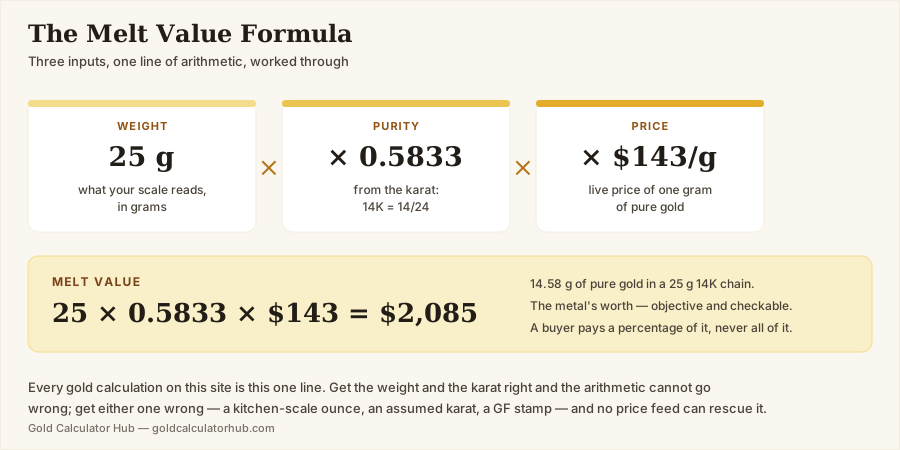
The entire calculation is one line:
Melt value = weight in grams × karat purity × price per gram of pure gold
For the price per gram, divide the spot price by 31.103 (grams per troy ounce). For purity, use the real percentages: 24K = 99.9%, 22K = 91.67%, 18K = 75%, 14K = 58.33%, 10K = 41.67%.
Example one — an 18K chain. Assume gold at $4,400 per troy ounce, so $141.46 per pure gram ($4,400 ÷ 31.103). A 20 gram 18K chain contains 20 × 0.75 = 15 grams of fine gold. Melt value: 15 × $141.46 = $2,122.
Example two — a 10K class ring. Same price assumption. A 7.5 gram 10K ring contains 7.5 × 0.4167 = 3.125 grams of fine gold. Melt value: 3.125 × $141.46 = $442.
Notice the karat leverage: the chain weighs under three times the ring but carries nearly five times the value, because each 18K gram holds 80% more gold than a 10K gram. This is why sorting mixed lots by karat before weighing — the discipline our scrap gold calculator page drills into — changes outcomes so much. The gold calculator on the homepage runs this identical formula with the live price, any karat, any unit.
Refining Losses, and Why Buyers Pay Less Than Melt
If your chain's melt value is $2,122, why does the best offer top out around $1,900? Because turning jewelry into sellable fine gold has real costs, and every hand the metal passes through takes a share. The gap between melt value and your payout covers, roughly in order of size:
- The buyer's margin — the profit that keeps the lights on, by far the largest slice at retail-facing buyers
- Refining fees — refineries charge processing fees or keep a percentage of recovered metal
- Assay costs — verifying actual purity, since stamps are claims rather than guarantees
- Small physical losses — trace metal lost to slag and processing, typically a percent or so
- Price risk — the buyer holds your metal while the market moves before they can sell it on
Stack those up and the familiar payout ranges emerge: online refiners pay 70–90% of melt because few hands touch the metal; local coin and bullion dealers run 65–85%; jewelry stores 50–75%; pawn shops 40–60%; and mail-in TV services as little as 20–50%, their advertising budgets being the most expensive hand of all.
The takeaway isn't outrage — margins are how commerce works — it's that the *percentage* is the entire game. Moving from a 50% buyer to an 85% buyer raises your payout 70%. Our gold value calculator guide goes deeper on reading offers against the melt floor.
A Household Lot, Melted Out on Paper
Abstract formulas are easy to nod along to and hard to act on, so here is an entire kitchen-table lot run start to finish. Assume gold at $4,400 per troy ounce, which puts pure gold at $141.46 per gram.
The lot: a tangle of chains and odds and ends totalling 37.2 grams, sorted by stamp into three piles.
The 14K pile weighs 22.6 grams. Fine gold: 22.6 × 0.5833 = 13.18 grams. Melt value: $1,864.81.
The 10K pile weighs 9.4 grams. Fine gold: 9.4 × 0.4167 = 3.92 grams. Melt value: $554.10.
The 18K pile weighs 5.2 grams. Fine gold: 5.2 × 0.75 = 3.9 grams. Melt value: $551.69.
Add them up and the lot contains almost exactly 21 grams of fine gold — about two-thirds of a troy ounce — worth $2,970.60 at melt. Note that the small 18K pile, at less than a quarter the weight of the 14K pile, nearly matches the entire 10K pile in value.
Now the part that pays for the half hour of sorting. Suppose you had handed the whole 37.2 grams over unsorted and the buyer priced it all as 10K, which is exactly what happens when a mixed pile gets assessed at its lowest visible stamp. That is 37.2 × 0.4167 = 15.50 grams of fine gold, or $2,192.80 — $777.80 less than the same metal correctly separated. No deception is required for that to happen. Only a seller who did not sort.
On the correctly-sorted $2,970.60, an online refiner at 70–90% offers $2,079.42–$2,673.54, while a pawn counter at 40–60% offers $1,188.24–$1,782.36. The spread between the best and worst realistic outcomes is $1,485.30 — more than the entire floor of the pawn range.
Coins vs. Jewelry: Same Formula, Different Market
Melt math works identically on coins — but selling coins at melt is often a mistake in both directions.
Bullion coins typically trade *above* melt. An American Gold Eagle contains exactly one troy ounce of fine gold in a 22K alloy (the whole coin weighs 33.93 grams; the extra is strengthening copper and silver), so its melt value simply equals spot. Yet Eagles routinely change hands at a few percent over spot, because the US Mint's guarantee of weight and purity is itself worth money — a coin needs no assay. Krugerrands and Canadian Maple Leafs behave the same way. Selling a recognized bullion coin to a scrap buyer at 80% of melt torches that premium plus the discount; coins should go to coin dealers.
Numismatic coins can trade *far* above melt — a common-date pre-1933 double eagle carries collector value well beyond its 0.9675 troy ounces of gold. The iron rule: identify any coin before treating it as metal.
Jewelry runs the opposite way, almost always transacting *below* melt for the refining-cost reasons above, with rare exceptions (designer signatures, true antiques) worth setting aside from the scrap pile. Melt value is the ceiling for ordinary jewelry and the floor for recognized coins; knowing which side of that line an item sits on is half of selling well.
What Actually Happens After the Buyer Takes Your Gold
Sellers picture a crucible in a back room. The reality is an industrial supply chain, and understanding its shape explains most of what feels arbitrary about offers.
A local buyer rarely refines anything. They accumulate scrap into lots, sort it roughly by karat, and sell it on to a wholesaler or directly to a refinery — pocketing the difference between what they paid you and what the next link pays them. That difference is the entire business model, and it is why the buyer's own confidence about your metal's purity matters: uncertainty gets priced in as a wider margin.
At the refinery, the lot is melted into a homogeneous bar and sampled. That sample is assayed — historically by cupellation, increasingly by X-ray fluorescence for speed — and the assay, not any stamp on any bracelet, determines the settlement. Chemical or electrolytic refining then strips the copper, silver, zinc, and nickel away, yielding fine gold at 999 or better that re-enters the market as bars and blanks. The recovered silver has modest value and is usually credited on large lots; the base metals are essentially a disposal cost.
Two practical consequences follow. First, the refinery genuinely does not care whether your chain is beautiful, broken, tarnished, or tangled — it becomes the same liquid either way, which is why condition never affects melt value. Second, the further up this chain you can sell, the fewer margins sit between you and the assay. That is the whole reason online refiners pay 70–90% while a pawn counter pays 40–60%: not virtue, just fewer intermediaries.
Stamps, Assays, and the Number You Actually Get Settled At
There is a gap between the melt value you calculate at home and the melt value a mail-in refiner computes on receipt, and it is worth knowing where that gap can open.
Your calculation trusts the stamp. Theirs trusts the assay. US law requires karat stamps to sit within tight tolerance of their mark and most manufacturers comply, but three situations routinely produce a lower settled purity than the stamp implies: older or imported pieces made to looser standards, repaired items where a jeweler used lower-karat solder at the joints, and hollow pieces whose interiors hold flux or filler. None of these are fraud. They simply mean a stamped 14K bracelet can assay a few points under 585.
So read the settlement terms before you ship, and look for four things: whether pricing is struck at receipt, at assay, or on a date you choose; whether purity is determined by stamp or by assay; what the refining and lot fees are in dollars rather than percentages; and — the one people skip — the return policy if you reject the offer. Reputable operations return your metal intact at their cost. Others quietly melt on receipt, which makes rejecting the offer impossible.
The FTC's guidance on selling gold jewelry covers the paperwork side, including photographing and itemizing everything before it leaves your hands. Do that, keep your own weights, and any discrepancy becomes a conversation rather than your word against theirs.
Five Melt-Math Errors That Cost Real Money
After years of watching people compute (and miscompute) melt values, the same handful of errors account for nearly all the damage:
- Using standard ounces instead of troy ounces. Spot is quoted per troy ounce (31.103 g), but kitchen and postal scales read standard ounces (28.350 g) — a 9% gap, always in the direction of disappointment. Weigh in grams, full stop; troy ounce vs ounce covers the carnage this one causes.
- Treating karat stamps as gospel. Stamps are claims. Most are honest; some are worn, wrong, or fraudulent, and unmarked pieces are pure guesses. Buyers will test — see how to test gold at home if you'd rather know first.
- Calling 24K "100% pure." Fine gold is 99.9%. On small lots the 0.1% is trivia, but quoting yourself a perfect 100% on larger weights builds in a small systematic overestimate — and makes buyers wonder what else you rounded in your favor.
- Weighing stones, springs, and solder as gold. A 6 gram ring with a 1.5 carat stone holds about 5.7 grams of metal (one carat = 0.2 g). Clasps hide steel springs; repairs add lower-karat solder. Estimate deductions before the buyer does it for you.
- Applying a retail per-gram price to melt math. Jewelry-store prices per gram include fabrication and markup. Melt value uses the raw spot conversion only — at $4,400/oz, that's $141.46 per *pure* gram and $82.51 per 14K gram, however much the mall charges.
Every one of these is avoidable with a gram scale and thirty seconds of care. The gold melt calculator never lies; it just obeys whatever numbers you feed it.
Frequently Asked Questions
Is melt value what I'll actually get paid?
No — melt value is the benchmark, not the offer. Real payouts run a percentage below it: roughly 70–90% from online refiners, 65–85% from coin and bullion dealers, 50–75% from jewelry stores, and 40–60% from pawn shops. The point of running a gold melt calculator first isn't to expect that exact figure; it's to convert every offer into a percentage so you can compare buyers instantly and recognize a lowball the moment you hear it.
Do buyers actually melt the gold they buy?
Mostly, eventually. Scrap jewelry flows up a chain — local buyer to wholesaler to refinery — and ends up as fine gold bars regardless of who first bought it. Two exceptions: pieces with resale potential (designer names, antiques, desirable styles) get cherry-picked and resold intact at a markup, and recognized bullion coins re-enter the coin market without melting. If a buyer might resell your piece rather than scrap it, check whether you're the one leaving that premium on the table.
What exactly is "fine gold"?
Refined gold of 99.9% purity or higher — the form gold takes in bullion bars and the form in which it's priced on world markets. The term comes from "fineness," purity expressed in parts per thousand: fine gold is 999, while 18K jewelry is 750 and 14K is 585. Melt value always refers to the fine gold recoverable from an item, which is why a 10 gram 14K bracelet has the melt value of about 5.83 grams of fine gold, not 10.
Why is 24K gold 99.9% pure and not 100%?
Because absolute purity is physically unattainable at commercial scale — refining always leaves trace elements measured in parts per thousand. Standard fine gold is 999; premium refining reaches 9999 (99.99%, "four nines"), used in coins like the Canadian Maple Leaf. The karat scale acknowledges this: 24K denotes gold at 99.9%+ rather than a theoretical 100%. Using 0.999 keeps melt math honest on bigger weights.
Is melt value different for white or rose gold?
No. Karat defines gold content regardless of color: 14K white, rose, and yellow gold all contain 58.33% pure gold and carry identical melt value per gram. The alloying metals differ — nickel or palladium whitens, copper blushes — but refiners pay for the gold fraction only. The single nuance: rhodium plating on white gold is worthless at scrap weight, and palladium-white alloys occasionally earn a token extra at refiners that recover platinum-group metals from large lots.
Can a gold coin ever be worth less than its melt value?
In a sane market, no — melt is the floor, since any coin can always be sold for its metal. What can happen is being *paid* less than melt by a buyer taking a margin, or holding a damaged coin whose numismatic premium has evaporated, leaving melt as exactly what it's worth. Heavily worn old coins also contain slightly less gold than their minted specification, so their true melt value is a hair under the book figure. Weigh worn coins rather than trusting the spec.
What are refining losses?
The small amount of precious metal that doesn't survive processing — trace gold left in slag, crucibles, and chemical baths, typically around 1% or less at a competent refinery. Refiners account for it in their settlement terms. For a household seller the line item is invisible; it's simply one ingredient baked into why payouts run below theoretical melt value. If a buyer cites dramatic "melt losses" to justify paying 50% of melt, that's a story, not metallurgy.
Can melt value change between getting a quote and selling?
Yes — melt value floats with the spot price, so a quote from Tuesday is stale by Friday in either direction. Typical daily moves are under 1%, so on a $500 lot you're talking a few dollars, not a few hundred. In-person sales price at the moment of transaction; mail-in refiners price at receipt or assay, per their stated policy. If the market is moving violently, sell locally for instant pricing — otherwise, buyer choice swamps price drift every time.
Should I do melt math in grams or pennyweights?
Grams. They're unambiguous, every digital scale reads them, and the spot conversion is one division: price per troy ounce ÷ 31.103. Pennyweights (1 dwt = 1.555 g, twenty to the troy ounce) survive in the US jewelry trade partly because unfamiliar units blur comparisons. If a buyer quotes per dwt, convert: multiply their per-dwt figure by 0.643 to get per gram, or just divide by 1.555. Any quote that resists being restated in grams deserves suspicion.
Does a hallmark guarantee the karat for melt purposes?
It's strong evidence, not a guarantee. US law requires stamped jewelry to be within tight tolerance of its mark, and the vast majority complies — but stamps can be counterfeited or applied to plated pieces. Buyers therefore verify with acid, electronic, or XRF testing before paying, and final refinery settlement rests on assay of the actual melt. For your own estimates, trust stamps on pieces with known provenance and treat flea-market finds as hypotheses.
Do buyers pay me for the silver and copper in my jewelry?
Effectively, no. A 14K piece is about 42% base metal by weight, but that fraction is mostly copper and zinc worth cents per gram, and separating it costs more than it returns on household quantities. Silver is the one component with real value, yet the few percent typically present in a karat alloy amounts to very little on a single bracelet. Large industrial lots do get silver credits at settlement. For a consumer selling a drawer of jewelry, assume you are paid for gold and nothing else.

Written by Sukie Gao
Sukie Gao holds a master's degree from a business school, where she picked up the markets-and-pricing toolkit she now applies to the consumer gold trade. She created Gold Calculator Hub to give people an independent, data-driven way to find out what their gold is really worth.
Published June 6, 2026 · Updated July 21, 2026