How Much Is My Gold Worth? Work It Out in 60 Seconds
 By Sukie Gao · Updated July 21, 2026
"How much is my gold worth?" is the question every drawer-cleaning, estate-settling, ring-outgrowing American eventually types into a search bar — and the honest answer takes about sixty seconds to find, not a trip across town. You need exactly two facts: the karat stamped somewhere on the piece, and its weight in grams. Feed both into the calculator above and you will see the melt value — what the pure gold inside is worth at the current spot price, recently in the neighborhood of $4,300 to $4,500 per troy ounce. That melt number is your floor. Every legitimate buyer in the country works from it and then subtracts a margin, so knowing it before you walk into a shop changes the entire conversation. This page walks through the sixty-second method step by step, shows what the most commonly sold items — wedding bands, chains, class rings, bracelets — are actually worth at a stated assumed price, explains the three questions that decide whether a piece deserves more than scrap money, covers what to do when a buyer's number comes in below yours, and tells you what you will realistically pocket once someone takes their cut. No appointment, no pressure, and no one across the counter quietly hoping you never learned the number.
Hallmark, Scale, Calculator: The 60-Second Method
Flip the piece over and hunt for the hallmark. On rings it is stamped inside the band; on chains and bracelets, check the clasp or the small flat tag soldered next to it; on pendants, look at the back or the bail. You are looking for either a karat stamp (10K, 14K, 18K, 22K) or a three-digit millesimal number — 417 means 10K, 585 means 14K, 750 means 18K, 999 means essentially pure. Our gold purity chart decodes every stamp you are likely to run into, including the odd European ones.
Next, weigh it. A kitchen scale that reads grams gives you a usable ballpark; a $15 pocket jewelry scale with 0.1 g resolution is better. Take the piece out of any box or pouch, remove anything that is not gold if it detaches easily, and record the weight in grams — not ounces, which is the single most common source of bad math in this business.
Finally, enter the karat and the weight into the calculator above. It multiplies your weight by the karat's purity and the live spot price, and the melt value appears instantly. That is the whole method: hallmark, scale, gold calculator. Sixty seconds, and you walk into any buyer's shop already knowing the number they were hoping you didn't.
What the Number on the Screen Actually Means
The figure the calculator shows is melt value: the market price of the pure gold inside your piece at the current spot price, before anyone takes a cut. Three consequences follow, and all three matter when you sell.
First, melt value is a floor, not a promise. No buyer pays 100% of melt, because they earn their living on the gap between what they hand you and what a refiner pays them. The good ones run a thin gap; the bad ones run a canyon. Either way, the melt number is the fixed point the whole negotiation orbits.
Second, melt value has nothing to do with what you (or your grandmother) originally paid. Retail jewelry prices bundle in design, labor, brand, and store margin — all of which evaporate the moment the piece leaves the display case. So when you ask how much is my gold worth, there are really two answers: what the metal is worth (melt) and what someone will hand you today (melt minus their margin).
Third — and this is the part almost nobody explains — the spot price you see quoted is a wholesale price for enormous, certified, perfectly known quantities of pure metal. It is the price for institutional bars traded between refiners and banks, not for a tangle of mixed karat jewelry with solder joints and a missing stone. Between your ring and that market sit real costs: sorting, testing, assaying, melting, refining away the copper and nickel, and the working capital to sit on metal until there is enough of it to ship. That chain of costs is the honest reason a fair offer is below melt, and it is worth internalizing, because it tells you which discounts are legitimate and which are opportunistic. A dealer taking 15% for handling a clean, marked 14K chain is running a business. One taking 60% for the same chain is running something else.
One more distinction that trips up sellers: melt value is not the same as an insurance appraisal. An appraisal states replacement value — what it would cost to buy a comparable piece new at retail — and can easily run two to four times melt. Both numbers are legitimate; they answer different questions. If your goal is to sell for cash, melt is the number that governs, and the appraisal in the safe deposit box will only make the offers feel worse than they are.
Three Questions That Decide If It's Worth More Than Melt
Before you mentally consign everything to the scrap pile, ask three questions. They take two minutes and occasionally pay for a vacation.
Is it signed? Look for a maker's mark near the hallmark: Tiffany & Co., Cartier, Van Cleef & Arpels, David Yurman, Bulgari. A signed piece from a name brand can sell for a multiple of its melt value on the resale market — and a scrap buyer will happily melt that premium into nothing if you let them. Signed pieces should never go in the scrap pile until someone who deals in designer resale has seen them.
Is it genuinely old? Intact Victorian, Edwardian, and Art Deco jewelry has a collector market of its own. The key word is intact: a period piece with original stones and no botched repairs interests an estate dealer; a mangled one is scrap with a backstory.
Does it carry real stones? Tiny accent diamonds (melee) add little — buyers often deduct their weight rather than pay for them. But a certified center diamond of roughly half a carat or more, or a quality sapphire, ruby, or emerald, deserves a separate appraisal before any gold buyer weighs the piece.
If you answer no to all three, melt value is your honest market, and the calculator above already gave it to you. If you answer yes to any of them, the cost of finding out is one extra opinion from a dealer who specializes in that thing — an estate jeweler, a designer-resale consignment shop, a gemologist. That opinion is usually free, and the asymmetry is enormous: you risk an afternoon and you protect against melting something worth several times its metal. Scrap is a one-way door. Nothing that goes through it comes back.
What the Most-Googled Items Are Really Worth
Let's put real numbers on the items people actually search for. Assume gold at $4,400 per troy ounce, which works out to $4,400 ÷ 31.103 g = $141.47 per gram of pure gold. A 14K piece is 58.33% gold, so each gram of it carries $141.47 × 0.5833 = $82.52 of gold. A 10K piece (41.67%) carries $58.95 per gram, and 18K (75%) carries $106.10.
Worked through on the classic example: a chunky 12 g 10K class ring holds 12 × 0.4167 = 5.0 g of pure gold, worth 12 × $58.95 = about $707 in melt. Here is the same math across the items we get asked about most, at typical weights:
| Item (typical weight) | 10K melt | 14K melt | 18K melt |
|---|---|---|---|
| Wedding band (4 g) | $236 | $330 | $424 |
| Curb chain (20 g) | $1,179 | $1,650 | $2,122 |
| Class ring (12 g) | $707 | $990 | $1,273 |
| Bracelet (8 g) | $472 | $660 | $849 |
Your piece will differ — weigh it, because a "heavy" chain can run 40 g and a dainty one 6 g, and that spread matters more than a karat step. All figures are melt value, not offers — which brings us to the unpleasant part.
What You'll Actually Pocket After the Buyer's Cut
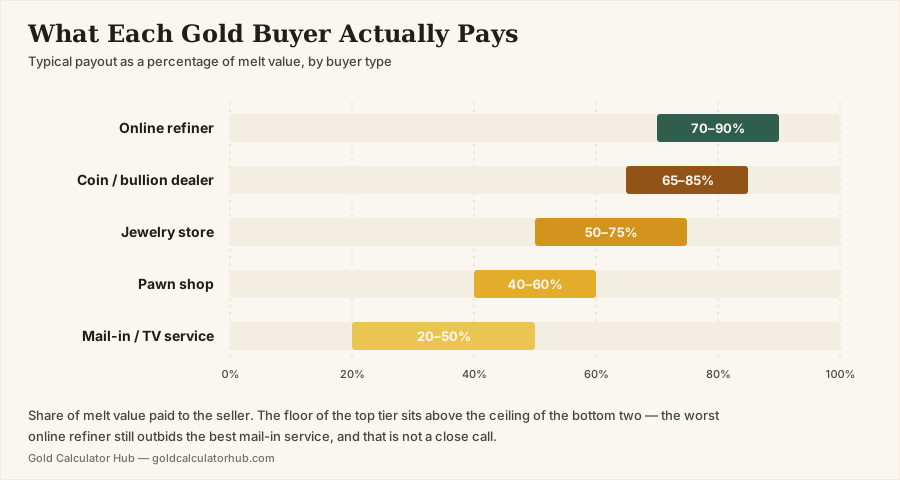
Every buyer pays a percentage of melt, and the percentages are brutally consistent across the industry: online refiners pay 70–90% of melt, local coin and bullion dealers 65–85%, jewelry stores 50–75%, pawn shops 40–60%, and mail-in TV-advertised services 20–50%.
Take a 31 g 14K curb chain. At our assumed $4,400 spot it holds 31 × 0.5833 = 18.08 g of pure gold, for a melt value of 31 × $82.52 = $2,558. Here is what that same chain turns into at each counter: an online refiner offers roughly $1,791–$2,302; a coin dealer $1,663–$2,174; a jewelry store $1,279–$1,919; a pawn shop $1,023–$1,535; and a mail-in service as little as $512. Same chain, same day — and a spread of $1,790 between the best and worst outcome.
The lesson writes itself: get at least two or three offers, and ask each buyer what percentage of melt they pay, because now you know the melt. The FTC's guidance on selling gold jewelry says the same thing in federal prose — shop around, know your karats, and deal with buyers who weigh in front of you. For a full ranking of who pays what and why, see our breakdown of where to sell gold.
When Their Number Comes In Under Yours
You did the math. You walked in with $2,558 in your head. The offer is $1,700, and now you have to decide in about ten seconds whether that is a fair margin or a fleecing. Five things account for nearly every gap, and only three of them are legitimate.
They quoted per pennyweight, not per gram. Old-school dealers price in dwt, and 1 dwt = 1.555 g — so a dwt number is always about 1.6× the equivalent gram number and sounds far more generous than it is. Convert before you react. That 31 g chain is 31 ÷ 1.555 = 19.94 dwt. At "$100 per pennyweight" the offer is 19.94 × $100 = $1,993.57, which against $2,558 of melt is 78% — genuinely a strong offer. The unit, not the generosity, was doing the surprising.
They weighed net, you weighed gross. Your scale included the cubic zirconia, the steel spring bar in the clasp, and the watch movement. Buyers deduct non-gold components before pricing and they are right to. Ask them to show you the deduction; a reasonable dealer will point at the stones and estimate out loud.
The piece is unmarked, so they assumed the worst. Faced with no hallmark, buyers quote the lowest plausible karat, because they eat the loss if they guess high. This one is entirely within your control: get the piece tested first, and the assumption disappears. See how to test gold at home for the $20 version.
Solder deduction. Chains, sized rings, and repaired pieces contain solder alloyed below the item's stated karat, so refiners recover slightly less than the stamp implies. A small, honest haircut on chain-heavy lots — a few percent, not a third.
They are using a stale or self-serving spot price. Gold moves daily, and "today's price" on a laminated card by the register might be from last month's peak or trough, whichever suits. Pull the live number up on your phone from the calculator above and put it on the counter.
The response that works is not indignation, it is arithmetic. Say the melt number out loud, ask what percentage of melt the offer represents, and let them do the division in front of you. Buyers who price fairly answer that question immediately and without irritation, because their number holds up. The ones who deflect, change the subject to how the market has been terrible lately, or start explaining that your gold is "only 14 karat" as though that were news — those are answering you anyway, just not with words.
The Heirloom Trap: When Feelings Inflate the Number
Here is the conversation that happens at every gold counter in America: a seller brings in their mother's ring, hears an offer of $480, and feels insulted, because the ring is obviously priceless. Both parties are right. The ring's emotional value is real — and the market cannot pay a dime for it.
This matters because sentiment distorts decisions in both directions. Some sellers refuse fair offers for years, storing pieces they never wear while the insurance and the worry pile up. Others, in the fog of a loss, dump an entire estate lot at the first pawn counter just to make the task disappear.
A calmer protocol: photograph everything, run each piece through the calculator above so the unsentimental floor is on paper, and keep the one or two items that genuinely carry the memory. Sell the rest with the same detachment you'd sell a used car. If you have inherited a whole jewelry box rather than a single ring, the stakes and the tax rules both change — our guide to selling inherited gold jewelry covers sorting the lot, the stepped-up basis rules, and keeping the family on speaking terms.
Frequently Asked Questions
Is gold-plated or gold-filled jewelry worth anything?
Almost nothing, to a gold buyer. Plated pieces (marked GP, GEP, or HGE) carry a gold layer measured in microns — too thin to recover economically. Gold-filled pieces (marked GF or 1/20 14K GF) contain about 5% gold by weight, but most local buyers decline them because refining costs eat the value. A pound of gold-filled scrap has some refiner value; a single plated chain has essentially none.
How do I weigh my gold without a jeweler's scale?
A digital kitchen scale set to grams gets you within a gram or two, which is fine for a first estimate. For real precision, a pocket jewelry scale with 0.1 g resolution costs about $15 online. Avoid bathroom scales entirely, and never accept a buyer's weight without watching the scale yourself. If a dealer quotes in pennyweights (dwt), remember 1 dwt = 1.555 g.
What if my gold has no hallmark at all?
Unmarked gold is common on older, handmade, or imported pieces. The absence of a stamp doesn't mean it's fake — but it does mean you need a test. A $10 acid test kit gives a karat estimate at home, and most coin dealers will test a piece with electronic or XRF equipment for free or a few dollars, in front of you. Test before you sell; buyers quote unmarked gold at the lowest plausible karat if you let them.
Why does my gold's value change every day?
Because melt value is anchored to the spot price of gold, which trades nearly around the clock on global markets and moves with interest rates, currency swings, and plain investor mood. Day-to-day moves of 1–2% are routine, which on a $2,500 chain means the answer shifts by $25–$50 between Monday and Friday. That's why this site's calculators pull a live price rather than a stale one — and why any written quote you get from a buyer is usually only good for that day.
How do I work out the per-gram value of 14K?
With spot recently in the $4,300–$4,500 per troy ounce range, a gram of 14K gold carries roughly $81 to $84 of gold content. The math: divide spot by 31.103 to get the pure-gold price per gram, then multiply by 0.5833, since 14K is 58.33% gold. At exactly $4,400 spot, that's $141.47 × 0.5833 = $82.52 per gram. Remember that's melt value — a buyer will pay you a percentage of it, not the full figure.
Do the stones in a piece change what I get paid for the gold?
Usually the opposite. Scrap buyers deduct the estimated stone weight before pricing the gold, and most pay nothing for small accent diamonds because removing and reselling melee isn't worth their time. The exceptions are significant stones — a certified diamond around half a carat or larger, or fine sapphires, rubies, and emeralds — which can be worth more than the mounting. Get those appraised separately before any gold buyer touches the piece, or you're donating the stones.
Is 10K gold worth selling, or too cheap to bother?
Worth selling, absolutely. 10K is 41.67% pure, which at recent prices still puts nearly $59 of gold in every gram (at $4,400 spot). A 12 g 10K class ring carries about $707 in melt value — real money for something living in a sock drawer. The percentage-of-melt that buyers pay is the same for 10K as for 18K; what changes is only the per-gram base. Don't let anyone wave off 10K as 'barely gold' and lowball accordingly.
How much is a dental gold crown worth?
Dental gold typically runs 10K to 22K, with around 16K (66.7% gold) being common for crowns. A full crown weighs roughly 2–3 g, so at $4,400 spot a 3 g, 16K crown holds about 3 × 0.6667 × $141.47 = $283 in melt value. Porcelain coatings and attached tooth material get deducted, and purity varies by the alloy your dentist used, so refiners often pay on assay. Send dental gold to an online refiner rather than a pawn shop — the payout difference is large.
Will any buyer pay me 100% of melt value?
No, and you should be suspicious of anyone who claims to. Every buyer resells to a refiner or wholesaler and lives on the spread, so 100% would mean working for free. The realistic ceiling is the top of the online-refiner range, around 90% of melt for clean, well-marked karat scrap in decent quantity. If an ad promises 'full market value,' read it as marketing, and ask what percentage of today's melt value they actually pay.
Should I clean my gold before getting it valued?
A gentle clean is fine — warm water, a drop of dish soap, a soft brush — and it helps you read the hallmark. Don't do more than that. Aggressive polishing removes a little metal, can damage patina that collectors of antique pieces actually pay for, and won't change a scrap offer by a cent, since scrap buyers price on weight and karat, not sparkle. If a piece might be a signed or period item, leave it exactly as found until a specialist sees it.
How much is my gold worth at a pawn shop specifically?
Plan on 40–60% of melt value, the lowest tier among walk-in buyers. Pawn shops price defensively because reselling is slow and their core business is collateral loans, not bullion. On a 14K chain with $1,000 of melt value, that's $400–$600 in hand. They do have two real advantages — instant cash and the option of a loan instead of a sale, so you can reclaim the piece later. If you don't need the money today, a coin dealer or online refiner typically pays meaningfully more.
Does white gold or rose gold change the value?
No. Value follows karat and weight, not color. A 14K white gold ring and a 14K rose gold ring of the same weight contain identical amounts of gold — 58.33% — and melt for the same figure. The color comes from the alloying metals: nickel or palladium for white, copper for rose. One footnote: a white gold piece alloyed with palladium can earn a tiny extra credit at a refiner, but for walk-in selling, treat all colors as equal.
Do I need a professional appraisal before selling for scrap?
For melt-value selling, no — an appraisal typically costs $50–$150 and states replacement value, which is what insuring the piece would cost, not what anyone will pay you. That number will only make offers look insulting. Appraisals earn their keep in three situations: insuring a piece you're keeping, settling an estate where heirs need a defensible figure, and confirming a significant center stone. For a plain 14K chain headed to a refiner, the calculator above plus two competing quotes tells you more than a paid appraisal will.
Is a small amount of gold even worth selling?
It depends on the channel more than the amount. A single 3 g 10K pendant carries about $177 of melt at $4,400 spot, and a pawn shop paying 40–60% turns that into roughly $71–$106 — often not worth a special trip. Online refiners pay far better percentages but frequently set minimum lot sizes and charge for insured shipping, which eats small parcels. The practical move is to accumulate: hold odd single pieces until the drawer adds up to 25–30 grams, then sell the lot as one, where the better channels become worth using.

Written by Sukie Gao
Sukie Gao holds a master's degree from a business school, where she picked up the markets-and-pricing toolkit she now applies to the consumer gold trade. She created Gold Calculator Hub to give people an independent, data-driven way to find out what their gold is really worth.
Published June 6, 2026 · Updated July 21, 2026