Gold Weight Calculator: Convert Grams, Ounces, dwt and More
 By Sukie Gao · Updated July 21, 2026
A gold weight calculator solves a quietly universal problem: gold is weighed in at least seven different units around the world, and the moment you inherit, buy, or sell across borders — or even just walk between two shops in the same American strip mall — you're translating between them. A US coin dealer quotes pennyweight. A financial site quotes troy ounces. Your scale reads grams. Your mother-in-law in Lahore counts tolas, your cousin in Bangkok counts baht, and an old receipt from Hong Kong says tael. Every one of those is a real, current unit of gold weight, and mixing any two of them up changes a valuation by anywhere from 9% to several hundred percent. The calculator above takes whatever weight you enter in grams and turns it straight into dollars by karat; this page supplies the other half — the conversion tables and the arithmetic to get any unit into grams correctly, with a worked example that walks a set of 22K tola bangles all the way to a US dollar figure.
Every Unit Gold Is Weighed In, Worldwide
Here is the full set you'll realistically encounter, anchored to grams — the unit every digital scale speaks and the one our gold calculator uses.
| Unit | Grams | Troy oz | dwt | Where you'll see it |
|---|---|---|---|---|
| Gram (g) | 1 | 0.0322 | 0.643 | Scales everywhere; most global dealers |
| Troy ounce (ozt) | 31.103 | 1 | 20 | Spot price quotes, bullion coins and bars |
| Pennyweight (dwt) | 1.555 | 0.05 | 1 | US pawn shops, estate buyers, dental labs |
| Standard ounce (oz) | 28.350 | 0.911 | 18.23 | Kitchen and postal scales — never gold |
| Grain | 0.0648 | 0.00208 | 0.0417 | Tiny gold items, historical records |
| Tola | 11.664 | 0.375 | 7.50 | India, Pakistan, South Asian jewelry |
| Baht | 15.244 | 0.490 | 9.80 | Thailand (also a purity tradition, 96.5%) |
| Tael (HK) | 37.43 | 1.203 | 24.07 | Hong Kong, Chinese gold trade |
Two of these earn special respect. The troy ounce is the unit the entire gold market prices in — the US Mint strikes American Eagles to troy weight, and every spot quote you'll ever see means troy. And the pennyweight survives in American buying counters precisely because most sellers don't know it, which makes quotes harder to compare. Exactly one-twentieth of a troy ounce, it's covered in its own right below.
The Conversion Math, With Real Numbers
All conversions reduce to one move: get the weight into grams, then go wherever you need. Three conversions cover nearly every real situation.
Grams to troy ounces — divide by 31.103. A 50-gram chain is 50 ÷ 31.103 = 1.608 troy ounces. Going the other way, multiply: a quarter-ounce of gold is 0.25 × 31.103 = 7.776 g.
Pennyweight to grams — multiply by 1.555. A buyer who says your ring weighs "4 dwt" is saying 4 × 1.555 = 6.22 g. This conversion matters most in reverse: when a shop quotes "$110 per dwt for 14K," divide by 1.555 to get $70.74 per gram, the comparable number. (At gold near $4,400/oz, 14K melt is about $82.52/g — so that dwt quote is roughly 86% of melt. Good rate, deliberately awkward unit.)
Tola to grams — multiply by 11.664. Three tolas is 34.99 g. The tola is delightfully tidy: it's exactly 0.375 troy ounces, so 8 tolas equal exactly 3 troy ounces, a relationship South Asian bullion dealers use constantly.
For baht, multiply by 15.244; for Hong Kong tael, by 37.43; for grains, by 0.0648. Then run the grams through the gold price per gram calculator for a live dollar figure at any karat.
The Ounce That Isn't: A 9.6% Trap
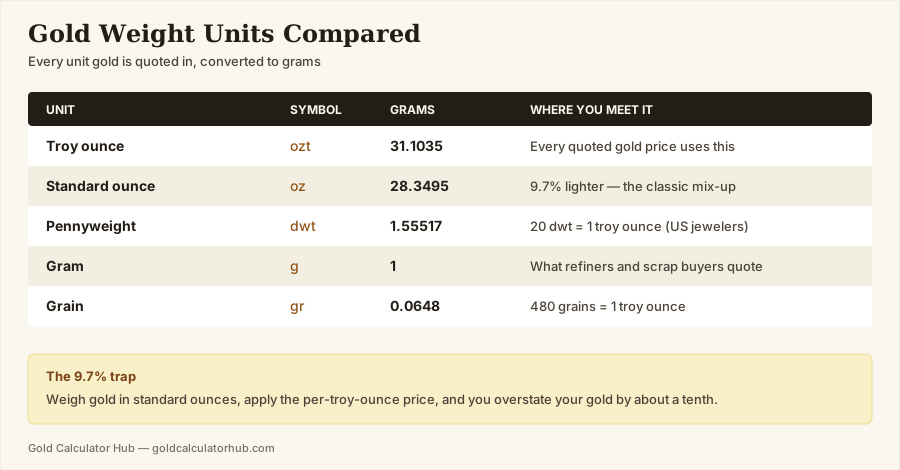
One conversion deserves its own warning label. The English word "ounce" refers to two different weights, and gold uses the rarer one. The troy ounce is 31.103 grams. The standard (avoirdupois) ounce — the one your kitchen scale, bathroom scale, and postal scale mean — is 28.350 grams. The troy ounce is about 9.7% heavier.
The expensive mistake runs like this: you weigh a pile of gold on a kitchen scale, see "3.5 oz," multiply by the spot price, and believe you own 3.5 troy ounces of weight. You actually have 3.5 × 28.35 = 99.2 g, which is 99.2 ÷ 31.103 = 3.19 troy ounces. You've overestimated by nearly 10% before purity even enters the picture, and a buyer's fair offer will feel like a ripoff when it's nothing of the sort. The reverse error — reading a dealer's troy figure as kitchen ounces — makes sellers underestimate and accept lowballs.
The defense is to refuse to think in ounces of either kind during a valuation. Weigh in grams, calculate in grams, compare quotes in grams. We dissect the history and the full damage report in troy ounce vs ounce; the one-line version is that gold kept medieval French troy weights while groceries didn't, and the 2.75-gram gap between the two ounces has been quietly taxing the confused ever since.
Weighing It Right Takes Two Minutes
Conversion math is only as good as the weight you feed into a gold weight calculator, so a compressed field guide — the full version lives at how to weigh gold.
Use a digital pocket scale with 0.1 g resolution or better; adequate ones cost less than a dinner out. Put the scale on a hard, level surface, away from drafts and the edge of the counter. Tare it to zero with the empty tray, then weigh.
What you weigh matters as much as how. Sort items by karat first — a pile that mixes 10K and 22K has no single meaningful weight, because value is computed per karat. Remove anything that isn't gold: pendants from chains if they're different karats, watch movements from gold cases, cotton wadding from lockets. Gemstones are the big one — a 1-carat stone is only 0.2 g, but a chunky cocktail ring can carry several grams of stone, and buyers will deduct for it whether you did or not.
And typical weights, so you can sanity-check your scale's verdict:
| Item | Typical gold weight |
|---|---|
| Thin 18" chain | 2–5 g |
| Wedding band | 3–7 g |
| Class or signet ring | 6–12 g |
| Link bracelet | 10–30 g |
| Heavy curb chain | 30–100 g |
| South Asian bangle | often sold by the tola: 1 tola = 11.664 g |
| Thai chain | sold in baht units: 1 baht = 15.244 g |
If your scale says a delicate chain weighs 40 grams, weigh it again — something on the tray isn't gold, or the scale isn't on level ground.
Convert Once, Then Refuse to Convert Again
There's a bad habit that costs people money quietly: converting in a chain. Tolas to pennyweights because the buyer speaks dwt, pennyweights to troy ounces because the price is quoted per ounce, troy ounces back to grams because that's what the scale said. Every hop rounds, and rounding compounds in one direction as often as it cancels out.
Watch it happen. Three tolas is exactly 3 × 11.664 = 34.992 g. Now do it the sloppy way: call a tola 11.66 g (34.98 g), divide by a rounded 1.55 to get 22.57 dwt, divide by 20 for 1.1285 troy ounces, multiply by a rounded 31.1 and land on 35.09 g. You've drifted 0.10 g — about 0.3% — on a piece of jewelry. At 22K purity and $4,400/oz gold, 22K runs $129.68 a gram, so that drift is roughly $13. Annoying, not fatal.
Now run the same sloppiness across a 500-gram estate lot. The same 0.3% is 1.5 g, or about $195 of 22K gold, sitting entirely on the wrong side of the ledger — and nobody in the room will ever know which conversion caused it.
The fix is a rule, not more care: convert everything into grams once, write the grams down, and never leave grams again. Put the number in a note on your phone with the karat next to it. When a buyer quotes per pennyweight, don't convert your weight to pennyweights — convert their price to a per-gram figure by dividing by 1.555, and compare in your own units. You control your arithmetic; you do not control theirs.
Worked Example: Four Tolas of 22K, Converted to US Dollars
Now the situation a gold weight calculator exists for. Say your aunt in Karachi left you a pair of 22K bangles, and the family knows them the way South Asian families always have: "four tolas, two tolas each." What is that in American money?
Step 1 — tolas to grams. 4 tolas × 11.664 g = 46.656 g of 22K gold. Confirm it on your own scale; heirloom weights are sometimes remembered generously, and clasped-in screws or lac filling (a resin core used in some bangle styles) can mean less gold than the family figure suggests.
Step 2 — adjust for purity. 22K is 91.67% gold — the standard for South Asian jewelry, often hallmarked 916. Pure gold content: 46.656 × 0.9167 = 42.77 g.
Step 3 — apply the gold price. Assume gold at $4,400 per troy ounce, which is $4,400 ÷ 31.103 = $141.47 per gram. Melt value: 42.77 × $141.47 ≈ $6,051.
Step 4 — translate to real offers. An online refiner paying 70–90% of melt would offer roughly $4,236–$5,446. A local jewelry buyer at 50–75% would land between $3,026 and $4,538. One genuine bright spot: in US cities with significant South Asian communities, specialist 22K jewelers sometimes pay near the top of the range or resell intact pieces rather than melting them — handmade bangles can be worth more as bangles than as metal. Get one quote from that world before anyone fires up a torch.
The Weight on the Scale Is Not the Weight of the Gold
Every conversion on this page assumes the number you started with is gold. Frequently it isn't — not because anyone lied, but because jewelry is an assembly. What a scale reports is gross weight. What a buyer pays for is net gold weight, and the difference can be most of the object.
The usual offenders, roughly in order of how much they matter:
- Movements and mechanical parts. A gold-cased quartz watch is mostly not gold. Say the whole watch reads 62 g; strip the movement, crystal, steel back, and pins and the 18K case itself is 38 g. At $4,400/oz gold — $106.10 per gram for 18K — the case melts at 38 × $106.10 = $4,031.80, while the 62 g figure would have suggested over $6,500. Sell a working watch whole rather than scrapping it, but if it's scrap-bound, know which number is real.
- Fillers. Traditional South Asian bangles and some hollow Italian work are packed with lac, resin, or cement to hold shape. A 46 g pair of bangles can hide 15 g of filler, and a buyer will drill or cut to check.
- Springs, clasps, and pins. Steel spring bars in a bracelet clasp, base-metal ear posts, and pin stems are small individually and add up across a lot.
- Stones. Usually the smallest deduction, contrary to expectation. A carat is 0.2 g, so a 14K cocktail ring reading 14.8 g gross with 3.1 carats of stones is carrying just 0.62 g of them. Net 14.18 g × $82.52 = $1,170.13, against $1,221.30 if you'd priced the gross weight — about $51 of difference. Real, but not the thing to worry about first.
So the honest procedure is: weigh gross, identify the non-gold, estimate or remove it, and convert only the remainder. When you can't tell — an unopenable locket, a bangle you'd rather not damage — say so up front and ask the buyer how they intend to establish net weight. The answer to that question tells you a great deal about who you're dealing with, and the FTC's guidance on selling gold jewelry is worth a read before you hand anything over.
Frequently Asked Questions
What is a tola, and how do I convert it?
One tola is 11.664 grams — exactly 0.375 troy ounces, or three-eighths of an ounce. It's the standard gold unit across India, Pakistan, and much of South Asia, and you'll hear weights quoted in tolas for bangles, sets, and coins. The tidy fraction means 8 tolas equal exactly 3 troy ounces. To value tola gold in US terms, multiply tolas by 11.664 to get grams, then price at the appropriate karat — usually 22K for South Asian jewelry.
What is a baht of gold, and is it really 96.5% pure?
In the Thai gold trade, one baht is a weight of 15.244 grams, and Thai gold jewelry is traditionally sold in baht units — a "two baht" chain weighs about 30.5 g. Thai standard gold purity is 96.5%, which sits between 23K and 24K and doesn't match Western karat marks. When valuing Thai gold for a US sale, use the weight in grams times 0.965 for gold content, and expect buyers unfamiliar with the standard to test it before quoting.
What is a pennyweight (dwt)?
A pennyweight is one-twentieth of a troy ounce: 1.555 grams, or 24 grains. The abbreviation dwt comes from "denarius weight," the old Roman-derived penny. It survives mainly at American pawn and gold-buying counters and in dental labs. There's nothing wrong with the unit itself — but a per-dwt quote is harder for sellers to compare against per-gram melt values, which is precisely why some buyers prefer it. Divide any dwt price by 1.555 to get the per-gram equivalent.
How many grams are in a troy ounce of gold?
31.103 grams — the figure behind every spot price quote, bullion coin, and bar specification in the gold world. It's about 9.7% heavier than the standard 28.35-gram ounce used for food and postage, a difference that regularly garbles home valuations. When any gold price is quoted "per ounce," it means troy, essentially without exception. To get the widely used per-gram rate, divide the spot price by 31.103: gold at $4,400/oz is $141.47 per gram of pure gold.
Will a kitchen scale give me a usable gold weight?
For a rough first estimate, yes — with two corrections. Most kitchen scales resolve only to whole grams, so a 4.4 g ring may read 4 or 5, an error of over 10% on small items. And if the scale reads in ounces, remember those are standard ounces of 28.35 g, not troy ounces of 31.103 g. Switch the display to grams, weigh items in groups by karat to beat the resolution limit, and buy a $15–$25 pocket scale with 0.1 g precision before accepting any offer.
What is a grain in gold weighing?
The grain is the smallest traditional unit: 0.0648 grams, with 24 grains to a pennyweight and 480 to a troy ounce. It descends from the weight of a barleycorn and survives in niches — very small gold items, some mint specifications, historical documents, and ammunition (the same grain). You'll rarely need it for jewelry, but if an old appraisal or coin reference quotes grains, multiply by 0.0648 to get grams before doing any value math.
Do gemstones count toward gold weight?
No — and every buyer will make sure they don't. Stones, watch movements, springs, enamel, and lac or resin cores in hollow jewelry are all non-gold weight that gets deducted before pricing. A small diamond is trivial (1 carat = 0.2 g), but large stones, full settings, or filled bangles can be a meaningful share of what your scale reads. Estimate stone weight yourself, or have stones removed and valued separately if they might be worth more than the deduction a scrap buyer would apply.
Is a tael the same weight everywhere?
No — it's the messiest unit in the gold world. The Hong Kong tael used in the gold trade is 37.43 grams; Taiwan's is 37.5 g; and mainland China's modern market often uses a metric 50-gram liang, while historical taels varied by city and trade. If you're valuing gold described in taels — an old Hong Kong receipt, a family bar — confirm which standard applies, or better, skip the question entirely and weigh the piece in grams on your own scale. The scale settles arguments the terminology can't.
My family calls it a vori or bhori — is that a different unit?
Same weight, different word. Vori (also bhori or bhari) is the Bengali term for what Hindi and Urdu speakers call a tola: 11.664 grams. You'll hear it across Bangladesh and West Bengal, usually attached to 22K jewelry. Some regional usages have historically rounded it to 11.66 g or even 10 g under later metric standardization attempts, so if a weight comes from an old receipt or a family memory rather than a scale, treat it as an estimate and reweigh. Multiply vori by 11.664 for grams, then price at 22K.
How much does a kilogram of gold cost?
A kilo of pure gold is 1,000 grams, which is 1,000 ÷ 31.103 = 32.15 troy ounces. With gold at $4,400 per troy ounce, that's about $141,460 — and at the recent range of roughly $4,300–$4,500 per ounce, somewhere between $138,000 and $144,700. Kilo bars are a standard bullion format, particularly in Asian markets, and they're refined to 99.9% or 99.99% purity, so essentially the whole weight is gold. Jewelry is the opposite case: a kilo of 14K scrap contains only about 583 grams of actual gold.
Does a bullion bar's stamped weight include the alloy?
For investment bars, the distinction barely exists. A bar stamped 1 oz .9999 contains one troy ounce of gold and is 99.99% gold, so gross and net weight are the same to within a rounding error. Coins are where it diverges: a 22K bullion coin is stamped for its gold content, not its total mass, so it physically weighs more than the ounce it advertises. Jewelry is the extreme case — nothing is stamped by weight at all, only by purity, so you must weigh it yourself and apply the karat fraction.

Written by Sukie Gao
Sukie Gao holds a master's degree from a business school, where she picked up the markets-and-pricing toolkit she now applies to the consumer gold trade. She created Gold Calculator Hub to give people an independent, data-driven way to find out what their gold is really worth.
Published June 18, 2026 · Updated July 21, 2026