Troy Ounce vs Ounce: The 10% Difference That Costs Sellers
 By Sukie Gao · Updated July 21, 2026
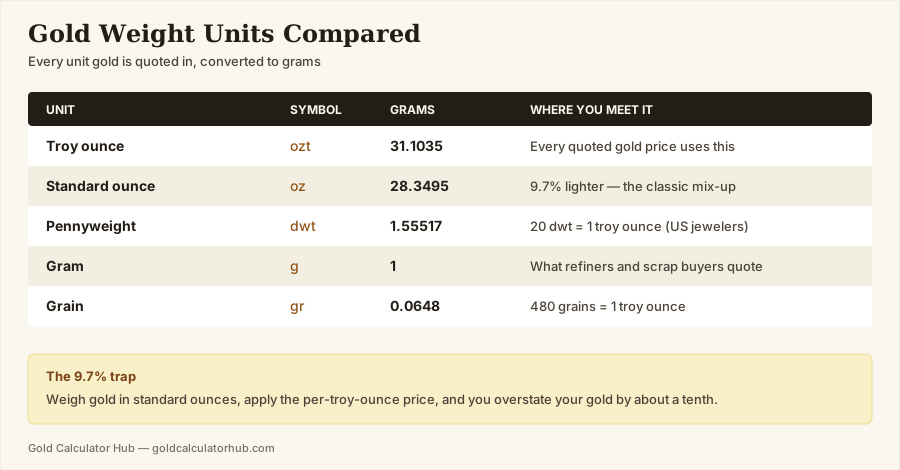
Troy ounce vs ounce sounds like trivia until you realize the gold market and your kitchen scale are speaking two different languages — and the gap between them is almost ten percent of your money. A troy ounce is 31.103 grams. The everyday ounce on American scales — the avoirdupois ounce — is 28.350 grams. Gold is priced, quoted, and traded exclusively in troy ounces, so when the news says gold hit $4,400, that's $4,400 for 31.103 grams, not for the ounce your postage scale reports. Mix the two up and every number downstream is wrong: your weight estimate, your melt value, and your sense of whether a buyer's offer is fair or insulting. Sellers make this mistake in both directions — sometimes overestimating what they have and feeling cheated by honest offers, sometimes underestimating and accepting low ones. What makes it durable is that neither unit ever announces itself. A scale display says "oz." A price quote says "per ounce." An estate inventory typed up decades ago says "approx. 6 oz." None of them tell you which ounce they mean, and the two numbers are close enough that a wrong answer never looks obviously wrong — it just looks like a disappointing offer, or a suspiciously generous one. This page pins down the difference once, gives you a conversion table worth keeping, explains why a one-ounce gold coin doesn't weigh an ounce, and walks through exactly how many dollars the confusion costs on a real piece of jewelry and again on a whole inherited collection.
The Exact Difference, Down to the Gram
Two ounces, two masses:
- Troy ounce (ozt): 31.103 grams. The unit of gold, silver, platinum, and palladium markets worldwide.
- Avoirdupois ounce (oz): 28.350 grams. The unit of grocery stores, body weight, postage, and every kitchen scale in America.
The troy ounce is about 9.7% heavier than the standard ounce (31.103 ÷ 28.350 = 1.0971). Flip it around and a standard ounce is only 91.15% of a troy ounce. That near-10% wedge is the entire problem: it's small enough that nothing looks obviously wrong when you confuse the units, and large enough to move hundreds of dollars on an ordinary jewelry lot.
To make matters more confusing, a troy pound is 12 troy ounces — about 373 g — which is actually lighter than the 16-ounce, 454 g avoirdupois pound. So a pound of feathers genuinely outweighs a pound of gold, while an ounce of gold outweighs an ounce of feathers. Bar trivia, but it's also why nobody in the gold trade ever says "pound." The professional units are troy ounces and grams, with pennyweight surviving in American scrap-buying shops.
The Conversion Table to Keep
Every cross-conversion you'll realistically need, in one grid:
| Unit | Grams | Troy oz | Standard oz | Pennyweight (dwt) |
|---|---|---|---|---|
| 1 troy ounce | 31.103 | 1 | 1.0971 | 20 |
| 1 standard ounce | 28.350 | 0.9115 | 1 | 18.23 |
| 1 gram | 1 | 0.0322 | 0.0353 | 0.643 |
| 1 pennyweight (dwt) | 1.555 | 0.05 | 0.0549 | 1 |
| 1 kilogram | 1,000 | 32.15 | 35.27 | 643 |
The only two conversions worth memorizing: 1 troy ounce = 31.103 g and 1 dwt = 1.555 g. Everything else can be derived or looked up. When in doubt, convert everything to grams — grams are unambiguous, every decent scale reads them, and per-gram pricing is how our gold price per gram calculator presents value precisely so the troy ounce vs ounce mess never enters the picture.
Blame Troyes — and Why Gold Never Switched
The name comes from Troyes, a fair town in the Champagne region of France whose medieval trade fairs drew merchants from across Europe. Goods changing hands between strangers from different countries needed a weight standard everyone trusted, and the system of weights used at Troyes — built around a grain, with 480 grains to the ounce — became the convention for precious metals and spread through European mints and assay offices. England adopted troy weight for coinage in the 1500s, the young United States inherited it for its own mint, and the unit simply never left the precious-metals world. One town's market rules, still pricing every gold bar on Earth nine centuries later.
So why does the unit survive? Mostly: because nothing that matters would improve, and everything expensive would need re-papering. The world's bullion infrastructure — futures contracts, vault records, refinery standards, central bank holdings — is denominated in troy ounces. The London Bullion Market Association's Good Delivery rules, the standard governing the large bars traded between banks, specify bar weights in troy ounces, and you can read those specifications yourself at lbma.org.uk. Repricing all of it to a different ounce would create exactly one thing: a decade of unit-conversion errors.
There's also a quieter reason. A single, slightly obscure unit acts as a competence filter. Everyone inside the trade uses troy ounces (or grams) without thinking; conversion mistakes live almost entirely at the retail edge — estate sales, pawn counters, first-time sellers. Which means the cost of the confusion lands on whoever knows the least. That isn't a conspiracy; it's just how specialized markets work. The fix is equally simple: do your math in grams, where there is exactly one definition and no trap.
The Kitchen-Scale Mistake, Priced in Dollars
Here's the error in its natural habitat. You weigh a 14K bracelet on a kitchen scale set to ounces. It reads 1.0 oz. You check the news — gold is around $4,400 — and start doing happy math.
The trap: your scale reported an avoirdupois ounce, 28.350 grams. Assume spot gold at $4,400 per troy ounce, which is $141.46 per gram of pure gold; 14K is 58.33% gold, so 14K melt runs $82.51 per gram.
- What you actually have: 28.350 g × $82.51 = about $2,339 in melt value.
- What you think you have (reading "1 oz" as one troy ounce, 31.103 g): 31.103 g × $82.51 = about $2,566.
- The phantom gap: roughly $227 — on a single, modest bracelet.
Now you walk into a dealer's shop. They weigh it properly, value it correctly, and offer you, say, 80% of melt — about $1,871, a genuinely strong offer by the standards laid out in how to calculate gold price. But you came in mentally anchored near $2,566, so the honest number sounds like a lowball, and there's a decent chance you walk out and eventually sell somewhere worse. The unit error doesn't just miscount grams; it sabotages your judgment of every offer that follows. Scale set to grams, melt math from grams — the whole failure mode disappears.
Pennyweight: Troy's Sneaky Cousin
One more unit hides inside the troy system: the pennyweight, abbreviated dwt. Twenty pennyweight make one troy ounce, so 1 dwt = 1.555 grams. It's an old English coin-weight unit, and American jewelry and scrap-gold buyers still quote in it constantly.
Why that matters to you: per-dwt prices sound bigger than per-gram prices, because the unit is bigger. "$75 per pennyweight for your 14K" has a generous ring to it. Convert before you feel anything: $75 ÷ 1.555 = $48.23 per gram. Against a 14K melt value of $82.51 per gram (at our assumed $4,400 spot), that offer is 58% of melt — pawn-shop territory, nothing more. The same buyer quoting "$48 a gram" would get a cooler reception, which is precisely why the quote came in pennyweight.
No buyer using dwt is necessarily dishonest — it's a legitimate trade unit with centuries of history. But whenever a quote arrives in pennyweight, convert it to grams before your gut reacts. Divide by 1.555. Every time.
A One-Ounce Gold Coin Weighs More Than an Ounce
Here is a fact that sounds like a contradiction and isn't. A one-ounce American Gold Eagle does not weigh one ounce of anything. It weighs 33.931 grams.
The explanation is purity. The Eagle is struck in a 22K alloy — 91.67% gold, with copper and silver added for durability, a recipe the US Mint inherited from centuries of circulating coinage. The coin is sold and stamped by its gold content, not its total mass, so the Mint adds enough alloy to bring the gold up to a full troy ounce: 33.931 g × 0.9167 = 31.103 g of pure gold. The South African Krugerrand, also 22K, works identically at about 33.93 g gross.
Compare that to a coin struck at 99.99% purity. An American Buffalo weighs 31.108 g in total, and a Canadian Maple Leaf about 31.10 g, because there's almost nothing in them but gold. Both contain the same one troy ounce as the Eagle; they just don't need the extra 2.8 grams of ballast.
The unit trap bites hardest on fractional and historical coins. A British Sovereign is 22K, 7.98805 g gross, which is 7.322 g of gold — 0.2354 troy ounces. At $4,400 per troy ounce that's 0.2354 × $4,400 = $1,035.76 of gold content, not the $1,130 you'd get by treating its gross weight as pure. Two different mistakes converge on that coin: reading gross weight as gold weight, and reading grams through the wrong ounce. If you're valuing coins, work from the published gold content, never from the scale alone.
Where the Two Ounces Collide Outside the Jewelry Counter
The kitchen scale is the famous case, but the collision happens in less obvious places, and the paperwork ones are worse because nobody catches them in the moment.
Shipping and insurance forms. When you mail gold to a refiner, the carrier's declared-weight field means avoirdupois ounces — it's a postage system, not a bullion system. Meanwhile the insured value you're declaring came from troy math. The two don't have to agree, but if a claim ever gets examined, a mismatch between declared weight and declared value invites questions you'd rather not answer.
Old appraisals and estate schedules. Jewelry appraisers work in grams or troy ounces. Whoever typed up the household inventory in 1994 may not have. An estate document that says "approx. 6 oz gold jewelry" is genuinely ambiguous, and the ambiguity is worth about 10%.
Online listings. Marketplace sellers describing scrap lots frequently weigh on a food scale and write "oz." Buyers read troy. This is the single most common source of disputed private gold sales, and it's almost always honest confusion rather than deception.
Recipes for other metals. If you also handle silver, brass findings, or platinum, note that a jeweler's bench mixes both systems constantly — supply catalogs list sheet and wire in troy weight while shipping boxes list avoirdupois. Reading the wrong column doesn't cost much on brass. It costs plenty on platinum.
Silver, Platinum, and the Rest of the Troy Family
Gold is not alone in this. Every precious metal that trades on a formal market is quoted in troy ounces: silver, platinum, palladium, rhodium. So when a silver spot price reads $52, that's per troy ounce, and a "one ounce" silver round is 31.103 g of metal, not 28.35 g. The proportional error from confusing the units is identical — 9.7% — even though the dollar consequences are smaller per ounce.
Sterling silver adds its own version of the purity step: it's 92.5% silver, marked 925, so a sterling piece's melt value is 0.925 × the pure per-gram rate, exactly parallel to the karat math you'd run on gold. The World Gold Council publishes market background on the gold side of this; the mechanics on the silver side are the same arithmetic with a different multiplier.
Two neighboring units are worth keeping straight so they don't get dragged into the confusion. A carat — spelled with a c — is a gemstone weight, exactly 0.2 grams, and has nothing to do with the karat that measures gold purity. And the grain, at 0.0648 g, belongs to the troy system: 480 grains to the troy ounce, 24 to the pennyweight. You'll meet it in old records and in some very small mint specifications.
The unifying rule is short. Precious metals are troy. Gemstones are carats. Groceries and postage are avoirdupois. Nothing you'd want to weigh for money is ever measured on the same scale as flour.
How to Sanity-Check Any Quote's Units
A 30-second checklist before you accept any number — from a buyer, a website, or your own scale:
- Ask the unit out loud. "Is that per gram, per pennyweight, or per troy ounce?" Any legitimate buyer answers instantly and without irritation.
- Convert everything to grams. Per-dwt price ÷ 1.555 = per-gram price. Per-troy-oz price ÷ 31.103 = per-gram price. One currency, one unit, no ambiguity.
- Check the weight units on the scale display. A proper jewelry scale shows g, ozt, dwt, or oz on screen. If the readout says "oz," confirm whether it's troy — and know that on kitchen and postal scales, it never is. Our guide on how to weigh gold covers scale setup in detail.
- Benchmark against melt. Multiply your grams by purity and the day's per-gram price (a live gold calculator does this for you), then compare the quote as a percentage of melt: 65–85% from a local coin or bullion dealer is solid; 40–60% is pawn range.
- Distrust round coincidences. A "one ounce" estimate that came from a food scale is a 28.35 g measurement wearing a 31.103 g costume. That costume costs about $227 per ounce of 14K to wear, as the example above showed.
Units are the cheapest thing in the gold trade to get right, and one of the most expensive to get wrong.
The Same Error, Multiplied by an Estate
A bracelet gets you a $227 mistake. An estate gets you something you'd notice on a tax return.
Consider a common scenario. A parent dies, and among the papers is a homeowner's insurance schedule from years ago listing "approximately 22 oz of gold jewelry, mostly 14K." Nobody in the family knows who weighed it or on what. You need a working number before you start calling buyers.
Run it both ways, with gold at $4,400 per troy ounce — $141.46 per gram pure, $82.52 per gram for 14K:
- If those were kitchen ounces: 22 × 28.350 = 623.7 g. Melt value 623.7 × $82.52 = $51,467.72.
- If those were troy ounces: 22 × 31.103 = 684.27 g. Melt value 684.27 × $82.52 = $56,465.63.
The ambiguity in one word on one old form is worth $4,998 — and that's before anyone argues about karat, stone deductions, or which buyer to use. It is also the kind of gap that quietly distorts an executor's decisions: split the estate on the higher figure and someone gets shortchanged; plan around the lower one and you may accept an offer you shouldn't have.
The resolution is unglamorous and takes an afternoon. Ignore the document. Sort the jewelry by karat stamp, weigh each pile in grams on a scale you control, and rebuild the number from scratch. Inherited gold carries enough genuinely hard questions — basis, timing, who wanted what — without letting a forty-year-old abbreviation supply a phantom five thousand dollars. Our guide to selling inherited gold jewelry covers the rest of that process; this page's only job is to make sure the weight you start from is real.
Frequently Asked Questions
Why is gold measured in troy ounces instead of regular ounces?
Tradition with infrastructure welded on top. The troy system, standardized at the medieval trade fairs of Troyes, France, became the precious-metals convention across European mints, and English-speaking markets never let it go. Today every layer of the bullion world — futures contracts, LBMA Good Delivery bars, refinery assays, central bank ledgers — is written in troy ounces, so switching would introduce enormous error risk for zero practical gain. The unit persists because the entire market already agrees on it.
How many grams are in a troy ounce vs a regular ounce?
A troy ounce is 31.103 grams; a regular (avoirdupois) ounce is 28.350 grams. The troy ounce is about 9.7% heavier. The difference of 2.753 grams sounds trivial, but at recent gold prices near $4,300–$4,500 per troy ounce, those misplaced grams represent several hundred dollars of pure gold — which is exactly what's at stake every time the two units get confused on a scale readout or a price quote.
Is a pound of gold heavier than a pound of feathers?
No — lighter, and it's a fair riddle. Gold uses troy weight: a troy pound is 12 troy ounces, about 373 grams. Feathers use avoirdupois weight: 16 ounces, about 454 grams. So the pound of feathers wins by roughly 80 grams. Meanwhile an ounce of gold (31.103 g) is heavier than an ounce of feathers (28.350 g), because the troy ounce is the bigger ounce despite belonging to the smaller pound.
What does dwt mean on a gold buyer's scale?
Pennyweight — an old English unit still standard in American scrap-gold buying. Twenty pennyweight equal one troy ounce, so 1 dwt = 1.555 grams. The abbreviation comes from "denarius weight," d being the old symbol for the English penny. When a buyer quotes per dwt, divide by 1.555 to get the per-gram price before judging the offer; per-dwt numbers sound roughly 50% more generous than the same offer expressed per gram.
Will a kitchen scale's ounces shortchange me when selling gold?
The scale itself reads honestly — the danger is interpretation. Kitchen scales report avoirdupois ounces (28.350 g), while every gold price you'll ever see is per troy ounce (31.103 g). Treat a kitchen-scale ounce as a troy ounce and you'll overestimate your gold by about 9.7%, then perceive every honest offer as a lowball. There's also a resolution problem: most kitchen scales round to whole grams or worse. Switch the display to grams and use the gram figure directly.
Do gold buyers ever use the troy ounce vs ounce confusion deliberately?
The blunt version — weighing in standard ounces and paying troy prices — would be plain fraud and is rare. The softer version is common: quoting in pennyweight because the numbers sound larger, or letting a seller's inflated self-estimate stand uncorrected so a mediocre offer feels generous by comparison. Your defense costs nothing: weigh your items in grams at home first, compute melt value with a calculator, and ask every buyer to confirm the unit behind any number they say out loud.
How many troy ounces make up one kilogram?
32.15 troy ounces — precisely 1,000 ÷ 31.103 = 32.1507. It's a number worth knowing because kilo bars are a standard bullion format and because it gives you a fast bridge between metric weights and dollar prices: at $4,400 per troy ounce, a kilogram of pure gold is about $141,470. For comparison, a kilogram is 35.27 standard ounces, and that 3-ounce discrepancy between the two counts is the same 9.7% gap in a different costume.

Written by Sukie Gao
Sukie Gao holds a master's degree from a business school, where she picked up the markets-and-pricing toolkit she now applies to the consumer gold trade. She created Gold Calculator Hub to give people an independent, data-driven way to find out what their gold is really worth.
Published June 6, 2026 · Updated July 21, 2026