How to Weigh Gold: Scales, Units, and Costly Mistakes
 By Sukie Gao · Updated July 21, 2026
Learning how to weigh gold properly takes about ten minutes and routinely changes what sellers get paid, because weight is half of the value equation and the half most people fumble. Purity times weight times price — that's the whole formula. You can't control the spot price, the karat is whatever it is, but the weight measurement is entirely in your hands, and a sloppy one quietly hands money to whoever measures more carefully than you. The usual villain isn't fraud; it's the kitchen scale, an instrument designed for flour that rounds away real dollars of precious metal. This guide covers the scale worth owning, the technique that makes your number match a dealer's number, the unit settings that prevent expensive confusion, a clever way to check accuracy with pocket change, and what you're entitled to see when a buyer puts your gold on their scale. By the end, your number and the dealer's number should match to the tenth of a gram — and when they don't, you'll know exactly which of you needs to recalibrate.
Start With the 0.1 Gram Rule
The rule: any scale used to value gold must resolve to 0.1 gram or finer. Not because gold people are fussy, but because at recent prices near $4,300–$4,500 per troy ounce, a tenth of a gram of 14K is real money and a whole gram is dinner for two.
Watch what a typical kitchen scale — 1-gram resolution on a good day — does to one item. Assume spot gold at $4,400 per troy ounce, which is $141.46 per gram pure, making 14K worth $82.51 per gram. Your 14K chain truly weighs 38.6 g:
- The kitchen scale rounds to 38 g. The missing 0.6 g of 14K is $49.51 that just evaporated from your asking position.
- Weigh five items separately on that scale and the rounding errors stack: half a gram lost per item is plausible, and at 14K that's $40-plus vaporized per piece.
- Worse, many kitchen scales drift near their minimum load — light items like single rings (3–6 g) may read wildly or not register at all.
A proper pocket scale reads that chain as 38.6 g, your math matches the dealer's, and negotiations start from a shared fact. The scale costs less than the error it prevents on its very first use.
Buying a Pocket Jewelry Scale ($15–25, Once)
The scale you want is sold as a "pocket scale" or "jewelry scale" online and at smoke shops, and it is one of the best ratios of usefulness to price in the entire gold trade.
Run quickly through what else is in the house and why each one fails. A kitchen scale ($10–30) resolves to 1–2 grams — rounding that eats real dollars. A postal or shipping scale ($20–40) resolves to half a gram at best and was designed for boxes, not jewelry. A laboratory balance ($100+) reads to a thousandth of a gram and is pure overkill unless you trade professionally. The dealer's certified scale you'll eventually face reads to 0.1 g and is legally inspected — that is the benchmark your own number needs to match. Which leaves the pocket jewelry scale at $15–25, reading 0.1 g and often 0.01 g: the only tool on that list built for exactly this job, at the price of a sandwich.
Specs that matter when you pick one:
- Resolution: 0.1 g minimum, 0.01 g is a nice luxury at the same price point.
- Capacity: 100–200 g covers nearly any household jewelry lot; you don't need 500 g.
- A tare button — non-negotiable, you'll use it constantly.
- A calibration weight included (usually 100 g). If the scale ships without one, a separate calibration weight costs a few dollars and turns your scale from "probably fine" into "verified."
- Unit switching among g, ozt, dwt, and oz — useful mostly so you can check a buyer's numbers in their own unit.
Calibrate it when it arrives, after battery changes, and after it's been bounced around in a drawer. The procedure is in every manual and takes thirty seconds.
Weigh It Like a Buyer Would
Owning the right scale is half of how to weigh gold; using it the way a refiner's intake desk would is the other half. The professional habits, in order:
- Hard, level surface. Countertop, not carpet, not a wobbly side table. Tilt skews readings.
- Tare first. Zero the scale, and if you're using a container or tray, zero with the empty container on it.
- Sort by karat before anything touches the scale. A pile of mixed 10K, 14K, and 18K weighed together can only be priced at the lowest karat in the pile — buyers will not assume in your favor. Make a 10K pile, a 14K pile, an 18K pile; weigh and record each separately.
- Subtract what isn't gold. Gemstones, glass, watch movements, leather cords, and steel clasp springs all register weight that nobody will pay gold prices for. Remove what's removable; for set stones you can't remove, expect the buyer to estimate and deduct — a small diamond might be 0.2 g, a big cocktail-ring stone several grams.
- Weigh twice. Lift the lot off, set it back, confirm the number repeats. A scale that gives two answers needs calibration before you trust either.
- Write everything down — karat, grams, date. Your notes are your negotiating file, and they feed straight into a scrap gold calculator for an instant melt value.
None of this takes five minutes, and it converts "a bag of old jewelry" into an inventory you can defend at any counter in town.
Where You Put the Scale
Small scales are honest instruments in a hostile environment. Four things move a reading that has nothing to do with your gold:
- Air movement. An open window, a ceiling fan, or an HVAC vent above the counter will make a 0.01 g scale wander continuously. Close things, or shield the pan.
- A soft or tilted surface. Tablecloths, placemats, and dish towels absorb load unevenly. Bare countertop, every time.
- Static. Dry winter air plus a plastic bag of jewelry can throw readings by tenths. Handle pieces directly or use a small ceramic dish.
- A dying battery. Low voltage causes drift long before the display complains. If the number won't settle, change the battery before you blame the scale.
A scale that gives you two different answers on the same item hasn't broken — it's usually telling you about the room.
Hollow, Filled, and Weighted: When Grams Mislead
Weight is only useful when all of it is gold, and several very ordinary items hide mass that isn't.
Hollow rope and box chains are common in 14K and weigh far less than their bulk suggests — that's the point of them. Nothing dishonest is happening; just don't estimate value by eye.
Watch cases carry movements, crystals, casebacks, and often a steel core. Weigh the case alone or don't quote yourself a number at all.
Weighted or "cement-filled" pendants and bangles contain a resin or plaster core to give a thin gold shell heft. A buyer will drill or cut to check, and the filler weight comes straight off.
Clasps and jump rings frequently include steel springs, and cord or leather elements weigh something while being worth nothing.
None of this changes your method — it changes what you subtract. When you can't separate the non-gold portion, note it on your inventory so the buyer's deduction doesn't arrive as a surprise.
Units: Set It to Grams and Leave It There
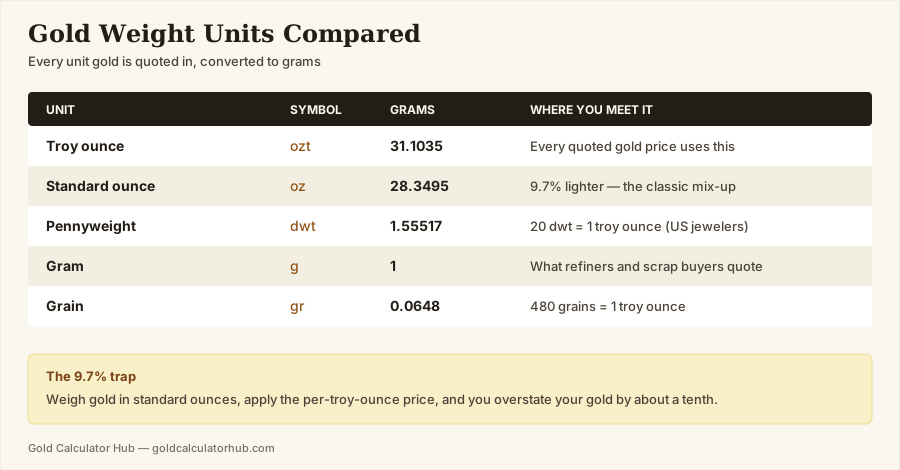
Your scale's mode button cycles through g, oz, ozt, and dwt, and that button has cost careless sellers a fortune. The four modes are four different languages: grams, avoirdupois ounces (28.350 g — the grocery ounce), troy ounces (31.103 g — the gold market's ounce), and pennyweight (1.555 g — the American scrap counter's favorite).
The advice is one sentence: set it to grams and never touch the button again. Grams are unambiguous — there's no "which gram" question the way there is a "which ounce" question — and every gold price source and every gold calculator can quote per gram. The classic disaster is reading an avoirdupois-ounce number against a troy-ounce price, an error of nearly 10% that we dissect in troy ounce vs ounce. The subtler one is glancing at a dwt readout and recording it as grams, which understates your weight by about a third (20 dwt is 31.1 g, not 20 g).
Know the conversions for defense — divide a per-dwt quote by 1.555 to get per-gram, divide a per-troy-ounce price by 31.103 — but do your own bookkeeping in a single unit. Professionals do exactly this; refinery paperwork is grams end to end.
No Scale Yet? A Nickel Is a Calibration Weight
A US five-cent piece is specified by the United States Mint at exactly 5.000 grams when new. That makes pocket change the cheapest precision reference in your house.
Two uses. First, as a sanity check on any scale: place one nickel — it should read 5.0 g. Stack four; 20.0 g. If your pocket scale reads a fresh-ish nickel at 4.7 or 5.4, recalibrate before weighing anything that matters. (Worn circulation nickels lose a little mass over decades, so use the shiniest ones in the jar and expect 4.9–5.0 g.)
Second, as a rough balance when you have no scale at all: a ring that feels like a nickel in the hand is in the 5 g neighborhood; a chain that clearly outweighs four nickels is north of 20 g. Improvised comparisons like this are estimation, not measurement — good enough to decide whether a lot is worth a trip across town, nowhere near good enough to evaluate an offer. Quarters (5.670 g) and pennies (2.500 g) extend the reference set. Then buy the $15 scale; the nickel trick is a bridge, not a destination.
The Mental Math That Turns Grams Into Dollars
Once you have a number on the scale, you want a dollar figure without opening anything. Two steps.
First, divide the day's ounce price by 31 for a close approximation of pure gold per gram. At $4,400 an ounce that's about $142 — the exact figure is $141.46, and being a few cents off doesn't matter for a counter conversation.
Second, multiply by the karat's purity: 0.75 for 18K, roughly 0.583 for 14K, roughly 0.417 for 10K. So at $4,400 spot, 18K runs about $106 a gram, 14K about $82.50, and 10K about $59.
That gives you the only two numbers you need at a counter. If your 14K weighs 21 g, its melt is 21 × $82.50 ≈ $1,733, and an offer of $1,300 is 75% of melt — a fair jewelry-store number and a weak refiner number. Anything under about $33 a gram for 14K is 40% of melt: pawn territory, and worth a phone call elsewhere before you agree.
How Buyers Weigh — and Your Right to Watch
Commercial gold buyers in the US weigh on scales that are certified for trade and inspected under state weights-and-measures programs — that's the same legal machinery that checks gas pumps and deli scales. A legitimate buyer's scale will carry a certification seal, and the FTC's guidance on selling gold jewelry is blunt about the practical rule: deal with buyers who weigh your items in front of you, and understand the scale and the units before you accept a number.
What watching actually buys you:
- You confirm your gold goes on the scale and comes back off — sleight of hand with similar-looking pieces is an old hustle.
- You see the unit on the display. A reading of "24.1" means very different money in grams versus pennyweight; ask the buyer to state the unit out loud.
- You verify karats stay sorted. A buyer who sweeps your separated 18K pile in with the 10K and prices the lot at 10K has just taken a large bite invisibly.
- You compare against the number you measured at home. Within a few tenths of a gram is normal; a multi-gram gap means stop and re-weigh, both of you.
Mail-in services break the watch-the-scale rule structurally — your gold is weighed by strangers, far away, after you've shipped it. Some are honest; the structure still removes your leverage, which is one reason mail-in TV-advertised services pay 20–50% of melt while a local dealer you can stand in front of pays 65–85%.
A Full Weigh-In, Start to Finish
Here's the whole method on a realistic lot: a small box of inherited jewelry — three 14K rings and a bent 10K bracelet.
Sort first. The rings are stamped 585, 14K, and 14K; the bracelet is stamped 10K. Two piles. Tare the scale with a paper cup on it, drop in the rings: 22.6 g of 14K. Swap cups, weigh the bracelet: 9.1 g of 10K.
Now price it. Assume spot at $4,400 per troy ounce — $141.46 per gram pure — so 14K (58.33%) is $82.51/g and 10K (41.67%) is $58.95/g:
- 14K pile: 22.6 g × $82.51 = $1,864.73 melt value
- 10K pile: 9.1 g × $58.95 = $536.45 melt value
- Lot total: $2,401.18 in melt
Now the punchline that justifies the sorting: had you dumped all 31.7 g on the counter unsorted, a busy or unscrupulous buyer pricing the whole pile "as 10K" would compute 31.7 × $58.95 = $1,868.72 — and the $532 difference would never come up in conversation. Sorting by karat isn't bookkeeping fussiness; it is, gram for gram, the highest-paid five minutes in the whole process.
With melt established, offers slot into place: a strong local-dealer offer at 80% of melt is about $1,921; a pawn shop at 50% is about $1,201. Whether those percentages are acceptable is your call — but you're now the person at the counter who knows, which was the entire point of owning a $20 scale. That, start to finish, is how to weigh gold: sort, tare, grams, write it down.
Keep the Inventory, Not Just the Number
The last habit costs two minutes and outlasts the sale. Write down, for each karat group: the karat, the grams, the count of pieces, the date you weighed them, and a photo. Keep it in a notes app.
Why it earns its keep: it lets you re-check any buyer's weights against yours on the spot, it survives the drive to a second shop when you're comparing offers from memory, it is your evidence if a mail-in buyer's reported weights come back lighter than what you sent, and if the sale ever produces a taxable gain, it's the only contemporaneous record you'll have of what left the house.
Sellers who keep this list get treated differently at the counter — not because buyers are afraid of it, but because it signals immediately that guessing won't work here.
Frequently Asked Questions
Can I use a kitchen scale to weigh gold?
For a rough first look, yes; for any real decision, no. Kitchen scales typically resolve only to a full gram and are least accurate with light loads like rings. At 14K values around $82 per gram (assuming $4,400/oz spot), each rounded-away gram is dinner money, and the errors compound across multiple items. A $15–25 pocket jewelry scale reading 0.1 g closes the gap between your number and a dealer's certified scale — it pays for itself the first time you use it.
What unit should my scale be set to when weighing gold?
Grams, and leave it there. Grams have exactly one definition, every price source quotes per gram, and there's no troy-versus-avoirdupois trap waiting in the wings. Pennyweight (1.555 g) and troy ounces (31.103 g) are legitimate trade units you should know how to convert from — multiply a dwt figure by 1.555, or multiply troy ounces by 31.103, to get grams — but doing your own records in one unambiguous unit eliminates the most common and most expensive class of seller mistakes.
How do I calibrate a pocket gold scale?
Use the calibration weight that came with it: enter calibration mode (usually holding the mode or cal button), place the reference weight when prompted, and the scale stores the correction. Do it on a hard, level surface with no drafts. Recalibrate after battery changes, travel, or any drop. Between formal calibrations, a quick check with a new-ish US nickel — minted at exactly 5.000 g — tells you in two seconds whether the scale is still honest.
Do you weigh gold with gemstones in it?
You weigh the piece, but you don't get paid gold prices for the stone's grams. Buyers either estimate the stone weight and deduct it, or price conservatively to protect themselves. Small accent stones might be 0.1–0.3 g each; a large center stone can be several grams. Remove stones you can remove safely (and have any potentially valuable diamond evaluated separately — it may be worth more than the metal). For glued or set stones, expect the deduction and ask the buyer to state it explicitly.
How much does a typical gold ring weigh?
Most solid gold rings land between 2 and 8 grams. A slim band might be 2–3 g, a standard men's wedding band 5–7 g, and a chunky signet or class ring 8–15 g. Chains vary far more — a delicate necklace can be 5 g while a heavy curb chain tops 50 g. These ranges are exactly why scale resolution matters: on a 3-gram band, a kitchen scale's full-gram rounding can be a 30% measurement error on an item worth a couple hundred dollars.
Why does the pawn shop's weight differ from my scale at home?
Small gaps — a few tenths of a gram — are normal: different scales, different calibration dates, maybe a clasp you included and they excluded. Multi-gram gaps are not normal. Ask them to re-weigh in front of you with the display visible, confirm the unit (a pennyweight readout is 1.555× a gram readout, a common source of confusion), and check that your karat piles weren't merged. If the discrepancy survives a re-weigh and they won't explain it, take your gold and your business elsewhere.
Am I allowed to watch a gold buyer weigh my items?
Yes — and you should treat any resistance as a verdict on the buyer. Commercial scales used for buying gold are certified under state weights-and-measures programs precisely because the public relies on them, and the FTC's selling-gold guidance tells consumers to use buyers who weigh items in their presence. Watching lets you confirm the unit on the display, keep your sorted karats from being merged, and match the reading against your own home measurement. Honest buyers expect spectators; some even angle the display toward you unasked.
How many grams are in a troy ounce, and why isn't gold sold by the regular ounce?
A troy ounce is 31.103 grams; the grocery-store ounce is 28.350 grams — about 10% lighter. Precious metals have been traded in troy weight for centuries and every spot quote you'll see is per troy ounce, so the convention is simply older than the alternative. The trap is arithmetic, not history: divide a per-troy-ounce price by 28.350 and you'll overstate your gold's per-gram value by nearly 10%. Divide by 31.103. And a troy pound is 12 troy ounces, not 16 — another reason to keep your own records in grams.
Should I weigh gold with the clasps, springs, and jump rings attached?
Weigh it as it is, then note what isn't gold. Spring-ring and lobster clasps contain steel springs, and some jump rings and end caps are base metal even on a solid gold chain. On a light necklace that hardware might be a couple of tenths of a gram; on several chains it adds up. Buyers deduct it either by removing the hardware or by estimating, and a buyer who does neither is quietly building the deduction into a lower percentage instead. Record the total and the hardware separately so both of you are looking at the same item.

Written by Sukie Gao
Sukie Gao holds a master's degree from a business school, where she picked up the markets-and-pricing toolkit she now applies to the consumer gold trade. She created Gold Calculator Hub to give people an independent, data-driven way to find out what their gold is really worth.
Published June 6, 2026 · Updated July 21, 2026