How Much Do Pawn Shops Pay for Gold? Real Numbers
 By Sukie Gao · Updated July 21, 2026
How much do pawn shops pay for gold? The honest answer: typically 40–60% of your gold's melt value, and sometimes less — occasionally as low as a third of melt at shops counting on you not to know the difference. That's the number this page is built around, because almost nobody walking up to a pawn counter knows it. The pawn shop knows your chain's melt value to the dollar before you've finished taking it off; the average seller knows only that gold is "worth a lot right now." That information gap is the entire business. None of this makes pawn shops villains — they're loan businesses with real overhead and real risk, and the discount they take has structural reasons we'll walk through. But it does mean a pawn shop should usually be where you collect a quote, not where you sell, unless speed matters more than money. Below: why pawn offers are what they are, exactly how a shop calculates its number, the difference between pawning and selling outright, how much negotiating room actually exists, and a worked example showing what one chain fetches at a pawn counter versus a refiner. Start by knowing your own melt value — the gold calculator gives it to you in seconds.
The Honest Number: 40–60% of Melt, Sometimes Lower
So how much do pawn shops pay for gold in practice? Across the industry, outright-sale offers cluster between 40% and 60% of melt value — the raw worth of the gold content at current market prices, which have recently run near $4,300–$4,500 per troy ounce. Well-run urban shops with bullion connections sit at the top of that range and occasionally a touch above it for clean, easily-tested items. Shops in low-competition areas, or any shop sizing up a seller who clearly hasn't done the math, can drift well below 40%.
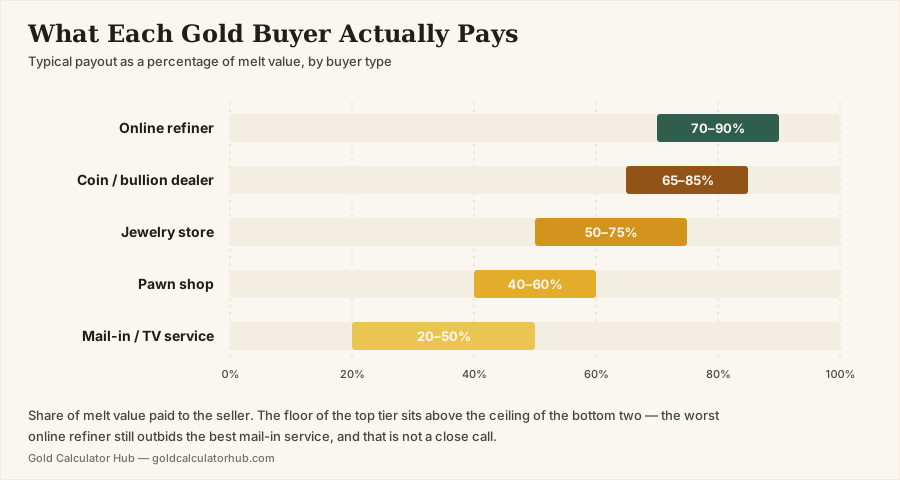
Compare that to the rest of the market: online refiners typically pay 70–90% of melt, local coin and bullion dealers 65–85%, and jewelry stores 50–75%. Pawn shops anchor the low end of the legitimate market — only the mail-in TV operations, at 20–50%, reliably pay less.
One more wrinkle: the *pawn loan* number is lower still. If you pawn an item rather than sell it, the loan is usually 25–50% of what the shop thinks it could sell the item for — not of melt value. More on that distinction below, because confusing the two costs sellers real money.
Why Pawn Shops Pay Less Than Everyone Else
The low offers aren't (usually) greed — they're the business model showing through.
Pawn shops are loan businesses first. The core trade is collateral lending: cash now against your item, interest and fees if you redeem it. Buying gold outright is a sideline, and the sideline gets priced conservatively because the shop's capital is committed to its loan book.
Overhead is real. Storefront rent, staff, security, insurance, and compliance — pawn shops are heavily regulated, with licensing, police reporting requirements, and mandatory holding periods in most states. Every one of those costs is paid out of the spread between what they give you and what they eventually collect.
Every purchase carries risk. Once a shop buys your chain, it holds the resale risk: gold prices can dip before it reaches a refiner, refiners charge fees and minimums, and items must sit through any mandated hold period before moving at all. A shop quoting 50% of melt isn't pocketing the other 50% — a chunk of it goes to refining costs, holding time, and the occasional item that turns out to be plated.
"A pawn shop isn't pricing your gold. It's pricing its own risk, rent, and patience — and sending you the bill."
Understanding that doesn't get you a better offer by itself. But it tells you exactly where the negotiating room lives, which we'll get to.
How a Pawn Shop Actually Calculates Your Offer
There's no mystery behind the counter — just arithmetic done quickly while you wait. Here's the sequence:
Step 1: Test and sort. The clerk checks hallmarks, then verifies karat with an acid kit or an electronic/XRF tester. Mixed lots get sorted by karat — or, at less scrupulous shops, bundled and priced at the lowest karat in the pile, a move worth watching for.
Step 2: Weigh. Usually in grams, sometimes in pennyweight (dwt — 1 dwt = 1.555 g). Watch the unit: a quote "per dwt" sounds bigger than the same money per gram.
Step 3: Compute melt. Spot price per gram × purity × weight. Assume gold at $4,400/oz, so $4,400 ÷ 31.103 = $141.46 per gram of pure gold. A 10-gram 14K item (58.33% gold) melts at 10 × 0.5833 × $141.46 = $825.
Step 4: Apply the house discount. The shop multiplies melt by its buy rate — commonly 40–60% for outright purchases. At a 50% rate, that 10-gram 14K item draws a $412 offer.
That's the whole calculation. The shop's only real edge is that they do steps 1–3 and you don't. Do them yourself at home with a $15 pocket scale and the scrap gold calculator, and the offer stops being a verdict and becomes a percentage you can evaluate — and counter.
Pawning vs. Selling Outright: Two Different Numbers
Walk in with a gold chain and you'll often be asked: loan or sale? They produce different offers, and it pays to know why.
Selling outright transfers ownership permanently. The shop pays its buy rate — the 40–60% of melt discussed above — and after any state-mandated hold, your chain heads to a showcase or a refiner. This gets you the larger lump sum.
Pawning is a collateral loan. The shop lends you roughly 25–50% of the item's resale value and stores the chain. Repay the loan plus interest and fees — which commonly total 10–25% per month depending on state caps — and you get it back. Default, and the shop keeps it; in most states that's the end of it, with no effect on your credit.
The trap: pawn loan offers are *smaller* than sale offers for the same item, and the interest compounds the cost fast. Borrow $300 against a chain at 20% monthly and redeem it after three months, and you've paid roughly $180 in fees to briefly not-sell your own gold. Pawning makes sense when the item has sentimental value you can't replace and you're confident — honestly confident — you'll redeem quickly. If the chain is just metal to you, selling outright at the best venue you can find beats pawning nearly every time. Not financial advice, but the arithmetic rarely flatters the loan.
The Rules Behind the Counter
Pawn shops are among the most heavily regulated small businesses in America, and the regulation shapes the offer you get more than most sellers realize.
Licensing is state-level, and so is nearly everything else. Shops generally must hold a state or municipal license, record identifying details for every seller and every item, and transmit those transaction reports to local law enforcement — often daily, and often electronically. This is a stolen-property control, and it is the reason you will be asked for a government-issued photo ID even for a $60 sale of a broken chain. Age minimums are typically 18, sometimes 21.
Mandatory hold periods are the piece that touches pricing directly. Most jurisdictions require a shop to keep a purchased or pawned item intact and unsold for a set window — commonly a couple of weeks to a month or more — so police have time to match it against theft reports. During that window the shop's cash is tied up in your chain and exposed to whatever gold does next. A buyer forced to hold inventory prices that holding into the offer, which is a real part of why the pawn discount is steeper than a refiner's.
Interest and fees on pawn loans are capped, and the caps vary widely from state to state; the 10–25% per month range quoted earlier reflects that variation rather than one national rate. Ask what the monthly total cost is, in dollars, before signing anything, and ask what the redemption window is.
None of this is a reason to distrust a pawn shop. If anything it is the opposite: a licensed, reporting, receipt-issuing business is a far safer counterparty than an anonymous cash buyer working out of a hotel conference room.
Pawn vs. Refiner on Real Items: The Side-by-Side
The question "how much do pawn shops pay for gold?" has a table-shaped answer. Assume gold at $4,400 per troy ounce ($141.46/g pure), a typical pawn buy range of 40–60% of melt, and a typical online refiner range of 70–90%:
| Item | Melt value | Pawn offer (40–60%) | Refiner offer (70–90%) |
|---|---|---|---|
| 5 g 14K class ring | $413 | $165–$248 | $289–$371 |
| 4 g 18K wedding band | $424 | $170–$255 | $297–$382 |
| 12 g 10K bracelet | $707 | $283–$424 | $495–$637 |
| 20 g 14K chain | $1,650 | $660–$990 | $1,155–$1,485 |
Now the worked example in full. Say you inherited a 7.3-gram 14K rope chain. Pure-gold content: 7.3 × 0.5833 = 4.26 g. Melt value: 4.26 × $141.46 ≈ $602.
A pawn shop at a fairly standard 45% buy rate offers $271. A reputable online refiner at 80% pays $482. Same chain, same week — a $211 difference, which is to say the refiner pays roughly 78% more cash for the identical item. The pawn shop's edge is that you walk out with $271 in twenty minutes instead of $482 in five days. Whether that trade is worth $211 is your call, but it should be a call you make knowingly. The full venue-by-venue ranking lives at where to sell gold.
When the Piece Is Worth More Than Its Gold
Everything above assumes your item is metal with a shape. Sometimes it isn't, and that is where a pawn counter can go from merely low to genuinely wrong for the job.
Bullion coins are the sharpest example. A one-ounce American Gold Eagle contains a full troy ounce of pure gold — about $4,400 of melt at our assumed price. It is sealed-grade, instantly recognizable, and needs no testing or refining at all. A bullion dealer will typically pay at or very near that melt figure. A pawn shop that treats it as scrap at 50% offers $2,200. Same coin, same afternoon, roughly $2,100 of difference — and unlike jewelry, there is no version of this where the pawn discount is defensible, because none of the costs that justify the discount apply. Take recognized bullion to someone who buys bullion.
Gemstones fare badly at a scrap counter. A 4.8-gram 14K solitaire ring holds 2.80 g of pure gold, worth $396 of melt; a 45% pawn offer on the metal is about $178, and the diamond contributes close to nothing to that figure. This is not a trick — the used-diamond market is genuinely brutal and most shops have no channel for stones. But it means a ring worth several thousand dollars at retail can draw a three-figure scrap offer, and the seller should know that is a scrap offer, not an appraisal.
Then there's the reverse case, where the pawn shop wins. A shop with a real jewelry showcase buys some items to resell rather than to melt, and for an attractive, intact, easily-photographed piece it may pay above scrap rates — sometimes well above. Ask directly: "Are you buying this to melt or to sell?" The answer tells you which pricing model you are inside of, and it is the single most useful question at the counter.
Anything unusual — a hallmarked antique, a signed designer piece, a coin you cannot identify — deserves a second opinion before it is weighed. Once a piece is priced by the gram, its history stops mattering.
Negotiating Room — and When the Pawn Counter Is the Right Call
First offers at a pawn counter are openers, not verdicts. Most shops build 10–20% of slack into the initial number precisely because some sellers push back and most don't. The negotiation script is short: state your melt value, name their offer as a percentage of it, and ask for better. "This is $602 of melt — you're at 45%. Can you get to 55%?" Shops move further for clean, hallmarked, easily-resold items, for larger lots, and for sellers who are visibly prepared to walk. A printed or on-screen melt calculation does more work in that conversation than any amount of haggling charm.
And despite everything above, sometimes the pawn shop genuinely is the right venue:
You need money today. No mail-in service, and few dealers, beat a pawn counter for raw speed. Cash in hand in under an hour is a real service, and the discount is its price.
The lot is small. On a single 2-gram 10K earring with maybe $165 of melt, the pawn-vs-refiner gap is $40–$60 — possibly not worth shipping, waiting, and tracking for.
You might want the item back. A pawn loan, costly as it is, is the only venue on the list with an undo button.
For everything else — especially lots over a few hundred dollars of melt — collect the pawn quote, thank them, and compare it against an online buyer before deciding. And whatever the venue, know the tricks first: cash for gold scams covers the moves that show up at every counter, pawn shops included.
What to Bring, and What to Leave at Home
Preparation is worth more at a pawn counter than confidence is. Bring:
- Your ID. Non-negotiable, legally required, and forgetting it wastes the trip.
- Your own melt number, written down or on your phone. Not a vague sense that gold is expensive — an actual figure, produced by weighing each karat group separately. The pawn shop gold calculator will also show you the realistic offer band around it, so you know in advance whether 45% or 55% is on the table.
- Your items sorted by stamp, in separate bags or envelopes, labeled. A sorted lot is faster to price, harder to bundle at the lowest karat, and signals that shortcuts will be noticed.
- Any paperwork you have — appraisals, receipts, certificates. It rarely moves a scrap price, but it matters enormously for anything that might be resold rather than melted.
Leave at home: anything you are not genuinely willing to sell today, anything plated or gold-filled (it dilutes a lot and wastes everyone's time), and — this is the important one — any attachment to the first number you hear. The opening offer is a position, not an appraisal.
One more habit worth building: ask to watch the weighing and the testing. Reputable shops do both in front of you as a matter of course, and the request is completely ordinary. Watch which unit the scale is set to, watch the tare, and ask what the tester read. A shop that wants to take your gold into a back room to weigh it is telling you something, and you should listen.
Where Your Chain Goes After You Leave
Follow one 20-gram 14K chain past the counter and the discount stops feeling arbitrary.
The shop pays you, tags the chain, photographs it, files the transaction report with local police, and then does nothing with it for the mandated hold period. That is dead time on the shop's money, with the gold price free to move against them the whole while.
After the hold clears, the chain goes one of two ways. If it is attractive and intact, it goes into the showcase at a retail price and waits for a buyer who may take months to arrive — which is why resale-grade pieces can earn a better offer up front. If it is scrap, it joins a lot: a bin of mixed karats accumulating until there is enough to be worth sending. That lot goes to a refiner, which assays it, deducts refining and assay fees plus a minimum charge, and settles against a market price on the day of settlement — not the day the shop bought your chain.
So the shop's actual take on your chain is not "melt minus your 50%." It is melt, minus refining costs, minus the price risk of holding, minus rent and staff and security across the weeks the metal sat there — and then the remainder. That remainder is a real business but a thinner one than the raw percentage suggests.
Which is also the clearest argument for skipping a step. An online refiner pays 70–90% precisely because it *is* the end of that chain — no showcase, no hold period, no middle margin. When you sell to a pawn shop, you are paying someone to stand between you and the refinery. Sometimes that convenience is worth it. Decide with the gold calculator open, not with a number someone else picked.
Frequently Asked Questions
Do pawn shops pay more for gold than jewelry stores?
Usually less. Jewelry stores typically pay 50–75% of melt value while pawn shops pay 40–60%, so the ranges overlap but the jeweler's midpoint is higher. The exception is resale-worthy pieces: a pawn shop with a strong jewelry showcase may pay above scrap rates for an attractive, intact piece it can retail, just as a jeweler would. For plain scrap — broken chains, single earrings, worn bands — both venues are out-paid by online refiners and coin dealers.
Can you negotiate gold prices at a pawn shop?
Yes, and you should — first offers typically carry 10–20% of built-in slack. The effective approach isn't haggling for its own sake; it's arithmetic. Weigh your gold at home, compute melt value, and frame their offer as a percentage: "That's 42% of melt — can you do 55%?" Shops move most readily on hallmarked, easy-to-resell items and larger lots. If the counter won't budge past 50% on a lot worth shipping, the negotiation is over and the refiner kit wins.
How do pawn shops test gold?
Most start with hallmarks (14K, 585, 750, and so on), then verify, because hallmarks can be faked. The classic method is an acid test: a small scratch of the item on a touchstone, then karat-graded acids applied to watch the reaction. Better-equipped shops use electronic conductivity testers or XRF analyzers, which read purity without marking the piece. Magnet checks screen out obvious fakes but prove nothing on their own, since most counterfeits use non-magnetic metals.
Do pawn shops buy broken gold jewelry?
Yes — enthusiastically. Broken chains, single earrings, bent rings, snapped clasps: a pawn shop buying for scrap pays on weight and karat, and a broken 14K chain contains exactly as much gold per gram as a perfect one. Where condition matters is resale-grade jewelry, since an intact piece the shop can showcase may earn an offer above scrap rates. Don't repair anything just to sell it; the repair cost almost never returns itself in the offer.
How much will a pawn shop loan me on gold versus buying it?
Loan offers run meaningfully lower than purchase offers — commonly 25–50% of the item's resale value, versus 40–60% of melt for an outright sale. The shop prices the loan low so the collateral comfortably covers the balance if you default. Add interest and fees, often 10–25% per month depending on state law, and pawning is the more expensive way to extract cash from gold unless you redeem quickly. Pawn the irreplaceable; sell the rest.
Why won't a pawn shop pay spot price for gold?
Because spot is a wholesale benchmark for refined, exchange-deliverable gold — not a retail buying price for a used chain of uncertain purity. Between your item and that benchmark sit testing, refining fees, holding periods, price risk while inventory sits, plus rent, staff, security, and compliance. Every buyer in the chain pays under spot for scrap; the honest question is how far under. Refiners run closest at 70–90% of melt. Pawn shops, with the heaviest overhead per transaction, run furthest.
What do I need to sell gold at a pawn shop?
A government-issued photo ID, almost universally, plus being of legal age — 18 in most states, 21 in some. Pawn shops are licensed and regulated: most states require them to record seller information, describe or photograph items, report transactions to local police, and hold purchases for a set period before resale, all to deter fencing stolen goods. The paperwork takes a few minutes and protects you too — a recorded, receipted sale beats an anonymous cash handoff if anything is ever disputed.
Do pawn shops rip people off on gold?
The legitimate majority don't lie — they just open low, and low offers aren't fraud. That said, the counter is where classic tricks surface: bundling mixed karats at the lowest karat's rate, quoting per pennyweight to make numbers sound bigger, or downgrading a hallmarked 14K piece to "tests like 10K." The Federal Trade Commission's selling-gold guidance recommends knowing your karats and weights before seeking offers. Sellers who arrive with their own melt math rarely get the bad version of the counter.
What happens if I don't pay back a pawn loan on my gold?
The shop keeps the gold and sells it — that's the whole arrangement. Your collateral covers the debt; in most states there's no further collection, no lawsuit, and no credit-bureau report, which is why pawn loans don't require credit checks. The real cost is losing the item for a loan that was typically 25–50% of its value. If there's a real chance you can't redeem within a month or two, you'll almost always net more by selling outright at the strongest venue you can find.
Will a pawn shop pay extra for the diamonds in my gold ring?
Usually barely, and often not at all. Most shops buying scrap price the metal and treat the stones as an inconvenience to be removed. A 4.8-gram 14K solitaire holds about 2.80 grams of pure gold — roughly $396 of melt at an assumed $4,400 per troy ounce — and a 45% offer of about $178 may be the whole number regardless of what sits in the setting. The exception is a shop with a jewelry showcase buying the ring to resell intact. Ask which it is before you accept anything.

Written by Sukie Gao
Sukie Gao holds a master's degree from a business school, where she picked up the markets-and-pricing toolkit she now applies to the consumer gold trade. She created Gold Calculator Hub to give people an independent, data-driven way to find out what their gold is really worth.
Published June 6, 2026 · Updated July 21, 2026