Selling Inherited Gold Jewelry: Values, Taxes, and Timing
 By Sukie Gao · June 6, 2026
Selling inherited gold jewelry is a different job than selling a chain you bought yourself, and it punishes people who treat it the same way. An estate lot is usually a mixed bag — a few karats, a few decades, signed pieces beside broken ones, real gold tangled up with costume — and the worst thing you can do is carry the whole tangle to one counter and ask, "What'll you give me for all of it?" That question has cost American families more money than any gold-buying scam ever has. Done well, the process has a sequence: inventory and sort the lot before any buyer sees it, pull out anything that might be worth more than its weight in metal, understand the surprisingly seller-friendly tax rules around inherited property, get the family aligned on paper, and only then decide where each kind of piece should be sold — on your timeline, not a buyer's. This guide walks through that sequence in order, with a worked example at the end showing real numbers on a typical lot. None of it requires expertise. All of it requires doing things in the right order, which is exactly what grief and urgency make hardest.
Inventory Everything Before a Single Buyer Sees the Lot
Your first session happens at the kitchen table, not a shop. Lay out every piece, put your phone on a stand, and photograph each item next to a ruler or coin for scale. Then sort the lot into piles — this twenty-minute exercise is the highest-paid work in the entire process:
- By karat: group pieces by their stamps — 10K/417, 14K/585, 18K/750, 22K/916 — and set unmarked items aside for testing. Our guide to gold hallmarks decodes the stamps, including older and foreign marks common in inherited pieces.
- Signed vs. unsigned: anything with a maker's name (Tiffany & Co., Cartier, a designer signature, even an unfamiliar workshop mark) goes in its own envelope and does not get sold as scrap until it's been researched.
- Intact vs. broken: broken chains, single earrings, and crushed settings are honest scrap. Intact, wearable pieces — especially older ones — may have a resale market above melt.
- Real vs. maybe: no stamp, suspiciously light, or magnetic? Quarantine it for testing rather than letting a buyer 'helpfully' sort it for you.
Weigh each pile in grams and write the numbers down. By the end you have what almost no estate seller walks in with: a documented inventory, with photos, that no buyer can quietly edit.
Why Estate Lots Get Lowballed as a Bundle
Buyers love estate lots for a reason that should make you cautious: bundles hide value. When a mixed pile hits the scale all at once, the offer tends to get built on the most pessimistic assumptions available — the unmarked pieces get treated as 10K, the signed bracelet gets priced as metal, the heavy 18K brooch gets averaged into the 14K pile. Nobody has to lie; the bundle does the discounting all by itself.
There's a psychological layer too. A bundled offer is one number — "I can do $2,400 for everything" — and one number is hard to argue with when you can't see how it was built. Itemized offers, by contrast, expose every assumption: this chain at this weight and karat, this percentage of melt. Buyers know which conversation they'd rather have.
The fix costs nothing: present the lot pre-sorted by karat, ask for a per-pile price based on weight, and ask what percentage of melt value the offer represents. Since you weighed everything at the kitchen table, you can run each pile through our gold calculator beforehand and walk in knowing every pile's melt value to the dollar. The moment a buyer realizes you know the floor, the lowball bundle offer quietly retires from the conversation.
Spotting the Pieces Worth More Than Their Melt Value
Most inherited gold is, honestly, scrap — and scrap at recent prices is genuinely good money. But a meaningful minority of estate pieces are worth more intact than melted — and spotting them is the one part of selling inherited gold jewelry that no scale can do for you.
Signatures come first. A maker's mark from Tiffany, Cartier, Van Cleef & Arpels, or a collectible mid-century designer can put resale value at a multiple of melt. Period pieces come second: intact Victorian, Edwardian, and Art Deco jewelry has its own collector market, where craftsmanship and originality — not gold weight — set the price. Third, look for quality stones: a substantial center diamond or fine colored stone deserves its own valuation before anyone prices the mounting.
When any piece checks one of those boxes, it can be worth paying a professional. Hire an independent, fee-based appraiser — one who charges for the appraisal and does not offer to buy, which removes the obvious conflict of interest. Ask for fair market value (what it would sell for between willing parties), not insurance replacement value, which runs much higher and misleads sellers. For a routine lot of unsigned 14K, an appraisal is wasted money; the melt math tells you everything. For the signed bracelet at the bottom of the jewelry box, it can be the difference between $300 of scrap and a four-figure consignment.
Matching Each Piece to the Right Buyer
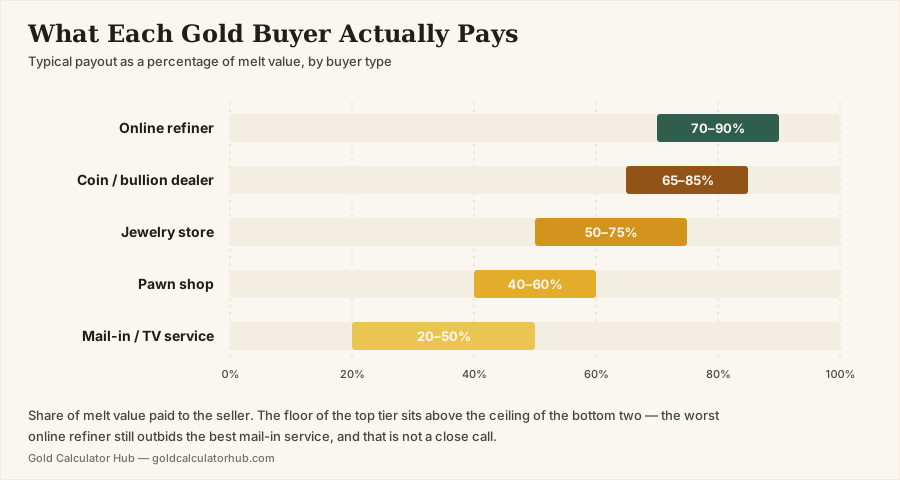
There is no single best place to sell an estate lot, because an estate lot isn't a single thing. Each pile from your kitchen-table sort has a different ideal buyer, and our full ranking of where to sell gold covers each in depth. The short version:
| What you have | Best first stop | Why |
|---|---|---|
| Broken or unsigned scrap | Online refiner or coin/bullion dealer | They pay on weight and karat (typically 70–90% or 65–85% of melt); condition is irrelevant |
| Signed designer pieces | Auction house or designer-resale specialist | Brand premium can be a multiple of melt — melting it destroys the premium |
| Intact antique/period pieces | Estate jewelry dealer or auction | Collectors pay for era and craftsmanship, not just metal |
| Gold coins or small bars | Coin/bullion dealer | Priced off spot with known premiums; some coins carry collector value above melt |
| Gold-cased watches | Watch specialist first, scrap buyer second | The movement and brand may outvalue the case |
Notice what's missing from the table: pawn shops and mail-in TV buyers. At 40–60% and 20–50% of melt respectively, they're the venues of urgency — and as the timing section below argues, urgency is the one thing an heir doesn't have to accept.
The Tax Rules in Plain English: Stepped-Up Basis
Here is the part most heirs are relieved to learn: you generally owe no income tax for simply receiving the jewelry, and when you sell, the rules are friendlier than people fear.
Inherited property gets a stepped-up basis — your cost basis becomes the fair market value on the date of death, not what the original owner paid decades ago. If your mother bought a bracelet for $300 in 1985 and it was worth $2,000 when she passed, your basis is $2,000. Sell it for $2,300 and you owe capital gains tax on $300 — the appreciation since you inherited it — not on $2,000 of decades-old gains. Those simply vanish for income-tax purposes. Sell soon after inheriting, before prices move, and the taxable gain is often close to zero.
When there is a gain, the IRS treats physical gold and jewelry as collectibles: long-term gains (held over a year, with inherited property automatically treated as long-term) are taxed at your ordinary rate but capped at 28%, per IRS Topic 409. This is why documenting date-of-death value matters — an appraisal or even dated spot-price records establish the basis that protects you later. None of this is tax advice; estate situations vary a lot, so run your specifics past a CPA before you file.
Document First, Sell Second: Keeping the Family Aligned
More inheritance disputes ignite over jewelry than over bank accounts, and not because of the money. Jewelry is the asset people remember on a body — grandma's ring at every Thanksgiving — and it's also the asset easiest to pocket quietly. Both facts argue for the same discipline: paper first.
Share the photographed inventory from your kitchen-table session with every heir before anything is sold, tested, or even worn. Note weights, karats, and any signatures. If pieces will be kept rather than sold, decide who keeps what before establishing sale values, and agree in writing — a group text everyone thumbs-up counts — on how proceeds get split.
Two specific habits prevent ninety percent of the fights. First, never sell anything until every heir has confirmed the inventory list; the sentence "wait, where's the gold watch?" asked after a sale is unanswerable. Second, when you do sell, keep the receipts showing weight, karat, and price paid, and circulate them. Transparency isn't an accusation of bad faith — it's what makes accusations impossible. If the estate is still in probate, check with the executor or an attorney before selling anything; some assets legally can't be sold until the estate settles.
No Deadline Is Your Biggest Advantage
Every venue that pays badly — the pawn counter, the mail-in envelope, the hotel-ballroom "gold buying event" — is selling the same product: speed. They convert urgency into margin, which makes urgency the most expensive ingredient in selling inherited gold jewelry. An heir who isn't desperate for cash has already won half the negotiation, simply by being able to walk away.
Use that leverage deliberately. Get two or three itemized offers on the scrap piles; the spread between buyers routinely runs 20–30% of melt for identical metal. Let the signed and antique pieces take the weeks they need for a specialist's opinion or an auction consignment — those channels are slower and pay for the wait.
A candid word about timing the gold market itself: don't try. Spot prices have recently traded near $4,300–$4,500 per troy ounce — historically elevated — but nobody reliably calls tops, and an heir holding scrap gold to chase another 5% is taking investment risk on an asset they never chose to buy. The honest reasons to wait are practical: probate isn't settled, the family isn't aligned, or you haven't gotten competing offers yet. The honest reason to sell now is just as simple: the inventory is documented, the offers are in hand, and the best one clears your floor. Grief makes everything feel urgent. The gold isn't.
A Worked Example: Pricing a Real Estate Lot
Put the whole method together on a plausible lot: a jewelry box containing 62 g of mixed unsigned 14K (two chains, three rings, a broken bracelet), one signed 4 g Tiffany & Co. band, and a handful of costume pieces that failed the magnet-and-stamp screen.
Assume gold at $4,350 per troy ounce. Pure gold is then $4,350 ÷ 31.103 = $139.86 per gram, and 14K (58.33% pure) carries $139.86 × 0.5833 = $81.58 per gram. The scrap pile's melt value: 62 × $81.58 = $5,058.
Now watch the venue decision move real money. An online refiner at 80% of melt pays about $4,046. A walk-in bundle offer at 50% — entirely typical for an unsorted estate lot — pays $2,529. Same metal, $1,517 apart, and the only difference was sorting and asking the percentage question.
The Tiffany band is the trap. As metal it's 4 × $81.58 = $326, and that's exactly what a scrap buyer would pay before melting a brand name into a puddle. As a signed piece in the designer-resale market, it sells well above its weight — which is why it was in its own envelope from day one. Total swing on this modest lot, between worst path and best: comfortably north of $2,000. Before any piece leaves the house, check your own numbers against how much is my gold worth — sixty seconds per pile, and you'll never negotiate blind.
Frequently Asked Questions
Do I owe taxes just for inheriting gold jewelry?
Generally no. There is no federal inheritance tax on recipients, and federal estate tax is the estate's responsibility, applying only above a very high exemption threshold that most estates never reach. A handful of states levy their own inheritance taxes, often exempting close relatives. Income tax enters the picture only when you sell, and then only on appreciation above your stepped-up, date-of-death basis. Document that basis early. This isn't tax advice — confirm your state's rules and your situation with a CPA.
How do I establish what the jewelry was worth on the date of death?
For pieces that are essentially scrap value, it's arithmetic: weight × purity × the spot price on (or near) the date of death, which is publicly archived — print the records and keep them with the estate file. For signed, antique, or stone-set pieces, a written fair-market-value appraisal from an independent, fee-based appraiser is the cleaner evidence, ideally dated close to the death. Either way, do it before selling; reconstructing basis years later is harder and invites IRS skepticism.
Should I sell inherited jewelry immediately or hold it?
Sell on your schedule, but for the right reasons. Selling soon after inheriting usually means minimal taxable gain, since your basis was just set at date-of-death value. Waiting makes sense while probate settles, while the family confirms the inventory, or while a specialist evaluates signed and antique pieces. Waiting to time the gold market is the weak reason — prices are historically elevated but unpredictable, and holding scrap to chase a few percent is investment risk you never signed up for.
What if inherited pieces have no hallmarks at all?
Common, especially on handmade, antique, and imported jewelry — and a missing stamp doesn't mean fake. Set unmarked pieces aside and have them tested before any buyer prices them: a home acid kit gives a rough karat read, and most coin dealers will run an electronic or XRF test in front of you for free or a few dollars. This matters because buyers price unmarked gold at the lowest plausible karat by default. Older immigrant-family gold often tests 21K or 22K, far richer than its unstamped look suggests.
Is it worth repairing broken pieces before selling them?
Almost never for scrap. Buyers pay on weight and karat, so a repaired chain and a broken one fetch the same offer, minus what you spent on the repair. The exception is the small class of pieces with above-melt value — a signed item or intact period piece — where a sympathetic, reversible repair can restore wearability and resale appeal. Even then, ask the specialist or auction house first; collectors of antique jewelry often prefer honest original condition over a fresh repair.
How do we split the proceeds fairly between siblings?
Agree on the mechanism before the first sale, in writing. The clean approach: every heir confirms the photographed inventory, anyone who wants to keep a piece 'buys' it from the estate at its appraised or melt value (offset against their share), and everything else is sold with receipts circulated to all. That converts an emotional negotiation into arithmetic. The worst pattern is one sibling selling 'to simplify things' and distributing cash afterward — even done honestly, it breeds suspicion that never fully clears.
Can I donate inherited gold jewelry and take a deduction instead?
Yes, if you itemize deductions. Donations of property to a qualified charity are generally deductible at fair market value, and the IRS requires increasingly formal substantiation as values rise — including a qualified written appraisal once a donated item or group of similar items exceeds the IRS's threshold. The charity must also actually be a qualified organization, so verify before handing anything over. For sentimental pieces with modest melt value, donation can beat the hassle of selling. Run the specifics past a CPA first — this isn't tax advice.

Written by Sukie Gao
Sukie Gao holds a master's degree from a business school, where she picked up the markets-and-pricing toolkit she now applies to the consumer gold trade. She created Gold Calculator Hub to give people an independent, data-driven way to find out what their gold is really worth.
Published June 6, 2026