How to Test Gold at Home: Methods From Free to $25
 By Sukie Gao · Updated October 16, 2026
Knowing how to test gold at home is the difference between walking into a buyer's shop informed and walking in hopeful. The good news: you can get a surprisingly confident answer without spending a dime, and a near-certain one for about the price of a pizza. None of these methods requires lab skills. A loupe (or your phone camera zoomed in), a kitchen magnet, a glass of water, an unglazed ceramic tile, and — if you want to go pro-am — a $20 acid test kit will collectively catch the overwhelming majority of fake and misrepresented gold in circulation. I've watched plenty of "solid gold" estate pieces leap onto a magnet, and plenty of unmarked, unloved chains turn out to be real 18K. The metal doesn't care what anyone hoped it was. This guide runs through every practical method in order of cost, tells you honestly what each one can and cannot catch, and finishes with the one free professional test that settles arguments. Once a piece passes, you can price it with a gold calculator and negotiate from facts.
Every Method at a Glance
Learning how to test gold at home is really learning a funnel: cheap, fast checks eliminate obvious fakes, and each step up in cost buys certainty. Here's the menu before we walk through it dish by dish:
| Method | Cost | Reliability | What it catches |
|---|---|---|---|
| Hallmark inspection | Free | Low on its own | Plated codes (GF, GP, HGE), silver marks, missing stamps |
| Magnet test | Free | Low–moderate | Steel/iron cores and clasps, many cheap fakes |
| Density check | Free | Moderate | Brass, copper, zinc alloys, most hollow fakes |
| Ceramic streak | Free (one tile) | Moderate | Plating over base metal |
| Acid test kit | ~$20 | High for jewelry | Wrong karat claims, plated pieces |
| Electronic tester | $25 entry, $150+ decent | Moderate–high | Plating, karat verification |
| XRF scan at a dealer | Free for sellers | Very high (surface) | Almost everything except deep cores |
No single home method is conclusive alone. A piece that passes the magnet, density, and acid tests together, with a coherent hallmark, is very probably what it claims to be. A piece that fails any one of them deserves suspicion regardless of what the stamp says.
Free Check #1: Read the Marks First
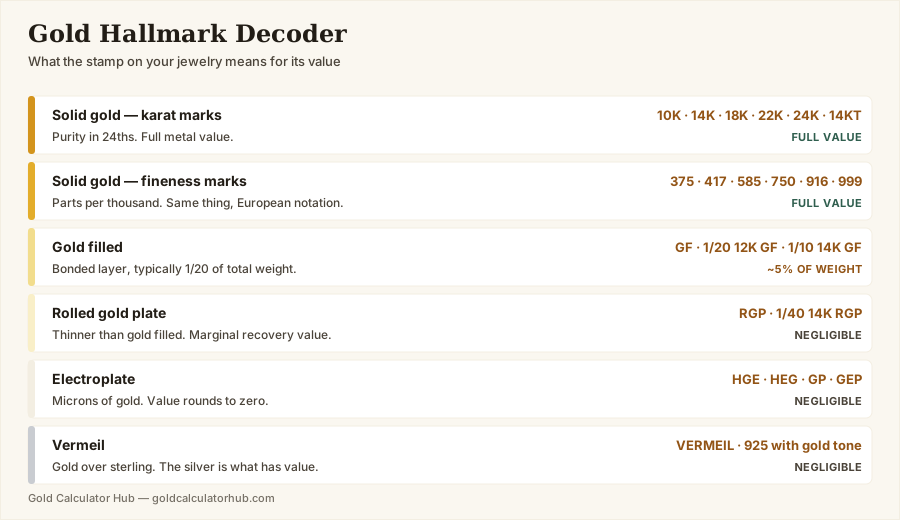
Before touching any test, find the stamp. Check clasps, the inside of ring shanks, earring posts, and the tag near a chain's clasp. You're looking for karat marks (10K–24K), fineness numbers (375, 417, 585, 750, 916/917, 999), or — just as usefully — the marks that tell you to stop hoping: GF, GP, GEP, HGE, RGP (plated or filled), and 925 or "Sterling" on gold-colored pieces (that's gold-plated silver). The complete decoder ring lives in our guide to gold hallmarks.
Two honest caveats. First, a missing mark proves nothing — older American pieces and much handmade jewelry were never stamped, and worn marks polish away. Second, a present mark also proves nothing by itself, because counterfeiters own stamping tools too. The hallmark sets your hypothesis; the physical tests below check it. Think of the stamp as the defendant's testimony: worth hearing, requires corroboration.
Free Check #2: The Magnet Test
Gold is not magnetic. Neither, for the record, are silver, copper, brass, zinc, or lead — but steel and iron emphatically are, and they're the skeleton of a huge share of cheap fakes, fashion jewelry, and "gold" chains sold from car trunks.
Use the strongest magnet you can find — a neodymium magnet from a hardware store works far better than a fridge magnet. Hold the piece by a thread or let it lie on a table, and bring the magnet close. A real gold piece will not respond at all. A sharp jump or stick means steel or iron under the surface: fake, or at best gold-plated steel.
Know the test's two blind spots. A weak pull at the clasp alone is common and innocent — clasps often contain steel springs even on genuine gold chains, so test the body of the piece, not the hardware. And a piece that ignores the magnet has only cleared one hurdle: brass, copper, and tungsten fakes pass the magnet test all day. Passing means "keep testing," never "it's gold."
Free Check #3: Density, the Honest Number
Gold is famously dense: 19.32 g/cm³ pure. Alloys dilute that — 14K typically lands around 13–14 g/cm³ depending on the recipe — but everything in the gold family is still far denser than brass (~8.5), steel (~7.8), or pot metal. Density is hard to fake cheaply, which makes this the best free test for solid pieces.
The home version needs a scale that reads 0.1 g and a glass of water:
- Weigh the piece dry. Say a ring reads 9.66 g.
- Fill a glass, place it on the scale, and tare to zero.
- Suspend the piece by a thread so it's fully underwater without touching the glass. The scale now shows the volume of displaced water in grams — effectively the piece's volume in cm³. Say it reads 0.70.
- Divide: 9.66 ÷ 0.70 = 13.8 g/cm³. That's consistent with 14K. A brass ring of the same size would have read closer to 8.5.
The folk "float test" — real gold sinks fast — is just this principle minus the math; nearly all metal sinks, so floating or slow-sinking only exposes hollow or plastic-cored junk. Run the full division when the answer matters. Caveats: gemstones, hollow construction, and watch movements wreck the measurement, so use density only on solid, stone-free metal.
Free Check #4: The Ceramic Streak
Drag the piece firmly across an unglazed ceramic tile — the rough bisque back of a bathroom tile works, and tile shops will often hand you a broken sample for nothing. Real gold leaves a gold-colored streak. Plated base metal typically leaves a gray or black streak as the thin gold skin gives way and the underlying metal writes its confession.
This is the most destructive of the free tests: you are literally sanding off a microscopic amount of the piece, and it can leave a fine scratch. Use an inconspicuous spot — the inside of a bangle, the back of a pendant — and a short stroke. Don't streak-test anything with collector or antique value; for heirlooms, skip straight to a professional scan instead. As with the magnet, interpret asymmetrically: a gray streak is strong evidence of fake; a gold streak is encouraging but not conclusive, since thick plating can briefly leave gold color too.
The Skin Test and Other Myths
You'll hear that real gold never discolors skin and anything that leaves a green or black mark is fake. Mostly myth. High-karat gold is indeed inert, but 10K and 14K pieces are roughly half copper, silver, nickel, and zinc by weight — and those alloy metals can absolutely react with sweat, lotion, chlorine, and individual skin chemistry. Plenty of people get a faint dark smudge from genuine 10K rings; plenty of fakes sit on skin politely for months.
Related folklore worth retiring:
- The bite test. Theatrical, ruins jewelry, and lead bites softer than gold anyway. Olympians bite medals for photographers, not assayers.
- "It's heavy, so it's real." Heft without measurement is a feeling. Tungsten and lead were chosen by counterfeiters precisely because they feel right. Do the density math instead.
- Color judgment. Polished brass under warm store lighting fools experienced eyes routinely.
Plenty of what circulates as advice on how to test gold at home is folklore of exactly this grade. If a method doesn't produce a number or a binary physical result, treat it as entertainment.
The $20 Upgrade: Acid Test Kits
An acid kit is the classic jeweler's bench test and the best accuracy-per-dollar purchase in this whole topic — typically $15–25 for a set of bottles marked 10K, 14K, 18K, and 22K, plus a basalt touchstone.
The procedure: rub the piece firmly on the stone to leave a visible metal streak a half-inch long. Apply one drop of the acid matching the claimed karat. Read at thirty seconds: if the streak stays bright and intact, the metal is at least that karat; if it fades, browns, or vanishes, it's below the claim or not gold at all. Work up or down the bottles to bracket the true karat — a streak that survives 14K acid but dissolves under 18K acid is 14K-to-17K metal, in practice 14K. For suspected plating, file a tiny notch in a hidden spot first so the acid reaches the core; a streak from the surface tests only the skin.
Safety is non-negotiable: these bottles contain nitric and hydrochloric acid. Wear nitrile gloves and eye protection, work over a disposable surface in a ventilated room, keep baking soda nearby to neutralize drips, cap bottles immediately, and store the kit away from kids — treat it like the corrosive it is, not a craft supply. Used carefully, an acid kit will correctly sort the overwhelming majority of jewelry that crosses a kitchen table — say, confirming that an unmarked 12.4 g ring is truly 14K, which at an assumed $4,400/oz spot ($82.51/g for 14K) makes it $1,023 of melt value instead of a $4 brass mystery. A local dealer paying 65–85% of melt would offer $665–$870 for that ring; knowing the number before you walk in is the entire point.
Electronic Testers: Worth It?
Electronic pen testers measure electrical conductivity through a gel or probe and display an estimated karat. Entry models start around $25; the units pawn shops actually trust run $150 and up. For a household testing one inheritance, they're hard to justify — the cheap ones are fooled by thick plating and confused by white gold, and the good ones cost more than most testing problems are worth. For someone buying estate lots monthly, a quality unit pays for itself in speed: no acid, no marks, ten seconds per piece.
If you do buy one, calibrate it on a piece of known-genuine gold first, test several spots per item, and treat readings on plated-looking or unusually light pieces as provisional. An electronic pass plus a density pass is a strong combination; an electronic reading alone is a hint with a battery.
What Home Tests Can't Catch — and the Free Fix
Honesty about the ceiling: two fakes defeat every method above. Tungsten-cored bars are the nasty one — tungsten's density (19.25 g/cm³) is within half a percent of pure gold's, so a bar with a real gold shell over a tungsten slug passes magnet, density, streak, and surface acid tests simultaneously. This is overwhelmingly a bullion-bar problem rather than a jewelry problem, which is one reason to buy bars only from reputable dealers. The second is high-quality heavy plating over silver: silver's conductivity and a thick gold skin can fool streak tests and budget electronic testers alike.
The answer to both is X-ray fluorescence. An XRF gun reads the actual elemental composition in seconds, non-destructively, and nearly every serious coin or bullion dealer owns one. Walk in as a potential seller and the scan is almost always free — the dealer wants to know what your metal is even more than you do. (For bar-shaped doubts, dealers use ultrasonic thickness gauges to find cores that XRF, a surface technique, can miss.) Treat the free XRF as the final word after your home funnel, and as a fraud check on any deal that smells wrong; the FTC's guidance on selling gold jewelry makes the same point about verifying before you sell. If a buyer refuses to test in front of you, or a seller refuses to allow testing at all, that refusal is itself a test result — see the playbook in cash for gold scams. And once a piece is confirmed, even humble 10K is real money at recent prices near $4,300–$4,500 per troy ounce. If you are still working out what kind of fake you might be holding, start with the identification guide, which maps what you can see to the one test that settles it.
Frequently Asked Questions
What is the most reliable way to test gold at home?
Stacked tests, in this order: read the hallmark, pass a strong magnet over the whole piece, run a water-displacement density check, then confirm with a $20 acid kit at the claimed karat. Each method covers the others' blind spots — the magnet catches steel, density catches brass, acid catches plating. A piece passing all four is very probably genuine. For certainty, finish with a free XRF scan at a coin or bullion dealer.
Can I test gold with just a magnet?
Only halfway. Gold is completely non-magnetic, so a piece that snaps to a strong neodymium magnet has steel or iron in it and is fake or plated steel. But brass, copper, zinc, lead, and tungsten fakes are also non-magnetic, so passing the magnet proves very little on its own. One nuance: test the body of the piece, not the clasp — genuine gold chains often use steel clasp springs that pull slightly without meaning anything.
Does the vinegar test for gold actually work?
Poorly. The idea is that vinegar's weak acetic acid discolors base metals but leaves gold untouched. Real gold does shrug off vinegar, but so does decent plating over copper or silver for the few minutes the test runs — and a thick lacquer coat protects even raw brass. It can't distinguish karats at all. As a free curiosity it's harmless; as a basis for a money decision it's worthless. Spend the $20 on a proper acid kit with karat-graded bottles.
How do I test gold at home without damaging the jewelry?
Stick to the non-destructive trio: hallmark inspection with a loupe, the magnet test, and water-displacement density. None of them touches the surface. Skip the ceramic streak and skip acid on bare surfaces — both leave marks. For pieces with antique, designer, or sentimental value, stop at the non-destructive tests and have a dealer run an XRF scan, which reads composition in seconds without a scratch. Never file-notch or streak anything you'd mind scarring.
What does it mean if gold turns my skin green?
Usually nothing about authenticity. Low-karat genuine gold — 10K is 41.67% gold, 14K is 58.33% — contains enough copper and nickel for sweat, lotion, or pool chlorine to produce a green or dark smudge on some people's skin. Meanwhile many fakes cause no mark at all. Skin discoloration tells you about the alloy's copper content and your personal chemistry, not about whether the gold is real. Use measurable tests instead.
Are home acid test kits dangerous?
They contain genuinely corrosive nitric and hydrochloric acid, but used like the hazardous chemical they are, they're manageable: nitrile gloves, eye protection, ventilation, a disposable work surface, baking soda on hand to neutralize spills, and locked storage away from children and pets. The drops involved are tiny. The realistic risks are skin burns from careless handling and ruined countertops. If that overhead is unappealing, a dealer's free XRF scan gives a better answer with zero chemistry.
Can fake gold pass a magnet test?
Easily. The magnet only catches ferromagnetic metals — steel and iron. Brass and copper fakes, lead-filled pieces, gold-plated silver, and tungsten-cored bars all sail past a magnet because none of those metals is magnetic. That's why the magnet is a first filter, not a verdict: it cheaply eliminates one large category of junk, and everything that passes moves on to density, streak, and acid testing. Treat 'didn't stick' as 'still a suspect.'
How can I tell if a gold bar is filled with tungsten?
Not with home methods — that's the uncomfortable truth. Tungsten's density of 19.25 g/cm³ is nearly identical to pure gold's 19.32, so weight and displacement look perfect, and a real gold shell defeats surface acid and even XRF scans. Dealers detect cores with ultrasonic thickness gauges, which spot the acoustic boundary between metals, or by drilling on suspicion. Practical defense: buy bars only from reputable dealers in sealed assay packaging, and have any inherited or secondhand bar ultrasonically checked before pricing it.
Where can I get gold tested for free?
Coin shops and bullion dealers, almost universally. Most own an XRF analyzer and will scan your pieces in seconds at no charge, because a scan is also their sales pitch — they hope you'll sell to them on the spot. You're under no obligation: take the composition reading, thank them, and compare offers elsewhere. Many jewelers offer testing too, though some charge a small fee. Avoid mail-in 'free appraisal' offers; a test you can't watch isn't a test, it's a custody transfer.

Written by Sukie Gao
Sukie Gao holds a master's degree from a business school, where she picked up the markets-and-pricing toolkit she now applies to the consumer gold trade. She created Gold Calculator Hub to give people an independent, data-driven way to find out what their gold is really worth.
Published June 6, 2026 · Updated October 16, 2026