Gold Value Calculator: Find Your Gold's Real Value
 By Sukie Gao · Updated July 21, 2026
A gold value calculator gives you something no appraiser, jeweler, or pawn broker will volunteer: an objective number with no agenda attached. Type in the karat and weight, and the calculator above multiplies them against the live price of pure gold. Simple. The complicated part — the part that costs people real money — is understanding which *kind* of value you just calculated, because "what's my gold worth?" has three honest answers that can differ by a factor of five for the same ring. There's melt value (the metal), resale value (what someone will pay you this week), and retail replacement value (what an insurer would spend to buy it new). Sellers routinely anchor on the wrong one, usually because the only document they have is an insurance appraisal showing the biggest and least relevant figure. This page sorts out the three numbers, shows you exactly when a piece is worth more than its metal, and gives you a sixty-second triage you can run on anything in your jewelry box before deciding whether it goes to a refiner or an auction house.
"Value" Means Three Different Numbers
Every gold item carries three legitimate valuations at once, and confusion between them is the root of nearly every bad selling decision I've seen.
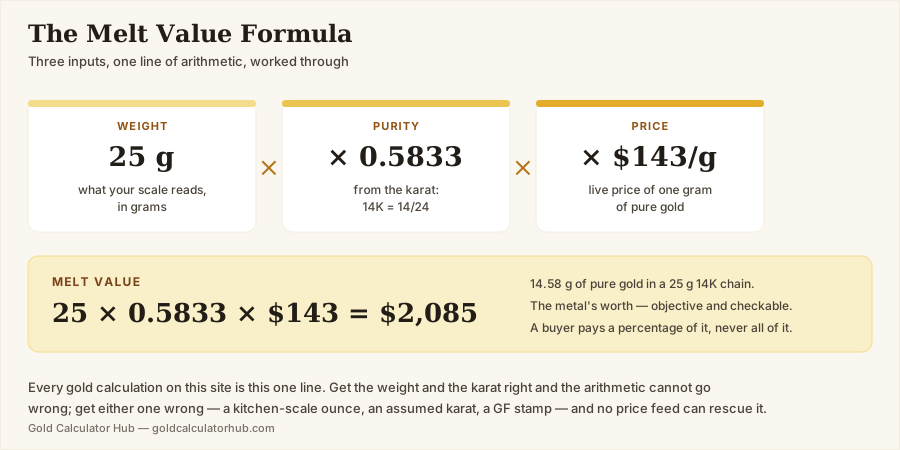
Melt value is the market price of the pure gold inside the piece — weight × purity × spot price. It's the only one of the three that's pure arithmetic, identical everywhere on earth at any given moment.
Resale value is what an actual buyer hands you this week. For ordinary jewelry it sits *below* melt (buyers need margin); for signed, antique, or designer pieces it can sit well above.
Retail replacement value is what it would cost to buy the equivalent piece new at a jewelry store — metal plus labor, design, brand, and retail markup. It exists for insurance purposes and has almost nothing to do with what you can sell for.
For a typical piece these stack roughly 1 : 0.7 : 3. Same ring, three true numbers. The question is never "what's it worth?" — it's "worth to whom, in which transaction?"
One Ring, Three Prices: The Numbers Side by Side
Take a concrete case: a plain 6 gram 14K ring, with gold at an assumed $4,300 per troy ounce — that's $138.25 per pure gram ($4,300 ÷ 31.103), or $80.64 per gram of 14K (58.33% purity).
| Value type | What it answers | Our 6 g 14K ring |
|---|---|---|
| Melt value | What is the metal worth on the open market? | 6 × $80.64 = $484 |
| Resale value | What will a buyer pay me this week? | $315–$411 (coin dealer at 65–85% of melt) |
| Retail replacement | What would buying it new cost? | $1,400–$2,000 |
The spread is brutal and completely normal. The $1,400+ figure isn't fraudulent — that genuinely is what a comparable new ring costs at retail. It's just irrelevant to you as a seller, because no buyer will pay retail for a used ring when they can order a new one wholesale.
Notice the only row you can compute without anyone's opinion is the first. That's why melt is the anchor: run it yourself through the gold value calculator above, then interpret every offer as a percentage of it.
The Per-Gram Ladder Behind Every Estimate
Before you can judge any of the three numbers, you need the one input everything else rests on: what a single gram of your item is worth as metal. Holding our assumed $4,300 per troy ounce — $138.25 per gram of pure gold ($4,300 ÷ 31.103) — the ladder looks like this:
| Karat | Purity | Value per gram | Value per dwt (1.555 g) |
|---|---|---|---|
| 24K | 99.9% | $138.11 | $214.76 |
| 22K | 91.67% | $126.73 | $197.07 |
| 18K | 75% | $103.69 | $161.23 |
| 14K | 58.33% | $80.64 | $125.40 |
| 10K | 41.67% | $57.61 | $89.58 |
| 9K | 37.5% | $51.84 | $80.62 |
Two things fall out of the table immediately. First, karat is not a small adjustment — an 18K piece is worth about 1.8 times a 10K piece of identical weight, which is why a buyer bundling mixed karats at the lowest rate is quietly helping themselves to your money. Second, the pennyweight column is why some buyers quote in dwt: "$125 a pennyweight" for 14K sounds generous next to "$80 a gram," and it's the same offer.
Multiply the relevant row by your item's weight and you have melt value. Everything else on this page is interpretation layered on top of that one number.
Why Insurance Appraisals Mislead Sellers
The single most common valuation document people own is an insurance appraisal — and it's the worst possible guide to selling. Appraisals state retail replacement value, deliberately on the high side, so your policy could replace the item brand new at a retail store after a loss. Some run higher still, because a bigger appraisal means a bigger premium for the insurer and a happier-feeling customer for the jeweler who wrote it. Nobody in that transaction is harmed by generosity.
Then the owner decides to sell, walks in clutching a $2,000 appraisal, hears an offer of $400, and concludes the buyer is a crook. Sometimes the buyer *is* lowballing — but the appraisal can't tell you that. Only melt value can. In the example above, $400 against a $484 melt value is a strong 83% offer; against the appraisal it looks like an insult. Same offer, opposite conclusions, depending on which anchor you brought.
The fix is simple: before selling anything, recompute its value from scratch — weight, karat, today's price — and file the appraisal under "insurance paperwork," which is the only thing it was ever for. The FTC's gold-selling guidance makes the same point in drier language: know the current market value of your gold before accepting any offer.
Melt Value Is the Floor — and the Floor Is Solid
Whatever else is true about a gold item, the metal inside it has a precise, public, global price. That makes melt value the *floor* under every negotiation: a piece can be worth more than melt, but it is never worth less to a properly informed seller, because the refinery door is always open.
When you're selling, the only number that matters is melt value minus the buyer's cut. Everything above that is a story someone has to prove.
The floor works because it requires no expertise to verify. You don't need to know whether the engraving is Edwardian or the stone is natural — you need a scale, the karat stamp, and today's price. Weight × purity × price per gram, done. The mechanics are spelled out step by step in our gold melt calculator guide, and how much is my gold worth turns it into a one-minute routine.
In practice, real offers come in at a percentage of that floor — online refiners around 70–90% of melt, local coin dealers 65–85%, jewelry stores 50–75%, pawn shops 40–60%. Those percentages are the buyer's margin, and they're negotiable in a way the floor itself never is. A seller who knows the floor negotiates the percentage; a seller who doesn't gets negotiated.
When Gold Is Worth More Than Its Metal
Some pieces clear the melt floor by a mile, and the worst mistake in the other direction is scrapping them. Four categories account for nearly all of it.
Designer signatures. Cartier, Tiffany & Co., Van Cleef & Arpels, Bulgari, David Yurman — a verifiable signature can put resale at two to five times metal value. The signature, the hallmark, and ideally the original box and papers are what carry the premium.
Genuine antiques. Victorian through Art Deco pieces with hand workmanship have collector markets that price craft, not grams. Crude test: if it survived a century intact, get an opinion before the furnace gets a vote. Our gold hallmarks guide helps date pieces from their stamps.
Gemstones. Melt math values stones at zero. A half-carat-plus natural diamond, or fine sapphires, rubies, and emeralds, can be worth more than the ring holding them. Stones deserve their own valuation before any scrap decision.
Numismatic coins. Pre-1933 US gold and many world coins trade above melt on rarity and condition — sometimes slightly, sometimes absurdly.
The honest caveat: most gold isn't any of these. Ordinary unsigned 10K–18K jewelry from the last sixty years sells for melt-based prices, full stop. The premium categories are real but rare, which is exactly why they're worth one careful look before you sell.
Form Changes the Value, Not Just the Karat
Two items can hold identical fine-gold content and still fetch very different money, because the *form* the gold arrives in decides how much work stands between it and a refined bar.
Bullion sits closest to the market. A recognized one-ounce coin or bar from a sovereign mint or an LBMA good-delivery refiner needs no assay and no processing, so dealers routinely buy at or slightly above melt — the opposite of the discount jewelry takes. Coins from the US Mint trade with a small premium attached in both directions.
Wearable jewelry in current styles can be resold rather than melted, so a clean, intact, fashionable piece sometimes earns a better percentage than its broken twin.
Broken scrap — snapped chains, single earrings, bent settings — is refiner-bound by definition and gets the plainest scrap math. Nothing wrong with that; it's just the baseline. Our scrap gold calculator walks that case end to end.
Dental gold confuses people most. Crowns and bridges use alloys that commonly land somewhere between 10K and 18K equivalent, blended with palladium and platinum, so you cannot read purity off a stamp — there isn't one. Buyers price dental lots conservatively pending assay, which is reasonable rather than sneaky.
Gold-plated and gold-filled items contain a small fraction of what the scale suggests and should never be run through a karat-based tool at face value.
The Sixty-Second Triage: More Than Melt, or Not?
Run each piece through this sequence and stop at the first "yes" — that's your answer.
- Is there a maker's signature or brand stamp? (Not just a karat mark — a name.) Yes → research the maker before selling; do not scrap.
- Is it plausibly over 80 years old — hand engraving, old-cut stones, unusual construction? Yes → get an antique-jewelry opinion first.
- Does it hold a sizable natural gemstone — roughly half a carat or larger center stone? Yes → value the stone separately before any melt decision.
- Is it a coin or a medal? Yes → check numismatic value before treating it as bullion; never scrap unidentified coins.
- None of the above? It's a metal-value item. Weigh it, check the karat against our gold purity chart, run the gold calculator, and sell to whichever buyer pays the highest percentage of melt.
Step 5 is where perhaps nine of every ten household pieces land, and that's fine — at recent prices near $4,300–$4,500 an ounce, "just metal" is the best it's paid in history. The triage isn't about hoping everything is a treasure; it's about making sure the one piece that is doesn't melt with the rest.
Five Ways People Miscalculate Their Own Gold
The arithmetic is easy. The inputs are where estimates go wrong, and the same five errors account for nearly all of it.
Weighing everything together. A 40-gram pile of 10K, 14K, and 18K is not "40 grams of gold." Sort by stamp, weigh each group, value each group. On a mixed lot, this alone routinely swings the total by a third.
Counting stones as gold. A ring's total weight includes its diamonds, its sizing beads, and any epoxy in the setting. Melt math applies only to metal, so a stone-heavy ring calculates high — expect a buyer to deduct.
Using the wrong ounce. Spot is quoted per troy ounce (31.103 g); a kitchen scale reports avoirdupois ounces (28.350 g). Mixing them overstates value by roughly 10%. The full trap is dissected in troy ounce vs ounce.
Trusting a stamp that shouldn't be trusted. Genuine hallmarks are reliable; unmarked pieces, tourist-market purchases, and anything with a suspiciously crisp stamp on a worn item deserve a test first. How to test gold at home covers methods from free to about $25.
Valuing plated or gold-filled items as solid. If the mark reads GF, GP, HGE, RGP, or carries a fraction like 1/20, the item is a thin gold layer over base metal and its real gold content is a couple of percent of its weight.
Get those five right and your estimate will land within a few dollars of what a refiner's assay says.
From a Value on a Screen to Cash in Hand
Once the gold value calculator gives you a number, getting paid close to it is a matter of routing. The percentage-of-melt ranges repeat all over this site because they decide your outcome more than any market move: online refiners 70–90%, local coin and bullion dealers 65–85%, jewelry stores 50–75%, pawn shops 40–60%, mail-in TV buyers 20–50%.
On our $484 ring, that's the difference between roughly $410 and under $200 — same ring, same day, same spot price. Choosing the buyer *is* the negotiation. Get at least two quotes, lead with the fact that you know your melt value, and watch how the conversation changes.
A few practical notes. Quotes are free almost everywhere, so use them. For 14K specifically — most American jewelry — the 14K gold calculator gives you per-gram figures at a glance. And if a sale produces a meaningful gain over what you (or the person who left it to you) paid, remember the IRS treats gold as a collectible for capital gains; that's a question for a tax professional, not this page.
Value is only theoretical until someone pays it. The sellers who get paid well aren't lucky — they're the ones who arrived knowing all three numbers and which one applied.
Frequently Asked Questions
My appraisal says $2,000 — why are buyers only offering $400?
Because the appraisal states retail replacement value (the cost to buy the piece new, for insurance purposes) while buyers pay based on melt value (the metal content). For ordinary jewelry, replacement value typically runs three to five times melt. Neither number is dishonest; they answer different questions. Judge the $400 offer against your calculated melt value instead — if melt is $484, that offer is a respectable 83%. If melt is $900, walk out.
How do I know if my piece is designer-signed?
Look with a loupe or phone macro lens at the inside of bands, the backs of pendants, clasp tongues, and earring posts. You're looking for a name or logo — Tiffany & Co., Cartier, VCA — alongside the karat stamp, often with a serial number on high-end houses. Then verify: search the exact marking plus "hallmark." Counterfeit signatures exist, so for anything potentially valuable, authentication by a reputable auction house or jeweler is worth the fee before you either sell or scrap.
Do gemstones count toward my gold's value?
Not in a melt transaction — scrap buyers pay for metal weight and either deduct stones or credit them at zero. Stones have value only through channels that price them: a diamond buyer, a jeweler purchasing for resale, or a private sale. As a rule, small accent stones under about a quarter carat rarely justify removal costs, while a natural center stone of half a carat or more deserves its own quote. Lab-created stones, regardless of size, carry minimal resale value.
Is melt value the same at every buyer?
The melt value itself is identical everywhere — it's arithmetic on a public price. What differs is the percentage of it each buyer pays, and the honesty of their scale and karat testing. That's why calculating melt yourself before getting quotes matters: it converts every offer into a comparable percentage. If one shop's "melt value" differs from your math by more than a couple percent, they're using a stale price, a wrong purity figure, or a creative scale.
How accurate is a value estimate if I haven't had the gold tested?
If the karat stamp is genuine, very accurate — within the rounding of your scale. The risk is counterfeit or worn stamps: a small fraction of stamped jewelry tests below its mark, and unmarked pieces are a complete guess until tested. For estimating at home, trust stamps on items with known history (inherited from the original purchaser, bought from real jewelers) and discount mystery pieces mentally by a karat until proven. Buyers will test regardless, so surprises surface before money changes hands.
How do I value a piece with no karat stamp at all?
Treat it as unknown until tested — never assume. Unmarked gold is common on antique pieces made before stamping was standard, on re-shanked rings where the mark was cut away, and on imported items sold outside regulated markets. An acid test kit costs about $15 and brackets the karat in a few minutes; an electronic tester or a jeweler's XRF scan is faster and non-destructive. Until you have a reading, estimate conservatively at 10K and treat anything better as good news rather than budgeting for it.
Should I sell now or wait for a higher gold price?
Nobody can time the gold market for you — recent prices near $4,300–$4,500 per troy ounce are historically extraordinary, but whether they rise or fall next quarter is genuinely unknowable. What's knowable: the spread between a weak buyer and a strong one (often 30–40% of melt) dwarfs typical short-term price moves. If you've decided to sell, optimizing the buyer matters far more than optimizing the date. Holding gold as an investment is a financial decision worth discussing with an advisor — not something a calculator should decide for you.

Written by Sukie Gao
Sukie Gao holds a master's degree from a business school, where she picked up the markets-and-pricing toolkit she now applies to the consumer gold trade. She created Gold Calculator Hub to give people an independent, data-driven way to find out what their gold is really worth.
Published June 6, 2026 · Updated July 21, 2026