10K Gold Calculator: Real Value of 10 Karat Gold
 By Sukie Gao · Updated October 16, 2026
A 10K gold calculator exists to deliver a number most sellers find smaller than they hoped — and that is exactly why it's worth using before you talk to any buyer. 10 karat gold is 41.67% gold; the rest is copper, silver, zinc, and nickel. The calculator above takes today's spot price, multiplies it by 0.4167, and gives you the honest melt value of whatever weight you type in. We're an independent valuation site — we don't buy gold, so we have no reason to flatter the number, and no reason to shave it either. Below: what the 417 mark means and why it's the legal floor for American gold, the per-gram math at recent prices, a worked class-ring example that explains why pawn shop offers feel insulting, how 10K stacks up against 14K and 18K in actual dollars, how to weigh and sort a drawer of mixed pieces before anyone else touches them, how to avoid confusing solid 10K with gold-filled and plated lookalikes, the three numbers to make any buyer state out loud, and an honest answer to the question everyone asks at the end — does anyone actually pay fairly for 10K, and who?
What 41.67% Gold Actually Means
10 karat gold is 10 parts gold to 14 parts everything else — 41.67% pure, marked 417 in the millesimal system. Under US federal stamping standards, 10K is the legal floor: alloy in any less gold and the piece cannot be marketed as karat gold in the United States at all. That floor is why 10K dominates the budget end of American jewelry — class rings, mall chains, birthstone rings, and much of what discount jewelers sell.
The alloy-heavy recipe has genuine upsides. 10K is the hardest of the common karats, shrugging off scratches and dents that would mark 18K, and it keeps retail prices within reach. The downsides: a paler, slightly brassier color, more potential for skin irritation (more nickel and copper against the skin), and — the reason you're on this page — less than half the melt value of pure gold, gram for gram.
If your stamp reads 417, 10K, or 10KT, this page's math applies. Seeing some other number or letter combination? Our gold purity chart translates every karat and fineness mark in one place.
Per-Gram Value at Recent Prices
Recent gold prices have hovered near $4,300–$4,500 per troy ounce. To keep the math clean, assume $4,350/oz: divide by 31.103 grams per troy ounce and pure gold runs $139.86 per gram. Multiply by 0.4167 and 10K is worth $58.28 per gram in melt value.
| Unit | 10K melt value at $4,350/oz gold |
|---|---|
| 1 gram | $58.28 |
| 1 pennyweight (dwt, 1.555 g) | $90.63 |
| 1 standard ounce (28.350 g) | $1,652.24 |
| 1 troy ounce (31.103 g) | $1,812.65 |
The 10K gold calculator above runs this same arithmetic with the live spot price instead of our assumed one, which matters because gold moves every trading day. One unit warning while you're here: gold trades in troy ounces of 31.103 grams, not the 28.35-gram ounces on food labels. A buyer or seller mixing those up — accidentally or otherwise — is off by nearly 10% before the negotiation even starts.
10K Against 14K and 18K, in Dollars
Purity percentages are abstract until you convert them into money. Holding our assumed $4,350 per troy ounce — $139.86 per pure gram — here is what one gram of each common karat is actually worth as metal:
| Karat | Purity | Melt value per gram |
|---|---|---|
| 24K | 99.9% | $139.72 |
| 22K | 91.67% | $128.21 |
| 18K | 75% | $104.89 |
| 14K | 58.33% | $81.58 |
| 10K | 41.67% | $58.28 |
| 9K | 37.5% | $52.45 |
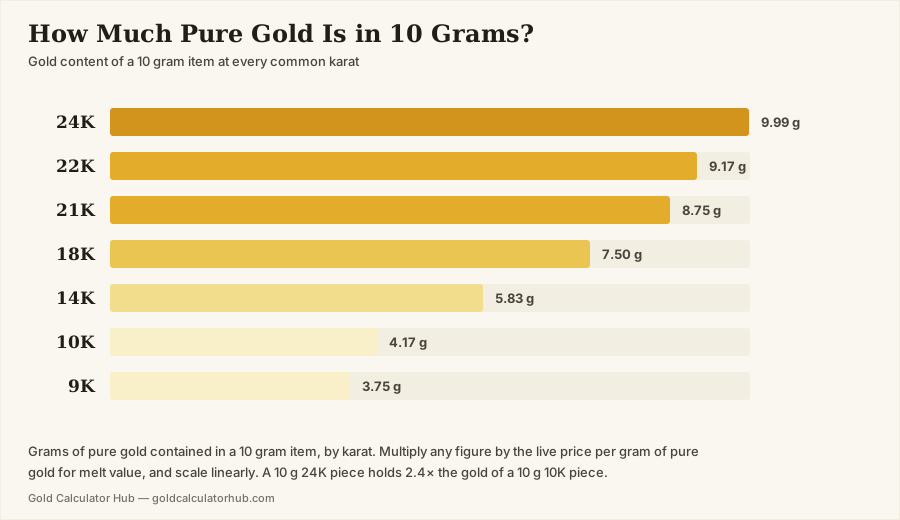
Now the version that actually changes decisions. Take ten grams of each — roughly a substantial chain — and the gap is stark: ten grams of 10K holds $582.80 of gold, ten grams of 14K holds $815.80, and ten grams of 18K holds $1,048.90. Same weight in your hand, same heft on the scale, and the 18K piece carries 80% more value than the 10K one. Against 14K the gap is exactly 40%.
This is why buyers care so much about sorting, and why you should too. A mixed pile weighed as one lump gets priced at whatever karat the buyer decides to call it, and buyers do not err in your favor. Separate by stamp before you leave the house. If some pieces are unmarked or the stamps have worn away, our gold purity chart shows what to look for, and the 14K calculator runs the same arithmetic one tier up.
The Class Ring Reality Check
Here is the conversation this page exists for. A chunky 10K class ring feels substantial — solid, heavy, obviously valuable. Then the math happens.
Say the ring weighs 14 grams on a kitchen scale. First deduction: the stone. Class ring stones are nearly always synthetic spinel or cubic zirconia worth effectively nothing, and a typical stone accounts for roughly 1.5 grams of that gross weight. That leaves about 12.5 grams of actual 10K gold.
12.5 g × $58.28 = $728.50 melt value at our assumed $4,350/oz.
Now apply real-world payout ranges:
- Online refiners (70–90% of melt): $510–$656
- Local coin and bullion dealers (65–85%): $474–$619
- Jewelry stores (50–75%): $364–$546
- Pawn shops (40–60%): $291–$437
So the heavy ring that feels like a thousand-dollar object is realistically a $300–$650 transaction depending on where you take it. That's not a scam; it's 41.67% purity meeting ordinary buyer margins. The scam version is the buyer who quotes you $150 hoping you never ran the numbers — which is precisely what a gold calculator is for. Know your melt figure before anyone else weighs your gold, and the lowball becomes obvious the moment it's spoken.
Weigh It Yourself Before Anyone Else Does
Every dollar figure on this page depends on one input you control completely: the weight. Get it right at your own kitchen table and no buyer can quietly get it wrong at theirs.
- Buy a 0.01 g jeweler's scale. They run $12–$25 online. A 0.1 g scale is acceptable for chains but hopeless on earrings, where a tenth of a gram is several dollars. Calibrate it with the included weight — cheap scales drift.
- Weigh in grams, never ounces. Kitchen and postal scales report standard ounces of 28.350 g, while gold is priced per troy ounce of 31.103 g. Reading one as the other overstates nothing and understates plenty; the details are at troy ounce vs ounce.
- Sort by stamp first, weigh each group separately. One number for the 10K pile, one for the 14K pile. Photograph each group on the scale with the reading visible — it takes ten seconds and settles any later dispute about what you handed over.
- Deduct what isn't gold. Stones, steel clasp springs, watch pins, and glued-in settings all add weight and no value. A gemstone's carat weight converts directly: one carat is 0.2 grams, so a 1.5 ct stone is 0.3 g. Class ring stones are bulkier — budget a gram to a gram and a half.
- Write the melt number down. Run your sorted weights through the calculator above and keep the figure on your phone. That written number is the difference between negotiating and being negotiated at.
One habit worth adopting: weigh the lot again when you get home if a buyer weighed it out of your sight. Honest buyers weigh in front of you and will happily do it twice.
Solid 10K, Gold-Filled, Gold-Plated: Three Different Things
A huge share of the disappointment around 10K traces to stamps that look like karat marks but aren't. Three categories to keep straight:
Solid 10K — stamped 10K, 10KT, or 417 with no qualifying letters. Gold alloy all the way through. Everything on this page applies.
Gold-filled — stamped 1/10 10K GF, 1/20 12K GF, or similar. This is a thin sheet of karat gold mechanically bonded over a brass core. The fraction tells you the gold layer's share of total weight: a 1/10 10K GF bracelet is one-tenth 10K by weight, which works out to roughly 4% actual gold content. Refiners buy gold-filled material by the pound in bulk; a single item is worth very little.
Gold-plated — stamped GP, GEP, RGP, HGE, or nothing at all. A microscopic electroplated layer, often under a thousandth of a millimeter thick. Scrap value: effectively zero.
Stamps wear off and counterfeits exist, so verify when a piece matters. A magnet test catches steel-core fakes in seconds (gold is not magnetic), and our guide to testing gold at home walks through every method from free to $25, including the acid test that reliably separates solid 10K from plated lookalikes.
A Mixed Drawer, Sorted and Priced
Single 10K items disappoint. Accumulated 10K surprises people. Here is a realistic household drawer, priced end to end at our assumed $4,350 per troy ounce, where 10K melts at $58.28 per gram.
- Broken rope chain, 8.2 g — $477.90
- Two orphaned hoop earrings, 3.4 g together — $198.15
- Dated signet ring, 5.1 g — $297.23
- Charm bracelet, 11.6 g gross — the steel jump rings and a base-metal charm account for about 1.1 g, leaving 10.5 g of gold at $611.94
Total gold weight: 27.2 grams. Total melt value: $1,585.22. That is a drawer most people would have guessed was worth two or three hundred dollars, because each piece individually looks like nothing.
Now the payout spread, which is where the real money is decided:
- Online refiners at 70–90%: $1,109.65–$1,426.70
- Local coin and bullion dealers at 65–85%: $1,030.39–$1,347.44
- Jewelry stores at 50–75%: $792.61–$1,188.91
- Pawn shops at 40–60%: $634.09–$951.13
The distance between the best plausible outcome and the worst is $792.61 — coincidentally almost exactly the melt value of half the lot. Nothing about the gold changed; only the door it walked through. That single comparison is why the where to sell gold rankings matter more than any timing strategy, and it is the argument for collecting three quotes on anything above a gram or two.
Who Actually Pays Fairly for 10K
The honest answer: fewer buyers than for higher karats, but the good ones barely discriminate. An online refiner melts everything down and recovers pure gold regardless of starting purity, so reputable refiners pay their standard 70–90% of melt on 10K just as they would on 18K. Local coin and bullion dealers (65–85%) are similar, though some set minimum lot sizes that one small 10K item won't meet.
Where 10K gets punished is the casual end of the market. Some jewelry stores and most pawn shops treat low-karat pieces as nuisance inventory and quote accordingly — 40–60% of melt is normal at a pawn counter, and worse happens. A few buyers also quietly round purity down, paying 10K as if it were 40% or even 38% gold; on our example ring above, the 40% version of that rounding skims about $29 without a word being said.
Your defenses are the same as for any gold sale: weigh the items yourself first, know your melt number from the calculator above, collect three quotes, and ask each buyer for their price per gram of 10K so the offers are directly comparable. The FTC's selling gold jewelry guidance is a short read before shipping anything to a mail-in operation. And while desirable makers occasionally worked in 10K, melt is the realistic outcome for low-karat gold far more often than it is with 18K — set expectations there and you won't be disappointed.
Reading a 10K Offer: The Three Numbers to Ask For
Most bad gold deals are not committed with a lie. They are committed with a single unexplained number — "I can do $410 for the lot" — that nobody asks to see decomposed. Make any buyer state three things, and the offer becomes legible.
One: the spot price they are working from. It is public and global, so there is no defensible reason to withhold it. A buyer quoting off a price that is days stale, or vaguely "what gold's at today" without a figure, is telling you something.
Two: the price per gram of 10K. This is the number that makes competing offers comparable — the live figure is on the 10K gold price per gram page, and every karat has its own tool in the gold calculators hub — and the number some buyers most want to avoid saying. Suppose one says "$36 a gram for your 10K." Against our $58.28 melt figure, that is 61.8% of melt — the low end of respectable, roughly jewelry-store territory, and $22 a gram behind a good refiner.
Three: every deduction, itemized. Lot fees, assay charges, shipping, "refining allowances." A headline percentage means nothing until the subtractions are on the table.
Run the same test on a lump-sum offer by reversing it. That $410 quote on the 12.5-gram class ring above, whose melt value is $728.50, works out to 56% of melt. Now it is not a mystery number; it is a below-average offer you can accept, counter, or walk away from with a clear head. Anchoring on melt first is the whole method, and it works identically for every karat — the 14K and 18K pages just change the multiplier.
Frequently Asked Questions
Is 10K gold real gold?
Yes. 10K is genuine solid gold at 41.67% purity — the lowest karat American jewelers routinely sell. It contains real, recoverable gold that refiners pay real money for. What it is not is high-purity gold: gram for gram it carries less than half the gold of 24K and about 71% of the gold in 14K. Real, but the budget tier — and price expectations should match.
What does 417 stamped on jewelry mean?
417 is the millesimal fineness mark for 10 karat gold — 417 parts gold per thousand, or 41.67% pure. It means the same thing as a 10K or 10KT stamp. Watch the letters that follow: 417 alone means solid 10K gold, while something like 1/10 10K GF means gold-filled, a thin 10K layer over brass with only a few percent actual gold content. That one suffix changes the value by a factor of twenty or more.
How much will a pawn shop give me for a 10K gold ring?
Pawn shops typically pay 40–60% of melt value. A ring holding 12.5 grams of 10K gold has a melt value around $729 with gold at $4,350 per troy ounce, so a realistic pawn offer runs $291–$437 — and the first number quoted is often below even that, since counters expect negotiation. If the offer is under 40% of the melt figure you calculated, walk; an online refiner or coin dealer will usually beat it comfortably.
Why is my 10K class ring worth less than I expected?
Three deductions stack up. Purity: only 41.67% of the ring's metal is gold. Stone weight: the synthetic stone and its setting can be a gram or two of the gross weight and add nothing. Buyer margin: nobody pays 100% of melt, and class rings usually get sold at the casual end of the market where payouts run 40–75% of melt. A 14-gram ring that feels like $1,000 typically nets $300–$650 — disappointing, but it's arithmetic, not theft.
Is 10K gold even worth selling?
Usually yes, especially in quantity. At recent prices around $4,350 per troy ounce, every gram of 10K carries about $58 of melt value, so even a thin 5-gram chain represents roughly $290 of gold. A drawer of orphaned 10K — single earrings, broken chains, dated rings — adds up faster than people expect. Just sell it to a buyer who pays well on low karat (refiners, coin dealers) rather than one who treats it as nuisance inventory.
Does 10K gold tarnish?
It can. With 58.33% of the alloy being copper, silver, zinc, and nickel, 10K is the most reactive of the common karats — it may dull, darken slightly, or leave the occasional green mark on skin, especially around sweat, chlorine, and cleaning chemicals. None of that affects melt value, which depends only on weight and gold content. A tarnished 10K chain and a polished one are worth exactly the same to a refiner.
What's the difference between 10K and 1/10 10K GF?
Everything. Solid 10K is 41.67% gold all the way through. 1/10 10K GF is gold-filled: a thin sheet of 10K bonded over brass, where the gold layer makes up one-tenth of the item's weight — so the actual gold content is around 4% of the piece. On identical 20-gram bracelets at recent prices, the solid one melts near $1,166 while the gold-filled one carries maybe $115 of gold that only bulk refiners will bother recovering.
How do I know if my 10K is real and not plated?
Start with the stamp: 10K, 10KT, or 417 with no GF, GP, RGP, or HGE suffix suggests solid gold. Then test, because stamps can lie: a strong magnet should not attract it, plating often shows wear at edges and clasps with a different metal peeking through, and a $15–$25 acid test kit gives a reliable answer at home. For high-stakes pieces, a jeweler's electronic or X-ray fluorescence test settles it in minutes, often free or for a few dollars.
Should I buy 10K or 14K jewelry?
For daily-wear durability on a budget, 10K is honestly underrated — it's harder than 14K and noticeably cheaper. For color, comfort on sensitive skin, and resale value, 14K wins: richer tone, less nickel and copper, and about 40% more gold content per gram when you eventually sell. If you think of jewelry as partly a store of value, buy 14K or higher; if you just want sturdy gold that takes a beating, 10K does the job.
Do I owe tax when I sell 10K gold?
Possibly. The IRS treats physical gold as a collectible, so a gain over what you originally paid can be taxable, and inherited pieces are generally measured against their value at the date of death rather than the original purchase price. In practice many household sales of old jewelry produce no gain at all, or one small enough that nothing is owed. The rules turn on your basis, holding period, and bracket, so read the IRS guidance on collectibles and talk to a tax professional for anything substantial — this isn't tax advice.
Is there a minimum amount of 10K gold worth mailing to a refiner?
Roughly ten grams is a sensible floor, which is about $580 of melt at recent prices. Below that, insured shipping and the hassle of a claim start to eat the advantage refiners have over a local dealer. Many refiners also set their own minimums or reserve their best rate tiers for larger lots. If you have a single 4-gram 10K ring, a local coin or bullion dealer paying 65–85% will usually net you more than mailing it. Pool small pieces until the lot justifies the trip.
Is 10K gold hypoallergenic?
Less so than any other karat. With 58.33% of the alloy being base metals — commonly copper, zinc, and nickel — 10K puts more of the usual irritants against your skin than 14K or 18K do. Nickel is the frequent culprit behind redness and itching under rings and earring posts. If a piece bothers you, higher karat or nickel-free white gold alloys generally help. None of this changes the melt value: refiners pay for the gold fraction whether or not the alloy agrees with your wrist.
Does an old 10K piece with a maker's name sell for more than melt?
Occasionally, but treat it as the exception. A handful of American makers worked in 10K during the mid-century, and Art Deco or Victorian pieces in good condition sometimes carry collector value above their metal. The realistic filter: if the piece is distinctive, intact, signed, and would look at home in a vintage shop window, get an antique jewelry opinion before scrapping it. Ordinary 10K chains, class rings, and mall pieces almost never clear melt, and holding out for a collector rarely pays.

Written by Sukie Gao
Sukie Gao holds a master's degree from a business school, where she picked up the markets-and-pricing toolkit she now applies to the consumer gold trade. She created Gold Calculator Hub to give people an independent, data-driven way to find out what their gold is really worth.
Published June 6, 2026 · Updated October 16, 2026