Scrap Gold Calculator: What Your Scrap Gold Is Worth Today
 By Sukie Gao · Updated July 21, 2026
A scrap gold calculator does one job: it tells you what the metal in your broken, unwanted, or orphaned gold is worth at today's price, before any buyer takes a cut. That number matters more than anything a pawn shop clerk says, because every offer you'll ever get is some percentage of it. The calculator above pulls the live spot price, so all you need to supply is the karat and the weight of each piece. That's genuinely it — no account, no photos, no "free appraisal kit" in the mail.
I've watched a lot of people sell scrap over the years, and the ones who get paid fairly all did the same two things first: they sorted their pieces by karat, and they knew their melt value before walking in the door. The ones who got fleeced skipped both steps. This page covers what counts as scrap, how the valuation works, what gets deducted, and a fully worked example of a real mixed lot — so by the end you'll know your number and what each kind of buyer should be offering against it.
What Actually Counts as Scrap Gold
Scrap is any gold item whose value comes from the metal alone — nobody is going to wear it, collect it, or resell it as-is. In practice that covers more than most people expect:
- Broken chains and bracelets — a snapped clasp or kinked link kills resale value, but the gold weight is untouched
- Single earrings — one orphaned stud is worthless as jewelry and full price as metal
- Dental gold — crowns, bridges, and inlays, typically alloyed somewhere between 10K and 22K
- Class rings — heavy, usually 10K, and almost nobody buys them secondhand
- Out-of-style pieces — herringbone chains from 1987, charm bracelets nobody claimed, mismatched findings
- Damaged rings — bent shanks, missing stones, worn-through bands
The common thread: condition and style are irrelevant. A mangled 14K chain and a pristine 14K chain of the same weight have identical scrap value, because both are headed for the same refinery furnace. If that feels brutal, it cuts the other way too — that hideous bracelet from a relative's estate is worth exactly as much per gram as something beautiful.
Why Scrap Is Valued at Pure Melt — Nothing Else
When a refiner melts your gold, everything except the gold itself burns off, separates out, or gets discarded. The craftsmanship, the brand, the memories — gone. What's left is fine gold, and that's the only thing the refiner can sell. So the entire scrap trade prices backward from one question: how many grams of pure gold are in this pile?
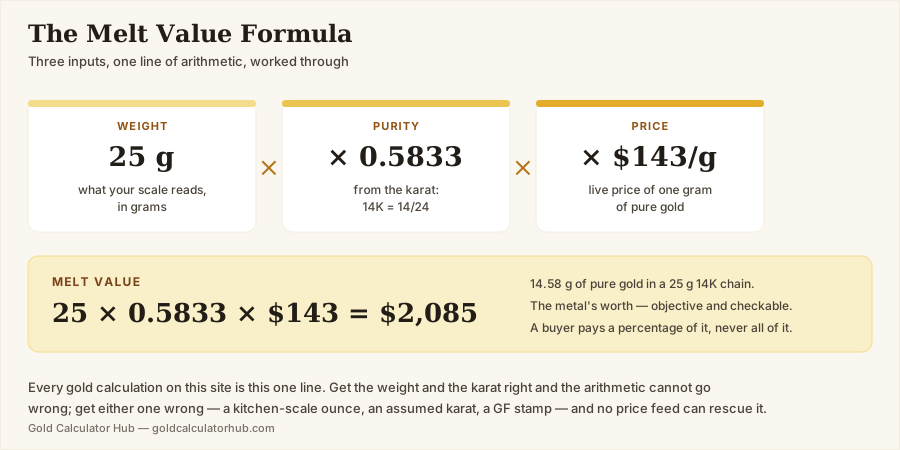
The formula is simple. Take the weight, multiply by the karat's purity, multiply by the per-gram price of pure gold. A 10 gram 14K item contains 5.83 grams of fine gold (14K is 58.33% pure), and that fine-gold content is its melt value. Our gold melt calculator walks through this math in detail if you want the full breakdown.
This is why "I paid $2,000 for it" means nothing to a scrap buyer. Retail jewelry prices include design, labor, brand markup, and the store's margin — often 2-4x the metal value. Scrap pricing strips all of that out and pays for atoms. With recent prices near $4,300–$4,500 per troy ounce, those atoms are worth more than they've ever been, which is some consolation.
Sort by Karat Before You Weigh Anything
Here's the single most expensive mistake scrap sellers make: dumping everything on the scale as one pile. If a buyer weighs your mixed lot together, guess which karat they'll price the whole pile at? The lowest one in the batch. Your 18K bracelet just got paid out at 10K rates.
So before you weigh, sort. Check every piece for a stamp — look inside ring bands, on clasps, on the backs of pendants. You're looking for karat marks (10K, 14K, 18K) or their millesimal equivalents (417, 585, 750). Our gold purity chart decodes every stamp you're likely to find. Unmarked pieces go in their own pile for testing.
Then weigh each karat group separately in grams. A kitchen scale that reads to 0.1 g is fine for estimates; see how to weigh gold for what buyers' scales will show and why pennyweights sometimes appear on offer sheets. Run each group through the scrap gold calculator separately and add the results. Two minutes of sorting routinely changes the outcome by 20% or more on mixed lots — it's the best hourly rate you'll earn all week.
The Unmarked Pile: Testing Gold That Has No Stamp
Every scrap lot produces a pile of pieces with no legible mark — worn-smooth bands, foreign jewelry that never carried a US karat stamp, findings, and anything where the stamp sat on a clasp that broke off years ago. Buyers price unmarked metal cautiously, so it pays to know what you have before they guess.
The fastest home method is density. Gold is extraordinarily heavy for its size, and the alloys separate cleanly on a density chart:
| Metal | Density (g/cm³) |
|---|---|
| Pure gold (24K) | 19.3 |
| 18K yellow gold | ~15.6 |
| 14K yellow gold | ~13.1 |
| 10K yellow gold | ~11.6 |
| Sterling silver | 10.5 |
| Brass | ~8.5 |
| Stainless steel | ~7.9 |
Measuring it takes a kitchen measuring cylinder and your scale. Weigh the piece dry, then lower it into a cylinder of water and read how much the water level rises in milliliters — that displaced volume equals the item's volume in cubic centimeters. Weight divided by volume is density.
Worked example: an unmarked band weighs 12.0 g and raises the water level by 0.92 mL. 12.0 ÷ 0.92 = 13.04 g/cm³ — squarely 14K territory, and nowhere near brass. That single measurement moves the band from the "unknown, price it low" pile into your 14K pile, which at $141.46 per pure gram is worth 12.0 × 58.33% × $141.46 = $990.
Density can't catch a tungsten-cored fake or distinguish 14K white from a palladium alloy, so treat it as a strong filter rather than proof. How to test gold at home covers the magnet, acid, and ceramic-streak checks that fill the gaps.
Deductions: Stones, Solder, and Everything That Isn't Gold
Buyers pay for gold content, and several common things reduce it. Gemstones are the big one — a 6 gram ring with a large center stone might be only 4.5 grams of actual metal. Honest buyers either remove stones before weighing or deduct an estimated stone weight; less honest ones weigh the whole ring and quietly price it as if the stone were gold, which sounds generous until you realize they lowballed the percentage elsewhere.
Solder is sneakier. Repaired chains and resized rings contain solder joints, and gold solder runs lower karat than the piece itself — 14K jewelry is often repaired with 10K-ish solder. Refiners account for this with a small deduction on heavily repaired items, usually 1-3%. Spring-loaded clasps contain steel springs. Watch cases hide entire movements. Hollow rope chains weigh less than they look like they should.
None of this is a scandal; it's just physics. But you should make the same deductions in your own estimate so the buyer's number doesn't surprise you. If a piece has a big stone, weigh it, subtract a reasonable guess for the stone, and run the metal weight through the calculator. You'll land within a few percent of what a fair buyer's scale says.
What Common Scrap Items Are Worth Right Now
To make this concrete, assume gold at $4,400 per troy ounce — that's $141.46 per gram of pure gold ($4,400 ÷ 31.103 g). Here's what typical scrap pieces contain at that price:
| Item | Typical weight | Karat | Melt value |
|---|---|---|---|
| Broken curb chain | 8 g | 14K | $660 |
| Single stud earring | 1.2 g | 14K | $99 |
| Class ring (stone deducted) | 10 g | 10K | $590 |
| Plain wedding band | 4 g | 18K | $424 |
| Dental crown | 3 g | ~16K (66.7%) | $283 |
| Bracelet with broken clasp | 12 g | 14K | $990 |
Math check on the first row: 8 g × 58.33% purity = 4.67 g fine gold × $141.46 = $660. Every row works the same way.
Two things jump out. First, small items add up fast — that lonely earring is a hundred dollars. Second, weight dominates everything: the chunky 10K class ring beats the 18K wedding band despite the lower purity. When prices move, the proportions hold; only the dollar figures shift, which is exactly what the scrap gold calculator above tracks for you in real time.
A Real Mixed Lot, Worked All the Way Through
Say you've emptied the jewelry box and sorted everything. You end up with: 22 grams of 14K (two broken chains, three single earrings, one damaged ring), 15 grams of 10K (a class ring and a heavy signet), and 3 grams of 18K (one bent band). Keep gold at $4,400/oz, so $141.46 per pure gram.
The 14K pile: 22 g × 58.33% = 12.83 g fine gold → 12.83 × $141.46 = $1,815
The 10K pile: 15 g × 41.67% = 6.25 g fine gold → 6.25 × $141.46 = $884
The 18K piece: 3 g × 75% = 2.25 g fine gold → 2.25 × $141.46 = $318
Total melt value: $3,018. That's your anchor number — write it down before talking to anyone.
Now the offers. An online refiner paying 85% sends you about $2,565. A local coin dealer at 75% offers around $2,263. A pawn shop at 50% offers $1,509 — and many open lower than that, expecting you not to know your number. Same pile of metal, a $1,000+ spread, decided entirely by where you walk in and whether you did this math first. If you want the full 60-second version of this process for any item, see how much is my gold worth.
Where Scrap Sellers Actually Get the Best Rates
Every buyer type pays a different slice of melt, and the ranges are remarkably consistent across the industry:
| Buyer type | Typical payout (% of melt) | On a $3,018 lot |
|---|---|---|
| Online gold refiners | 70–90% | $2,113–$2,716 |
| Local coin & bullion dealers | 65–85% | $1,962–$2,565 |
| Jewelry stores | 50–75% | $1,509–$2,264 |
| Pawn shops | 40–60% | $1,207–$1,811 |
| Mail-in TV services | 20–50% | $604–$1,509 |
Online refiners top the table because they cut out middlemen — your gold goes more or less straight to the furnace. The trade-off is shipping your gold away and waiting on a payout, so use established companies, insure the package, and photograph everything first. The FTC's guidance on selling gold jewelry covers the protections worth insisting on.
Local coin and bullion dealers are the best in-person option: they deal in metal daily, know exactly what your lot is worth, and compete on thin margins. Get quotes from at least two. A full ranked breakdown of every option lives at where to sell gold.
Waiting for a Better Price vs. Choosing a Better Buyer
Sellers routinely agonize over whether to hold their scrap for a stronger gold market. It's the wrong lever, and the arithmetic says so bluntly.
Take the $3,018 mixed lot from the example above. If gold rallies 5%, your melt value goes to $3,169 — a gain of $151. A 5% move is a meaningful market swing that might take weeks or might never come, and it can just as easily go the other way and cost you the same $151.
Now compare that to buyer choice on the very same lot, today. A pawn shop at 50% hands you $1,509. An online refiner at 85% hands you $2,565. That's $1,056 — seven times the entire benefit of a 5% price rally, available this afternoon, with no forecasting required.
The practical conclusion is boring and correct: spend your effort on the decision you control. Price movement is a lottery ticket you're holding whether you want it or not; payout percentage is a choice you make by picking up the phone. The one legitimate timing consideration is a very soft market — if spot has fallen sharply in the last month and you have no urgency, sitting out a quarter costs nothing but patience. Beyond that, the seller who compares three buyers today beats the seller who waits six months for a better headline nearly every time.
When Something Is Not Scrap — Stop Before You Sell
A few categories of "scrap" are worth meaningfully more intact, and once melted, that premium is gone forever. Check for these before any piece goes in the scrap pile.
Signed pieces. Flip the item over and look for a maker's signature: Tiffany & Co., Cartier, Van Cleef & Arpels, David Yurman, Georg Jensen. A signed piece can resell for two to five times its metal value even with wear. Buyers of scrap will happily pay you melt rates for a Cartier band and pocket the difference.
Genuinely antique items. Victorian, Art Nouveau, and Art Deco jewelry has a collector market. Hand engraving, old cut stones, and unusual construction are clues. An appraisal costs little compared to what melting destroys.
Coins. Pre-1933 US gold coins and many world coins carry numismatic premiums above melt. Never scrap a coin without checking it first.
Watches. A gold watch case might be scrap; a gold Rolex, Patek Philippe, or Omega absolutely is not.
When in doubt, a quick search of the maker's mark or a $50-100 appraisal is cheap insurance. The gold calculator on our homepage will always tell you the metal floor — just make sure the floor is really all there is before you take it.
Frequently Asked Questions
Is gold-plated or gold-filled jewelry worth anything as scrap?
Gold-plated: essentially nothing — the gold layer is microns thick and costs more to recover than it's worth. Gold-filled is slightly better: it's a bonded layer that's typically 5% of the item's weight in 12K or 14K gold, so a refiner processing it in bulk pays a little, but a single gold-filled bracelet might net you a few dollars. Look for stamps like "GP," "GF," "1/20 14K," or "HGE" — any of these means the piece doesn't belong in your scrap math. Only karat-stamped solid gold (or tested unmarked gold) counts.
Should I remove gemstones before selling scrap gold?
If the stones have any value — diamonds over about a quarter carat, sapphires, rubies, emeralds — yes, have them removed or sell to a buyer who credits you for them, because most scrap buyers pay zero for stones. Small melee diamonds and synthetic stones usually aren't worth the removal labor. Either way, expect the stone weight to be deducted before the gold is priced. A jeweler can unset stones for a modest fee, and you keep them or sell them separately.
How do buyers test the karat of my scrap?
Most start with the stamp, then verify. Common methods: acid testing (scratching the piece on a stone and applying karat-specific acids), electronic testers, and increasingly XRF analyzers — desktop machines that read the alloy's exact composition in seconds without damage. Refiners doing final settlement may do a fire assay after melting, which is the definitive measure. If you want a head start before selling, our guide to testing gold at home covers cheap DIY options like the magnet check and density test.
Can I sell dental gold with the tooth or porcelain still attached?
Yes — refiners that handle dental gold deal with attached porcelain, amalgam, and even tooth material routinely. They'll deduct the non-gold weight after processing. Dental alloys vary widely, roughly 10K to 22K equivalent, so payouts are estimated up front and settled after assay. A typical full crown contains 2-4 grams of alloy. Don't try to separate the materials yourself; just disclose what it is and use a buyer who explicitly accepts dental scrap.
Is there a minimum amount of scrap gold worth selling?
There's no hard floor, but practical minimums exist. Mail-in refiners often have minimum lot values (sometimes around an ounce of scrap weight) for free shipping or best rates. For a single gram of 14K — worth roughly $80 at recent prices — a local coin shop is the realistic option, and they'll still buy it. If you're under a few grams, consider waiting until you've accumulated more, since fixed costs like insured shipping eat a bigger share of small lots.
Do buyers pay a better percentage for 18K than 14K?
The percentage of melt value is usually the same across karats — what changes is the melt value itself, since 18K contains more gold per gram. That said, some refiners pay slightly stronger percentages on higher-karat and larger lots because refining costs are proportionally smaller. Where karat genuinely matters is sorting: making sure your 18K isn't weighed in with your 10K matters far more than negotiating an extra point or two of percentage.
Should I melt my gold into a bar before selling it?
No — this is one of the most counterproductive things a seller can do. A home-melted bar has no verifiable purity, so buyers must assay it before paying, and many will price it pessimistically or refuse it outright. Karat stamps on intact jewelry, even broken jewelry, are evidence in your favor. Melting destroys that evidence along with any chance the piece was worth more than melt. Leave the furnace work to the refinery.
Do I owe taxes when I sell scrap gold?
Possibly. The IRS treats physical gold as a collectible: if you sell for more than your cost basis, the gain is taxable, with long-term collectible gains capped at a 28% rate. For inherited pieces, your basis is generally the value at the previous owner's death, which often wipes out most of the gain. Buyers file Form 1099-B only for certain bullion transactions, but the reporting obligation on gains is yours either way. See the IRS guidance on collectibles and talk to a tax professional — this isn't tax advice.
Are white gold and rose gold worth the same as yellow gold scrap?
Per karat, yes. A gram of 14K white gold contains the same 58.33% pure gold as a gram of 14K yellow — the color comes from the other 41.67% (nickel or palladium for white, copper for rose). Refiners pay on gold content, so color is irrelevant to the price. One small exception: white gold containing palladium can carry a tiny additional value at some refiners, since palladium is itself a precious metal, though most buyers ignore it on small lots.
How long does it take to get paid for scrap gold?
It depends entirely on the venue. A pawn shop or coin dealer pays cash the moment you agree — under an hour including the drive. An online refiner runs a cycle: kit out, gold shipped, testing, offer, payment, which lands somewhere around seven to ten days door to door. Refiners that settle after a formal assay on mixed dental or industrial scrap can take two to three weeks. Confirm the payment method and timeline in writing before you ship anything; a vague answer there is a warning about everything else.
Does a scrap gold calculator account for the buyer's fees?
No, and it shouldn't. The calculator gives you melt value — the pure gold content at the live market price — which is the neutral fact both sides of the counter agree on. Fees, refining charges, and margin are the buyer's side of the equation and vary by an enormous range. Take the melt number, then apply the payout band for the venue you're considering: 70–90% for online refiners down to 40–60% at a pawn counter. That two-step keeps your expectations honest without pretending anyone can predict one shop's overhead.
What records should I keep after selling scrap gold?
Keep the itemized receipt showing weights and karats per group, the per-gram rate you were paid, the date, and the buyer's business name and address. Photograph the lot before it leaves your hands. You want this for two reasons: if the buyer's assay comes back different from the quote, your photos and home weights are the only evidence you have — and if the sale produced a taxable gain, your records establish both the sale price and, ideally, what you originally paid. Shops are legally required to record most purchases anyway, so asking for a copy is routine.

Written by Sukie Gao
Sukie Gao holds a master's degree from a business school, where she picked up the markets-and-pricing toolkit she now applies to the consumer gold trade. She created Gold Calculator Hub to give people an independent, data-driven way to find out what their gold is really worth.
Published June 6, 2026 · Updated July 21, 2026