Where to Sell Gold: Every Buyer Ranked by Real Payout
 By Sukie Gao · June 6, 2026
Where to sell gold is the question that decides whether you walk away with 90% of your gold's melt value or 25% of it — same chain, same scale, wildly different check. The gold-buying industry is built on the hope that you won't comparison shop, and most sellers don't: they take the first offer from whoever has the biggest sign. This guide ranks every type of gold buyer by what they actually pay as a percentage of melt value, because that's the only honest yardstick. We don't buy or sell gold ourselves, which means we have no reason to steer you anywhere. The short version: online refiners and local bullion dealers pay the most, jewelry stores and pawn shops pay for their own convenience and overhead out of your check, and the TV mail-in operations pay least of all. There's also a small but important category of pieces — signed designer jewelry, antiques, rare coins — that should never be sold for melt at all. Before any of it, work out your melt value with a gold calculator so every offer you hear has a number to stand against.
The Master Ranking: Who Pays What
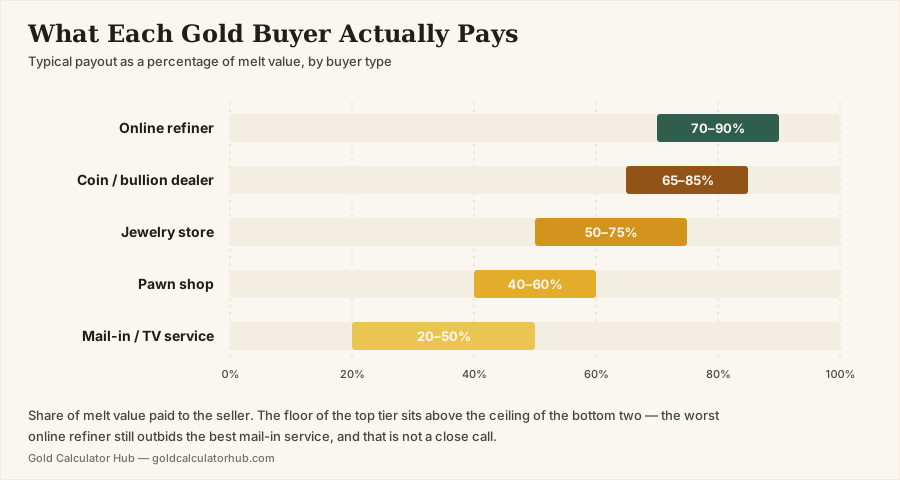
Every buyer below pays some fraction of melt value — the raw worth of the gold content at current prices, which have recently run near $4,300–$4,500 per troy ounce. If you're deciding where to sell gold, here's the whole market in one table:
| Buyer type | Typical payout (% of melt) | Speed | Best for |
|---|---|---|---|
| Online gold refiner | 70–90% | 2–7 days | Most scrap jewelry; maximizing dollars |
| Local coin/bullion dealer | 65–85% | Same day | Coins, bars, larger lots, fast cash |
| Local jewelry store | 50–75% | Same day | Trade-ins, store credit deals |
| Pawn shop | 40–60% | Under an hour | Small lots, emergencies |
| Mail-in TV/late-night service | 20–50% | 1–3 weeks | Honestly, nobody |
| Auction house / consignment | Varies — can exceed melt | Weeks to months | Designer, antique, signed pieces |
| Private sale (marketplace, forum) | Varies — near melt or above | Days to weeks | Patient sellers with desirable pieces |
The spread between the top and bottom of this table is enormous. On a piece with $1,000 of melt value, the difference between a strong refiner offer and a weak mail-in offer is $600 or more. The rest of this page walks through each row so you know what you're dealing with.
Online Refiners: 70–90% of Melt, the Payout Ceiling
Online refiners — companies that buy scrap by mail and melt it themselves or feed it directly to a refinery — sit at the top of the payout range because their cost structure is thin. No retail storefront, no showcase staff, and volume measured in kilos rather than single chains. The good ones publish their per-gram payout rates by karat right on their websites, which is the single most useful trust signal in this business: a published rate is a rate you can hold them to.
The process: request a free kit, mail your gold in a prepaid insured package, receive an emailed offer after they weigh and test it, then accept or have everything returned. Two things to verify before you ship: the insurance limit on the mailer (often $1,000–$5,000 by default; you can usually pay to raise it for bigger lots) and the return policy if you decline — the reputable ones return your items free and intact.
The trade-off is time and trust. You're parted from your gold for several days, and you need to vet the company first. For the full breakdown of that process, see selling gold online vs. locally.
Local Coin and Bullion Dealers: 65–85% and Same-Day Cash
The local coin shop is the most underrated venue on this list. These dealers live on tight bullion margins, test gold all day, and will typically quote you a percentage of spot without theatrics. For gold coins and bars, they're often the *best* option, period — a recognizable bullion coin can fetch 95%+ of its gold value because the dealer can resell it without refining.
For scrap jewelry, expect 65–85% of melt depending on the shop and the size of your lot. Bigger lots earn better percentages because the dealer's fixed costs (testing time, refining minimums) spread across more grams.
A practical note: coin dealers respect sellers who arrive informed. Walk in knowing your weight in grams, your karat, and your melt number from the scrap gold calculator, and the conversation starts at a different level than it does for someone who dumps a sandwich bag on the counter and asks "what'll you give me?"
Jewelry Stores and Pawn Shops: Paying for Convenience
These two venues sit in the middle and lower-middle of the table, and both charge you — in payout percentage — for being easy to find and fast to deal with.
Jewelry stores (50–75% of melt) buy gold as a sideline; the real business is selling new pieces at retail markups, and their offers carry that retail overhead. The number to watch is the store credit offer: many jewelers offer noticeably more in trade credit than cash — say, 70% of melt as credit versus 55% cash. That's a fine deal *only* if you were already going to buy something there at a fair price; otherwise the jeweler just bought your gold at a discount and sold you marked-up inventory in one transaction. Where jewelers genuinely shine is pieces with resale value above melt — a good one can recognize a piece worth reselling intact and pay accordingly, which a refiner's crucible never will.
Pawn shops (40–60%) are the fastest legal way to turn gold into cash — often under thirty minutes, no appointment — and that speed is exactly what you pay for. The low offers are structural, not sinister: pawn shops are loan businesses first, with heavy per-transaction overhead and resale risk priced into every offer. We break down the full math, including the pawn-versus-sell distinction and the negotiating room most people never use, in how much pawn shops pay for gold. For anything substantial, the pawn counter should be your quote-gathering stop, not your selling stop.
Mail-In TV Services: 20–50%, the Bottom of the Barrel
The heavily advertised mail-in operations — the ones with celebrity endorsements, late-night spots, and "free Gold Pak" envelopes — consistently anchor the bottom of the payout table at 20–50% of melt. The advertising budget that got their envelope into your hands comes out of your check.
The model works on friction and inertia. You mail your gold in, they send a check that's far below melt, and they're betting you'll cash it rather than go through the return process. Some sweeten the trap by making the check itself the acceptance — cash it and the deal is done. The Federal Trade Commission's guidance on selling gold jewelry specifically advises checking how a mail-in buyer handles returns, reimbursement for lost items, and payment timing before you ship anything — questions these operations tend to answer badly.
To be clear, mailing gold is not the problem; reputable online refiners use the same logistics and pay two to three times more. The problem is the specific business model of mass-market TV buyers. If an envelope arrived in your mailbox unrequested, that's your cue to sell elsewhere.
When Auction, Consignment, or a Private Sale Beats Them All
Everything above assumes your gold is worth its melt value and nothing more. For most scrap — broken chains, single earrings, dated class rings — that's true. But some pieces are worth more intact than melted, and selling those to any scrap buyer is the most expensive mistake on this page.
Pieces that may beat melt:
- Signed designer jewelry — Cartier, Tiffany & Co., Van Cleef & Arpels, David Yurman; signatures can double or triple value
- Antique and period pieces — Victorian, Art Deco, Art Nouveau work with hand craftsmanship
- Rare or pre-1933 US gold coins — numismatic value can dwarf gold content; never scrap these unchecked
- Pieces with significant gemstones — scrap buyers pay little or nothing for stones
- Watches in gold cases — Rolex, Patek Philippe, Omega cases sell as watches, not as gold
For these, an auction house (many offer free valuations), a jewelry consignment dealer, or a careful private sale will usually out-pay every scrap venue — sometimes by multiples. The cost is time: weeks to months instead of days, plus auction commissions of roughly 10–25%. The first step is simply knowing what you have — and what its plain melt value would be, so you can judge whether the slower route is worth it.
How to Get Quotes That Actually Mean Something
A quote is only useful if you can compare it to something. Here's the process that turns you from a price-taker into a price-checker:
Know your melt value first. Weigh each karat group on a kitchen or pocket scale, work out melt value at the current price, and write the numbers down. Every offer you hear afterward instantly becomes a percentage instead of a mystery.
Apply the two-quote minimum rule. Never sell on a single offer. Two quotes is the minimum; three is better. The second quote costs you twenty minutes and routinely adds 10–20% to your final payout, which on a $1,000-melt lot is a very good hourly rate.
Get offers per karat group, in writing. A legitimate buyer will quote your 10K, 14K, and 18K separately. "One price for the whole bag" is how lots get valued at the lowest karat — a classic move covered in cash for gold scams.
Negotiate with the melt number in hand. "My melt value is $1,240 — your offer is 52% of that. Can you do better?" is a complete negotiation. Dealers move for sellers who clearly know the math, because the alternative is watching you walk to the competitor who'll pay 70%.
For mail-in sales, confirm insurance before shipping. Check the declared-value limit, photograph everything, and keep the tracking number.
Red Flags by Venue
Each venue has its own characteristic way of underpaying you. Here's the field guide:
| Venue | Watch out for |
|---|---|
| Online refiner | No published rates; vague return policy; low insurance caps; offer valid only if you respond same-day |
| Coin/bullion dealer | Quotes in pennyweight (dwt) when you weighed in grams; "refining fee" deducted after the quote |
| Jewelry store | Inflated store-credit offers tied to marked-up inventory; karat "re-testing" that downgrades hallmarked pieces |
| Pawn shop | Single bundled price for mixed karats; scale you can't see; pressure to pawn instead of sell |
| Mail-in TV service | Check-as-acceptance terms; lost-item reimbursement far below value; stall tactics on returns |
| Hotel/pop-up buying event | "Tonight only" urgency; uncertified scales; cash deals with no receipt |
| Private sale | Counterfeit payment, chargebacks, and meet-up safety — use insured, irreversible payment methods |
None of these flags means every buyer in the category is dishonest — there are excellent pawn shops and terrible coin dealers. They mean the *incentive structure* of each venue produces a predictable failure mode, and now you know each one on sight.
Worked Example: One Bracelet, Five Offers
Let's make the ranking concrete. Say you have a 40-gram 18K bracelet — solid, no stones, no designer signature. Assume gold at $4,400 per troy ounce, which is $4,400 ÷ 31.103 = $141.46 per gram of pure gold. 18K is 75% gold, so the bracelet contains 30 grams of fine gold:
40 g × 0.75 × $141.46 = $4,244 melt value
Now run that one bracelet down the table at typical mid-range payouts:
- Online refiner at 80%: $3,395
- Coin/bullion dealer at 75%: $3,183
- Jewelry store at 60%: $2,546
- Pawn shop at 50%: $2,122
- TV mail-in service at 35%: $1,485
Same bracelet, same day, and the spread from top to bottom is $1,910 — money that changes hands purely based on where you walked in. Even the gap between the refiner and the pawn shop is $1,273, which prices out to several hundred dollars per hour for the extra effort of getting a kit and waiting a few days.
Run your own pieces through the melt calculator on this site before you collect a single quote. The sellers who get the top of every range are simply the ones who knew their number first.
Frequently Asked Questions
What is the single best place to sell gold for the most money?
For ordinary scrap jewelry, a reputable online refiner with published per-gram rates usually pays the most, at 70–90% of melt value. For gold coins and bars, a local bullion dealer often matches or beats that, since recognizable bullion resells without refining. For signed designer or antique pieces, an auction house or consignment dealer can exceed melt entirely. There's no one answer to where to sell gold — there's a best venue per type of gold, which is why identifying what you have comes before selling it.
Do banks buy gold?
In the United States, no — retail banks don't buy gold jewelry, coins, or bullion from the public, and most won't sell it either. This surprises a lot of people because banks deal in money and gold feels like money. Your actual options are the buyer types ranked on this page: refiners, bullion dealers, jewelers, pawn shops, and auction venues. A bank can still be useful in one respect: a safe deposit box is a reasonable place to keep gold while you take your time comparing offers.
How many quotes should I get before selling gold?
Two at absolute minimum, three if the lot is worth more than a few hundred dollars in melt value. Quotes are free, take minutes each, and the spread between buyers routinely runs 10–30% of melt for identical items. On a $2,000-melt lot, a third quote that finds you 12% more is $240 for roughly twenty minutes of effort. Get each quote broken out by karat group and in writing — a photo of a written offer is fine — so buyers know you're comparing.
Should I sell my gold now or wait for higher prices?
Nobody can time the gold market reliably, including dealers. With recent prices near $4,300–$4,500 per troy ounce — historically elevated — sellers today are getting far more per gram than they would have a few years ago. The practical answer: sell when you need or want the money, and concentrate your effort on the thing you actually control, which is the percentage of melt you receive. Improving your payout from 50% to 85% beats waiting and hoping for a 10% price move. This isn't financial advice — for large holdings, talk to a financial professional.
What ID or paperwork do I need to sell gold?
Nearly all legitimate buyers require a government-issued photo ID, and many states require licensed precious-metals buyers to record your information, photograph items, and report purchases to local law enforcement — a theft-deterrence measure. Pawn shops typically must also hold purchased items for a mandated period before reselling. A buyer who wants no ID and offers cash with no receipt is a red flag, not a convenience: you'd have no paper trail if anything went wrong.
Do I have to pay taxes when I sell gold?
Possibly. The IRS treats physical gold as a collectible, and gains on collectibles held over a year are taxed at a maximum rate of 28% — see IRS Topic 409. The taxable gain is the sale price minus your cost basis; for inherited gold, the basis usually steps up to the value at the previous owner's death, which often means little or no gain on a prompt sale. Keep your receipts. This isn't tax advice — a tax professional can confirm what applies to your situation.
Is it safe to sell gold to an online buyer?
With a properly vetted company, yes — the established online refiners process enormous volumes daily using insured carriers, and shipping problems are rare. The vetting is the work: confirm published payout rates, a free-return policy if you decline the offer, adequate insurance for your lot's value, and a long track record with consistent independent reviews. Photograph and weigh everything before shipping, and keep the tracking number. What's genuinely unsafe is skipping that vetting and mailing gold to whoever advertised most loudly.

Written by Sukie Gao
Sukie Gao holds a master's degree from a business school, where she picked up the markets-and-pricing toolkit she now applies to the consumer gold trade. She created Gold Calculator Hub to give people an independent, data-driven way to find out what their gold is really worth.
Published June 6, 2026