Gold Purity Chart: Every Karat, Fineness Mark and Percentage
 By Sukie Gao · Updated October 16, 2026
A gold purity chart answers the question every seller, buyer, and inheritor of jewelry eventually asks: how much of this thing is actually gold? The answer is almost never "all of it." Pure gold is too soft for daily wear, so jewelers cut it with copper, silver, zinc, nickel, and sometimes palladium — and the karat stamp on the clasp tells you the recipe. The catch is that the stamp comes in two competing languages: karats (24K, 18K, 14K) and millesimal fineness (999, 750, 585), with a third dialect, parts per million, showing up on assay reports and refinery paperwork. Most people half-speak one of the three.
The tables below translate all of them into the number that matters — the percentage of gold by weight — and then into dollars per gram at a stated price. They also run in reverse, which is the direction people actually need more often than anyone admits: you have a percentage from an XRF scan or a listing that says "60% gold," and you need to know what karat that is. There is a table for that. There is also a color breakdown for yellow, white, and rose gold, a walk through the odd karats nobody mentions (23K, 20K, 16K, 12K), and an explanation of why every number here is by weight rather than by volume, which turns out to matter more than it sounds like it should.
Print it, screenshot it, or bookmark it. Once you can read a purity mark cold, you stop being the person at the counter taking the buyer's word for it, and you can run any piece through a gold calculator yourself in about thirty seconds.
The Chart: Every Karat at a Glance
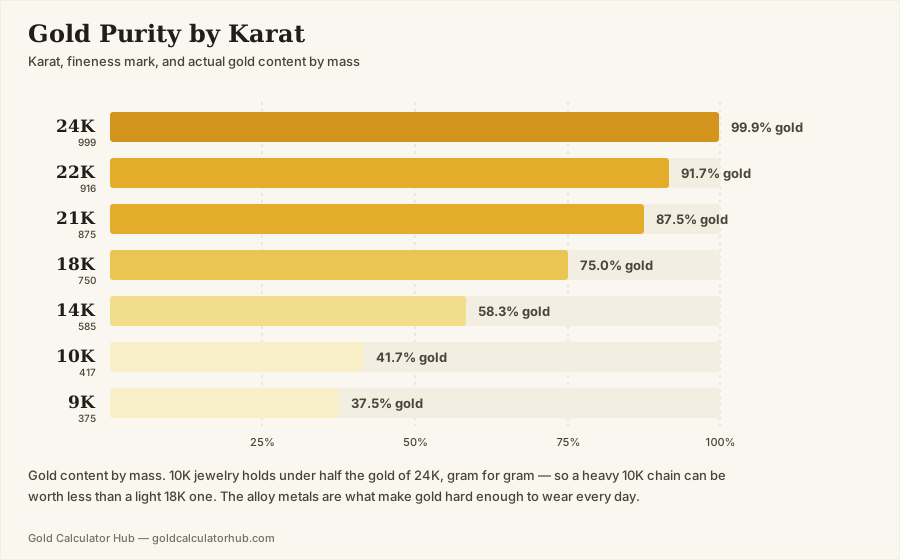
Here is the master table. Melt values assume a spot price of $4,400 per troy ounce, which works out to $141.46 per gram of pure gold ($4,400 ÷ 31.103 g). Recent prices have run near $4,300–$4,500 per troy ounce, so treat the dollar column as a current ballpark, not gospel — purity percentages never change, but spot moves every trading day.
| Karat | Fineness mark | % gold | Typical use | Melt value per gram* |
|---|---|---|---|---|
| 24K | 999 | 99.9% | Bullion bars, investment coins, some East Asian jewelry | $141.32 |
| 22K | 917 (916 in India) | 91.67% | South Asian and Middle Eastern jewelry, American Gold Eagles | $129.68 |
| 21K | 875 | 87.5% | Gulf-state and broader Middle Eastern jewelry | $123.78 |
| 18K | 750 | 75% | Fine European jewelry, luxury watches, designer pieces | $106.10 |
| 14K | 585 (occasionally 583) | 58.33% | The default for American jewelry | $82.51 |
| 10K | 417 | 41.67% | Budget US jewelry; the lowest karat common in America | $58.95 |
| 9K | 375 | 37.5% | Everyday jewelry in the UK, Ireland, and Australia | $53.05 |
*At an assumed $4,400/troy oz spot price.
Reading it is simple: find the stamp on your piece in column one or two, and the percentage tells you what fraction of the item's weight is actual gold. A 20-gram bangle stamped 22K contains 18.33 g of pure gold and melts for about $2,593.60 at our assumed price. A 20-gram chain stamped 14K — identical weight, also legitimately "gold" — contains 11.67 g of pure gold and melts for about $1,650.20. That is a $943 difference between two pieces a kitchen scale says are the same. The stamp is doing all the work, which is exactly why you should learn to read it before anyone makes you an offer.
Karats and Millesimal Fineness: Two Systems, One Answer
The karat system divides purity into 24 parts. The word traces back to the carob seed, which ancient traders used as a counterweight on balance scales, and the 24-part convention is genuinely old — it predates every government currently stamping gold. A karat number is just a fraction with 24 on the bottom: 18K means 18/24 gold, which is 75%. 14K means 14/24, or 58.33%. Do the division and the mystery evaporates.
Millesimal fineness is the metric world's cleaner answer: parts per thousand. A 750 stamp means 750 parts gold per 1,000 — the same 75% as 18K, written by an engineer instead of a medieval goldsmith. Most of Europe stamps fineness; America stamps karats; plenty of modern jewelry carries both.
One quirk worth knowing: 14K math gives 583.3 parts per thousand, and older European pieces are often stamped 583. American manufacturers later settled on 585 — alloying very slightly rich so a stamped piece would never assay under the mark. Both numbers mean 14K. Similarly, India's BIS hallmarking system stamps 22K gold as 916 rather than 917. If you see a three-digit number in the 370–999 range on jewelry, it is almost certainly a fineness mark, and the chart above converts it.
The one number the stamp never tells you is the day's price. Purity is fixed; spot is not. The World Gold Council publishes market data at gold.org if you want the long view on where prices have been.
Reading the Chart Backwards: You Have a Percentage, You Need a Karat
Plenty of people arrive at this from the opposite direction. A coin dealer runs an XRF scanner over your ring and reads out "about 89%." An online listing says "60% gold." A refiner's assay report comes back at 0.7512. None of those are karat numbers, and the conversion is one multiplication:
Karat = gold percentage × 0.24
Check it against the chart: 58.33 × 0.24 = 14.0. 91.67 × 0.24 = 22.0. 75 × 0.24 = 18.0. It always works, because 0.24 is just 24 ÷ 100. Going to fineness is even easier — fineness = percentage × 10, so 75% is 750, and 41.67% is 417.
| Gold, by weight | Karat equivalent | What it would be stamped |
|---|---|---|
| 99.9% | 23.98K | 24K / 999 |
| 95.8% | 23.0K | 23K / 958 |
| 91.67% | 22.0K | 22K / 916 or 917 |
| 89% | 21.36K | no standard — 890 if stamped honestly |
| 87.5% | 21.0K | 21K / 875 |
| 83.3% | 20.0K | 20K / 833 |
| 75% | 18.0K | 18K / 750 |
| 62.5% | 15.0K | 15K / 625 |
| 60% | 14.4K | no standard — 600 if stamped honestly |
| 58.33% | 14.0K | 14K / 585 (or 583) |
| 50% | 12.0K | 12K / 500 |
| 41.67% | 10.0K | 10K / 417 |
| 37.5% | 9.0K | 9K / 375 |
| 33.3% | 8.0K | 8K / 333 |
Two of those rows come up constantly, so here they are spelled out. 89% gold is 21.36 karat — a shade over 21K, and no mainstream market stamps a 21.36K standard. A piece that assays at 89% is most likely a 21K piece alloyed comfortably above its mark, or a 22K piece running a little under, or a non-standard alloy from a small workshop that mixed to taste. 60% gold is 14.4 karat — just above the 14K line at 58.33%. Again, not a standard anywhere; the honest read is "14K and change."
Why does the distinction matter in dollars? Because a refiner who pays on assay pays on the real number, not the nearest stamp. On a 30 g piece at our assumed $4,400 spot, being paid on 60% instead of 58.33% is 30 × 0.0167 × $141.46 = about $70.87 more in your pocket. That is the practical argument for assay-based settlement over stamp-based settlement on any lot big enough to bother with.
The Full Purity Scale, Including the Karats Nobody Mentions
The seven karats in the master table cover the overwhelming majority of jewelry you will ever hold. But the scale runs continuously from 0 to 24, and a handful of in-between standards show up often enough to be worth recognizing — usually on older, foreign, or specialty pieces.
- 23K (958) — Rare in the West, occasionally seen in Southeast Asian and Chinese jewelry that wants near-pure color with a hair more strength than 24K.
- 20K (833) — A traditional standard in parts of the Middle East and North Africa. If you find an 833 stamp, it is gold, not silver, despite 800 being a silver mark.
- 16K (667) — Not a jewelry standard, but roughly where a lot of dental gold lands. Crown alloys were mixed for casting behavior rather than to hit a karat mark, so dental scrap almost always gets paid on assay.
- 15K (625) and 12K (500) — Both were legal British standards until 1932, when the UK dropped them in favor of 14K. Victorian and Edwardian English pieces carry them. 12K is also the exact halfway point of the scale: half gold, half everything else.
- 8K (333) — A German and central European budget standard, one third gold. Legal to sell as gold there; not legal to call gold in the United States, where 10K is the floor.
That last point is the one that surprises people. American law does not recognize anything below 10 karat as gold for sales purposes, which is why 9K jewelry — completely ordinary in the UK, Ireland, and Australia — cannot be marketed as "gold" in a US store, even though it is 37.5% gold and a refiner will happily buy it. If you inherited jewelry from a British relative, expect 9K, and expect a US buyer to occasionally act as if it is exotic. It is not; it is just below the line the FTC drew.
A note on where the scale stops at the top: 24K is conventionally written as 99.9% rather than 100%, because commercially refined gold always carries trace impurities. Truly absolute purity is a laboratory abstraction, not something that comes out of a refinery on a Tuesday.
Percent, Parts per Thousand, Parts per Million: One Number in Three Costumes
Once you leave the jewelry counter and step into refining, assaying, and bullion, the same purity gets expressed in parts per million. It sounds like a different measurement. It is not — ppm is fineness with three more zeros bolted on.
| Karat | % gold | Fineness (parts per thousand) | Parts per million |
|---|---|---|---|
| 24K | 99.9% | 999 | 999,000 |
| 22K | 91.67% | 916.7 | 916,700 |
| 21K | 87.5% | 875 | 875,000 |
| 18K | 75% | 750 | 750,000 |
| 14K | 58.33% | 583.3 | 583,300 |
| 10K | 41.67% | 416.7 | 416,700 |
| 9K | 37.5% | 375 | 375,000 |
The conversions are trivial once you see them: ppm = percentage × 10,000, and ppm = fineness × 1,000. So 18K gold is 750,000 ppm, and a percentage point is 10,000 ppm.
Why bother with a unit this granular? Because at the top of the scale, the interesting differences are tiny. Good delivery bullion is defined by minimum fineness standards published by the LBMA, and refiners distinguish between 999 ("three nines"), 9999 ("four nines," 999,900 ppm), and 99999 ("five nines," 999,990 ppm). Expressed as percentages those are 99.9%, 99.99%, and 99.999% — visually easy to misread, and a mouthful to say out loud. In ppm the gap is legible: four-nines gold carries 900 ppm of impurity, five-nines carries 90.
For a jewelry seller, none of this changes your payout — every buyer on earth treats 999 and 9999 bullion as effectively pure. It matters when you are reading an assay certificate, comparing bullion products, or trying to work out why one bar costs a little more than another of identical weight.
Every Number Here Is Purity by Weight — and That Is Not Obvious
There is a hidden assumption running through every purity chart ever printed, including this one: purity is measured by weight, not by volume. A 14K ring is 58.33% gold by mass. Nobody states it because within the trade it is taken for granted, but it produces a genuinely counterintuitive result.
Gold is extremely dense — 19.3 grams per cubic centimeter. The metals it gets alloyed with are not: silver is 10.49, copper 8.96, nickel 8.91, zinc 7.14. So when you mix 58.33 grams of gold with 41.67 grams of silver and copper, the gold contributes far less than its share of the *bulk*.
Run the arithmetic on a representative 100 g of 14K yellow gold — call it 58.33 g gold, 29 g silver, 12.67 g copper:
- Gold: 58.33 ÷ 19.3 = 3.02 cm³
- Silver: 29 ÷ 10.49 = 2.76 cm³
- Copper: 12.67 ÷ 8.96 = 1.41 cm³
- Total: 7.19 cm³
Gold's share by volume is 3.02 ÷ 7.19 = about 42% — meaningfully less than the 58.33% on the stamp. Roughly two-fifths of the space inside a 14K ring is gold; nearly three-fifths of its weight is. Both statements are true, and only one of them gets you paid.
The practical consequences are worth holding onto. First, this density gap is exactly what makes a density test work at home: a solid 14K piece has a predictable density around 13 g/cm³, while a plated brass fake comes in near 8.5, and the water-displacement method catches that without touching the metal. Second, it explains why higher-karat jewelry feels noticeably heavier than lower-karat jewelry of the same physical size — more gold in the same volume. And third, it is why every honest transaction in this business starts on a scale rather than with a ruler. If you want the methods that use this, see how to test gold at home, and for getting the weight itself right, how to weigh gold.
Why the World Can't Agree on a Karat
Walk into a jewelry store in Mumbai, Dubai, Paris, and Dallas and you will be shown four different defaults — and each market considers its own choice obviously correct.
South Asia and the Middle East run on 22K and 21K. There, jewelry doubles as family savings: a wedding set is a store of value first and an ornament second, so buyers want maximum gold content and tolerate the softness. The 916 stamp is so standard in India that it functions as a synonym for 22K. Even the US Mint follows this logic for one product — the American Gold Eagle is struck at 91.67% gold (22K) for durability, per the US Mint's own specifications, while its Buffalo coin is 24K for purists.
Europe settled on 18K (750) as the fine-jewelry standard — enough purity for rich color, enough alloy for a secure stone setting. Most luxury watch cases and designer pieces worldwide follow it; our 18K gold calculator handles that math.
America is 14K country. It is durable, affordable, and still well past half gold — the workhorse karat of US chains, rings, and class jewelry, priced out in detail on the 14K gold calculator.
The UK, Ireland, and Australia go lower still: 9K is a fully legal and extremely common everyday standard there, while American stores rarely go below 10K, even though the current FTC Jewelry Guides accept a stated "9 Karat Gold" marking. Same metal, different cultures, different floors. None of this changes the math — it only changes what stamp you are most likely to find on an inherited piece, depending on where it was bought.
Color Is an Alloy Story, Not a Purity Story
"Gold purity color chart" is a search that comes from a reasonable but mistaken instinct — that a paler piece must be less gold and a deeper yellow must be more. Color tracks the *alloy recipe*, and the recipe can be varied freely at any karat. An 18K white ring and an 18K yellow ring contain exactly the same 75% gold and are worth exactly the same money per gram.
What changes is the other 25%, and the pattern is broadly consistent across manufacturers:
| Color | What does it | Gold content |
|---|---|---|
| Yellow | Roughly balanced silver and copper | Set by the karat, nothing else |
| Rose / red / pink | Copper-heavy, silver light — more copper means redder | Set by the karat, nothing else |
| Green ("electrum") | Silver-heavy with little or no copper | Set by the karat, nothing else |
| White | Nickel, zinc, or palladium to bleach the yellow, then usually rhodium-plated | Set by the karat, nothing else |
That right-hand column is the whole point of the table.
Color does carry two indirect signals worth knowing. First, the higher the karat, the less room there is to shift the color — at 22K there is only 8.33% of anything else to work with, so 22K is intensely yellow no matter what, and true 22K white gold essentially does not exist. A convincingly white piece is 18K or below, which is a useful sanity check on an unmarked item. Second, white gold's rhodium plating wears, and a piece that has gone slightly warm and yellowish at the high points is not degrading in purity — it is just showing the alloy underneath its plating. That is a replating job, not a valuation event.
The one caution for sellers: because rhodium plating is itself a coating, a bright white surface can disguise what is underneath, including base metal. Color is decoration. The karat mark, confirmed by a test, is the money.
Purer Isn't Tougher: The Trade-Off
People assume higher karat means better jewelry. Higher karat means more valuable jewelry; it usually means weaker jewelry. Pure gold is soft enough to scratch with a coin. Every step down the chart trades gold content for hardness, scratch resistance, and structural strength — which is why the regions that wear 22K daily also employ a lot of goldsmiths who repair bent bangles.
A few practical consequences of the trade-off:
- Rings and bracelets take the most abuse. For daily-wear pieces, 14K or 18K hold shape and finish far better than 22K. Prongs holding stones are almost never made above 18K for exactly this reason.
- Earrings and pendants barely touch anything, so high-karat metal is a fine choice there.
- Skin sensitivity is an alloy issue, not a gold issue. Nickel in some white gold alloys is the usual culprit, which is why palladium-alloyed white gold exists and costs more.
- Repairability varies. A skilled bench jeweler can size and solder any karat, but matching color on a repair is easier at 14K than at 22K, where the solder seam tends to announce itself.
For a seller, the takeaway is blunt: durability is the wearer's concern, but value is purely the chart's left three columns. Melt buyers do not pay extra because a 10K ring survived thirty years of yard work.
Marks That Are Not Purity Marks
The most expensive mistake in this topic is reading a non-purity stamp as a purity stamp. Several common marks contain a karat number and describe an item that is almost entirely not gold:
- GF (gold-filled) — e.g., "1/20 14K GF." A thin sheet of real 14K gold mechanically bonded over brass. The gold layer is 1/20th of the item's weight; total gold content is around 2–3% by weight. Worth a small fraction of solid gold.
- GP, GEP (gold-plated / gold electroplate) and HGE (heavy gold electroplate) — microscopically thin plating. Gold content is effectively zero for melt purposes.
- RGP (rolled gold plate) — gold-filled's thinner cousin. Same verdict.
- Vermeil — gold plating over sterling silver. Pretty, legitimate, and worth silver money, not gold money.
- 925 or "Sterling" — that is a silver fineness mark (92.5% silver). Gold-tone jewelry stamped 925 is gold-plated silver, full stop.
A buyer who "reads" your 1/20 14K GF chain as 14K does not exist; one who lets *you* believe it is 14K while paying you scrap-brass money absolutely does. The full decoding guide lives at gold hallmarks, and since stamps can be counterfeited outright, it pays to know how to test gold at home so the metal can confirm what the mark claims. A stamp is a label; a purity chart only works when the label is honest.
One Signet Ring, Four Counters: What the Chart Is Actually For
Charts are abstractions until you put a specific object on a specific scale, so here is one, worked all the way through.
The item: a man's signet ring, stamped 750, no stones, weighed on a 0.1 g jeweler's scale at 9.4 g. Assumed spot: $4,400 per troy ounce, giving $141.46 per pure gram.
- Decode the stamp. 750 fineness = 75% gold = 18K. Third row from the bottom of the master table.
- Find the gold content. 9.4 g × 0.75 = 7.05 g of pure gold.
- Convert to dollars. 7.05 × $141.46 = $997.29, or equivalently 9.4 × $106.10 per 18K gram = $997.34. Call it $997 of melt value.
Now apply the payout ranges that hold across the industry, and the same ring turns into five different numbers depending on which door you walk through:
| Buyer | % of melt | Offer on $997 |
|---|---|---|
| Online refiner | 70–90% | $698–$898 |
| Local coin or bullion dealer | 65–85% | $648–$848 |
| Jewelry store | 50–75% | $499–$748 |
| Pawn shop | 40–60% | $399–$598 |
| Mail-in TV service | 20–50% | $199–$499 |
One ring, a $699 spread between the best and worst realistic outcome, and the only thing separating the seller who gets $898 from the seller who gets $199 is that the first one read the stamp and did two multiplications first.
Here is the purity lesson hiding inside it. Suppose that same 9.4 g ring had been stamped 585 instead of 750. Its melt value would be 9.4 × $82.52 = $775.69 — about $222 less, on a piece that looks identical, weighs identical, and wears identical. Between two rings on the same scale, the four-character stamp is worth more than a fifth of the value. Read it carefully, and if it is worn to illegibility, test before you sell. The FTC's guidance on selling gold jewelry makes the same point in federal prose: know your karat, watch the scale, and take more than one offer.
Five Ways People Misread the Chart
Every mistake below costs real money, and all five are common enough that any working gold buyer sees them monthly.
1. Using the wrong ounce. A troy ounce is 31.103 g; the ounce on a kitchen scale is 28.350 g. Gold is always quoted in troy. Treating a kitchen-scale ounce as a troy ounce inflates your expected value by about 9.7% and guarantees a disappointing counter visit. If a dealer quotes in pennyweight instead, 1 dwt = 1.555 g. More on the unit traps in troy ounce vs ounce.
2. Applying the purity percentage to gross weight. The chart's percentages apply to the *gold* in the piece. A gemstone ring's total weight includes stones, and a watch's includes a movement, a crystal, and often a steel back. Buyers deduct non-gold components before pricing, and a seller who calculated on gross weight walks in with an inflated number and no explanation for the gap.
3. Confusing karat with carat. Karat (K) is gold purity in 24ths. Carat (ct) is gemstone weight, at 0.2 g per carat. The UK spells both "carat," which keeps the confusion permanently alive.
4. Treating 583 and 585 as different karats. They are both 14K — one is the mathematically exact 583.3 rounded down, the other is the American convention of alloying slightly rich. Same metal, same value per gram. The same goes for 916 versus 917 at the 22K line.
5. Reading the purity percentage as a payout percentage. This is the big one. A 14K piece is 58.33% gold — that number describes the *metal*, not the offer. What you get paid is a percentage of the melt value, decided by which buyer you choose. Two entirely separate percentages, applied in sequence, and mixing them up is how people conclude that a fair offer is a rip-off or that a terrible offer is fine. Run the melt number first with a gold melt calculator, then evaluate every offer as a share of it.
Frequently Asked Questions
What is the best karat for everyday jewelry?
For pieces that take contact — rings, bracelets, watch cases — 14K is the practical sweet spot in the US: 58.33% gold, hard enough to keep its shape and hold stones securely. 18K trades a little durability for richer color and more value per gram. 22K and above are best reserved for low-contact pieces like pendants and earrings, or for jewelry bought primarily as a store of value, as is common in South Asia and the Middle East.
What does a 585 stamp mean?
585 is the millesimal fineness mark for 14K gold: 585 parts gold per 1,000, or 58.33% (manufacturers alloy a hair above the mathematical 583.3 so pieces never assay under the stamp). You'll also occasionally see 583 on older European jewelry — it means the same thing. Either way, the piece is solid 14K gold, worth about $82.51 per gram with spot gold at an assumed $4,400 per troy ounce.
Does 10K count as real gold?
Yes. 10K is 41.67% gold — less than half by weight, but legally and genuinely gold, and it is the minimum purity that can be marketed as gold in the United States. It is the most durable and most affordable common karat, which is why budget rings and class rings use it. Its melt value scales with that 41.67%: a gram of 10K carries about $58.95 of gold at an assumed $4,400/oz spot price.
What is the difference between a karat and a carat?
Karat (K) measures gold purity in 24ths — the subject of this chart. Carat (ct) measures gemstone weight, where one carat equals 0.2 grams. They share an etymology (the carob seed used as an ancient counterweight) but describe completely different things. A "1 carat 14 karat ring" is a 14K gold ring set with a 0.2 g diamond. The UK spells both "carat," which keeps the confusion alive.
What does a 916 stamp on gold mean?
916 is 22K gold — 91.67% pure — as stamped under India's BIS hallmarking system, which rounds the fineness down rather than up to 917. Indian wedding and investment jewelry is overwhelmingly 916, often accompanied by a BIS triangle logo, an assay center mark, and a jeweler's identification mark. For valuation purposes, treat 916 and 917 identically: multiply the piece's weight by 0.9167 to get its pure gold content.
What does 999.9 or "four nines" gold mean?
It means 99.99% pure gold — 999,900 parts per million, with only 100 ppm of everything else. Three nines (999) is the common bullion standard at 99.9%; four nines is a step finer, and five nines (99.999%) exists mainly for industrial and specialist minting uses. For selling purposes the distinction is academic: buyers treat 999 and 9999 bullion as interchangeably pure and price both at spot. It matters when comparing bar products or reading an assay certificate.
Why is 22K gold standard in India and the Middle East?
Because jewelry there functions as portable family savings as much as adornment. Higher purity means the piece tracks the gold price more closely and is easier to resell or remelt at predictable value — liquidity matters more than scratch resistance. Cultural tradition, wedding-gift customs, and well-established 916/22K hallmarking ecosystems reinforce the standard. Softer metal is accepted as the cost of holding more gold on the wrist.
Does gold purity degrade or change over time?
No. Purity is the alloy's recipe, fixed when the metal was mixed — a 14K ring is 58.33% gold on day one and on day ten thousand. Gold itself doesn't tarnish or oxidize. What does change: plating wears off (relevant for vermeil and white gold's rhodium coat), surfaces scratch, and the piece slowly loses tiny amounts of weight to abrasion. Value changes come from weight loss and spot-price movement, never from the percentage drifting.
Are white gold and rose gold on the same purity chart?
Yes — color says nothing about purity. An 18K white gold ring, an 18K rose gold ring, and an 18K yellow gold ring are each 75% gold and worth the same per gram at melt. The difference is the other 25%: nickel or palladium whitens, extra copper blushes. One caution: white gold is usually rhodium-plated, so a bright white surface can hide the stamp's true story — the karat mark, not the color, is what a refiner pays on.
How do I know if the purity stamp on my gold is genuine?
You don't — not from the stamp alone, because counterfeiters stamp fakes with cheerful confidence. Treat the mark as a claim to verify: a magnet test and density check catch crude fakes free, a $20 acid kit verifies karat at home, and most coin or bullion dealers will run a non-destructive XRF scan in seconds, typically free if you're a potential seller. If the metal and the mark disagree, believe the metal.
What karat are gold coins like the American Eagle?
The American Gold Eagle is 22K (91.67% gold), alloyed with silver and copper for durability — but it still contains a full troy ounce of pure gold in the one-ounce size, so it weighs more than an ounce. The American Buffalo, Canadian Maple Leaf, and most modern world bullion coins are 24K (999 or 9999 fine). Older circulating gold coins, like pre-1933 US pieces, are typically 90% gold — close to 21.6K.

Written by Sukie Gao
Sukie Gao holds a master's degree from a business school, where she picked up the markets-and-pricing toolkit she now applies to the consumer gold trade. She created Gold Calculator Hub to give people an independent, data-driven way to find out what their gold is really worth.
Published June 6, 2026 · Updated October 16, 2026