Gold to USD Calculator: Convert Gold Weight to Dollars
 By Sukie Gao · Updated July 21, 2026
A gold to USD calculator does one job: it turns a physical quantity of gold — grams, troy ounces, tolas, whatever is engraved on the bar or written on the receipt — into a US dollar figure at this moment's market price. The calculator above does exactly that, live: choose your unit, enter the weight, set the purity, and it multiplies through against the current spot price. No lookup tables that went stale last Tuesday, no guessing. This page is for everything around that number. I will show you the conversion formula so you can verify any quote by hand, explain why gold is priced in dollars everywhere on earth (which is why your gold from Dubai, Delhi, or Bangkok converts cleanly), warn you about the unit mistake that inflates a home estimate by nearly ten percent, walk through tola and baht conversions for gold bought abroad, kill the persistent myth that foreign gold carries a foreign price, separate bullion math from jewelry math, and — most practically — cover the gap between the dollar value on your screen and the cash a buyer will actually hand you.
The Conversion Formula: Weight × Purity × Spot
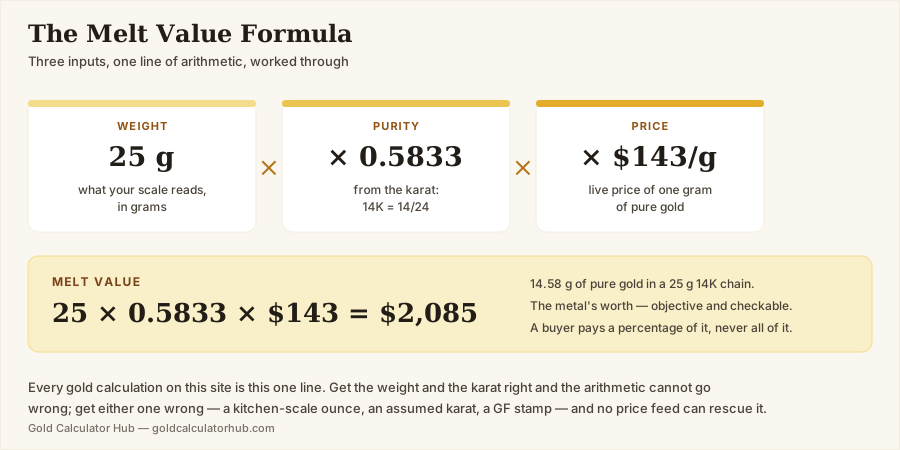
Converting gold to dollars takes three numbers and two multiplications:
- Weight in grams. If your figure is in another unit, convert first: 1 troy ounce = 31.103 g, 1 pennyweight (dwt) = 1.555 g, 1 tola = 11.664 g. (A standard kitchen-scale ounce is 28.350 g — a different animal, and a 10% error if you mix them up.)
- Purity as a decimal. 24K = 0.999, 22K = 0.9167, 18K = 0.75, 14K = 0.5833, 10K = 0.4167.
- Spot price per gram. Take the quoted dollars-per-troy-ounce figure and divide by 31.103.
Worked once, by hand: assume gold at $4,400 per troy ounce, so $4,400 ÷ 31.103 = $141.46 per pure gram. A 15.5 g 18K bracelet converts to 15.5 × 0.75 × $141.46 = $1,644.47 in US dollars. That is the full derivation behind every number the calculator above produces — the same arithmetic explained step by step in how to calculate gold price, if you want to drill deeper.
Why Gold Is Quoted in US Dollars Everywhere
Walk into a gold souk in Dubai, a jeweler in Mumbai, or a bullion desk in Zurich, and the price on the screen traces back to the same dollar-denominated benchmarks. The global reference prices are set in London — the LBMA Gold Price, an electronic auction run twice each business day — and in New York through COMEX futures, both quoted in US dollars per troy ounce (LBMA). Local markets take that dollar price and translate it into rupees, dirhams, or baht at the day's exchange rate, then layer their own taxes and making charges on top.
This has a convenient consequence for anyone holding gold in America: there is no conversion ambiguity. The dollar is gold's native quote currency, so "gold to USD" is the one direction that needs no exchange-rate step at all — just weight, purity, and spot.
It also explains a pattern you may have noticed in headlines: because gold is priced in dollars, the dollar's own strength moves the number. When the dollar weakens against other currencies, gold typically gets cheaper for foreign buyers and the dollar price tends to drift up, and vice versa. That is context, not a forecast — no one should be timing the market off one sentence on a calculator site.
Grams to USD at a Glance
For quick reference, here is the conversion at an assumed spot price of $4,400 per troy ounce ($141.46 per pure gram). Recent prices have run roughly $4,300–$4,500, so treat these as a calibration table and use the live calculator above for the real number.
| Grams | 24K | 22K | 18K | 14K | 10K |
|---|---|---|---|---|---|
| 1 g | $141.32 | $129.68 | $106.10 | $82.52 | $58.95 |
| 5 g | $706.62 | $648.41 | $530.49 | $412.58 | $294.74 |
| 10 g | $1,413.24 | $1,296.81 | $1,060.99 | $825.17 | $589.48 |
| 20 g | $2,826.47 | $2,593.62 | $2,121.98 | $1,650.33 | $1,178.97 |
Read it like a multiplication grid: the karat column sets the per-gram rate, the row scales it. Notice how steep the purity gradient is — 20 grams of 10K converts to fewer dollars than 10 grams of 24K. Karat moves the dollar figure more than most people's intuition allows for, which is why identifying the stamp correctly is worth more than weighing to a tenth of a gram. If your weight is in ounces, pennyweight, or you need to translate between units first, the gold weight calculator handles every conversion in one place.
The Ounce Problem: Your Kitchen Scale Is Lying by 9.7%
Before any conversion, settle which ounce you are holding, because there are two and they are not close.
- Troy ounce = 31.103 g. The unit precious metals are priced in, worldwide, without exception.
- Avoirdupois ounce = 28.350 g. The unit on your kitchen scale, your bathroom scale, and the back of a cereal box.
A troy ounce is 31.103 ÷ 28.350 = 1.097 times heavier — 9.7% more metal. This is the single most common arithmetic mistake made by people valuing gold at home, and it always errs in the direction that stings: it makes you expect more money than the metal contains.
Watch it happen. A 14K chain reads 2 oz on a kitchen scale, which is 2 × 28.350 = 56.70 g, worth 56.70 × $82.52 = $4,678.88 at our assumed price. Now suppose you assumed those were troy ounces: 2 × 31.103 = 62.206 g, giving 62.206 × $82.52 = $5,133.24. You walk in expecting $5,133 of melt, the dealer's scale says $4,679, and a $454.36 gap opens up that has nothing to do with anyone being dishonest. Two people, one chain, two different definitions of "ounce."
The fix is to stop using ounces at home entirely. Weigh in grams and convert once, in one direction. Grams are unambiguous, every calculator on this site takes them, and the unit error simply cannot occur. If a dealer quotes you per pennyweight instead — 1 dwt = 1.555 g, so 20 dwt to the troy ounce — convert that to grams too before comparing offers. The full breakdown of how this one unit quietly costs sellers money is at troy ounce vs ounce.
Foreign-Bought Gold in US Dollars: Tola, Baht, and Gram Markets
A huge share of the gold sitting in American households was bought abroad — wedding sets from India and Pakistan, chains from Dubai, baht chains from Thailand — and arrives with unfamiliar units on the receipt. Converting it to dollars is the same formula with one extra step: get the weight into grams.
Tola markets (India, Pakistan, Gulf states) One tola = 11.664 g. South Asian jewelry is overwhelmingly 22K, so one tola of 22K converts to 11.664 × 0.9167 × $141.46 = about $1,512.60 at our assumed spot. A four-tola wedding set is roughly $6,050 of metal.
Baht gold (Thailand) Thai gold is its own system: jewelry-grade baht gold is 96.5% pure (between 22K and 24K), and one baht of jewelry weighs 15.16 g. Conversion: 15.16 × 0.965 × $141.46 = about $2,069.55 per baht at our assumed price.
Gram markets (Dubai, much of East Asia) Easiest of all — the receipt usually states grams and purity directly, often 22K or 24K. A 30 g 22K Dubai bangle: 30 × $129.68 = $3,890.40.
In every case the dollar value lives in the metal, not the geography. The purity stamp and an accurate scale are all you need — and if a stamp looks unfamiliar, decode it before you convert.
The Exchange-Rate Myth: Your Dubai Gold Has No "Dubai Price"
A belief I run into constantly: that gold bought overseas carries its origin's price — that a bangle from the Dubai souk is somehow pegged to "Dubai gold rates," or that Indian wedding gold should be valued off Mumbai's market when selling in the States. It feels plausible and it is wrong. There is one global spot price, quoted in dollars, and your gold is worth weight × purity × that price wherever it happens to sit today.
What actually differed abroad was everything *around* the metal: lower making charges, different taxes, and the cultural practice of selling jewelry at a thin margin over melt. A 22K bangle bought in Dubai for close to its gold value was a better *purchase* than the same bangle at triple melt in a US mall — but once owned, both convert to dollars identically. The origin story adds nothing at a US buyer's counter, and a buyer who waves a phone showing "today's gold rate in Dubai" as if it changes your payout is performing, not pricing.
The honest caveats: genuinely antique or designer pieces can carry value above melt as objects, and purity claims from informal markets deserve verification — a 22K stamp is a claim, not a guarantee, and US buyers will test it. But the baseline is always the same dollar spot. Run your piece through the gold calculator with its true purity, and you have its value in dollars — the same number a dealer in Dubai would start from too.
Bars and Coins Don't Convert Like Jewelry Does
Everything above assumes you are converting jewelry, where melt value is essentially the whole story. Bullion works differently in one important respect, and it cuts in the seller's favor.
Start with the melt math, which is unchanged. A one-ounce American Gold Eagle is 22K — 91.67% gold — with a gross weight of 33.931 g. Multiply and you get 33.931 × 0.9167 = 31.10 g of pure gold, exactly one troy ounce, which is the point: the coin is specified to contain a full ounce of gold and simply weighs more than an ounce because of its alloy. At our assumed $4,400 spot, its metal converts to $4,400. A one-ounce Canadian Maple Leaf at .9999 fine reaches the same $4,400 with less alloy and more heft of pure metal per gram.
The difference from jewelry is the premium. Recognized bullion is a verified, liquid, instantly resellable product, so it trades *above* melt on the way in and close to melt on the way out. Practically:
- Buying, you pay spot plus a premium — modest per ounce on large bars, and proportionally much larger on small formats. A one-gram bar holds $141.46 of gold at our assumed price but never sells for $141.46; the fabrication cost of a tiny stamped bar is spread over very little metal.
- Selling, sovereign coins and well-known refiner bars typically fetch at or near spot from a bullion dealer — far better than the 70–90% ceiling that karat jewelry scrap faces.
- Numismatic value is separate again. Pre-1933 US gold, scarce dates, and graded coins can be worth multiples of their metal. Never convert those to dollars with a calculator and sell on the result; melt is only their floor.
So the rule of thumb: for jewelry, the gold to USD conversion is roughly the whole value and your payout is a fraction of it. For bullion, the conversion is the floor and the market pays around or above it. Two different products that happen to share a formula. More on translating spot into an item's value at the gold spot price calculator.
One Bracelet, Three Legitimate Dollar Figures
Here is a source of genuine confusion that has nothing to do with anyone lying. Take the 15.5 g 18K bracelet from the first section. Depending on who is asking and why, it has at least three defensible dollar values, and they are far apart.
Melt value: $1,644. The metal content at spot — 15.5 × 0.75 × $141.46. This is what the calculator above returns and what every scrap transaction is priced off.
Cash-in-hand value: roughly $1,150–$1,480. Melt times a buyer's percentage, using the 70–90% range a good refiner or dealer pays. This is the number that matters if you are selling today.
Replacement value: commonly two to four times melt. What an insurance appraiser writes down — the retail cost of buying a comparable new bracelet, including design, labor, brand, and store margin. It is not a fantasy figure; it is the honest answer to a different question, namely "what would it cost to replace this if it were stolen." It is also why appraisal documents make sale offers feel like insults.
A fourth figure exists for estates and gifts: fair market value, roughly what the piece would trade for between a willing buyer and seller — usually much closer to the cash-in-hand number than to the appraisal.
The practical discipline is to name which figure you are using before you use it. Insuring? Replacement value. Selling for cash? Melt times a percentage. Splitting an estate between siblings? Fair market value, applied consistently to every piece so nobody is quietly shortchanged. Most family arguments about jewelry are two people confidently using two different definitions and assuming the other one is being unreasonable.
From Paper Dollars to Actual Cash
The figure a gold to USD calculator returns is melt value: what the metal is worth at the market price. Nobody buying from the public pays 100% of it — the gap funds refining, overhead, and the buyer's margin. Realistic ranges, as a percentage of melt:
- Online refiners: 70–90%
- Local coin and bullion dealers: 65–85%
- Jewelry stores: 50–75%
- Pawn shops: 40–60%
- Mail-in TV buyers: 20–50%
So our 15.5 g 18K bracelet — $1,644 of metal — should realistically bring $1,150–$1,480 from a refiner or a good local dealer, and a pawn-counter offer near $700 is not an insult, just a different channel.
Knowing the dollar conversion *before* you walk in is the entire negotiating advantage, and the reason is subtler than it looks: the melt figure converts every offer into a comparable percentage. Without it, you are comparing $1,300 against $1,150 against $980 with no idea which is generous. With it, you are comparing 79% against 70% against 60%, and the ranking is instant and unarguable. Ask each buyer, out loud, what percentage of today's melt value their offer represents. The good ones answer without hesitating.
Write the Conversion Down: Records for Insurers and the IRS
One habit worth building, and it costs about two minutes per transaction.
Whenever you convert gold to dollars for a reason that matters — an insurance schedule, an estate inventory, a sale, a divorce settlement — record the four inputs alongside the output: the date, the spot price you used, the weight in grams, and the purity. A dollar figure with no date attached is nearly useless six months later, because the only thing that changed is the one variable you failed to write down. A screenshot of the calculator with the timestamp visible does the job.
Why it earns its keep:
- Insurance. Schedules drift out of date. A dated valuation makes a renewal conversation quick, and makes a claim far easier to substantiate.
- Estates and gifts. Executors and heirs need a defensible basis, and "we thought it was worth about that" is not one. Dated, itemized, and consistently calculated is.
- Taxes on a sale. The IRS treats physical gold as a collectible for capital-gains purposes rather than as ordinary investment property, which affects the rate applied to a long-term gain — see the IRS's overview of capital gains and losses. Your gain depends on your cost basis, which for inherited pieces is generally their value at the date of death. If you never recorded that value, you will be reconstructing it under pressure years later. None of this is tax advice; for a meaningful sale, talk to a tax professional.
On how often to revalue: sensibly, not obsessively. Gold's dollar price moves daily, and the World Gold Council publishes long-run price history if you want the big picture (gold.org). Monthly or quarterly is plenty for holdings you are not transacting on, plus a fresh conversion before any insurance renewal or planned sale. Refreshing a price chart at breakfast is a hobby, not a strategy — the only conversion that ever really counts is the one on the day you transact.
Frequently Asked Questions
How much is 1 gram of gold in US dollars?
Divide the spot price per troy ounce by 31.103, then multiply by purity. At an assumed $4,400 per ounce, a pure gram is $141.46; a gram of 22K is about $129.68, 18K about $106.10, and 14K about $82.52. With recent prices ranging roughly $4,300–$4,500 per ounce, a pure gram has sat near $138–$144. The calculator at the top of the page applies the live price so you do not have to redo the division.
Does the gold-to-USD rate change every day?
It changes continuously, not just daily. Gold trades nearly around the clock across global markets, with the London LBMA auctions and New York COMEX futures anchoring the reference price in dollars per troy ounce. Day-to-day moves are usually fractions of a percent, but they compound: a quote you got two months ago is stale for any real transaction. For selling or insuring, use the live price on the day itself — that is the whole reason this page's calculator pulls spot in real time.
Is gold really cheaper in Dubai than in the US?
The metal costs the same — one global spot price in dollars. What can genuinely be lower in Dubai is everything around the metal: making charges on jewelry are often modest, and tourists can sometimes reclaim VAT, so the all-in price per gram of 22K jewelry can beat a US mall jeweler's by a wide margin. But that is a retail-markup difference, not a gold-price difference. Once you own the piece, its dollar value is identical whether it was bought in Dubai or Denver.
How do I convert a tola gold price to USD?
One tola is 11.664 grams. Multiply 11.664 by the purity and by the per-gram dollar price. At an assumed $4,400 per troy ounce ($141.46 per pure gram), one tola of 24K is about $1,648, and one tola of 22K — the standard for South Asian jewelry — is about $1,513. If you are reading a price quoted per tola in rupees from an overseas market, ignore it for US valuation purposes: weigh your piece, confirm the karat, and apply the US dollar spot directly.
Will a buyer actually pay me the dollar value the calculator shows?
No — the calculator shows melt value, and buyers pay a percentage of it. Expect roughly 70–90% from online refiners, 65–85% from local coin and bullion dealers, 50–75% from jewelry stores, 40–60% from pawn shops, and as little as 20–50% from mail-in TV operations. The dollar figure is still the essential number: it converts every offer into a transparent percentage, which instantly reveals who is bidding seriously. Get two or three offers and compare them against the same melt baseline.
If the US dollar weakens, is my gold worth more dollars?
Historically the two tend to move inversely — a weaker dollar makes dollar-priced gold cheaper for foreign buyers, lifting demand and often the dollar price — but the relationship is loose and routinely overwhelmed by interest rates, central-bank buying, and market sentiment. Treat it as background, not a trading signal, and nothing here is investment advice. For someone simply holding family gold, the practical takeaway is humbler: the dollar value floats, so revalue before you sell, insure, or divide an estate.

Written by Sukie Gao
Sukie Gao holds a master's degree from a business school, where she picked up the markets-and-pricing toolkit she now applies to the consumer gold trade. She created Gold Calculator Hub to give people an independent, data-driven way to find out what their gold is really worth.
Published July 19, 2026 · Updated July 21, 2026