24K Gold Calculator: Pure Gold Value by Weight
 By Sukie Gao · Updated July 21, 2026
A 24K gold calculator is the most honest valuation tool on this site, because 24K is the one karat with almost nothing to subtract: it is 99.9% pure gold, so its value is essentially the world spot price multiplied by weight. Enter your weight in the calculator above — grams, troy ounces, pennyweight, whatever your scale or receipt shows — and it pulls the live spot price and returns what the metal itself is worth right now. That one number matters whether you are holding a 10-gram minted bar, a Gold Buffalo coin, or a chuk kam bracelet from a Hong Kong wedding. Below, I cover what the 999 and 9999 stamps actually mean, where pure gold genuinely shows up (mostly bullion and Asian jewelry — almost never Western jewelry, for a reason you can test with your own fingernail), how 24K serves as the reference number behind every other karat on this site, and why counterfeiters concentrate their effort on pure gold bars specifically. I also work the math by hand at a clean assumed price, so you can sanity-check any figure a buyer ever quotes you.
What 999, 9999, and "Fine Gold" Actually Mean
Karat is a 24-part purity scale, so 24 karat means 24 parts gold out of 24 — in practice 99.9% pure, stamped 999 in the millesimal system. You will also see 9999 ("four nines," 99.99%) on products like the Canadian Maple Leaf and most modern minted bars, and the Royal Canadian Mint has even struck 99.999% gold as a showpiece. For valuation, the differences are rounding dust: at an assumed $4,400 per troy ounce, chemically pure gold runs $141.46 per gram, while 999 fine works out to $141.32 — about 14 cents apart on a gram.
Here is a wrinkle most people never hear: the 400-ounce London Good Delivery bars that settle the world's institutional gold trades only need to be 995 fine under LBMA rules. Each bar's stamped fineness and assayed weight determine its exact gold content, and that — not the gross weight — is what gets paid for. The lesson carries all the way down to the scale on your kitchen counter: nobody pays for the impurities. Gold value is always weight × fineness × price; 24K just makes the middle term nearly invisible.
If your item is stamped 999, 9999, 24K, or 足金 (chuk kam) from a Chinese jeweler, the calculator above already assumes that purity. Weigh the piece, type the number, and the result is live melt value with nothing held back.
24K Value at Common Weights and Units
The table below shows what 24K gold is worth at the weights and units people actually encounter. I am using an assumed spot price of $4,400 per troy ounce — recent prices have run roughly $4,300–$4,500, so adjust proportionally or just use the live 24K gold calculator above. The base figure: $4,400 ÷ 31.103 g × 0.999 = $141.32 per gram.
| Weight or unit | In grams | 24K value at $4,400/oz |
|---|---|---|
| 1 gram | 1 | $141.32 |
| 1 pennyweight (dwt) | 1.555 | $219.76 |
| 10 grams | 10 | $1,413.24 |
| 1 tola | 11.664 | $1,648.40 |
| 1 troy ounce | 31.103 | $4,395.60 |
| 100 grams | 100 | $14,132.35 |
| 1 kilogram | 1,000 | $141,323.50 |
Watch the ounce trap: gold trades in troy ounces of 31.103 g, not the 28.35 g ounce your postage scale reports. If a seller quotes you "an ounce of gold" weighed on a kitchen scale, you are 10% apart before the negotiation even starts. And the tola — still the standard unit in Indian and Pakistani gold markets — is 11.664 g, so one tola of pure gold is worth a little more than a third of a troy ounce.
Where 24K Gold Actually Shows Up
Pure gold concentrates in a few specific places, and knowing them tells you a lot about what you are probably holding:
- Minted bullion bars — PAMP Suisse, Royal Canadian Mint, Perth Mint, Valcambi. Nearly all modern retail bars are 9999 fine and ship in sealed assay cards.
- 24K bullion coins — the American Gold Buffalo (9999), Canadian Maple Leaf, Austrian Philharmonic. Note the famous American Gold Eagle is *not* 24K — the US Mint strikes it in 22K alloy for durability, though it still contains a full troy ounce of gold.
- Chinese chuk kam jewelry — 足金 means "full gold." Wedding bangles, zodiac pendants, baby gifts, and dragon-and-phoenix bracelets are traditionally sold by weight at close to the day's gold price, plus a labor charge.
- Festival and gift gold — small bars and coins for Lunar New Year, weddings, and births across East and Southeast Asia. (Indian wedding jewelry, by contrast, is usually 22K.)
- Refined scrap — when a refiner melts your old jewelry, the output is fine gold; 24K is where every gold item eventually ends up.
What you will almost never find: 24K engagement rings, 24K watch cases, or 24K chains at an American mall jeweler. That absence is not snobbery — it is metallurgy, which is the next section.
Why Western Jewelry Avoids Pure Gold
Pure gold is soft — genuinely, surprisingly soft. On the Mohs hardness scale it sits around 2.5, the same as a fingernail, which means you can literally mark a 24K bar by pressing a nail into it. A 24K ring worn daily will scratch, dent, and slowly go out of round. Prongs made of pure gold cannot reliably grip a diamond. That is why Western jewelers alloy gold with copper, silver, nickel, and zinc to make 14K and 18K: the alloy is harder, springier, and holds detail.
Chinese jewelers solved the same problem differently — by design rather than by alloy. Chuk kam pieces tend to be chunky bangles, thick charms, and high-relief castings that tolerate dings, because the tradition prices the piece as stored wealth first and ornament second. A scratched 24K bangle has lost nothing; a scratched 18K setting may have lost a stone.
For valuation, the softness story has one practical consequence: 24K jewelry trades much closer to melt value than Western jewelry does, because everyone in that market already thinks in grams. If your piece is 22K — the compromise purity that dominates Indian, Middle Eastern, and older Hong Kong jewelry — head to the 22K gold calculator; the math is the same with 91.67% plugged in. The full ladder from 9K to 24K, with every stamp, lives on the gold purity chart.
24K Is the Reference: Every Other Karat Is a Fraction of This Page
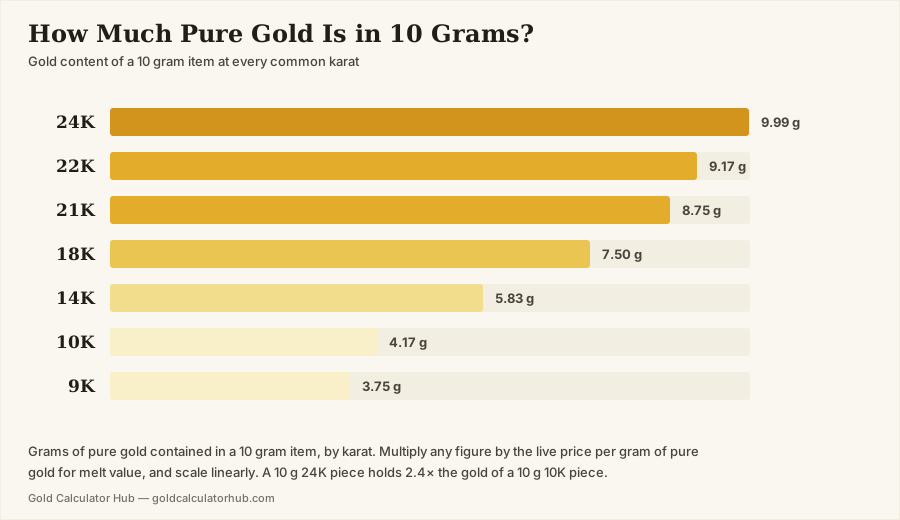
Every karat value on this site is downstream of the 24K number. Karat ÷ 24 = fineness, and fineness × the pure-gold price = that karat's per-gram value. Using our assumed $141.46 per pure gram:
- 22K = 91.67% → $129.68/g
- 18K = 75% → $106.10/g
- 14K = 58.33% → $82.52/g
- 10K = 41.67% → $58.95/g
So when someone asks why their chunky 14K bracelet is "only" worth 58% of what a same-weight chuk kam bangle fetches, the answer is arithmetic, not a stingy buyer. Worked side by side: a 20 g chuk kam wedding bangle carries 20 × $141.32 = $2,826.47 of metal, while a 20 g 18K bracelet carries 20 × $106.10 = $2,121.98. Same weight on the scale, $704 apart in gold content.
This is also why I suggest running any mixed pile of jewelry through the main gold calculator one karat group at a time: sort by stamp first, weigh each group, and let the fractions do their work. Buyers who weigh everything together and quote one blended number are usually blending in their own favor — the 24K reference price is your defense, because every legitimate offer can be traced back to it with one division.
Bars vs Coins vs Jewelry — Premiums, Payouts, and the Counterfeit Problem
Three forms of 24K gold, three different relationships to the melt number the calculator gives you. Minted bars carry the smallest premium when you buy and trade closest to melt when you sell — a recognized brand in a sealed assay card is about as liquid as gold gets. Sovereign coins like Buffalos and Maple Leafs cost a bit more over spot going in, but their government backing and instant recognizability help on the way out; run specific coins through the gold coin melt value calculator. 24K jewelry bought in Asia typically cost you the day's gold price plus a making charge, and resells by weight. The scrap-style payout ranges that apply to Western jewelry — local coin and bullion dealers paying 65–85% of melt, jewelry stores 50–75%, pawn shops 40–60% — mostly reflect refining friction that recognized pure bullion skips.
Now the uncomfortable part: counterfeiters love 24K bars above everything else, because tungsten's density (19.25 g/cm³) is within half a percent of gold's (19.32 g/cm³). A tungsten-core bar wrapped in real gold passes a weight check and a water-displacement density test — the classic home methods simply cannot see the core. The risk concentrates in larger sizes, one ounce and up, where the payoff justifies the machining. Your defenses: buy sealed assay-card bars from reputable dealers, favor smaller sizes and coins (milled designs are far harder to fake), and understand exactly what home testing can and cannot prove — covered honestly in how to test gold at home.
Weighing Pure Gold Without Fooling Yourself
Every dollar figure on this page rests on one input you control completely: the weight. Gold is dense — 19.32 g/cm³, about two and a half times the density of steel — so pure gold items are physically smaller than people expect, and a weighing error costs more than people expect.
Buy resolution, not size. A scale reading to 0.01 g is the right tool; they cost under $20. A scale that rounds to the nearest whole gram can be off by half a gram in either direction, and at our assumed $141.32 per gram that is $70.66 of ambiguity on a single reading. On a 100-gram lot weighed piece by piece, sloppy resolution compounds into real money.
Tare everything, or weigh nothing. A 10-gram minted bar still sealed in its assay card can read 10.4 g on the pan. That extra 0.4 g of plastic and card stock is $56.53 of gold that does not exist. For sealed bullion, do not weigh through the packaging at all — the stamped weight was assayed at the mint and is more accurate than your scale.
Subtract what is not gold. Chuk kam pieces are usually solid metal, but hollow bangles, jade or gemstone insets, silk cords, spring clasps of a different alloy, and enamel all have to come off the number. If you cannot separate them, say so when you get quotes; a buyer who discovers it on their own scale will assume the omission was deliberate.
Calibrate. A $5 set of calibration weights settles the question permanently. In a pinch, a US nickel is minted to 5.000 grams — if your scale reads 4.8 or 5.3 with a nickel on it, stop trusting it. The full method, including how buyers' scales are certified, is in how to weigh gold.
A 47-Gram Chuk Kam Wedding Set, Priced by Four Buyers
Abstractions are easy to argue with, so here is one concrete pile. A Hong Kong wedding set — a dragon-and-phoenix bangle, a matching pair of smaller bangles, and a pendant — comes to 47.0 grams on a calibrated scale after the silk cord is removed. Every piece is stamped 足金 999.
Melt value at our assumed $4,400 per troy ounce: 47.0 × $141.32 = $6,642. That is the honest number, the one the calculator above produces from the live price, and the one no buyer will hand you in full.
What the four legitimate buyer types would realistically offer against that $6,642:
- Online refiner (70–90% of melt): $4,649–$5,978
- Local coin and bullion dealer (65–85%): $4,317–$5,646
- Jewelry store (50–75%): $3,321–$4,982
- Pawn shop (40–60%): $2,657–$3,985
The distance between the best plausible outcome and the worst is $3,321 — exactly half the value of the set, riding entirely on which door you walk through. Nothing about the gold changed. No week of price movement in recent memory has been worth anywhere near that much on a lot this size.
Two details specific to pure gold are worth flagging. First, 999 material is the easiest thing a refiner ever processes — no separation, no assay surprises — so the top of the refiner range is genuinely attainable for a lot this clean, and it is fair to say so out loud when you ask for a number. Second, if any piece is a recognized minted bar or sovereign coin rather than jewelry, pull it out of the pile and price it separately with a bullion dealer, because sealed bullion trades near melt rather than at scrap percentages. The venue-by-venue ranking is laid out in where to sell gold.
Five Ways People Lose Money on Pure Gold
The mistakes cluster, and none of them require a dishonest buyer:
- Weighing in standard ounces. Your postage scale's ounce is 28.350 g; gold's ounce is 31.103 g. Quote or compare in the wrong one and you have handed over 9.7% before anyone says a number.
- Letting sealed bullion be graded as scrap. A branded bar in an intact assay card and a snapped chain are not the same product. Sold together as one lot, the bar gets scrap pricing. Sell it separately, sealed, to someone who buys bullion.
- Assuming 24K means unsellable-for-less. Purity is not liquidity. Unstamped, unbranded, or opened-card pure gold still has to be tested and refined like anything else, and gets priced accordingly. The certainty a buyer has about your metal is worth real percentage points.
- Taking the first quote because the number is large. A 24K item's melt value is naturally impressive — four figures happens fast at $141 a gram — and a large offer feels generous in a way that a small one does not. Percentage of melt is the only comparison that means anything. Ask every buyer for theirs.
- Buying big bars for the lower premium and ignoring the counterfeit math. The tungsten-core problem scales with bar size, and so does the loss if you are wrong. Smaller sealed bars and milled sovereign coins cost slightly more per gram and are meaningfully harder to fake.
The common thread: the arithmetic on this page is not hard, and doing it before anyone else does it for you is the entire edge. Run your weights through the gold calculator first, then go collect offers.
Frequently Asked Questions
Is 24K gold 100% pure?
Not quite — and no commercial gold is. 24K means 99.9% pure (stamped 999) or 99.99% (stamped 9999). Removing the last fractions of silver, copper, and other trace elements gets exponentially more expensive, so refiners stop where the market stops paying. For valuation it barely matters: at $4,400 per troy ounce, the gap between 999 and chemically perfect gold is about 14 cents on a gram. Calculators, including ours, treat 24K as 99.9% and the answer lands within pennies.
What is the difference between 999 and 9999 gold?
One decimal place of purity: 999 is 99.9% gold, 9999 is 99.99%. Most modern minted bars and coins like the Maple Leaf are 9999; older bars and much Asian jewelry are 999. At an assumed $4,400 per ounce, a gram of 9999 is worth about $141.45 versus $141.32 for 999 — roughly 13 cents apart. That difference matters on a 400-ounce institutional bar; on your bracelet or 10-gram bar, it disappears into the buyer's rounding.
What is one gram of pure 24K gold worth today?
Take the spot price per troy ounce, divide by 31.103, and multiply by 0.999. At an assumed $4,400 per ounce: $4,400 ÷ 31.103 × 0.999 = $141.32 per gram. With recent prices running roughly $4,300–$4,500 per ounce, a gram of pure gold has been worth about $138–$144. The 24K gold calculator at the top of this page does this with the live price, so you never have to trust a static number.
Why isn't the American Gold Eagle 24K?
Tradition and toughness. The Eagle is struck in 22K (91.67%) alloy — a holdover from the era of circulating gold coinage, when coins had to survive pockets and purses. It still contains a full troy ounce of pure gold; the copper and silver alloy just makes the coin heavier overall, about 33.93 g. When the US Mint wanted a 24K product to compete with the Maple Leaf, it launched the Gold Buffalo in 9999 fine. Same gold content per coin, different durability philosophy.
Can you wear 24K gold jewelry every day?
You can — hundreds of millions of people do — but expect it to show its life. Pure gold is about as hard as a fingernail, so daily-worn 24K picks up scratches, dings, and gradual deformation, especially rings. Chuk kam pieces are designed around this: thick bangles and solid castings that tolerate wear without losing material. The reassuring part is that scratches don't reduce melt value. A battered 20-gram bangle is still 20 grams of pure gold.
What does chuk kam mean?
Chuk kam (足金) is Cantonese for "full gold" — jewelry of at least 99.0% purity under Hong Kong's trade rules, and in practice usually 999 or better. It is the traditional form for Chinese wedding gold, zodiac pendants, and gifts marking births and milestones. Chuk kam is priced transparently: the day's gold price times weight, plus a stated labor or making charge. That pricing culture means it resells far closer to melt value than Western retail jewelry ever does.
Do dealers pay full spot price for 24K gold bars?
For recognized, sealed bullion — a PAMP or Royal Canadian Mint bar in its assay card, or a Buffalo or Maple Leaf — reputable bullion dealers typically pay at or very near melt value, sometimes within a percent or two. Generic, unsealed, or unverifiable 24K items get treated more like scrap, where local coin and bullion dealers commonly pay 65–85% of melt. The brand and the packaging are doing real work; keep bars in their cards.
How do counterfeiters fake 24K bars, and can I catch it at home?
The serious fakes use a tungsten core wrapped in real gold. Tungsten's density is 19.25 g/cm³ against gold's 19.32 — a difference under half a percent — so the bar passes weight, caliper, and water-displacement density tests. Home methods like magnets and acid only test the surface, which on these fakes is genuine gold. Practical protection: buy from reputable dealers, prefer sealed assay cards and milled coins, and for anything large, pay for an ultrasonic or electrical-conductivity check. See our guide to testing gold at home for what each method can actually prove.
Is buying 24K jewelry a smarter way to own gold than bars?
It can be surprisingly competitive. Chuk kam jewelry is sold at the gold price plus a modest making charge and resells by weight, so the round-trip cost can rival small bars — and you get to wear it in the meantime. Western 14K–18K retail jewelry, by contrast, often costs two to four times its metal value and resells for a fraction. That said, premiums, labor charges, and resale channels vary widely, and this is not financial advice — compare the all-in cost per gram of pure gold before you buy.
How much is one tola of 24K gold worth?
A tola is 11.664 grams — still the working unit in Indian and Pakistani gold markets, and often used for small bars sold to South Asian buyers. At an assumed $4,400 per troy ounce, 999 fine gold runs $141.32 per gram, so one tola of pure gold is worth about $1,648. That is roughly 37.5% of a troy ounce, which is why a tola bar feels surprisingly small in the hand. Enter 11.664 grams in the calculator above for the live figure.
Should I open the assay card on a 24K bar before selling it?
No. The sealed card is part of the product. An intact PAMP, Valcambi, or Royal Canadian Mint card carries the serial number, the assayer's mark, and the tamper-evident seal, and that packaging is why a bullion dealer can pay you at or near melt without testing anything. Once the seal is broken, the bar becomes an unverified lump that has to be assayed, and it starts getting quoted at scrap percentages instead. Do not weigh it through the card either — the stamped weight is more accurate than your scale.

Written by Sukie Gao
Sukie Gao holds a master's degree from a business school, where she picked up the markets-and-pricing toolkit she now applies to the consumer gold trade. She created Gold Calculator Hub to give people an independent, data-driven way to find out what their gold is really worth.
Published July 12, 2026 · Updated July 21, 2026