Gold Fineness Chart: Every Mark From 375 to 999
 By Sukie Gao · September 21, 2026
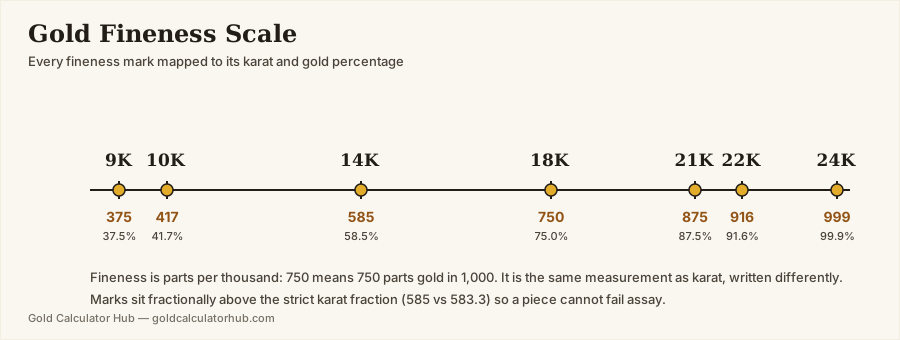
A gold fineness chart translates the three- or four-digit number stamped on your jewelry into something you can actually use. Fineness is purity expressed in parts per thousand: a piece marked 750 is 750 parts gold out of 1,000, which is 75% gold, which is 18 karat. Same metal, same purity, three different notations — and the fineness number is the one most likely to be on a piece made outside the United States.
The reason this trips people up is that the two systems look nothing alike. Karat counts in twenty-fourths, an inheritance from a medieval coin standard. Fineness counts in thousandths, which is how modern assay offices and every bullion refinery in the world express purity. A jewelry box that has travelled will contain both, and the marks will not obviously correspond.
The chart below maps every fineness mark you are likely to meet to its karat, its gold percentage, and what it means for value. Then it covers the parts a bare chart leaves out: why 585 rather than 583, what a four-digit mark means, and which stamps look like fineness marks but are telling you something else entirely.
The complete fineness chart
| Fineness | Karat | Gold content | Where it's common |
|---|---|---|---|
| 9999 | 24K | 99.99% | Investment bars, Canadian Maple Leaf, Buffalo |
| 999 | 24K | 99.9% | Bullion bars and coins, Asian jewelry |
| 990 | ~23.8K | 99.0% | Chinese "chuk kam" jewelry |
| 958 | 23K | 95.8% | Britannia standard (silver analogue), rare in gold |
| 916 | 22K | 91.6% | India, Gulf states, Sovereign coins |
| 900 | 21.6K | 90.0% | Pre-1933 US gold coins, many European coins |
| 875 | 21K | 87.5% | Middle Eastern jewelry |
| 833 | 20K | 83.3% | Older European and Portuguese pieces |
| 750 | 18K | 75.0% | Fine jewelry worldwide, standard in Europe |
| 585 | 14K | 58.5% | Germany, Eastern Europe; equals US 14K |
| 583 | 14K | 58.3% | Older Soviet-era and some Asian pieces |
| 500 | 12K | 50.0% | Uncommon; older US and German work |
| 417 | 10K | 41.7% | US legal minimum |
| 375 | 9K | 37.5% | UK legal minimum, common in British jewelry |
| 333 | 8K | 33.3% | Germany; not legally "gold" in the US or UK |
Every row is the same conversion in both directions: fineness ÷ 1000 = decimal purity, and decimal purity × 24 = karat. So 750 ÷ 1000 = 0.75, and 0.75 × 24 = 18. Once you internalise that, you never need the chart again — though it is quicker to glance at than to compute at a counter.
Why 585 and not 583
Strictly, 14 karat is 14/24 = 58.333%. So why is the European mark 585?
Because a hallmark is a legal guarantee of a *minimum*, and assay tolerances are unforgiving. If a manufacturer alloys to exactly 58.33% and the mix drifts a fraction low in one batch, the piece fails assay and cannot be sold. Alloying slightly over — to 58.5% — buys a safety margin at trivial cost. The same logic produces 916 rather than 916.67 for 22K and 375 rather than exactly 375 for 9K.
You will also meet 583 on older Soviet-era and some Asian pieces, which used the strict fraction rather than the rounded-up European convention. Both are 14K in every practical sense; the difference is under a quarter of a percent and will never change a decision.
The useful takeaway: when a fineness mark sits a whisker above the exact karat fraction, that is a sign of a properly assayed piece, not a discrepancy to worry about.
Three- versus four-digit marks
A four-digit mark — 9999, sometimes written 999.9 — appears almost exclusively on investment-grade bullion. It means 99.99% pure, often called "four nines" in the trade. The Canadian Maple Leaf and the American Buffalo are struck at this standard; most cast and minted bars from recognised refiners are too.
Three-digit 999 means 99.9%, or "three nines," which is the ordinary bullion standard and is what most bars and rounds carry.
The practical difference between them is close to nothing for a seller: 99.9% versus 99.99% is one hundredth of one percent of your metal. It matters to refiners buying industrial quantities and to collectors who care about mint specifications. It should not affect what you accept for a coin.
What *is* worth noticing is the absence of any fineness mark on something claiming to be bullion. Recognised bars and coins are marked. An unmarked bar is not automatically fake, but it does need testing before anyone should pay bullion prices for it.
Marks that look like fineness but aren't
Several stamps are three digits and are not purity claims. Mistaking one for a fineness mark is a genuinely expensive error.
- 925 — sterling silver, not gold. On a gold-coloured item this usually means vermeil: gold plating over sterling. The silver has real value; the gold layer has almost none.
- 1/20 or 1/10 preceding a karat mark — a gold-filled ratio. "1/20 12K GF" means the gold layer is one twentieth of the item's weight, and that layer is 12K. The gold content is roughly 2.5% of total mass, not 50%.
- Three-digit maker codes — some manufacturers stamp a model or design number that reads like a fineness mark. Context helps: a genuine fineness mark usually sits alongside an assay or maker's mark, and it will be one of the standard values in the chart above. A number like 412 or 731 is not a standard fineness and is almost certainly something else.
- Country of origin numerals and date letters in UK hallmarking, which appear near the fineness mark and are not purity.
When a mark is ambiguous, the resolution is a test rather than a guess. An acid kit costs about $15; a jeweler's XRF reading takes seconds and most will do it free.
Turning fineness into value
Fineness is the purity term in the only formula that matters:
grams × (fineness ÷ 1000) × price per gram of pure gold = melt value
Because fineness is already a decimal purity scaled by a thousand, it slots straight in — arguably more cleanly than karat does. A 12 g piece marked 750, at a pure gold price of $143/g:
12 × 0.750 × $143 = $1,287
The same 12 g marked 585: 12 × 0.585 × $143 = $1,004. Marked 375: $643.
That is a $644 spread across three pieces of identical size, determined entirely by a number stamped somewhere you probably need a loupe to read. It is the single highest-value piece of information on any item of gold jewelry, and it is free.
How assay offices verify fineness
In the UK, Ireland and much of Europe, a fineness mark is not the manufacturer's opinion — it is a third-party guarantee. Independent assay offices test the metal and apply their own mark alongside the fineness, and hallmarking is legally required above small weight thresholds.
A full British hallmark carries several elements: the sponsor's mark (who submitted it), the fineness number in a shaped surround indicating the metal, the assay office mark (a leopard's head for London, an anchor for Birmingham, a rose for Sheffield, a castle for Edinburgh), and often a date letter. That combination is strong evidence, and it is why British and European pieces can generally be trusted on their marks.
The United States has no equivalent system. American karat marks are applied by the manufacturer under the National Gold and Silver Stamping Act, which makes misrepresentation illegal but involves no independent testing. The marks are usually accurate, and there is no third party who checked. That difference is worth knowing when you are deciding whether to test a piece before selling it: a hallmarked British 750 needs less scrutiny than an unhallmarked American 18K.
UK hallmarking is overseen by the British Hallmarking Council, which regulates the four assay offices and the marks they apply.
Regional conventions worth recognising
Fineness marks carry geography, and the geography often tells you something about the piece.
916 is overwhelmingly South Asian and Gulf. In India, 22K at 916 fineness is the dominant jewelry standard, and "916 gold" is used as a noun. Pieces are typically higher purity than Western jewelry because gold there functions substantially as savings rather than only as ornament.
875 points to the Middle East, where 21K is a common standard that barely exists elsewhere.
750 is the international fine-jewelry default and appears everywhere, though it dominates in Italy, France and Switzerland.
585 signals German, Eastern European or Scandinavian manufacture. Americans call the same alloy 14K.
375 is distinctly British. 9K is legal as gold in the UK and not in the US, so a 375 piece in an American jewelry box almost always arrived from Britain.
333 is German 8K, which cannot legally be sold as gold in either the US or the UK. It still has real metal value — a third of its mass is gold — but expect confusion at a counter.
Frequently Asked Questions
What does 750 mean on gold?
750 parts gold per thousand — 75% gold, which is 18 karat. It is the standard European and international mark for the same alloy Americans stamp 18K. Nothing about the metal differs; only the notation does.
What does 585 mean on gold jewelry?
58.5% gold, which is 14 karat. It is the German and Eastern European mark for the alloy stamped 14K in the United States. The slight discrepancy with the strict 14/24 = 58.33% is deliberate: manufacturers alloy just above the nominal figure so a piece cannot fail assay.
Is 999 gold better than 916?
Purer, yes; better depends entirely on use. 999 is 99.9% gold and is what bullion is made from — but it is soft enough to scratch and deform in ordinary wear, which is why almost no wearable jewelry is made from it. 916 (22K) is hard enough to wear while still carrying over 91% gold, which is why it dominates in India and the Gulf. For storing value, 999 is the right choice; for a bracelet worn daily, it is not.
What is the difference between fineness and karat?
They measure the same thing on different scales. Karat expresses purity in twenty-fourths; fineness expresses it in parts per thousand. 18K and 750 are identical, as are 14K and 585, and 22K and 916. Convert by dividing fineness by 1,000 and multiplying by 24. Fineness is the modern international convention and what assay offices use; karat marks dominate in the United States.
What does 9999 mean on a gold bar?
99.99% pure gold — "four nines" — which is the highest purity in ordinary commercial production. It appears on investment-grade bars and on coins like the Canadian Maple Leaf and American Buffalo. Compared with 999 (99.9%), the practical difference for a seller is one hundredth of one percent of the metal, so it should not change what you accept for a coin.
My gold is stamped 925 — what fineness is that?
925 is sterling silver, not gold. On a gold-coloured item it almost always means vermeil: a gold layer plated over a sterling silver base. The silver is genuinely valuable and can be sold as sterling scrap; the gold layer is microns thick and its recoverable value rounds to nothing. Value a 925 item as silver, not gold.
What fineness is 10K gold?
417, meaning 41.7% gold. That is the minimum purity that can legally be sold as gold in the United States. You will see 417 stamped on American pieces alongside or instead of 10K, particularly on newer work and on items intended for export.
Is there a fineness mark for 12K gold?
500, or 50% gold. It is uncommon in modern jewelry — you meet it mostly on older American and German pieces, and very often as part of a gold-filled mark like "1/20 12K GF," where the 12K describes the thin bonded layer rather than the whole item. A solid 12K piece is legal to sell as gold in the US, since it exceeds the 10K minimum.
Does higher fineness always mean more value?
Per gram, yes — value scales directly with purity, so a gram of 916 is worth more than a gram of 585. But total value depends on weight as well, so a heavy 585 piece easily outvalues a light 916 one. And for coins and designer jewelry, collector or design premium can exceed metal value entirely, at which point fineness stops being the main determinant of what the object is worth.
What fineness are Sovereign coins?
916, or 22 karat — the British "crown gold" standard used for Sovereigns since 1817. A full Sovereign weighs 7.98 grams gross and contains 7.32 grams of pure gold. The 22K alloy was chosen because coins circulate and pure gold wears away too quickly; the copper in the alloy is what let Sovereigns survive decades in pockets.
Can a fineness mark be faked?
Yes, and it happens — a stamp is just a stamp. Marks applied by European assay offices are third-party verified and hard to fake convincingly, since a full hallmark includes an assay office mark and a sponsor's mark in a specific arrangement. US karat marks carry no independent verification. If a piece is unusually heavy for its size, discoloured at wear points, or the mark looks crudely applied, test before you trust it.
What does a fineness mark inside a shaped border mean?
In UK hallmarking, the shape around the fineness number tells you which metal it is. Gold fineness numbers sit inside an oval-ish shape with angled ends; silver sits in an oval; platinum in a pentagon-like outline. That way a worn mark can still be identified by shape when the digits are hard to read. It is one of several redundancies built into a system designed to survive decades of wear.
How do I calculate value from a fineness mark?
Divide the fineness by 1,000 to get decimal purity, then multiply by the weight in grams and by the current price per gram of pure gold. A 20 g piece marked 585, at $143 per gram: 20 × 0.585 × 143 = $1,673 of melt value. That is the metal's worth, not what a buyer will pay — expect 70–90% of it from a good refiner and considerably less from a pawn shop.
Why do some old pieces have no fineness mark at all?
Hallmarking requirements have varied by country and era, and small or delicate items are often exempt below a weight threshold. Plenty of genuine antique gold carries only a maker's mark, or nothing at all. An absent mark is not evidence of fake gold — it just means the mark cannot do your testing for you. Acid or XRF testing settles it, and for a piece old enough to lack marks it is worth asking whether it is worth more intact than melted.

Written by Sukie Gao
Sukie Gao holds a master's degree from a business school, where she picked up the markets-and-pricing toolkit she now applies to the consumer gold trade. She created Gold Calculator Hub to give people an independent, data-driven way to find out what their gold is really worth.
Published September 21, 2026