916 Gold Price Calculator: What 22K Gold Is Worth per Gram
 By Sukie Gao · September 30, 2026
A 916 gold price calculator answers a question that comes up constantly across India, the Gulf, Malaysia and Singapore, and almost never in American jewelry stores: what is 22 karat gold worth right now, per gram? 916 means 916 parts gold per thousand — 91.6% pure, which is 22 karat. It is the dominant jewelry standard across South Asia and much of the Middle East, and it behaves differently from the 14K and 18K that Western calculators are built around.
The calculator above is set to 22K. Enter a weight in grams and it applies the live international gold price to the 91.67% purity that a 916 mark guarantees. That gives you the metal value — the objective floor underneath any transaction.
What it deliberately does not include, and what makes 916 gold different from Western scrap, is making charges: the labour and wastage percentages a jeweler adds when selling and subtracts when buying back. Understanding that gap is most of what separates people who get a fair deal in a 916 market from people who do not.
What 916 actually guarantees
916 is a fineness mark: parts of gold per thousand parts of alloy. Strictly, 22 karat is 22/24 = 91.667%, and the mark is rounded down to 916 so a piece cannot fail assay by a rounding error.
The remaining 8.3% is typically copper and silver, which is what makes 22K hard enough to survive being worn. Pure 24K gold is soft enough to deform against a fingernail — beautiful, and impractical for a bangle that gets worn daily for thirty years.
In India, hallmarking became mandatory for gold jewelry under the Bureau of Indian Standards scheme, and a hallmarked piece carries the BIS mark, the purity in both karat and fineness ("22K916"), and a six-digit alphanumeric HUID identifying the individual item. That is a stronger guarantee than an unhallmarked karat stamp on an American piece, where the mark is applied by the manufacturer with no third-party test.
So when you see 916, you are looking at a claim of 91.6% gold that, in a hallmarking jurisdiction, an independent body has verified.
India's mandatory hallmarking scheme is run by the Bureau of Indian Standards, which publishes the purity grades permitted for sale and the HUID system used to identify individual hallmarked items.
The calculation, worked twice
The formula is the same as for any karat:
grams × 0.9167 × price per gram of pure gold = metal value
At an international pure gold price of $143 per gram:
- A 10 g 916 chain: 10 × 0.9167 × 143 = $1,311
- An 8.519 g 22K bangle: 8.519 × 0.9167 × 143 = $1,117
- A 50 g 916 necklace: 50 × 0.9167 × 143 = $6,554
Compare that with the same weights in 14K, which is what a comparable Western piece would be: the 50 g necklace in 14K holds $4,170 of gold. The 916 version carries 57% more metal value at identical weight, which is precisely why gold functions as savings in markets where 916 is standard and as ornament in markets where 14K is.
One worked comparison people often ask for directly: at a quoted pure rate of ₹14,100 per gram, the 916 rate is 14,100 × 0.9167 = ₹12,925 per gram. Any time someone gives you a 24K rate, multiplying by 0.9167 gets you the 22K equivalent.
Making charges: the number that actually decides your deal
This is where 916 markets diverge sharply from Western scrap buying, and where most of the money moves.
When you buy 916 jewelry, the price is typically built as: metal value + making charges + wastage + GST. Making charges are the jeweler's labour, quoted either as a percentage (commonly 8–25%, higher for intricate work) or as a flat rate per gram. Wastage is a legacy allowance for metal lost in fabrication, often 2–10%, though on machine-made pieces the physical loss is far lower than the charge suggests.
When you sell back, making charges and wastage vanish entirely. You are paid on metal content only, usually with a further deduction of a few percent for refining or purity testing.
The practical consequence: a piece bought at metal value plus 20% making plus 5% wastage is worth roughly its metal value the moment you leave the shop. That is not fraud — the labour was real — but it means the buy-sell round trip on intricate jewelry costs 20–30%, and the way to reduce it is to prefer simpler pieces or coins if the purchase is partly an investment.
Ask for making charges as a separate line item. A jeweler who will only quote one all-in figure per gram is making comparison impossible, which is the point.
916 versus 750 versus 585, in value terms
| Mark | Karat | Purity | Value of 20 g at $143/g pure |
|---|---|---|---|
| 999 | 24K | 99.9% | $2,856 |
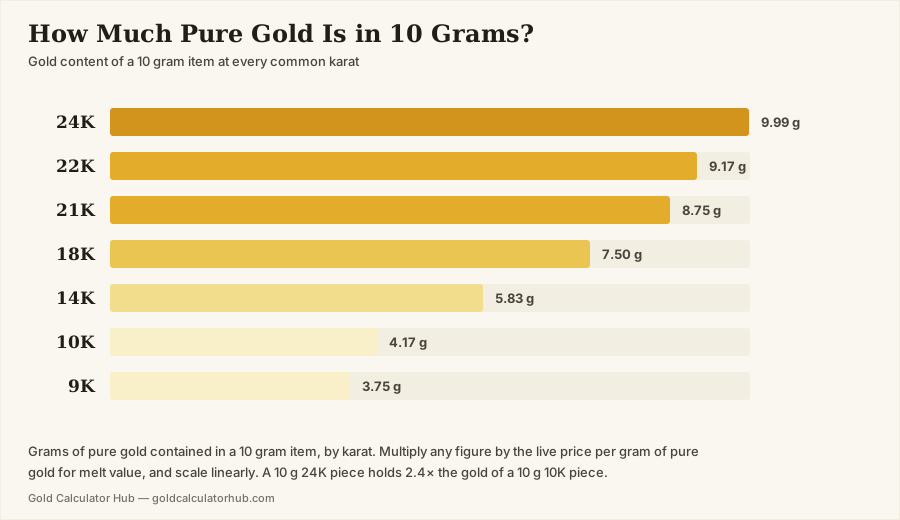
| 916 | 22K | 91.67% | $2,622 |
| 875 | 21K | 87.5% | $2,503 |
| 750 | 18K | 75.0% | $2,145 |
| 585 | 14K | 58.3% | $1,668 |
The pattern worth carrying away: 916 sits close enough to pure that the difference is modest, while being dramatically harder-wearing. That combination is why it became the standard where jewelry doubles as a store of value.
A related question that comes up often: is 916 the same as 22K? Yes, exactly. "916 gold," "22 carat," and "22K" describe one alloy. The only reason three names exist is that fineness, karat and the local vernacular all coexist in the same market.
Sovereigns, tola, and other local units
916 markets use weight units that do not appear in Western gold calculators, and the conversions are worth knowing.
| Unit | Grams | Where used |
|---|---|---|
| Sovereign (pavan / pavun) | 8 g | South India — jewelry sold by the sovereign |
| Tola | 11.6638 g | India, Pakistan, Gulf |
| Bhori / Vori | 11.664 g | Bangladesh — equal to a tola |
| Masha | 0.972 g | 1/12 of a tola |
| Ratti | 0.1215 g | 1/8 of a masha |
The sovereign used in South Indian jewelry retail is 8 grams and should not be confused with the British Sovereign coin, which weighs 7.98 g gross and contains 7.32 g of gold. The names collide; the objects do not.
So "12 sovereign of 916 gold" is 96 grams gross, containing 96 × 0.9167 = 88 grams of pure gold. At $143 per gram that is $12,584 of metal.
A tola of 916 gold is 11.6638 × 0.9167 = 10.69 g of pure gold. Converting any local unit to grams first, then applying purity, keeps the arithmetic unambiguous.
Why your local 916 rate differs from the international price
If you convert the international spot price into rupees or dirhams, you will usually get a number below the rate your local jeweler quotes. That gap is not a markup in the ordinary sense — it is a stack of real costs.
Import duty and levies. Gold-importing countries commonly apply customs duty, and in India an additional agriculture infrastructure cess. These land directly on the domestic price.
GST or local sales tax, charged on both metal and making charges.
Local supply and demand. Wedding and festival seasons genuinely move domestic premiums, independent of the international price.
Currency. Gold is priced in US dollars globally, so a weakening local currency raises the domestic gold price even when the dollar price is flat. This is a large effect and frequently mistaken for gold "rising."
The useful check: compute the international 916 equivalent, then ask what the local premium consists of. A jeweler who can itemise duty, GST and making charges is being straight with you. One who cannot may not be.
Selling 916 gold back
The buy-back conversation is where the earlier sections pay off.
Expect metal value only. Making charges and wastage do not come back. Anyone who tells you otherwise at purchase time is describing an exchange scheme with conditions, not a refund.
Expect a purity deduction. Buyers typically test with an XRF machine and pay on the measured purity. A hallmarked 916 piece should test at or near 91.6%; older unhallmarked jewelry sometimes tests lower, which is a legitimate reason for a lower payment and also a reason to insist on seeing the reading.
Exchange usually beats cash. Most jewelers offer materially better terms when you exchange old gold for new than when you sell for cash, because they recover margin on the new piece. If you were going to buy anyway, exchanging is often the better arithmetic.
Get more than one quote. The same principle that governs Western scrap applies here: the spread between buyers is larger than any short-term price move. In cash-sale terms, expect somewhere in the region of 90–95% of metal value from a reputable jeweler on hallmarked 916, and less on unmarked pieces that need assay.
A checklist before you buy or sell 916
- Check the hallmark. In India, look for the BIS mark, "22K916," and the HUID. Elsewhere, look for 916 alongside a maker's or assay mark.
- Weigh in grams, and ask to see the scale. Convert sovereigns or tola to grams yourself.
- Get today's pure gold rate and multiply by 0.9167 for the 916 equivalent. The calculator above does this with the live international price.
- Ask for making charges as a separate line, in percent or per gram. Compare that number between jewelers, not the all-in price.
- When selling, expect metal value only and ask to see the XRF purity reading.
- Weigh simplicity against design if any part of the purchase is investment. Coins and plain chains carry the lowest round-trip cost; heavily worked bridal sets carry the highest.
Frequently Asked Questions
What does 916 mean in gold?
916 parts of gold per thousand — 91.6% pure — which is 22 karat. The strict fraction for 22K is 91.667%, and the mark rounds down so a piece cannot fail assay on a rounding error. 916 is the dominant jewelry purity across India, Pakistan, Bangladesh, the Gulf states and much of Southeast Asia.
Is 916 gold the same as 22K?
Yes, exactly the same alloy. 916 is the fineness notation (parts per thousand) and 22K is the karat notation (parts per 24). Both describe metal that is roughly 91.6% gold with the balance usually copper and silver. Which notation you see depends only on local convention.
How do I calculate the 916 gold price from the 24K rate?
Multiply the 24K rate by 0.9167. If pure gold is quoted at 14,100 per gram, the 916 rate is 14,100 × 0.9167 = 12,925 per gram. This works in any currency, because it is a purity ratio rather than a conversion. Going the other way, divide a 916 rate by 0.9167 to get the equivalent 24K rate.
Why is 916 gold more expensive than 18K?
Because it contains substantially more gold. 916 is 91.67% gold; 18K (750) is 75%. Per gram, 916 carries about 22% more metal value. It is also softer, which is why 18K is preferred where a piece needs to hold fine detail or stone settings, and 916 is preferred where the jewelry is partly a store of value.
What are making charges on 916 gold?
The jeweler's labour cost for turning metal into a finished piece, quoted either as a percentage of metal value (commonly 8–25%) or as a flat rate per gram. Intricate and handmade work costs more; plain chains and machine-made pieces cost less. Making charges are added when you buy and are not returned when you sell, so they represent a real round-trip cost. Always ask for them as a separate line item so you can compare jewelers.
What is wastage in gold jewelry?
An allowance historically charged for metal lost during fabrication — cutting, filing, soldering and polishing. It is typically quoted at 2–10% of the piece's weight. On handmade work some genuine loss occurs; on modern machine-made pieces the physical loss is much smaller than the charge implies, which makes wastage substantially negotiable. Ask what the wastage percentage is and whether it can be reduced.
How much is 1 sovereign of 916 gold worth?
A sovereign in South Indian jewelry retail is 8 grams gross, containing 8 × 0.9167 = 7.33 grams of pure gold. At an international price of $143 per gram, that is about $1,049 of metal value. Note that this retail "sovereign" is not the British Sovereign coin, which weighs 7.98 g gross and holds 7.32 g of gold — similar gold content by coincidence, different objects.
How many grams is a tola of gold?
11.6638 grams. It remains a common unit across India, Pakistan and the Gulf, and a tola of 916 gold contains 11.6638 × 0.9167 = 10.69 grams of pure gold. In Bangladesh the same weight is called a bhori or vori. Convert to grams before applying purity and price — it removes all the ambiguity.
Will I get the full 916 value when I sell my gold back?
Close to it for hallmarked pieces, but not all of it. Expect metal value only — making charges and wastage are never returned — minus a small deduction of typically 5–10% for testing and refining. A reputable jeweler buying hallmarked 916 will usually land in the 90–95% of metal value range for a cash sale, and often better if you exchange for a new piece rather than take cash.
Why is the gold rate in my country higher than the international price?
Import duty, local levies, GST or sales tax, dealer premiums, and seasonal demand all sit on top of the international price. Currency movement matters too: gold is priced globally in US dollars, so a weakening local currency raises the domestic gold price even when the dollar price has not moved. Converting the international rate and comparing tells you the size of the local premium, and a jeweler should be able to itemise what it consists of.
Is 916 hallmarked gold guaranteed to be 91.6% pure?
In a jurisdiction with mandatory third-party hallmarking, yes — that is the point of the system. Indian BIS hallmarking requires an independent assay, and a compliant piece carries the BIS mark, the "22K916" purity statement and a unique six-digit HUID that can be verified. That is a stronger guarantee than an unverified manufacturer's stamp. Where hallmarking is not mandatory, a 916 stamp is a claim rather than a certification, and an XRF test settles it.
Should I buy 916 jewelry or gold coins as an investment?
Coins, if investment is the primary goal. The round trip on jewelry costs 20–30% because making charges and wastage are added on purchase and never returned on sale, whereas coins and plain bars carry small premiums and sell back close to metal value. Jewelry earns its cost when you actually want to wear it. Many people buy both for exactly that reason, and the mistake is only in treating an intricate bridal set as if it were bullion.

Written by Sukie Gao
Sukie Gao holds a master's degree from a business school, where she picked up the markets-and-pricing toolkit she now applies to the consumer gold trade. She created Gold Calculator Hub to give people an independent, data-driven way to find out what their gold is really worth.
Published September 30, 2026