How to Tell Real Gold From Fake: Spot the Type Before You Test
 By Sukie Gao · Updated October 16, 2026
Knowing how to tell real gold from fake starts with a question most guides skip: fake *how*? A gold-colored chain can be brass with a forged 14K stamp, steel wearing a skin of plating thinner than a hair, sterling silver under a gold coat, an honestly labeled gold-filled piece that someone oversold, a real 10K chain stamped 14K, or a bar with a tungsten heart. Those are six different objects worth anything from nothing to most of what the seller claimed, and each one gives itself away in a different place.
Running every test on everything is how people lose an afternoon and still end up unsure. This page is the identification side of the problem. It sorts fakes into families, lists the visible tells each family leaves on chains, rings, coins, and bars, flags where each tends to turn up (estate sales, online marketplaces, shops abroad), and walks a decision tree from what you can see to what the piece probably is. For each suspect it names the one test that settles the case, in a sentence, and hands the procedure to our step-by-step guide on how to test gold at home. Once a piece is cleared, a gold calculator turns grams and karat into dollars.
Six Things People Mean by "Fake Gold"
"Fake" is a verdict that hides the evidence. Before you test anything, name the suspect, because the suspects differ in what they're made of, what they're stamped, and whether any money is left at the end.
| Type | What it actually is | Typical marks | Gold you can recover | Where you tend to meet it |
|---|---|---|---|---|
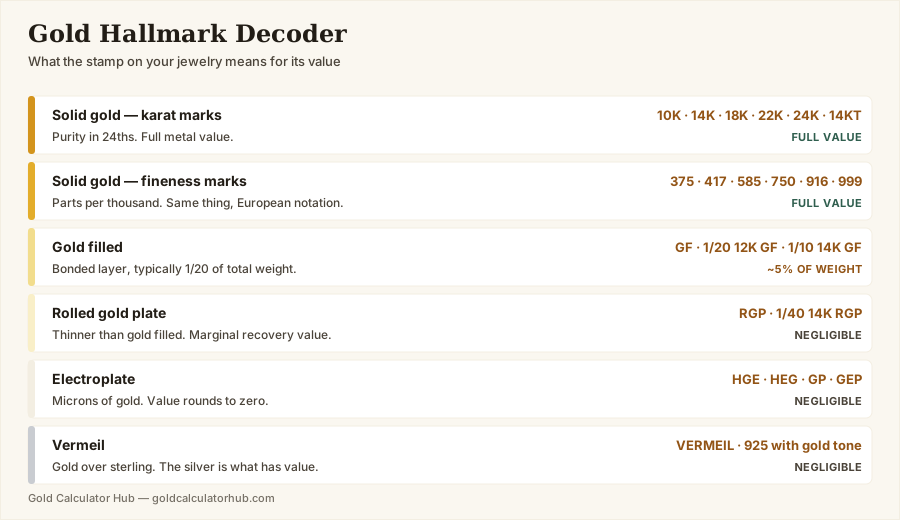
| Electroplated | A gold layer of a micron or two (often less) over brass, copper, or steel | GP, GEP, HGE, or nothing | Effectively none | Fashion jewelry, costume chains, cheap online listings |
| Vermeil | Sterling silver with a gold skin | 925, sometimes "vermeil" | Silver value only | Boutique and designer pieces, gift shops |
| Gold-filled / rolled gold plate | A thick, mechanically bonded layer of 10K-or-better gold | 1/20 12K GF, 1/40 10K RGP | Small, often below refining minimums | Vintage watch cases, lockets, chains, eyeglass frames |
| Misstamped low karat | Genuine gold, but lower purity than the stamp claims | A confident 14K or 18K | Yes, just less than promised | Unbranded chains, mixed resale lots |
| Counterfeit solid | Brass, copper, or zinc alloy with a forged karat stamp | 14K, 18K, 585, 750 | None | Street sales, too-cheap listings |
| Tungsten-core | A real gold shell around a tungsten slug | Full bar markings, sometimes copied from a real refiner | Only the shell | Bars; jewelry is a poor target |
Two of those rows aren't fake in any legal sense. A piece honestly stamped 1/20 12K GF or 925 is exactly what it says; it becomes "fake" only when someone sells it as solid gold. That distinction matters when you're deciding whether you were cheated or merely mistaken, and whether a complaint has any footing.
The cruel case is gold-filled, because it *is* partly real gold and people reasonably expect to be paid for it. On a 1/20 12K piece the gold layer is one-twentieth of the metal weight, and that layer is half gold, so pure gold comes to about 2.5% of what the scale reads. A 20 g chain holds roughly half a gram. Our gold filled calculator runs that arithmetic for any fraction and karat. Vermeil is the sneakiest for home testers, because the silver underneath is a precious metal that behaves politely under several of the checks people trust most.
What the Stamps Are Legally Supposed to Promise
In the US, the FTC's Guides for the Jewelry, Precious Metals, and Pewter Industries (16 CFR Part 23) spell out what each plating and filling term should mean. They're guidance on what counts as deceptive rather than a stamping police force, but they're the standard honest makers mark against, which makes them the best yardstick for a dishonest mark:
- Gold electroplate (GEP): gold of at least 10K, at least 0.175 microns thick measured as fine gold.
- Heavy gold electroplate (HGE): the same 10K floor, at least 2.5 microns.
- Rolled gold plate or gold overlay (RGP): a mechanically bonded layer of 10K or better that makes up at least 1/40 of the metal's weight.
- Gold filled (GF): the same construction, at least 1/20 of the metal's weight.
- Vermeil: a sterling silver base under 10K-or-better gold at least 2.5 microns thick.
- Karat marks: the stamp should match the alloy within the National Stamping Act tolerance, three parts per thousand, or seven where the tested part contains solder.
Three practical consequences follow. First, a plating code is a confession, not a trick: GP, GEP, HGE, RGP, and GF all mean the piece is not solid gold, however good it looks. Second, the guides say a piece with a hollow center shouldn't be described as "solid," so a listing promising "solid 14K" on something built from light, puffy tubing is making a claim you can hold the seller to. Third, when a quality mark applies to only part of an item, the guides expect the item to say which part. A 14K clasp on a chain that is a slightly different color from the clasp is the classic way a stamp tells the truth about the wrong object.
For foreign marks, assay-office symbols, and the fineness numbers from 375 to 999, use the decoder in our guide to gold hallmarks.
Visible Tells, Item by Item
Different objects fail in different places. The same counterfeiter's habits look different on a chain than on a coin, so read the piece according to what it is.
Chains
Chains are where misstamps and plating live, because the stamp sits on a tag or clasp that can be swapped or bought separately. Watch for:
- A karat stamp only on the clasp, with links that don't quite match its color
- "Italy" or a maker's code with no karat or fineness number beside it (a country of origin is not a purity claim)
- A chain that feels improbably light for its width, which usually means hollow tubing: legal if disclosed, misleading if sold as solid
- Dents or crushed links, another sign of hollow construction and of less gold than the size suggests
- Pink, gray, or silvery color at the link pivots, where links grind against each other all day
Rings
Rings wear in one predictable spot: the underside of the shank, the part that rubs the neighboring finger, the steering wheel, and the gym bar. A pinkish, silvery, or gray patch there on an otherwise yellow ring is plating giving up. Look inside the band for the mark; 925 next to gold color means gold over silver, not gold. A seam or faint color shift across the bottom of the shank usually means an old resize, which is normal on genuine rings and is also why some real rings lost their stamp entirely. On cheap men's bands sold online, read the listing language before the metal: "gold tone" and "gold color" describe a color, not a material.
Coins
Bullion coins hand you an advantage jewelry never does: the issuing mint publishes the exact weight, diameter, and thickness, so a fake has to match all three at once while being the right metal. Tells include soft or mushy detail in fine areas like hair and lettering, a weight that's off the published figure by more than your scale's error, uneven edge reeding, and a color that's wrong for the alloy (22K coins look warmer than 24K ones because of their copper and silver). Coins also carry a second kind of fake: a genuine gold coin with an altered date or mint mark, made to steal a collector premium. That's a numismatic question for a dealer, not a metal question.
Bars
Bars are where the expensive fakes are. Tungsten's density is within half a percent of pure gold's, so a cored bar weighs right in the hand and on the scale. The tells live in the packaging and paperwork: a missing or mismatched assay card, a serial number on the bar that doesn't match the card, packaging that has been opened and resealed, a refiner logo that doesn't match the refiner's own published designs, and an asking price below spot. Nobody sells real gold below spot to a stranger for long.
Where It Came From Changes the Odds
Source doesn't prove anything, but it tells you which row of the table to suspect first.
Estate sales and inherited drawers
Estate pieces lean toward honest confusion rather than deliberate fraud: gold-filled lockets and watch cases from decades when GF was everyday jewelry, costume pieces stored in the same box as the real thing, and older unstamped gold that was never marked in the first place. The family's memory ("she only wore real gold") is a hypothesis, not a finding. Price is the other tell. A seller asking a small fraction of melt for a stamped 18K piece either doesn't know what they have or knows exactly what they have.
Online marketplaces
Online, the photos are the seller's and the stamp in the picture may not be on the item that arrives. Read the listing literally: "gold tone," "gold color," "18K plated," "gold filled," and "stainless steel with gold PVD coating" are all honest descriptions of not-solid-gold that skim as gold in a search result. Before paying, ask for a close-up of the stamp and a photo of the item on a scale showing grams. A seller who won't provide both has answered your question. Pay with a method that has buyer protection, and check the piece the day it arrives, inside the return window.
Travel purchases
Abroad, the usual surprise isn't fake gold but unfamiliar gold. Much of the jewelry sold across the Middle East and South Asia is 21K or 22K, stamped 875 or 916, and it looks warmer, more saturated, and softer than American 14K. That color difference is not a warning sign; it's what high karat looks like. The real risks are the street seller you can't find again and the price that undercuts the day's melt value. Buy from a shop that writes karat and weight on the receipt, and keep the receipt with the piece.
Decision Tree: From What You See to What It Probably Is
Start at the top and stop at the first line that matches. The verdicts are probabilities, not proof; the next section names the test that turns each one into an answer.
| If you see this | It's probably | What to do next |
|---|---|---|
| GP, GEP, HGE, RGP, GF, or a fraction like 1/20 | Plated or gold-filled, by its own admission | Stop testing for solid gold; value it as plated or filled |
| 925 or "Sterling" on a gold-colored piece | Vermeil or gold-plated silver | Value it as silver |
| The body of the piece pulls toward a magnet | Plated steel | Treat as costume jewelry |
| Gray, pink, or silver showing at wear points | Electroplate over base metal, whatever the stamp says | Confirm under the surface, then stop |
| Karat stamp, very light for its size, dents easily | Genuine hollow gold | Confirm karat; expect less gold than its size implies |
| Karat stamp, right look and heft, bought cheap or from a stranger | Either genuine or counterfeit solid | Measure density |
| Karat stamp, color paler or more coppery than other pieces of that karat | Possibly a lower karat than stamped | Check karat directly |
| No stamp at all | Unknown, not fake: old, handmade, resized, or worn | Go straight to a karat check |
| Warm, deep yellow with 875 or 916, bought abroad | Genuine 21K or 22K | Verify weight against the receipt |
| Bar or large coin at or below spot, packaging disturbed | Tungsten-core risk | Professional verification only |
Notice what the tree never asks: how heavy it feels, whether it looks expensive, whether it marked your skin. Those impressions are exactly what counterfeiters design around, and none of them sorts one row from another.
The One Test That Settles Each Suspect
You rarely need more than one test once you know what you're looking for. Here is the deciding check for each suspect; the step-by-step procedures, safety notes, and costs live on the methods page.
- Counterfeit solid (brass or zinc alloy): density, because every gold alloy is far denser than any base metal a counterfeiter can afford, and the water-displacement measurement takes ten minutes with a kitchen scale.
- Plated steel: a strong magnet on the body of the piece, not the clasp, which the magnet section of the methods guide explains.
- Electroplate over brass or copper: acid placed inside a small filed notch, since surface acid only reads the gold skin; the acid-kit procedure covers the notch and the safety gear.
- Vermeil or plate over silver: a free XRF scan at a coin or bullion dealer, which reports the silver underneath in seconds without a mark, as described in the professional-testing section.
- Misstamped low karat: an acid kit run at the claimed karat and one step below, which brackets the true purity within a single sitting.
- Unstamped, probably genuine: the same acid bracketing to find the karat, plus density if you also want to rule out a base-metal core (both procedures here).
- Tungsten-core bar: nothing you can do at home; a dealer's ultrasonic thickness check is the deciding test, and the methods guide explains why home tests miss it.
Gold-filled is missing from the list on purpose. If the piece is stamped GF or RGP, the stamp has already answered the question, and testing it only confirms what the maker told you.
A Worked Case: The "Solid 18K" Estate-Sale Bracelet
Here's the identification approach applied to one object, with the money at the end.
A link bracelet turns up at an estate sale for $60, stamped 750 on the clasp tag, weighing 24.6 g on a kitchen scale. The stamp claims 18K, which is 75% gold. If true, that's 24.6 × 0.75 = 18.45 g of pure gold. Assume gold at $4,400 per troy ounce; at 31.103 g to the troy ounce that's $141.46 per gram, so melt value is 18.45 × 141.46 = $2,610. A $60 asking price for $2,610 of metal should trigger suspicion, not excitement.
Walk the tree. No plating code, no 925. The stamp sits only on the clasp tag, so the first question is whether the links match it, and under a loupe they do: same yellow through the link pivots, no pink bleed at the edges. Nothing about the weight says hollow. That leaves the one row that matters, "right look, bought cheap from a stranger," which is a choice between genuine 18K and counterfeit solid. The deciding test for that pair is density, so it's the only one worth running. The bracelet displaced 1.59 cm³ of water: 24.6 ÷ 1.59 = 15.5 g/cm³, right where 18K belongs and nowhere near brass at about 8.5. Verdict: genuine, with no acid and no scratch.
Now the part sellers skip. That $2,610 is melt value, not an offer. Using the site's standard payout ranges, an online refiner at 70–90% of melt lands between $1,827 and $2,349; a local coin or bullion dealer at 65–85% offers $1,696 to $2,218; a jewelry store at 50–75% says $1,305 to $1,957; and a pawn shop at 40–60% opens around $1,044 to $1,566. Same verified bracelet, a spread of more than $1,300 depending only on who you hand it to.
When the "Fake" Is Real Gold: The Misstamped Chain
The fake that costs careful buyers the most isn't brass. It's genuine gold of a lower karat than the stamp claims, because it passes every real-versus-fake check: it isn't magnetic, its density is in gold territory, and it doesn't wear through to another color. Only a purity check catches it.
Take a 20 g rope chain stamped 14K, bought from a private seller at a price based on that stamp. Keep the same assumed $4,400/oz ($141.46/g):
- As 14K (58.33% gold): 20 × 0.5833 = 11.666 g pure, worth 11.666 × 141.46 = $1,650 in melt.
- As 10K (41.67% gold): 20 × 0.4167 = 8.334 g pure, worth 8.334 × 141.46 = $1,179 in melt.
- The gap: about $471 of metal that the stamp promised and the chain doesn't contain.
The tells are subtle. A misstamped chain may look slightly paler or more coppery than other 14K pieces you own, and its stamp often sits on a generic tag rather than a maker's mark. Unbranded chains and mixed lots are where this shows up, which is why an acid check at the claimed karat is worth running on any chain bought from someone you can't call back. If you're the seller, it matters too: a buyer's test will find the real karat, and the offer will be built on it.
Red Flags That Have Nothing to Do With the Metal
Sometimes the clearest evidence is the behavior around the piece rather than the piece itself. None of these proves a fake on its own, but each one should move you up the table toward the suspicious rows:
- A price below melt. Anyone selling real gold can get close to melt from a refiner in a week. A stranger offering less is pricing the item like the thing it is.
- "Solid" on something light and puffy. As above, hollow gold is legitimate but shouldn't be sold as solid. The word is doing work the weight can't.
- No testing allowed. A seller who won't let you magnet, weigh, or scan an item before money changes hands has told you something. The reverse holds when you're selling: a buyer who won't test in front of you is one to walk away from.
- Urgency. "Another buyer is coming at four" exists to stop you from doing the ten minutes of checking that would end the conversation.
- Stamp photos that don't match. On a listing, a stamp close-up with a different background, lighting, or link style from the full-item photo may belong to a different item.
The whole point of learning how to tell real gold from fake by identification rather than by brute-force testing is that most pieces confess early. The stamp, the wear points, the item type, and the circumstances narrow six possibilities to one or two, and a single well-chosen test finishes the job.
Frequently Asked Questions
Is a piece with no hallmark automatically fake?
No. Plenty of genuine gold carries no stamp at all: most handmade jewelry, a lot of older American work, pieces whose mark sat on a section later removed during resizing or repair, and items where decades of wear polished it away. A missing mark means there's no claim to verify, not that the claim is false. Skip the stamp question and go straight to a karat check, which tells you what an unmarked piece is made of more reliably than any stamp would have.
Is gold vermeil real gold?
Partly. Under the FTC's jewelry guides, vermeil means sterling silver coated with gold of at least 10K and at least 2.5 microns thick. So the surface is real gold and the base is real silver, but it isn't solid gold and shouldn't be priced like it. When you sell vermeil, the realistic value is the silver content, since the gold layer is far too thin to be worth refining. Look for 925 or the word vermeil inside rings and on clasps.
What does HGE stamped on jewelry mean?
Heavy gold electroplate. It means a layer of gold of at least 10K was applied electrically over another metal, at least 2.5 microns thick under the FTC guides, which is thicker than ordinary GEP plating but still a surface coating. The base is usually brass or another base metal. HGE often appears on vintage costume pieces and class rings, and it means the piece holds no meaningful recoverable gold, however heavy and convincing it feels.
Can a chain be real gold and still be sold misleadingly?
Yes, in two common ways. Hollow chains are genuine gold tubing, but they contain much less metal than their size suggests, and the FTC guides say hollow items shouldn't be described as solid. And a chain can be real gold of a lower karat than its stamp claims, such as 10K stamped 14K. Both pass a magnet and look right. The fixes are weighing the chain rather than judging by width, and checking the karat directly when the source is unknown.
Can a jeweler tell real gold from fake just by looking?
An experienced jeweler can often form a strong opinion from color, construction, wear pattern, and how the piece handles, and they're right far more often than a layperson. But they'll still test before quoting money, because polished brass under warm shop lighting fools trained eyes and modern counterfeits are made to survive a glance. If someone offers to buy your piece on visual inspection alone, ask them to test it in front of you.
Is gold bought in Dubai, India, or Turkey more likely to be fake?
Not inherently. Established jewelry markets in those countries sell a lot of 21K and 22K gold, stamped 875 or 916, that looks deeper and warmer than American 14K, and that color is a feature, not a warning. The risk sits with sellers you can't find again and prices below the day's melt value. Buy from a shop that writes karat and weight on the receipt, keep it, and check the weight when you get home.
Once I know it's real, how do I find out what it's worth?
Three inputs: weight in grams from a scale reading to 0.1 g, purity from the karat mark or a purity check, and the current gold price. Multiply weight by the purity decimal for pure gold content, then by the price per gram. The gold calculator on our homepage does it live. Then subtract reality: buyers pay roughly 70–90% of melt at online refiners down to 40–60% at pawn shops, so get at least three quotes.

Written by Sukie Gao
Sukie Gao holds a master's degree from a business school, where she picked up the markets-and-pricing toolkit she now applies to the consumer gold trade. She created Gold Calculator Hub to give people an independent, data-driven way to find out what their gold is really worth.
Published September 3, 2026 · Updated October 16, 2026