Best Place to Sell Gold: Decide by What You Have, Not by Who Advertises
 By Sukie Gao · October 21, 2026
Where is the best place to sell gold? Anyone who answers with a company name is selling advertising; the honest answer is a match between three things you already know — what the item is, how much of it you have, and how soon you need the money — and five kinds of buyer who pay very different shares of the same melt value. Get the match right and the same 31-gram chain brings $2,300 instead of $1,000. Get it wrong and you can lose a third of the value before you have left the parking lot.
This site does not buy gold, sell gold, or take a referral fee from anyone who does, which is the only reason it can rank the buyer types honestly. The where to sell gold guide lists every buyer type with its payout range; this page is the other half of the job — it starts from your side of the counter and tells you which of those buyers to walk into. Use the calculator above to get your melt figure first; every recommendation below is a percentage of that number, and you cannot judge an offer without it.
One rule applies to every branch of the decision: get at least three written quotes, and let each buyer weigh the item in front of you. The FTC's consumer guidance on selling gold says the same, and it costs nothing to follow.
Which of the five buyer types is each one actually for?
Every gold buyer in the country falls into one of five types, and each type exists to solve a different problem — which is why their payouts differ so much. The ranges below are the site-standard figures used on every calculator page here, expressed as a share of melt value.
| Buyer type | Pays (% of melt) | Speed | Exists to |
|---|---|---|---|
| Online gold refiner | 70–90% | 2–7 days, by mail | Turn scrap into bars at volume |
| Local coin / bullion dealer | 65–85% | Same day | Trade recognizable metal — coins, bars, chunky karat scrap |
| Jewelry store | 50–75% | Same day | Resell wearable pieces; scrap is a sideline |
| Pawn shop | 40–60% | Minutes | Lend against collateral; buying outright is secondary |
| TV / mail-in "cash for gold" | 20–50% | 1–3 weeks | Convert advertising spend into low-cost inventory |
Read the last column, not the second. A refiner pays the most on scrap because scrap is the only thing it wants; the same refiner has no interest in a signed Art Deco bracelet beyond its weight. A jewelry store pays a poor scrap rate but may pay well above melt for a piece it can put in the case tomorrow. A pawn shop's low percentage is not a scam — it is the cost of a business that lends money to strangers and needs a margin if you never come back. The what percentage do gold buyers pay guide goes deeper into why each tier lands where it does.
The number every branch below starts from
Take a 31-gram 14K curb chain as the running example. 14K is 58.33% pure, so it carries 18.08 g of fine gold. Assume gold at $4,400 per troy ounce — $141.46 per gram — and the melt value is 18.08 × $141.46 = $2,558. At the five payout tiers that is roughly $1,790–$2,300 from a refiner, $1,660–$2,170 from a coin dealer, $1,280–$1,920 from a jewelry store, $1,020–$1,540 from a pawn shop, and $510–$1,280 from a mail-in service. Same chain, a $1,800 spread. Everything on this page is about landing in the top of that range.
What are you holding?
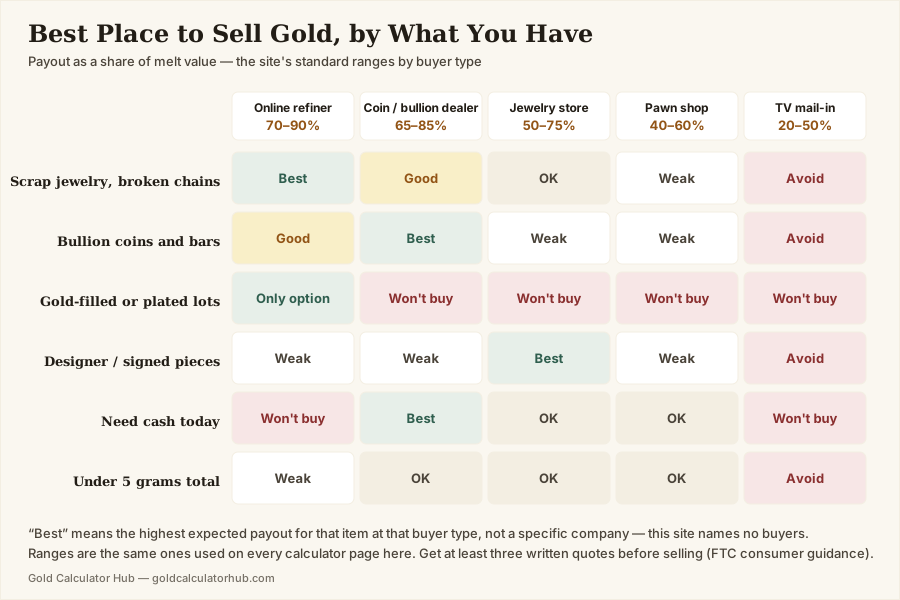
Broken, mismatched or unwearable karat gold — scrap. Online refiner first, coin dealer second. Nobody will resell a single earring or a snapped chain, so its only value is metal, and the refiner is the buyer whose entire business is metal. Sort it by karat before you send it (a 10K/14K/18K mix gets priced at the lowest karat if you let the buyer sort), photograph the lot, and use a shipping method with tracking and insurance. Expect the top of the range on lots over about an ounce of fine gold; below that, the coin dealer's same-day 65–85% often beats the refiner once you subtract shipping and the wait. For the arithmetic on any lot, the scrap gold calculator is built for exactly this.
Bullion coins and bars — Eagles, Maples, Krugerrands, kilo bars. Local coin or bullion dealer, no contest. Bullion is standardized, so the dealer can resell it the same afternoon and pays close to spot — frequently better than a refiner, who would only melt it. Refiners are second choice; jewelry stores and pawn shops are the wrong counter entirely because they price coins as scrap. Run the gold coin melt value calculator so you know the metal floor, then expect a dealer to quote at or slightly above it for common bullion.
Designer, signed, antique or gem-set pieces. Jewelry store, estate buyer or auction — not a scrap buyer. A signed piece can sell for two to ten times its melt value to someone who wants the object rather than the metal, and a refiner will pay you for the metal only. Get the melt figure from the gold calculator so you know the floor, then get a resale quote from a jeweler who deals in that maker. Stones complicate this: melt buyers deduct stone weight and pay nothing for the stones, while a resale buyer may pay for them.
Gold-filled, plated or vermeil lots. Online refiner with a published gold-filled rate, and only above their minimum lot weight (often a pound). No other buyer type will touch it, because recovering 2.5% gold from brass is a refining job. The gold filled calculator shows why the numbers are small.
Dental gold, crowns, bridges. Refiner. Dental alloys vary in purity and contain palladium and platinum a jeweler cannot assess; a refiner assays and pays for everything in the alloy. See the dental gold value calculator for what a crown typically holds.
Inherited mixed boxes. Sort first, sell second — usually to two or three different buyers. The typical estate lot has all of the above in one drawer, and selling it as one lot to one buyer guarantees the lowest price on every category. The selling inherited gold jewelry guide walks through the triage.
Where is the best place to sell gold for your timeline?
Speed has a price, and it is worth stating plainly so you can decide whether to pay it.
- Today, in cash. Coin dealer if you have karat scrap or bullion; jewelry store if you have a wearable piece; pawn shop only if the first two are closed or you are out of options. On the 31-gram chain, choosing a pawn shop over a coin dealer for the sake of an hour costs roughly $640 at the middle of each range.
- This week. The coin dealer remains the best same-day option for most karat gold, and a nearby refiner with a walk-in counter may match it. A jewelry store is fine for a piece it wants to resell. Use the extra days to collect three quotes rather than to wait on one buyer.
- Within a month. Online refiner. Mail the lot insured, wait for the assay, accept or have it returned. This is where the 70–90% tier lives, and a month is more than enough for the round trip. If the refiner's quote comes in below the coin dealer's, you have lost nothing but postage.
- No deadline at all. Consider not selling scrap at all yet if the price is falling, and selling signed or antique pieces through consignment or auction, where the buyer pool is largest and the price is set by demand for the object rather than by the metal. Consignment takes months and a commission, but it is the only route that captures value above melt.
The pattern is simple: every step down in urgency moves you one tier up in payout, until you reach the point where the item is worth more as an object than as gold. The people who lose money selling gold are almost always the ones who let a deadline choose the buyer for them.
Which places are almost never the best — and which one surprises people?
- TV and mail-in "cash for gold" services. The advertising is paid for out of your payout. The 20–50% tier exists because these operations are optimized for people who will not compare offers; the envelope is designed to make comparison feel like effort. There is no item for which this is the best place to sell gold. If you have already mailed something, most of these services offer a return window — use it if the offer is under the coin-dealer range.
- Pawn shops for outright sale. A pawn shop is a lender, and its buying rate reflects a business model in which you may never return for the item. That is fair for a loan and poor for a sale. The how much do pawn shops pay for gold guide has the full numbers; the short version is that the same item sold to a coin dealer across town will bring 25 points more of melt. The exception is a pawn shop that also runs a jewelry counter and wants your piece for resale — ask, because then it is pricing as a jeweler, not as a lender.
- Local coin dealers — the surprise. Most sellers never consider them because the sign says "coins." But bullion dealers live on thin margins over spot, price karat scrap by the gram the same way, pay the same day, and are used to sellers who arrive with a melt figure and a scale reading. For anyone with more than a few grams of karat gold and less than a month to wait, they are the best place to sell gold more often than any other type. Walk in with your weight, your karat and your melt number, and ask for their price per gram of fine gold; a dealer who will state that number is a dealer you can compare.
How do you make any buyer pay the top of its range?
Whichever door you choose, the difference between the bottom and the top of that buyer's range is mostly in your hands.
- Arrive with the melt number. Weight in grams, karat, and the value at today's price. Buyers pay less to sellers who do not know what they have, not out of malice but because the first offer is a probe. The calculator on this page gives you the figure in seconds; the how much is my gold worth guide shows the sixty-second routine.
- Sort by karat and keep stones out of the weight. A 14K lot with a 10K ring in it is priced as 10K. A ring with a stone is weighed with the stone deducted; if you can have the stone removed first, do.
- Get three quotes and say so. Quotes are free. Saying you are comparing is not rude; it is the single most effective sentence in the transaction.
- Watch the scale and the units. The cash for gold scams guide covers the tricks — pennyweight quotes that sound bigger than gram quotes, scales set to the wrong unit, lot bundling — and each one is defeated by knowing your own gram weight before you walk in.
- Larger lots get better rates. Every buyer has fixed costs per transaction; spreading them over more grams moves you up the range. If you are selling small amounts over time, accumulate.
- Keep the paperwork. Gold jewelry, coins and bullion are collectibles for federal tax purposes, and a gain on sale can be taxed at up to the 28% collectibles rate under IRS Topic 409. Inherited pieces generally take a stepped-up basis at the date of death, which is why an appraisal at that date matters. This is not tax advice; a preparer can tell you what applies to you.
Put together, those habits are worth more than choosing the right buyer type. A prepared seller at a jewelry store often beats an unprepared seller at a refiner. Do both — the right buyer, prepared — and the 31-gram chain in the example comes home as $2,000 or more instead of $1,200, with nothing changed about the chain. The rest of the selling gold guides cover each buyer type in detail.

Written by Sukie Gao
Sukie Gao holds a master's degree from a business school, where she picked up the markets-and-pricing toolkit she now applies to the consumer gold trade. She created Gold Calculator Hub to give people an independent, data-driven way to find out what their gold is really worth.
Published October 21, 2026