How Much Is 14K Gold Worth? Per Gram, dwt and Ounce
 By Sukie Gao · July 23, 2026
How much is 14K gold worth? Two numbers settle it: the live spot price of gold, and the fact that 14 karat is 58.33% pure gold by weight. Multiply the pure-gold gram rate by 0.5833 and you have the melt value of every gram of 14K you own — chain, class ring, broken clasp, single orphaned earring, all identical once they hit the scale. Everything people instinctively worry about (the brand, the style, whether it is white or yellow, whether it is scratched) moves that number by exactly zero.
With gold trading in recent months near $4,300–$4,500 per troy ounce, a gram of 14K lands somewhere around $80–$85, which puts most individual pieces of American jewelry between the price of a nice dinner and the price of a used car. The calculator above runs the arithmetic at today's actual price. The tables further down are worked at a clean assumed $4,400 per troy ounce so you can follow every step and re-run it yourself at whatever spot is doing this week.
There is a second number nobody volunteers, and it is the one that decides what actually lands in your hand: no buyer pays melt value. They pay a percentage of melt, and that percentage swings from roughly 40% to 90% depending entirely on which door you walk through. So this page does both jobs — what your 14K contains, then what that content is realistically convertible into. Melt first, payout second, because you cannot judge an offer until you know the first number cold.
The Short Answer, With the Math Behind It
Three multiplications, in order. Assume gold at $4,400 per troy ounce:
- Pure gold, per gram: $4,400 ÷ 31.103 g = $141.47
- 14K, per gram: $141.47 × 0.5833 = $82.52
- Your pieces: $82.52 × the grams you actually have
That is the whole formula. The 0.5833 comes from the karat scale, which measures purity in 24ths — 14 parts gold to 10 parts other metal, or 58.33%. The stamp you will find on the clasp reads 14K, 14KT, 585, or on older work 583; all four describe the same alloy and the same value. The remaining 41.67% is usually copper, silver, zinc, or nickel, and at scrap volumes it is worth close to nothing. Refiners recover it, but they do not pay you for it.
This matters more than it sounds. Price a 14K bracelet as though it were pure gold and you overvalue it by 71% — you would be expecting $141 a gram for metal that contains $82.52 of gold. That single misunderstanding is the source of most disappointment at the buyer's counter, and it is entirely avoidable. If you want the formula generalized across every karat, how to calculate gold price walks the same chain for 10K through 24K.
14K Gold Value by Weight: 1 g to 100 g
Here is the table most people arrive looking for, computed at our assumed $4,400 per troy ounce ($82.52 per gram of 14K). Round your own weight to the nearest row or interpolate — the relationship is perfectly linear, so doubling the grams doubles the money.
| Weight of 14K | Melt value | Typical real-world item |
|---|---|---|
| 1 g | $82.52 | a thin stud earring pair |
| 5 g | $412.58 | a light 18-inch chain |
| 10 g | $825.17 | a men's wedding band |
| 20 g | $1,650.34 | a substantial curb bracelet |
| 25 g | $2,062.92 | a heavy rope chain |
| 50 g | $4,125.84 | a small drawer of mixed scrap |
| 100 g | $8,251.68 | a full estate jewelry lot |
Two notes before you use it. First, the weight has to be gold weight — stones, spring bars, steel watch pins, and non-gold clasps all have to come off the total, and a gem-set ring can easily be 20% non-gold by mass. Second, hollow jewelry lies to your hands. A hollow rope chain looks and feels like serious metal and can weigh a third of what a solid one of the same dimensions does. Weigh, do not estimate; how to weigh gold covers scale choice and the mistakes that cost real money.
Grams, Pennyweights, Ounces: Same Gold, Four Prices
American buyers quote 14K in whichever unit suits the conversation, and the same metal produces four very different-looking numbers. Still at $4,400 spot:
| Unit | Mass | 14K value |
|---|---|---|
| Gram | 1 g | $82.52 |
| Pennyweight (dwt) | 1.555 g | $128.31 |
| Standard (avoirdupois) ounce | 28.350 g | $2,339.35 |
| Troy ounce | 31.103 g | $2,566.52 |
Nothing here is a trick on its own, but the gaps are exploitable. A quote of $128 per pennyweight sounds far more generous than $82 per gram, and it is the identical rate — the unit is simply 55.5% heavier. Meanwhile a kitchen or postal scale reports standard ounces, which are 8.8% lighter than the troy ounces gold is priced in, so anyone converting a kitchen-scale reading into a gold price without adjusting will overestimate their haul by nearly ten percent and then feel cheated by a fair offer.
The defense is one habit: convert everything to grams before you have an emotional reaction to a number. Divide any per-dwt quote by 1.555. Divide any per-troy-ounce figure by 31.103. Our breakdown of troy ounce vs ounce shows exactly how many dollars the unit confusion costs on an ordinary bracelet.
Worked Examples: 25 g, 26 g, and 159 g of 14K
Abstract rates are less useful than specific piles, so here are three, all at $4,400 per troy ounce and $82.52 per gram of 14K.
25 grams — one heavy chain. 25 × $82.52 = $2,062.92 in melt. This is the classic single-item sale: a rope or Cuban chain someone stopped wearing a decade ago. At a good online refiner paying 85%, that is about $1,753. At a pawn counter paying 45%, about $928. Same chain, same afternoon, $825 of difference.
26 grams — a small mixed lot. 26 × $82.52 = $2,145.44. Twenty-six grams is roughly what a shoebox of tangled chains, a broken bracelet, and three or four rings comes to. The important move with a lot like this is sorting by stamp before anyone weighs it, because a pile priced uniformly at the 14K rate that secretly contains 18K pieces quietly underpays you 29% on those items.
159 grams — a genuine estate lot. 159 × $82.52 = $13,120.17. At this size the payout percentage stops being a rounding error and becomes the whole negotiation:
- Online refiner (70–90% of melt): about $9,184–$11,808
- Local coin or bullion dealer (65–85%): about $8,528–$11,152
- Jewelry store (50–75%): about $6,560–$9,840
- Pawn shop (40–60%): about $5,248–$7,872
Best realistic outcome versus worst: roughly $6,560. That is the entire reason to get three quotes on a lot this size instead of one.
Melt Value Is Not the Offer You'll Get
Melt value is what the gold inside your jewelry is worth as raw metal. It is a ceiling, not a price. Every buyer between you and a refinery has to cover assaying, shipping, insurance, refining loss, staff, rent, and the risk that gold drops 3% before they can hedge — and they would like to eat, too. So they buy at a discount to melt and the size of that discount is essentially their business model.
The working ranges, as a percentage of melt value:
- Online refiners: 70–90%. Highest payouts, lowest overhead, but you mail your gold away and wait. Read the return policy before the package ships.
- Local coin and bullion dealers: 65–85%. The best balance for most sellers — same-day cash, a professional scale you can watch, and enough volume that they are pricing off real spot.
- Jewelry stores: 50–75%. Convenient and often trustworthy, but scrap buying is a sideline and priced like one.
- Pawn shops: 40–60%. Fast, no questions, and the most expensive convenience in the trade.
- Mail-in TV and envelope services: 20–50%. Consistently the worst outcome available.
The FTC's guidance on selling gold jewelry puts the same advice in consumer-protection language: know what you have, use buyers who weigh in front of you on a certified scale, and never let the first offer be the only offer. Our full ranking sits at where to sell gold, and what percentage do gold buyers pay breaks down why each tier lands where it does.
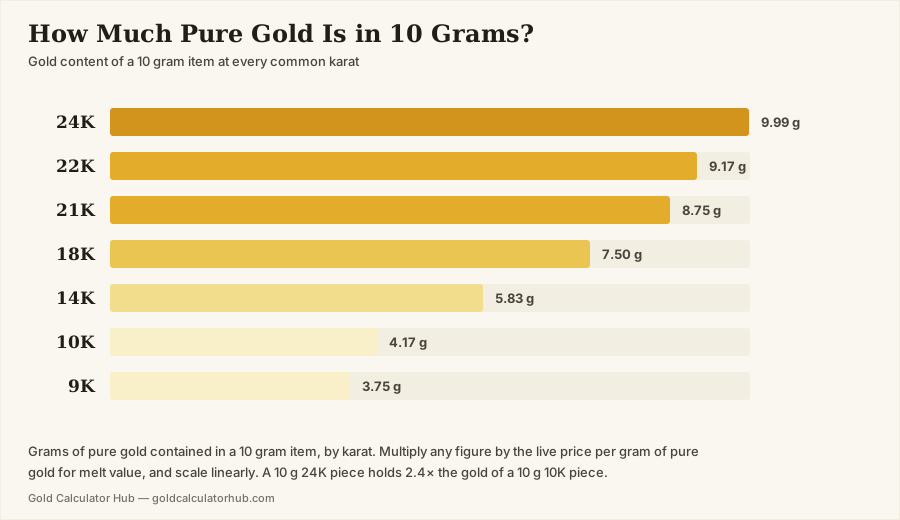
Where 14K Sits Against the Other Karats
Per gram, at our assumed $4,400 spot:
| Karat | Purity | Stamp | Per gram | Relative to 14K |
|---|---|---|---|---|
| 24K | 99.9% | 999 | $141.32 | +71% |
| 22K | 91.67% | 917 | $129.68 | +57% |
| 21K | 87.5% | 875 | $123.78 | +50% |
| 18K | 75% | 750 | $106.10 | +29% |
| 14K | 58.33% | 585/583 | $82.52 | — |
| 10K | 41.67% | 417 | $58.95 | −29% |
| 9K | 37.5% | 375 | $53.05 | −36% |
14K is the American default for reasons that have nothing to do with investment and everything to do with wear: it survives daily abuse better than 18K, holds warmer color than 10K, and costs less than either of the high karats. Jewelry demand patterns tracked by the World Gold Council show the preference is regional rather than universal — much of South Asia buys 22K, the Gulf favors 21K, continental Europe leans 18K — but open a random American jewelry box and 14K dominates.
One practical consequence: mixed lots are the norm in the US, and karat sorting is where sellers lose money silently. If you have 18K pieces mixed in, a buyer weighing the whole pile as 14K keeps the 29% difference on every one of those grams. Check every stamp yourself first — how much is 18K gold worth and 10K gold price per gram cover the neighbors on either side.
What Can Make Your 14K Worth Less Than the Table Says
The tables above assume solid 14K and honest weight. Four things break that assumption.
It is not solid. Marks like 14K GF (gold-filled), 14K GP or HGE (electroplated), or fractional marks such as 1/20 14K describe a thin gold skin over brass. A gold-filled piece may be 5% gold by weight at best, and most scrap buyers decline it outright rather than pay pennies. Plated is worth essentially nothing as metal.
The stamp is a lie. Counterfeit 585 marks turn up regularly on marketplace chains. Real gold is not magnetic, real gold is startlingly dense for its size, and real gold does not show a different color metal at rubbed clasp edges. None of those checks is conclusive alone, but together they catch most fakes. How to tell real gold from fake runs through the tests in order of cost.
Stones and hardware inflate the weight. A gem-set 14K ring weighed whole is not 14K weight. Serious buyers deduct stones; casual ones sometimes deduct generously in their own favor. Ask how the deduction is being calculated.
The item is hollow. Hollow rope and herringbone chains are legitimate 14K, just far lighter than their bulk suggests. Nothing dishonest is happening; your expectation simply needs recalibrating before you walk in.
What does not reduce value: scratches, dents, tarnish on the alloy, missing stones, broken clasps, being ugly, or being white or rose rather than yellow. Colored golds are the same 58.33% gold with different alloy metals, and the furnace does not care. A buyer discounting for condition on scrap is negotiating, not appraising.
When 14K Is Worth More Than Melt
Everything above answers the question — how much is 14K gold worth? — as a question about metal. For a small minority of pieces, that is the wrong question entirely.
Melt is the floor, and for most jewelry it is also the ceiling — the resale market for generic used gold is thin, and consignment fees eat whatever small premium exists. But there are real exceptions, and it costs nothing to check before your pieces go somewhere irreversible.
The categories that regularly beat melt: signed designer work (a recognizable maker's mark can multiply value several times over), genuine period pieces in original condition, items with certified gemstones of meaningful size, and anything with documented provenance. A 14K piece worth $900 in metal may be worth $2,500 as jewelry if the right name is stamped inside the band — and once it is melted, that difference is gone permanently.
The practical test takes ten minutes. Photograph the stamps, search the maker's mark, and check completed sales for comparable pieces. If nothing comes back, you own metal and you should be optimizing for the highest percentage of melt available. If something does come back, get a second opinion before selling to a scrap buyer, because scrap buyers price scrap — that is not a criticism, it is their job.
Inherited jewelry deserves an extra beat of patience for the same reason, plus a tax one: gold is treated as a collectible by the IRS, and an inherited piece generally takes a stepped-up cost basis at the date of death. Selling inherited gold jewelry covers that ground. None of this is tax advice — a short conversation with a tax professional before a large sale is cheap insurance.
How to Check Your Own Pieces in Ten Minutes
A repeatable routine, start to finish:
- Sort by stamp. Separate 585/583/14K into its own pile. Anything unstamped, plated, or marked GF goes in a third pile you deal with separately.
- Strip the non-gold. Remove stones where practical, and set aside steel clasps, watch pins, and spring bars. If a stone cannot come out, note it and expect a deduction.
- Weigh in grams on a digital scale that reads to 0.1 g. Kitchen scales rounding to whole grams will cost you real money on small items; a jeweler's pocket scale costs about the price of a takeout dinner.
- Run the melt number. Enter the grams into the calculator above with 14K selected, or use the gold calculator on the homepage for a mixed lot. Write the figure down before you speak to anyone.
- Convert every quote to a percentage. Offer ÷ melt value. Now you are comparing buyers on one axis instead of arguing about spot prices you cannot control.
- Get at least three quotes on anything over a few hundred dollars, and include one online refiner even if you expect to sell locally — it anchors the top of the range.
That sequence takes ten minutes and routinely moves the outcome by 20 to 40 percent. Not because it is clever, but because most sellers skip it entirely, and the ones who do it are visibly harder to lowball. For same-day per-gram numbers on the day you actually sell, 14K gold price today keeps the live figure and the payout math side by side.
Frequently Asked Questions
How much is a gram of 14K gold worth right now?
Divide the live spot price by 31.103 to get the pure-gold gram rate, then multiply by 0.5833. With spot in the recent $4,300–$4,500 per troy ounce range, that puts a gram of 14K at roughly $80–$85 in melt value. The calculator at the top of this page runs it against the current price rather than an assumed one, which is the figure that matters on the day you sell. Remember it is melt value — expect an offer somewhere between 40% and 90% of it.
How much is 25 grams of 14K gold worth?
At an assumed $4,400 per troy ounce, 14K melts at $82.52 per gram, so 25 grams is $2,062.92 in metal. What you get paid depends on the buyer: an online refiner at 85% would be near $1,753, a local dealer at 75% near $1,547, a pawn shop at 45% near $928. Twenty-five grams is a substantial single chain, so it is worth the effort of three quotes — the spread on a piece this size runs well over $800.
How much is 26 grams of 14K gold worth?
26 × $82.52 = $2,145.44 in melt value at an assumed $4,400 spot. If those 26 grams are a mixed lot rather than one item, sort by stamp before anyone weighs it. A pile containing 18K pieces but priced uniformly at the 14K rate loses you 29% on each of those grams, and it is the single most common way value quietly disappears at the counter.
How much is 159 grams of 14K worth?
At $82.52 per gram, 159 grams of 14K carries $13,120.17 in melt value at our assumed $4,400 spot. At that scale the payout percentage is the entire negotiation: 90% is about $11,808 while 40% is about $5,248, a gap of more than $6,500 on the same lot. Lots this size should never go to a single buyer without comparison, and are large enough that an online refiner's assay-based pricing usually beats any walk-in offer.
How much is 14K gold worth per ounce?
It depends which ounce, and the difference is nearly ten percent. At an assumed $4,400 spot, a troy ounce of 14K — 31.103 grams — carries $2,566.52 in melt value, while a standard avoirdupois ounce of 28.350 grams carries $2,339.35. Gold is priced exclusively in troy ounces, but kitchen and postal scales report the standard kind. If you weighed at home in ounces, you almost certainly measured the smaller one, so use the lower figure or reweigh in grams.
Is 14K gold a good investment?
Not really, and that is not a knock on it. You pay a retail markup when you buy jewelry and sell at a discount to melt, so a 14K piece has to appreciate substantially just to break even. It is jewelry that happens to hold a metal floor. If the goal is gold exposure, bullion coins and bars trade much closer to spot in both directions — our page on the melt value of gold coins shows how much tighter that spread is.
Does white 14K gold sell for less than yellow?
No. White, yellow, and rose 14K are all 58.33% gold; only the alloy metals differ — nickel or palladium for white, extra copper for rose. The rhodium plating on white gold is microns thick and adds nothing recoverable. Refiners pay on assayed gold content, full stop. If a buyer offers a lower per-gram rate because a piece is white gold, that is a negotiating position dressed as metallurgy, and it is worth saying so out loud.
What does 585 mean, and is 583 worth less?
Both mark 14K. The millesimal system states purity in parts per thousand, and 14 divided by 24 is 583.3 — so older American pieces are often stamped 583 while the modern convention rounds up to 585, with many makers alloying fractionally above the minimum for safety. There is no meaningful value difference. Treat 14K, 14KT, 585, and 583 as identical at 58.33% purity when you run the numbers.
Do gemstones add to what a gold buyer pays?
Usually not. Scrap buyers price metal, and small accent stones — the melee diamonds and semi-precious stones in most commercial jewelry — have almost no resale value loose. Expect their weight to be deducted, not paid for. The exception is a certified stone of real size or quality, which should be valued and often sold separately rather than handed over inside a ring being bought by the gram. If in doubt, pull the stone before the sale.
Can I sell 14K gold that has no stamp?
Yes, but it has to be tested first, and the buyer will do that testing. Acid tests and electronic conductivity testers both identify karat quickly, and any serious buyer performs one in front of you at no charge. Unstamped does not mean fake — plenty of older and handmade pieces were never marked, and stamps wear off ring shanks entirely. What it does mean is that you should never accept a karat assignment you did not watch being determined.
How much does a pawn shop pay for 14K gold?
Typically 40–60% of melt value. On a 10-gram 14K item with about $825 of melt at an assumed $4,400 spot, that is roughly $330–$495. Pawn shops sit at the bottom of the range because gold buying is a sideline against high overhead and resale risk, and because their customers are usually optimizing for speed. If you can wait a few days, a local bullion dealer at 65–85% or an online refiner at 70–90% will nearly always pay more for the identical piece.
Should I clean my 14K jewelry before selling it?
It makes no difference to a scrap sale and a small one to a jewelry sale. Refiners assay the metal; a smudged chain and a polished one yield identical gold. If you think a piece might sell above melt as jewelry, then yes, gentle cleaning helps it photograph and present better. What you should not do is have anything aggressively polished — professional buffing removes a measurable amount of metal, and on thin worn pieces that is your own gold going into the polishing wheel.
Why did a buyer offer me so much less than my calculated value?
Four usual reasons, in order of likelihood: they are quoting a percentage of melt and you were comparing against full melt; your weight included stones or non-gold hardware; some of the lot tested lower than 14K; or the offer is simply poor. Ask them directly what percentage of melt the offer represents and what price per gram they are using. A legitimate buyer answers immediately. Hesitation on that question tells you most of what you need to know.

Written by Sukie Gao
Sukie Gao holds a master's degree from a business school, where she picked up the markets-and-pricing toolkit she now applies to the consumer gold trade. She created Gold Calculator Hub to give people an independent, data-driven way to find out what their gold is really worth.
Published July 23, 2026