Karat Gold Calculator: Value by Karat and Weight
 By Sukie Gao · August 6, 2026
A karat gold calculator does one job, and it does it better than any appraiser's eyeball: it converts a purity stamp and a weight into a dollar figure, using today's spot price rather than yesterday's memory. Set the karat in the calculator above, enter the weight, and you have the melt value of the piece in your hand. That is the whole trick — but the reason people search for this tool is rarely because the arithmetic is hard. It is because the karat stamp is the single variable that changes the answer most, and almost nobody knows by heart that 14K is 58.33% gold while 18K is 75%. Those two numbers, three karats apart on the scale, differ by about 29% in money. Get the karat wrong and every downstream number is wrong with it.
This page is built as a reference rather than a sales pitch. We are an independent valuation site — we do not buy gold, we do not broker it, and we have no reason to talk your number up or down. Below you will find the conversion formula written out in full, a complete karat chart with per-gram, per-pennyweight and per-ounce columns, the multiplier shortcut that lets you do the melt math on a napkin, and a worked example showing exactly how much money a seller loses when a mixed parcel gets weighed as one karat instead of three. Read the chart, run your own piece, then go get quotes knowing what the metal is worth.
The Karat System in One Sentence
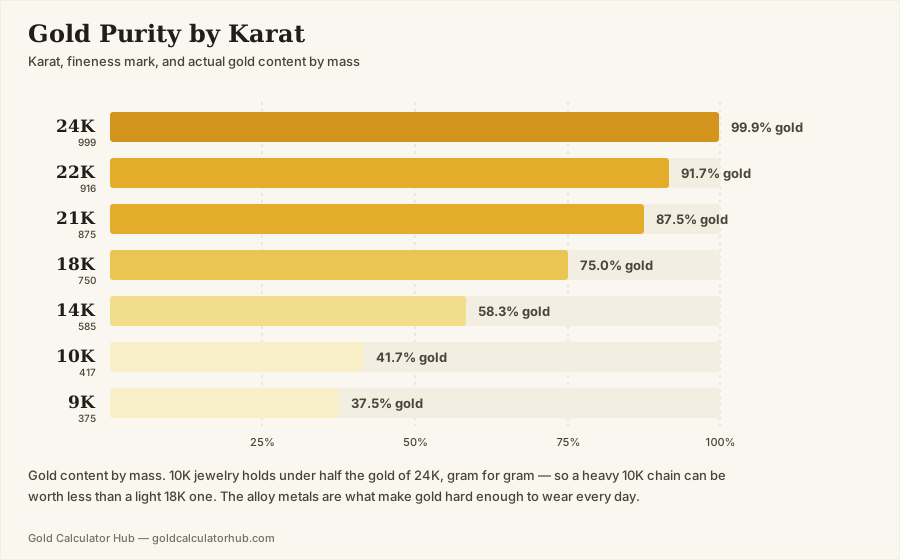
A karat is a twenty-fourth. That is the entire system: 24K means 24 parts out of 24 are gold, 18K means 18 parts out of 24, 10K means 10 parts out of 24. Divide the karat number by 24 and you have the gold fraction; multiply by 100 and you have the percentage. Everything else on this page is bookkeeping.
The reason jewelry is not simply pure gold is mechanical. Pure gold is soft enough to mark with a fingernail edge and far too ductile to hold a stone setting or survive a decade of doorframes. Alloying it with copper, silver, zinc, nickel or palladium buys hardness, and — as a side effect — color. The alloy is why rose gold blushes and white gold pales, and it is also why a 22K bangle bends where a 10K ring shrugs.
Europe and most of the metric world skip the fraction and stamp millesimal fineness instead: parts per thousand. A 750 stamp is 18K. A 585 stamp is 14K. A 417 stamp is 10K. Same information, different dialect. Our gold purity chart lines up both systems side by side, and the gold percentage to karat chart works the conversion in reverse if you already know the percentage and need the karat name.
The Formula: Spot Price to Karat Value
Every karat calculation, on this site or anywhere else, is this expression:
(spot price per troy ounce ÷ 31.103) × (karat ÷ 24) × weight in grams = melt value
Three moving parts, in order. The first term converts the market's quoting unit — the troy ounce, 31.103 grams — into a per-gram price for pure gold. The second term is the purity fraction. The third is simply how much metal you have.
Work it through with a clean assumed price. Take gold at $4,400 per troy ounce, which sits inside the recent trading band of roughly $4,300–$4,500. Divide $4,400 by 31.103 and pure gold runs $141.46 per gram. That single number is the backbone of every row in the chart below; each karat is just that figure scaled down by its purity fraction.
For 14K: $141.46 × (14 ÷ 24) = $141.46 × 0.5833 = $82.52 per gram. For 18K: $141.46 × 0.75 = $106.10 per gram. For 10K: $141.46 × 0.4167 = $58.95 per gram.
The only variable you cannot pin down in advance is spot, which moves every trading session and is fixed twice daily through the London auction run by the LBMA. That is precisely the part the calculator above handles for you — it pulls the live price so the purity math never runs on a stale number. If you want the derivation spelled out step by step with more examples, we wrote it up separately in how to calculate gold price.
The Complete Karat Chart: 9K Through 24K
Here is every karat you are realistically going to encounter, with its fineness stamp, gold percentage, decimal multiplier, and melt value in the three units buyers actually quote. All dollar columns assume gold at $4,400 per troy ounce.
| Karat | Stamp | % gold | Multiplier | Per gram | Per dwt | Per troy oz |
|---|---|---|---|---|---|---|
| 24K | 999 | 99.9% | 0.999 | $141.32 | $219.76 | $4,395.60 |
| 22K | 917 / 916 | 91.67% | 0.9167 | $129.68 | $201.65 | $4,033.48 |
| 21K | 875 | 87.5% | 0.875 | $123.78 | $192.48 | $3,850.00 |
| 18K | 750 | 75% | 0.75 | $106.10 | $164.98 | $3,300.00 |
| 14K | 585 / 583 | 58.33% | 0.5833 | $82.52 | $128.31 | $2,566.52 |
| 10K | 417 | 41.67% | 0.4167 | $58.95 | $91.66 | $1,833.48 |
| 9K | 375 | 37.5% | 0.375 | $53.05 | $82.49 | $1,650.00 |
A few notes on the odd entries. India's BIS hallmarking system stamps 22K as 916 rather than 917 — it rounds down, so a 916 piece is treated identically to 917 for valuation. Older European 14K is often stamped 583, the mathematically exact figure, while American manufacturers standardized on 585 so a piece would never assay below its mark. And 9K, the everyday standard in Britain, Ireland and Australia, cannot legally be sold as "gold" in the United States at all — the US floor is 10K, which is why 10K exists as a category in the first place.
The pennyweight column is worth memorizing if you sell in the US, because a large share of dealers quote in dwt. One pennyweight is 1.555 grams, so every per-gram figure above is multiplied by 1.555. The full per-unit breakdown lives on our gold price per pennyweight calculator.
The Multiplier Column, or How to Do This Without a Calculator
People search for an "all karat melting formula chart" because they want one number per karat that they can carry in their head or write on the back of an envelope. The multiplier column is that number.
The procedure has two steps and no arithmetic you cannot do on a phone:
- Find today's price of pure gold per gram — spot divided by 31.103, or just read it off the calculator above.
- Multiply by the karat's decimal multiplier, then by your weight in grams.
That is it. At $141.46 per gram of pure gold, a 40-gram 14K parcel is 141.46 × 0.5833 × 40 = $3,300.68. A 6.2-gram 22K pendant is 141.46 × 0.9167 × 6.2 = $803.98. An 88-gram 10K bracelet lot is 141.46 × 0.4167 × 88 = $5,187.48.
The multiplier never changes. Only spot moves. If you memorize one column from the chart above, memorize that one — it is the part of the formula that stays true on every trading day for the rest of your life.
A karat gold calculator does exactly this, just faster and with a live price instead of an assumed one. The multipliers are worth sanity-checking against each other, too, because the ratios are a useful gut check. 10K is exactly 5/9 the value of 18K per gram, and about 71% of 14K's value. 22K is roughly 1.22 times 18K. If a buyer's quoted prices for two karats do not sit in roughly those proportions, something in their pricing is arbitrary, and you should ask them to explain it.
Worked Example: A 50-Gram Mixed Lot, Sorted and Unsorted
Abstract percentages do not persuade anyone. Money does. So take a realistic drawer clear-out: a 22K bangle at 18.4 g, a 14K figaro chain at 26.7 g, and a 10K signet ring at 4.9 g. Fifty grams of gold, three different karats, all stamped legibly.
Priced correctly at our assumed $4,400/oz:
- 22K bangle: 18.4 g × $129.68 = $2,386.14
- 14K chain: 26.7 g × $82.52 = $2,203.20
- 10K ring: 4.9 g × $58.95 = $288.85
- Total melt value: $4,878.19
Now suppose the lot goes on the scale as one pile and gets priced as 14K — the karat with the most metal in the parcel, and the assumption a rushed buyer defaults to. Fifty grams × $82.52 = $4,125.85. The seller just donated $752.34 to the counter, and every stamp was there to be read.
It gets worse if the pile is priced at the lowest karat present. Fifty grams valued as 10K is $2,947.43 — a shortfall of $1,930.76, or roughly 40% of the true melt value, on a transaction that took four minutes.
The fix costs nothing. Sort by stamp before you leave the house, weigh each karat separately, and ask for a per-gram price *per karat* rather than a lump sum for the bag. Run each pile through the gold calculator first so you know the three ceilings you are negotiating down from. At an 80% payout — a reasonable outcome from a competitive online refiner — the correctly sorted lot brings $3,902.55, which is still more than the unsorted lot's *full melt value* priced as 10K.
Units: Where Sellers Quietly Lose 10%
Karat sets purity. Units set everything else, and they are the second most common place a valuation goes wrong.
The troy ounce (31.103 g) is the gold market's unit. The standard or avoirdupois ounce (28.350 g) is your kitchen scale's unit. They are not the same, and the gap is about 9.7%. If you weigh a piece in standard ounces and multiply by a troy-ounce price, you underprice your gold by roughly a tenth before anyone has said a word about karat. We took that trap apart in detail on troy ounce vs ounce.
The pennyweight (1.555 g) is the traditional US jewelry-trade unit — twenty of them make a troy ounce. Nothing about quoting in dwt is dishonest; it is simply older than the metric system's arrival in the trade. But it does mean a per-dwt price looks larger than the equivalent per-gram price, which makes a low offer harder to spot at a glance. If a dealer says "$95 a pennyweight for your 14K," divide by 1.555 to get $61.09 per gram, compare that to the $82.52 melt figure in the chart, and you know instantly that you are being offered about 74% of melt.
Grams are the safest default. They are what jewelry scales report, what refiners settle in, and what the calculator above expects. When a buyer switches units mid-conversation, convert everything back to grams before you compare anything.
When the Stamp Is Wrong or Missing
A karat calculator is only as honest as the number you feed it, and the stamp is a claim, not a certificate. Three failure modes turn up constantly.
The stamp is a plating code. Marks like 14K GF (gold-filled), GP or GEP (gold-plated), HGE (heavy gold electroplate), RGP (rolled gold plate) and "1/20 12K" all contain a karat number and describe items that are overwhelmingly base metal. A gold-filled chain carries roughly 2–3% gold by weight; running it through any karat calculator as solid gold produces a number off by a factor of thirty. Our guide to gold hallmarks decodes the full alphabet soup.
The stamp is counterfeit. Fake 750 and 585 marks are cheap to apply and turn up on plated brass constantly. A magnet test is free and catches the crudest fakes; a $20 acid kit resolves karat at home; and most coin or bullion dealers will run a non-destructive XRF scan in seconds. How to tell real gold from fake walks through the tests in order of cost.
There is no stamp at all. Common on very old pieces, on jewelry that has been resized, and on anything made where hallmarking was not required. Unmarked does not mean worthless — it means untested. Get it assayed before you accept a price, because a buyer facing an unmarked piece has every incentive to assume the lowest plausible karat.
When the metal and the mark disagree, believe the metal.
Melt Value Is the Ceiling, Not the Offer
The number the calculator gives you is the value of the raw gold in the item. It is not what anyone will hand you, and expecting otherwise is the fastest route to feeling cheated by a perfectly fair offer.
Every buyer in the chain needs margin — for refining costs, assay, shipping, insurance, inventory risk and profit. What varies enormously is how much margin each type takes. Across the market, the ranges look like this:
- Online refiners: 70–90% of melt. Highest payouts, because they sit closest to the refinery and compete on rate.
- Local coin and bullion dealers: 65–85%. Immediate cash, no shipping, real negotiating room on larger parcels.
- Jewelry stores: 50–75%. Convenient, often better if you take store credit rather than cash.
- Pawn shops: 40–60%. Paying for speed and anonymity, and pricing accordingly.
- Mail-in TV services: 20–50%. The advertising budget comes out of your payout.
On our 50-gram example lot, that spread runs from about $976 at the worst end to $4,390 at the best — on identical metal. We break down where those numbers come from in what percentage do gold buyers pay and how much below spot should you sell gold.
Before you mail anything anywhere, the FTC's guidance on selling gold jewelry is a five-minute read covering appraisal disclosure, return terms and what a reputable mail-in operation does differently.
Cases Where Karat Value Is the Wrong Question
For most scrap — broken chains, single earrings, dated settings, dental crowns, unmarked fragments — melt value is the honest benchmark and the calculator gives you the right frame. But there are three categories where running the karat math and stopping there costs real money.
Signed and designer pieces. A Cartier, Tiffany, Van Cleef or Bulgari item routinely resells above its gold content, sometimes far above. So do vintage pieces from named American makers. If there is a signature next to the karat stamp, get a resale quote before a scrap quote.
Bullion coins. A sovereign, Krugerrand, Eagle or Maple Leaf trades at a premium over its metal content that reflects mintage, condition and demand, not just purity. Melting one is almost always the worst available outcome. Our melt value of gold coins page gives the metal floor for each major coin so you can see how much premium a dealer's offer actually contains.
Watches. An 18K case on a working Swiss watch is worth a fraction of the assembled watch. Never scrap a watch whole, and never let a buyer weigh one with the movement inside.
Everything else — and that is the large majority of what comes out of a jewelry box — is priced by purity times weight times spot, exactly as the chart above lays out. If you are weighing whether to sell now or wait, that is a question about the gold market, not about your karat stamp, and the stamp will still say the same thing next quarter.
Using the Calculator Without Getting Fooled
A short operating checklist, in the order the steps actually matter.
- Read every stamp and sort into piles by karat. Set aside anything with a plating code or a designer signature.
- Weigh each pile separately in grams, on a scale that reads to 0.1 g. A $15 jeweler's scale pays for itself on the first transaction; how to weigh gold covers the pitfalls, including stones and clasps.
- Deduct non-gold weight — stones, steel spring bars, watch movements, enamel. Buyers deduct it, so you should too, or your expectations will be permanently out of line with every offer you receive.
- Run each pile through the calculator above at its own karat. Write down the melt figures.
- Get at least three quotes, and ask each buyer for a price per gram at each karat rather than a single number for the bag. Comparable quotes are the entire point.
- Compare each offer to melt as a percentage. Anything under 50% deserves a reason.
One last thing worth saying plainly, because it is the reason this site exists: the person across the counter knows all of the above. The only asymmetry in a gold transaction that you can actually close is the information gap, and it closes in about ninety seconds with a stamp, a scale and a karat gold calculator. This is general valuation information rather than financial advice — if you are selling an estate or a large holding, a professional appraisal and a conversation with a tax adviser are both worth the fee.
Frequently Asked Questions
What karat is 585 gold?
585 is 14K — 585 parts gold per thousand, or 58.33% pure. It is the most common stamp on American jewelry and one of the two marks used worldwide for 14 karat. You will also see 583 on older European pieces, which is the mathematically exact figure; US manufacturers rounded up to 585 so a piece would never assay below its own stamp. Both mean the same metal, and both price identically at melt.
Can a karat calculator tell me if my gold is real?
No. A calculator converts a karat and a weight into a dollar value; it takes the stamp on faith. Verifying the metal is a separate physical step — a magnet test rules out steel cores for free, a density check catches many fakes, an acid kit costs about $20 and resolves karat at home, and an XRF scan at a coin dealer is non-destructive and usually free for potential sellers. Test first, then calculate.
Why is 24K listed as 99.9% instead of 100%?
Because refining to literal 100% purity is not commercially achievable, and every standard reflects that. Investment-grade gold is 999 fine (99.9%) or 9999 fine (99.99%), with the remainder being trace amounts of silver, copper or platinum-group metals. For valuation purposes the difference is negligible — a gram of 999 gold contains 0.001 g less gold than a hypothetical pure gram, which at recent prices is about fourteen cents.
How do I convert a karat number to a percentage myself?
Divide the karat by 24 and multiply by 100. So 18 ÷ 24 = 0.75 = 75%. 14 ÷ 24 = 0.5833 = 58.33%. 10 ÷ 24 = 0.4167 = 41.67%. The same division gives you the decimal multiplier used in every melt calculation on this page. Going the other direction — percentage back to karat — just multiply the decimal by 24, which is what the reverse lookup chart on this site is built for.
Do refiners pay more per gram for higher karat gold?
They pay more in absolute dollars, obviously, since there is more gold per gram. They often also pay a slightly higher percentage of melt on high-karat parcels, because refining costs are largely fixed per batch and recovery is better when the input is purer. In practice the difference is modest — a few percentage points — and it is dwarfed by the spread between buyer types. Shopping around beats optimizing karat mix every time.
What is the lowest karat that can be sold as gold in the US?
10K, which is 41.67% gold. Anything below that cannot legally be marketed as gold in the United States, which is why 10K exists as a distinct commercial category and why you almost never see American 9K jewelry. The UK, Ireland and Australia set their floor at 9K (37.5%), so inherited or imported pieces from those markets will legitimately carry a 375 stamp that no US retailer would use.
Is white gold worth less than yellow gold at the same karat?
At melt, no — 18K white and 18K yellow both contain 75% gold and price identically per gram. The other 25% differs (nickel or palladium versus copper and silver), and palladium-alloyed white gold can carry a small extra recovery value at some refiners. White gold is usually rhodium-plated, which adds nothing to melt value but can obscure the karat stamp, so check the clasp and the inside of the shank carefully.
How much does a karat calculator's answer change day to day?
As much as spot does, which historically means fractions of a percent on a quiet day and a few percent on a volatile one. The purity multipliers never move; only the price of pure gold does. That is why a static chart printed last month is still perfectly useful for the percentage columns and completely useless for the dollar columns — and why the tool above pulls a live price rather than shipping a hardcoded one.
My piece is stamped 14K but a buyer says it tested 12K. Who is right?
Possibly both, and it is worth understanding why. Solder joints, clasps and repair work are often lower karat than the body of the piece, so a spot test on the wrong millimeter reads low. Plated or filled items also test low at the surface once the layer is worn. Ask which point was tested and request a second reading elsewhere on the item. If the whole piece consistently tests below its stamp, the stamp is not honest.
Should I sell 22K jewelry as scrap or as jewelry?
Check resale first, especially for South Asian and Middle Eastern wedding pieces, which have real secondhand demand within their communities and often sell close to or above melt with the workmanship included. Generic 22K chain with no design interest is fine to scrap. The high purity means refiners like it and payouts tend to sit near the top of each buyer type's range, so the downside of scrapping is smaller here than at 14K.
Does the calculator account for stones set in the piece?
No, and neither will a buyer in your favor. Every calculation on this page prices gold by weight, so any weight that is not gold has to come off before you enter a number. Weigh the piece, estimate or have the setter remove the stones, and use the gold-only figure. Diamonds and valuable colored stones should be removed and sold or kept separately; commercial-grade stones in class rings generally add nothing to a scrap transaction.
Why do two buyers quote such different prices for identical gold?
Because they have different cost structures and different reasons for wanting your metal, not because one of them has a different opinion about purity. A refiner processing kilos a week runs on thin margins and high volume. A pawn shop is pricing an illiquid loan against an item it may hold for months. A jeweler may be buying to re-set rather than melt. The metal is identical; the business model is not, and that is the entire spread.

Written by Sukie Gao
Sukie Gao holds a master's degree from a business school, where she picked up the markets-and-pricing toolkit she now applies to the consumer gold trade. She created Gold Calculator Hub to give people an independent, data-driven way to find out what their gold is really worth.
Published August 6, 2026