How Much Is a Gram of Gold Worth? By Karat, Today
 By Sukie Gao · August 25, 2026
How much is a gram of gold worth? That depends entirely on one thing people skip past: a gram of *what*. A gram of bullion and a gram of the chain around your neck are different amounts of gold by a factor of nearly two, and the difference is the whole ballgame. The calculator above pulls the live spot price and does the conversion for whatever karat you pick, so if you just want the number, take it and go. What follows is the arithmetic underneath it — because the single most useful thing you can learn about gold pricing is how to get from a headline "gold hits $4,400 an ounce" to what your specific piece is worth per gram, without anyone's help. It's one division and one multiplication. Once you can do it, no quote you're ever offered is a mystery again, and you'll notice immediately when someone quotes you a per-gram figure that quietly assumes a different unit than the one on their scale.
Start With the Ounce, End With the Gram
Gold is quoted globally in US dollars per troy ounce. That's the LBMA benchmark, the futures contracts, the number on every financial news ticker. Nothing in that world is quoted per gram. So the conversion is on you.
A troy ounce is 31.103 grams. That's the only constant you need.
Step 1 — Spot price to price per gram of pure gold: spot price ÷ 31.103 = dollars per gram of 24K
Assume gold at $4,400 per troy ounce. $4,400 ÷ 31.103 = $141.46 per gram of pure gold.
Step 2 — Adjust for your karat: dollars per gram of pure × purity = dollars per gram of your item
A gram of 14K gold is 58.33% gold, so 0.5833 × $141.46 = $82.51.
That's it. Two operations, no software. If you want the value of an actual object, add a third step — multiply by the item's weight in grams — and you have its melt value.
The reason this matters more than it looks: almost every price you'll be quoted by an American buyer is per gram, and almost every price you'll see in the news is per troy ounce. The gap between those two units is where confusion lives, and confusion is expensive. The how to calculate gold price page walks the same formula from a slightly different angle if you want a second pass at it.
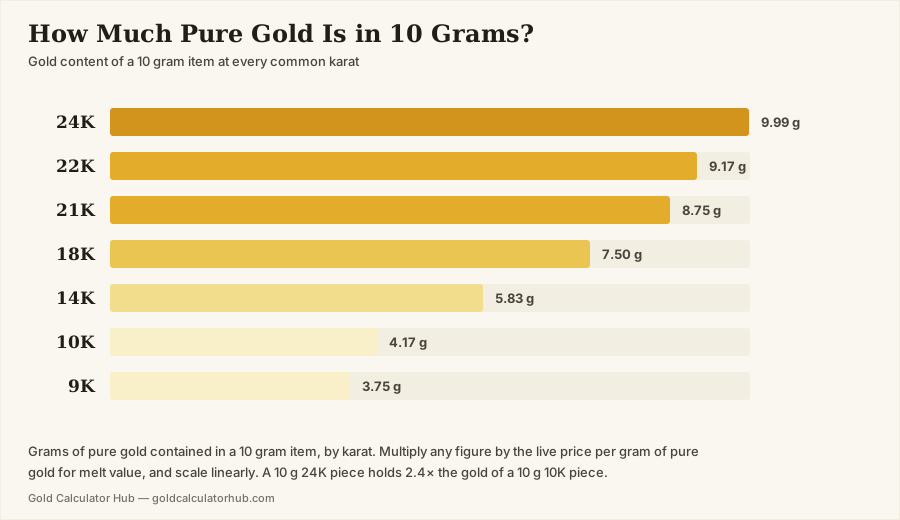
What One Gram Is Worth at Each Karat
Here's the full ladder — how much is a gram of gold worth at each of the karats you're realistically holding. Every figure assumes gold at $4,400 per troy ounce — that is, $141.46 per gram of pure gold. Recent prices have run near $4,300–$4,500 per troy ounce, so treat this as a working ballpark and let the calculator above give you the live figure.
| Karat | Fineness | Purity | Value of 1 gram |
|---|---|---|---|
| 24K | 999 | 99.9% | $141.32 |
| 22K | 917 | 91.67% | $129.68 |
| 21K | 875 | 87.5% | $123.78 |
| 18K | 750 | 75% | $106.10 |
| 14K | 585 | 58.33% | $82.51 |
| 10K | 417 | 41.67% | $58.95 |
| 9K | 375 | 37.5% | $53.05 |
Look at the spread. A gram of 24K is worth 2.4 times a gram of 10K. Same weight, same metal on the periodic table, wildly different money. Which is why "how much is gold per gram" is an unanswerable question until someone tells you the karat — and why any buyer who weighs your mixed pile as one lot and quotes a single per-gram rate is doing something that costs you money.
Two of the most-searched cases have their own pages with deeper treatment: how much is 14K gold worth for the American default, and how much is 18K gold worth for European and designer pieces. If your piece is 10K, 10K gold price per gram covers the low end in detail.
Change the Spot Price, Change Everything
Purity percentages never move. Spot moves every trading day, sometimes several percent in a week. So the useful skill is running the conversion at whatever number is on the screen today.
| Spot price per troy oz | Price per gram (24K) | 18K per gram | 14K per gram | 10K per gram |
|---|---|---|---|---|
| $3,300 | $106.10 | $79.58 | $61.89 | $44.21 |
| $3,500 | $112.53 | $84.40 | $65.64 | $46.89 |
| $4,000 | $128.61 | $96.46 | $75.02 | $53.59 |
| $4,300 | $138.25 | $103.69 | $80.64 | $57.61 |
| $4,400 | $141.46 | $106.10 | $82.51 | $58.95 |
| $4,500 | $144.68 | $108.51 | $84.39 | $60.29 |
| $5,000 | $160.76 | $120.57 | $93.77 | $66.99 |
That first row answers a question people search verbatim: *how much is 1 gram of gold worth when the international gold price is $3,300 per ounce?* Answer: $3,300 ÷ 31.103 = $106.10 per gram of pure gold. If the gram in question is 14K, multiply by 0.5833 and you get $61.89.
One trap buried in that phrasing. "International gold price" always means the troy-ounce price. If someone quotes you $3,300 per *standard* ounce — the 28.350 g kitchen ounce — the per-gram figure would be $3,300 ÷ 28.350 = $116.40, about 10% higher. Nobody in the bullion market uses standard ounces, but the two words look identical on a page, and sellers have been burned by the difference. Troy ounce vs ounce unpacks that specific 10% gap.
Notice also that the columns scale perfectly linearly. Gold at double the price makes every karat worth exactly double per gram. There's no threshold, no bonus, no penalty — just one multiplication propagating through.
A Real Piece: The 18.4-Gram Bangle
Abstract tables are easy to nod at and hard to use. So take a specific object: an 18K bangle, hallmarked 750, weighing 18.4 grams on a $15 digital pocket scale. Assume gold at $4,400 per troy ounce.
- Price per gram of pure gold: $4,400 ÷ 31.103 = $141.46
- Pure gold content of the bangle: 18.4 g × 0.75 = 13.8 g
- Melt value: 13.8 × $141.46 = $1,952
That $1,952 is the gold in the object. It is not what anyone will hand you, and this is the point where most people's mental model breaks. Apply the real payout bands and the same bangle looks like this:
| Buyer type | Typical payout | What you'd get |
|---|---|---|
| Online refiner | 70–90% | $1,366–$1,757 |
| Coin/bullion dealer | 65–85% | $1,269–$1,659 |
| Jewelry store | 50–75% | $976–$1,464 |
| Pawn shop | 40–60% | $781–$1,171 |
| Mail-in TV service | 20–50% | $390–$976 |
Same bangle, same afternoon, and the best outcome is more than four times the worst. That spread is not a rounding error or a matter of luck — it's a predictable function of which door you walk through, and it's covered in full at what percentage do gold buyers pay.
One more wrinkle specific to this example: an 18K bangle in good condition with a recognizable maker's mark may be worth more intact than melted. Melt value is the floor, not the ceiling. Check for hallmarks and designer signatures before you scrap anything — the floor is always available tomorrow.
A Gram of Gold Is Not a Gram of Payout
The number the calculator above gives you is melt value: the market worth of the gold content, priced off the global benchmark. Every buyer in the chain pays some fraction of it, and understanding why keeps you from taking a 45% offer personally.
Between your gram and the benchmark sit real costs. The metal has to be tested, and a buyer paying cash before an assay is taking a purity risk. It has to be melted and refined, which carries per-lot fees and minimums that fall hardest on small lots. It has to be held — sometimes through a state-mandated waiting period — during which the gold price can move against the buyer. And the buyer has rent, staff, insurance, and compliance obligations to cover out of the spread.
None of that entitles anyone to lowball you. It just explains why nobody pays 100% of melt for scrap, and why the honest question is never "will I get spot?" but "what percentage am I getting, and is it competitive?"
The Federal Trade Commission's guidance on selling gold jewelry makes the same point in fewer words: know your item's weight and karat before you shop it around, and get more than one offer. Both of those are free. Knowing your per-gram melt value turns a quote from a verdict into a percentage you can compare — see how much below spot should you sell gold for where the realistic lines fall.
Grams, Pennyweights, and the Ounce That Isn't an Ounce
American gold buyers use three different weight units, and switching between them is the oldest trick at the counter — not because it's illegal, but because a bigger-sounding number lands better.
- Gram (g) — the default for jewelry and scrap. What most scales show.
- Pennyweight (dwt) — 1 dwt = 1.555 g, or 1/20th of a troy ounce. Still standard in parts of the US jewelry trade.
- Troy ounce (ozt) — 31.103 g. The unit gold is quoted in worldwide.
- Standard ounce (oz) — 28.350 g. The kitchen ounce. Has no business anywhere near gold, and appears mostly in errors.
Take our 14K at $82.51 per gram and watch the same metal change costume:
| Unit | 14K value | 18K value |
|---|---|---|
| 1 gram | $82.51 | $106.10 |
| 1 dwt (1.555 g) | $128.30 | $164.98 |
| 1 troy oz (31.103 g) | $2,566.52 | $3,300.00 |
A buyer offering "$128 a pennyweight" and a buyer offering "$82.50 a gram" are offering exactly the same money. The first sounds meaningfully better. Always ask which unit a quote is in, then convert to grams before comparing anything — the gold price per pennyweight calculator handles that conversion if you'd rather not do it on your phone at the counter.
And weigh at home first. A $15 scale reading to 0.01 g removes any argument about the number the whole calculation rests on.
Where the Per-Gram Number on Your Screen Comes From
It's worth knowing what you're actually looking at when a site — this one included — shows a live gold price.
The reference number for the global market is the LBMA Gold Price, set twice each London business day through an electronic auction among accredited participants. Around that benchmark, gold trades continuously in over-the-counter markets and on futures exchanges, which is what produces the second-by-second "spot" quote you see online. The LBMA publishes the benchmark methodology and the good-delivery standards that define what deliverable gold even is.
Three things follow that matter for a per-gram figure:
It's wholesale. Spot describes large, assayed, exchange-deliverable bars moving between institutions. Your chain is none of those things, which is the structural reason retail scrap trades at a discount and retail bullion trades at a premium.
It's per troy ounce, always. Any per-gram price anywhere is a derived number — someone divided by 31.103 on your behalf. If a site won't tell you what spot price its per-gram figure came from, you can't check its work.
It's stale the moment it renders. The answer to how much is a gram of gold worth changes during market hours. A quote from an hour ago is directionally useful and precisely wrong, which is why any responsible calculator timestamps its price.
For a live figure you can act on today, the gold price per gram calculator runs the same conversion across all karats at once, and the main gold calculator handles weight, karat, and payout estimates together.
Frequently Asked Questions
How much is 1 gram of 24K gold worth?
With gold at $4,400 per troy ounce, one gram of pure gold is worth about $141.32. The arithmetic: $4,400 divided by 31.103 grams per troy ounce gives $141.46 per gram of theoretically pure gold, and 24K bullion is 99.9% fine, so multiply by 0.999. Prices have recently run near $4,300–$4,500 per troy ounce, which puts a gram of 24K roughly in the $138–$144 band. Use the calculator above for the live number.
How much is 1 gram of 14K gold worth?
About $82.51 with gold at $4,400 per troy ounce. Fourteen karat is 58.33% gold, so a gram of it contains 0.5833 g of actual gold: 0.5833 × $141.46 = $82.51. That's melt value — the worth of the metal itself. A buyer will pay a percentage of it, typically 70–90% at an online refiner and 40–60% at a pawn counter, so the same gram fetches roughly $58–$74 from a refiner or $33–$50 at a pawn shop.
Why do buyers quote per gram when gold trades per ounce?
Because jewelry is small. A typical chain weighs 5 to 40 grams, which is a fraction of a troy ounce, and quoting a fraction is awkward at a counter. Grams also match the scales used in the trade. The conversion is a straight division by 31.103, so nothing is hidden by it — but it does mean you can't compare a news headline to a counter offer without doing that division yourself first.
Is a gram of gold jewelry worth the same as a gram of gold bullion?
No, and the gap is large in both directions. A gram of 14K jewelry contains 58.33% of the gold in a gram of 24K bullion, so its melt value is lower by that ratio. Then bullion trades near or slightly above spot because it's assayed, recognizable, and instantly resellable, while scrap jewelry trades well below spot because it has to be tested, melted, and refined. The two are different products that happen to share an element.
How much is 1 gram of gold worth if gold is $3,300 an ounce?
$106.10 per gram of pure gold — $3,300 divided by 31.103 grams per troy ounce. At that spot price, 18K works out to $79.58 per gram, 14K to $61.89, and 10K to $44.21. The formula never changes with the price level; only the input does. Be careful with the word 'ounce' in that question, though: international gold quotes are always troy ounces. Using the 28.350 g standard ounce would inflate the per-gram figure by about 10%.
How many grams of gold are in a troy ounce?
31.103 grams, usually rounded to 31.1 for mental math. A standard avoirdupois ounce — the one on a kitchen scale — is 28.350 grams, about 10% lighter. Precious metals have used the troy system for centuries, so every spot quote, futures contract, and bullion bar is denominated in troy ounces. Mixing the two units is one of the most common and most expensive mistakes a first-time gold seller makes.
How much does a gram of gold cost to buy versus sell?
Buying costs more than melt and selling brings less. Retail bullion carries a premium over spot to cover minting, distribution, and dealer margin, so a one-gram bar typically costs meaningfully more than its gold content. Selling scrap jewelry runs the other way at 40–90% of melt depending on the buyer. That round-trip spread is why gold is generally a poor short-term trade in physical form, and why melt math is the useful anchor in both directions.
Does the weight of stones and clasps count toward the gram price?
No. Buyers pay for gold content only, so gemstones, pearls, spring clasps made of steel, and any non-gold components get deducted or removed before weighing. On a stone-set ring the deduction can be substantial. Weigh the piece yourself, then ask any buyer to show you what they subtracted and why. If a store won't itemize the deduction, that's a reason to get a second quote rather than a reason to argue.
How accurate does my scale need to be?
Readable to 0.01 g is plenty for jewelry, and pocket scales at that resolution are inexpensive. At $141 per gram of pure gold, a tenth of a gram of 14K is roughly eight dollars — small on one ring, not small across a lot of twenty pieces. Calibrate with the weight that ships with the scale, weigh on a hard flat surface, and weigh each karat group separately rather than tossing everything in one pan.
Why did my gold's per-gram value change between two visits?
Spot moved. Gold trades nearly around the clock and can swing a few percent in a week, so a quote from Monday is genuinely a different number by Friday. Beyond that, buyers set their own buy rates and adjust them with volume, inventory, and how busy the refining pipeline is. If two quotes on the same piece differ by more than the price moved, the difference is the buyer's margin, not the market's.
Is white gold worth less per gram than yellow gold?
No. Color comes from the alloying metals, not the gold content. An 18K white gold ring and an 18K yellow gold ring are both 75% gold and carry identical melt value per gram. The only practical difference is that white gold is usually rhodium-plated, so its surface can mislead a quick visual assessment — and the plating itself has no melt value. The karat stamp, not the color, is what any refiner pays on.
What is the smallest amount of gold worth selling?
It depends on the venue more than the gram count. Online refiners often set lot minimums and charge per-shipment fees, so a single 2 g 10K earring — about $118 of melt at $4,400 an ounce — may not clear the friction. Local dealers and pawn shops will take small lots but pay the least. The usual advice is to accumulate scrap until you have a few hundred dollars of melt, then shop it seriously to two or three buyers at once.
Can I use the per-gram price to value a gold coin?
For melt value, yes — multiply the coin's gold content by the per-gram price. But most bullion and collectible coins sell for more than melt. A one-ounce American Gold Eagle contains a full troy ounce of gold despite weighing more than that (it's 22K), and it trades at a premium over spot because it's recognized and liquid. Numismatic coins can be worth multiples of melt. The melt value of gold coins page covers the major issues.

Written by Sukie Gao
Sukie Gao holds a master's degree from a business school, where she picked up the markets-and-pricing toolkit she now applies to the consumer gold trade. She created Gold Calculator Hub to give people an independent, data-driven way to find out what their gold is really worth.
Published August 25, 2026