Gold Ring Value Calculator: Melt Value Minus the Stones
 By Sukie Gao · October 10, 2026
A gold ring value calculator gives you the melt value of the metal in a ring — and with rings, that qualifier does more work than with any other piece of jewelry. A chain is gold and a clasp. A ring is very often gold, plus stones, plus sometimes a second metal in the setting, plus in a meaningful minority of cases a design or maker that is worth more than everything else combined.
So the sequence for rings is: separate the metal from everything else, value the metal honestly with the calculator above, and then ask separately whether the ring is worth more as a ring. That last question is where people lose real money, because it is the one a scrap buyer has no incentive to raise.
Rings are also the item most likely to carry a legible hallmark, since the inside of a band is protected from wear. Slip it off, look inside with a loupe, and the purity question usually answers itself in ten seconds.
Reading the inside of the band
Nearly every gold ring made in the last century is marked inside the shank, and because that surface rubs against a finger rather than against the world, the mark often survives decades of wear.
What you will find there, in roughly this order of frequency:
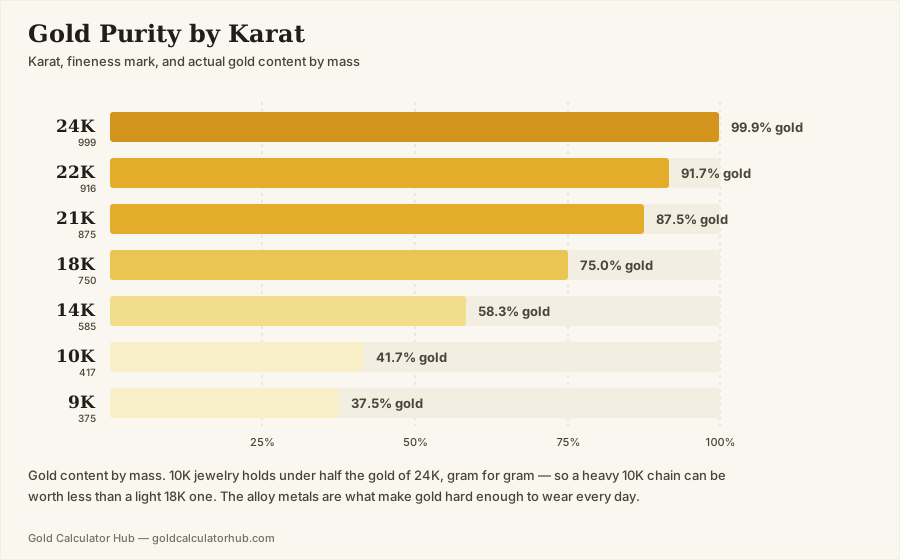
Purity — 10K, 14K, 18K, or the fineness equivalents 417, 585, 750, 916.
A maker's mark — initials, a symbol, or a registered logo. Worth photographing and searching; this is how you discover a ring is signed.
A country or assay mark on British and European pieces.
A ring size, usually a plain number, which is not a purity mark and confuses people constantly. A "7" inside a band is a size, not seven karat.
Plating codes — GP, HGE, GEP, or "14K HGE" which means heavy gold electroplate over base metal, not 14K gold. The presence of extra letters after a karat mark almost always downgrades the item severely.
If the band is worn smooth with no mark at all, that is common on older or resized rings — resizing frequently removes the marked section. It means testing rather than reading.
US karat marking is governed by the National Gold and Silver Stamping Act as interpreted in the FTC Jewelry Guides, which make a false karat mark illegal but require no independent assay — unlike the UK system.
Subtracting the stones
This is the step that makes ring valuation different, and the one where estimates go wrong.
A gold ring's melt value depends on the mass of gold, not the mass of the object. A solitaire setting can easily be 30–40% stone by weight; a pavé band can be more.
Three approaches, in order of accuracy:
Have it weighed with stones excluded. A jeweler can estimate stone weight from dimensions, or in some cases weigh the mount separately. This is the honest number.
Estimate from carat weight. A one-carat diamond weighs 0.2 g. So a ring with a 1 ct centre and 0.3 ct of accent stones carries roughly 0.26 g of diamond. Coloured stones vary — sapphire and ruby are denser than diamond, so a one-carat sapphire is physically smaller but weighs the same by definition, since a carat is a unit of mass.
Estimate conservatively and move on. Subtract a plausible stone mass and treat the result as a floor. Being wrong in the direction of "less gold than I thought" means a real quote surprises you upward.
What you should not do is put the whole ring on a scale and apply the gold price to it. On a stone-heavy ring that overstates the metal by a third or more.
The calculation with realistic ring weights
gold weight in grams × purity × price per gram of pure gold = melt value
At $143 per gram of pure gold:
| Ring | Gross | Stones | Gold | Karat | Melt |
|---|---|---|---|---|---|
| Plain wedding band, 4 mm | 4.6 g | — | 4.6 g | 14K | $384 |
| Plain band, 6 mm comfort fit | 8.1 g | — | 8.1 g | 18K | $869 |
| Solitaire mount, 1 ct centre | 3.9 g | 0.20 g | 3.7 g | 14K | $309 |
| Signet ring | 11.2 g | — | 11.2 g | 10K | $667 |
| Wide pavé band | 7.4 g | 0.55 g | 6.85 g | 18K | $735 |
| Heavy 22K band | 9.0 g | — | 9.0 g | 22K | $1,180 |
Two things fall out of that table. Plain bands are the best-value scrap because all the weight is metal. And a solitaire's melt value is usually modest — the money in an engagement ring is in the stone, which is a completely separate market with completely different economics.
When the ring is worth far more than its gold
Rings carry design and provenance premiums more often than any other jewelry category, and melting destroys them permanently.
Signed pieces. A maker's mark from a recognised house can multiply value several times over. Photograph any mark you cannot identify and search it before doing anything else.
Antique and period rings. Georgian, Victorian, Art Deco and mid-century rings are collected as objects. Original settings, cut styles and hand-fabrication all matter, and a competent dealer will pay well above melt.
Meaningful stones. A quality diamond over about half a carat, or a good coloured stone, is frequently worth more than the entire gold content. Certified stones especially — a GIA report attached to a diamond makes it far more liquid.
Unusual construction, hand engraving, or filigree that is no longer commercially produced.
The asymmetry is stark: checking costs an afternoon; being wrong costs the object forever. Any ring that is old, signed, or set with something that might be real deserves a second opinion before a scale.
White gold, rose gold, and two-tone rings
Colour is an alloy choice, not a purity difference — a fact worth knowing because it comes up in almost every ring conversation.
White gold is gold alloyed with palladium, nickel or silver, then usually rhodium-plated for brightness. A 14K white gold ring contains exactly as much gold as a 14K yellow one and has the same melt value. The rhodium wears off every few years and needs redoing, which is a maintenance cost rather than a value difference.
Rose gold is copper-heavy alloy. Same karat, same gold content, same melt value.
Two-tone rings combine colours, and both parts are usually the same karat. Value the whole gold weight together.
Platinum settings on gold rings — or the reverse — are the one case where colour signals a real difference. Platinum is denser and priced separately, and a platinum head on a gold shank needs to be separated in the valuation. If a white portion feels notably heavier than it looks, it may be platinum rather than white gold, which a buyer will identify and which is worth confirming.
What buyers pay for rings
| Buyer | Share of melt | Notes on rings specifically |
|---|---|---|
| Online refiner | 70–90% | Best for plain bands and stoneless mounts |
| Coin / bullion dealer | 65–85% | Often uninterested in stone-set pieces |
| Jewelry store | 50–75% | Can pay well above melt if they want to resell it |
| Pawn shop | 40–60% | Will lend against it as well as buy |
| Mail-in / TV service | 20–50% | Frequently returns stones separately, or not at all |
The jewelry store row deserves attention. For scrap, a jeweler pays the least of the serious buyers. But for a ring they can clean, resize and resell — a decent solitaire, a signed piece, a saleable style — a jeweler can pay several times melt, because they are buying an object rather than metal.
That means the right buyer for a ring depends entirely on which kind of ring it is. Plain worn-out band: refiner. Attractive resaleable ring: a jeweler or a secondhand jewelry specialist, and get more than one opinion.
A practical order of operations
- Look inside the shank with a loupe. Note purity, any maker's mark, and anything that looks like GP or HGE.
- Photograph the maker's mark and search it before doing anything irreversible.
- Decide whether it is a scrap candidate at all. Old, signed, or well-set rings usually are not.
- Weigh it in grams on a 0.1 g scale.
- Subtract stone weight — measured if possible, estimated conservatively otherwise.
- Calculate melt with the tool above.
- If the stone is significant, value it separately. Gold melt and stone value are two different markets.
- Get quotes from the right buyer type, and convert each to a percentage of melt.
A plain band can go straight from step 4 to step 8. A grandmother's ring should probably stop at step 3.
Frequently Asked Questions
How much is my gold ring worth?
Its melt value is the weight of gold in grams × purity × the current price per gram of pure gold. For a plain 14K band weighing 5 g, at $143 per gram of pure gold, that is 5 × 0.583 × 143 ≈ $417. For stone-set rings, subtract the stone weight first — a one-carat stone is 0.2 g. And melt is only the floor: signed, antique or well-set rings are frequently worth more intact.
Does the diamond in my ring count toward its gold value?
No — a diamond adds weight but no gold, so including it overstates the metal. Subtract stone weight before calculating: one carat equals 0.2 grams. More importantly, the diamond has its own separate value, which for a good stone over about half a carat often exceeds the entire gold content of the ring. A gold buyer scrapping the mount will typically return the stone to you or offer very little for it, so have it valued on its own terms.
Where is the karat stamp on a ring?
Inside the band, on the shank, usually opposite the setting. Because that surface faces your finger rather than the world, the mark often survives decades of wear better than marks on other jewelry. Use a loupe or a phone camera at maximum zoom. Be careful not to read the ring size — a plain number like 7 inside a band is the size, not a purity mark.
Is white gold worth less than yellow gold?
No. A 14K white gold ring and a 14K yellow gold ring contain identical amounts of gold and have identical melt value. The difference is in the alloy metals — white gold uses palladium, nickel or silver instead of copper, and is usually rhodium-plated for brightness. That plating wears off every few years and needs redoing, which is a maintenance cost rather than a difference in what the metal is worth.
What does 14K HGE mean on a ring?
Heavy gold electroplate: a base metal ring with a microns-thick layer of 14K gold on the surface. It is not 14K gold and its recoverable gold value rounds to essentially zero. Similar codes are GP (gold plated), GEP (gold electroplated) and RGP (rolled gold plate). Any letters following a karat mark should make you stop before applying gold prices to the item's weight.
How much does a gold wedding band weigh?
A plain 4 mm band typically runs 3–5 g, a 6 mm comfort-fit band 7–9 g, and a heavy 8 mm band 10–14 g. Weight rises with width, thickness and ring size, and comfort-fit bands are heavier than flat ones of the same width. Because plain bands are all metal with no stones, they are among the most straightforward gold items to value and among the better scrap items by payout percentage.
Should I sell my engagement ring for scrap gold?
Almost certainly not, and this is the most common expensive mistake in ring valuation. The gold in a solitaire mount is usually worth a few hundred dollars, while the diamond may be worth several thousand. Scrapping the ring destroys the setting and gets you little for the stone. Sell it as a ring — through a secondhand jewelry specialist, a consignment dealer, or a jeweler who resells — and get the stone independently assessed, ideally with any certification you have.
Can a jeweler tell if my ring is real gold?
Yes, in seconds. Most jewelers have an XRF analyser, which reads the actual alloy composition without damaging the piece, and many will test free while you wait. Failing that, an acid test on an inconspicuous spot distinguishes karats reliably. If you want to check at home first, an acid kit costs about $15, and specific gravity testing — weighing the ring dry then submerged — works well for plain bands with no stones.
Do pawn shops pay well for gold rings?
Not compared with the alternatives. Expect 40–60% of melt for an outright sale, and 25–50% for a loan against the ring. On a plain 14K band with $400 of melt, that is roughly $160–$240. An online refiner would pay $280–$360 for the same metal. Pawn shops make sense when you need cash within the hour, or when you intend to redeem the item — not as a way to get a good price.
How do I know if my ring is worth more than melt value?
Four signals: a maker's mark you can identify with a search, a style that dates it before about 1970, stones that look like real gemstones rather than cubic zirconia, and hand-fabrication details like engraving, filigree or milgrain that machine work does not reproduce. Any one of them justifies an appraisal or a second opinion from a dealer who handles estate jewelry. Melting is permanent, so the asymmetry strongly favours checking.
What is a signet ring worth?
Signet rings are usually plain, solid and comparatively heavy, which makes them good scrap by weight — a 10K signet at 11 g holds around $670 of gold at $143 per gram of pure gold. But older signets with hand-engraved crests, hardstone intaglios, or hallmarks from British assay offices are collected, and some sell for well above melt. Check for an assay mark and an engraved face before deciding.
Can I sell a ring without the stone in it?
Yes, and for scrap purposes an empty mount is simpler — the whole weight is gold and there is nothing to estimate. If a stone has fallen out, you are effectively holding a gold mount, and the calculator gives you its value directly. Just check first that the missing stone was not a significant one worth replacing or claiming on insurance, and that the mount itself is not a signed or period piece worth keeping intact.
Does resizing a ring affect its value?
Not its melt value in any meaningful way — a resize adds or removes a small amount of metal, and a good jeweler uses matching karat solder. Two side effects do matter. Resizing often removes or obscures the hallmark, which means the purity has to be tested rather than read. And on antique or signed rings, a visible resize can reduce collector value, because originality is part of what a collector is paying for.

Written by Sukie Gao
Sukie Gao holds a master's degree from a business school, where she picked up the markets-and-pricing toolkit she now applies to the consumer gold trade. She created Gold Calculator Hub to give people an independent, data-driven way to find out what their gold is really worth.
Published October 10, 2026