Gold Percentage to Karat Chart: Reverse Lookup
 By Sukie Gao · Updated October 16, 2026
A gold percentage to karat chart is almost always printed the wrong way around for the person who actually needs it. Most charts start with the karat — 24K, 22K, 18K, 14K — and hand you the percentage, which is fine if you are holding a stamped piece of jewelry and want to know what fraction of it is gold. But a large share of the people searching for this are coming from the other direction entirely. A tester spat out a number. A jeweler said "it's about sixty percent." An assay report on an inherited lot lists purities to two decimal places and not a karat mark anywhere. An old family piece is stamped with a three-digit fineness nobody in the room recognizes. In every one of those cases the percentage is the thing you have, and the karat is the thing you want.
So this page runs the lookup in reverse. Below you'll find the conversion arithmetic (it's one multiplication, and you can do it in your head), a table that goes from percentage to karat rather than the other way, and — more usefully — the off-standard percentages that never appear on a normal chart because they don't correspond to any karat anyone stamps. Sixty percent. Eighty percent. Eighty-nine percent. Those numbers show up constantly in real testing, and every one of them is telling you something: usually that the piece is unmarked, foreign, plated, or that the test itself was measuring the wrong thing. Knowing which is which is worth real money, because a 60% reading and a 58.33% reading look nearly identical and are not the same claim at all. Run any result you land on through the gold calculator when you want the dollar figure attached.
One Multiplication, Both Directions
The karat system is a fraction with 24 on the bottom. That's the whole system. A karat number tells you how many twenty-fourths of the item are gold, so converting in either direction is a single operation:
Percentage to karat: karat = (percentage ÷ 100) × 24. Shortcut: multiply the percentage by 0.24.
Karat to percentage: percentage = (karat ÷ 24) × 100.
Try it. A piece testing at 75.0% gold: 75 × 0.24 = 18. Eighteen karat, exactly. A piece testing at 58.33%: 58.33 × 0.24 = 14.0. Fourteen karat. A piece testing at 91.67%: 91.67 × 0.24 = 22.0. Twenty-two karat.
Millesimal fineness — the three-digit stamps like 750, 585, 375 — is even easier, because it's just the percentage with the decimal moved: fineness = percentage × 10. So 75% is 750, 58.33% is 583 (stamped 585 by American convention, for reasons covered further down), and 37.5% is 375.
The trouble starts when the multiplication produces something that isn't a whole number. Sixty percent × 0.24 = 14.4 karat. There is no 14.4K. No mint strikes it, no manufacturer stamps it, no hallmarking office recognizes it. The arithmetic is perfectly valid and the answer is perfectly useless, which is exactly why a reverse chart needs a fourth column that a normal karat chart doesn't have: what an off-standard number probably means.
The Reverse Table: Percentage In, Karat Out
This gold percentage to karat chart runs from the bottom of the scale to the top. The second column is the raw arithmetic; the third is the nearest karat anyone actually stamps; the fourth is the practical read.
| Gold % | Exact karat (% × 0.24) | Nearest real karat | What a reading here usually means |
|---|---|---|---|
| 33.3% | 8.0K | 8K (333) | A genuine German, Austrian, or Scandinavian standard. Below the UK minimum; rare in US stores. |
| 37.5% | 9.0K | 9K (375) | The UK, Irish, and Australian everyday standard. Common in inherited British jewelry. |
| 41.67% | 10.0K | 10K (417) | The lowest karat common in US jewelry. Class rings, budget chains. |
| 50% | 12.0K | 12K (500) | A real but rare karat. Most 12K stamps you'll see are on gold-filled marks like "1/20 12K GF." |
| 58.33% | 14.0K | 14K (585) | The American default. Half of all US jewelry lands here. |
| 60% | 14.4K | 14K | Not a karat. Usually a rounded quote, a surface-enriched 14K piece, or a rough test. |
| 62.5% | 15.0K | 15K (625) | An obsolete British karat, legal until 1932. Real, and genuinely old if you find it. |
| 65% | 15.6K | 14K or 18K | Not a karat in any system. Almost always a test artifact or a mixed lot averaged together. |
| 70% | 16.8K | 18K | Not a standard. Sometimes seen on under-karated trade goods sold as "18K." |
| 75% | 18.0K | 18K (750) | The European fine-jewelry standard; most luxury watch cases. |
| 80% | 19.2K | 18K | Not a gold karat. An 800 stamp is far more likely a silver fineness mark. |
| 83.3% | 20.0K | 20K (833) | A genuine karat, used sporadically in Middle Eastern and East Asian pieces. |
| 87.5% | 21.0K | 21K (875) | The Gulf-state standard — Saudi, Emirati, Kuwaiti jewelry. |
| 89% | 21.36K | 21K | Not a karat. Overwhelmingly a 21K piece read slightly high, or a 21K/22K boundary case. |
| 91.67% | 22.0K | 22K (916/917) | The South Asian standard. India stamps 916; most other markets stamp 917. |
| 95.8% | 23.0K | 23K (958) | Occasionally struck in Thai and Southeast Asian jewelry. |
| 99.9% | 24.0K | 24K (999) | Bullion. Bars, investment coins, and some East Asian gift jewelry. |
Only seven of those rows — 9K, 10K, 14K, 18K, 21K, 22K, 24K — cover the overwhelming majority of what walks through an American buyer's door. The rest are the interesting cases.
Why Most Percentages Have No Karat at All
The karat scale is not continuous. It has 24 possible integer positions, and commerce uses maybe seven of them with any regularity. That means that of all the purity percentages a tester can physically report — anything from 0.1% to 99.99% — the vast majority correspond to no karat whatsoever.
This trips people up because purity *feels* like a continuous quantity, and physically it is. An alloy can genuinely be 63.2% gold. Nothing in metallurgy forbids it. What forbids it is the market: goldsmiths mix to established recipes because established recipes are what hallmarking offices certify, what refiners quote against, and what buyers recognize. An alloy nobody recognizes is an alloy nobody wants to pay a premium for.
Floors differ by country, and the US one is often misquoted. The current FTC Jewelry Guides set no 10-karat minimum for solid gold: "9 Karat Gold" is one of their own examples of a proper marking, as long as the karat is stated. In practice American stores rarely go below 10K. The UK's legal minimum is 9K (375), and Germany goes down to 8K (333). So a 35% alloy is sold as gold in Frankfurt, falls below the line in London, and is legal but rare in Chicago.
The practical consequence for reverse lookup: when your number lands between two standard karats, the correct first assumption is not "this is an unusual alloy." It's "this is one of the two neighboring standards, and something about my measurement or my source is off." Unusual alloys exist. They are far rarer than imprecise tests, and running the piece through a karat gold calculator at both neighboring karats will show you how much the ambiguity is actually costing you.
Sixty Percent Gold: The Most Common Off-Standard Reading
Sixty percent comes up more than any other non-karat number, and there are three ordinary explanations.
It's a rounded 14K. Fourteen karat is 58.33%. Round that in conversation and "about sixty percent" is what a jeweler says. Nine times out of ten this is the answer, particularly in the US market where 14K is the default.
It's surface enrichment on a real 14K piece. Karat gold jewelry is often finished in a process that strips a little copper and silver from the outermost microns, leaving the surface marginally richer in gold than the body. An XRF gun reads the surface. That surface can genuinely test 59–61% on a piece whose bulk is honestly 58.33%. This is why refiners assay a melted, homogenized sample rather than trusting a surface scan.
It's an off-standard trade alloy. Some jewelry made for markets without strict hallmarking is mixed to whatever the workshop found economical. A 60% piece sold as 15K exists. It is uncommon in the US and worth verifying.
Now the money question, since "cost of 1 gram of 60% gold alloy" is a search people actually run. Assume gold at $4,400 per troy ounce. One troy ounce is 31.103 g, so pure gold is $4,400 ÷ 31.103 = $141.46 per gram. A gram of a genuine 60% alloy contains 0.60 g of gold: 0.60 × $141.46 = $84.88 of gold. A gram of 14K contains 0.5833 g: 0.5833 × $141.46 = $82.51.
The gap is $2.37 per gram. Trivial on an earring. On a 30-gram chain it's $71 — and if the "60%" was really a rounded 14K all along, that $71 was never there. This is precisely the kind of small, invisible discrepancy that makes the difference between two quotes on the same item, so it's worth knowing whether your number is measured or estimated.
Eighty, Eighty-Nine, and Other Numbers That Signal a Problem
80%. Multiply by 0.24 and you get 19.2K, which is not a thing. If you're reading 80% off a stamp — an "800" mark — stop and consider silver. The 800 fineness mark is a widespread European silver standard, common on German and Italian flatware, hollowware, and jewelry. Gold-toned 800 silver is an extremely ordinary object. If instead 80% came from a tester on a gold-colored piece, the two live possibilities are a heavily gold-plated base or a machine reading a thick plating layer rather than the core.
89%. That's 21.36K. Twenty-one karat is 87.5% and twenty-two is 91.67%, so 89% sits almost exactly between them, slightly nearer 21K. In practice this is a 21K Gulf-market piece reading a touch high — same surface-enrichment effect described above, plus normal instrument tolerance. Treat it as 21K unless a destructive assay says otherwise, and price it at 21K, because a buyer will.
65%, 70%, 95%. All non-karats (15.6K, 16.8K, 22.8K). Any of these on a mixed scrap lot usually means the lot was averaged: throw four 14K rings and two 18K bands into one pan and the aggregate reads somewhere in the sixties. Sort by stamp before you test, or you'll be quoted at the average and paid at the lowest.
The general rule for reverse lookup: a percentage that doesn't map to a whole karat is data about your measurement, not about your metal. The London Bullion Market Association publishes the good-delivery standards that define what "assayed purity" means at the wholesale level — see the LBMA's standards documentation — and none of that machinery exists for a reason. Purity claims get expensive when they're wrong, and jewelry from unregulated markets frequently is. If a number keeps landing between standards, that's your cue to learn how to tell real gold from fake before you accept anyone's read.
The Karats That Used to Exist
A handful of the odd rows in the table above are real historical standards, and finding one tells you something about where and when a piece was made.
- 8K (333) — legal in Germany, Austria, and parts of Scandinavia. Exactly one-third gold. Reads copper-pink, tarnishes noticeably, and is almost never seen in American stores.
- 12K (500) — a genuine half-and-half karat that had a real run in American jewelry in the early twentieth century. Today the "12K" you're most likely to encounter is inside a gold-filled mark, where "1/20 12K GF" means a 12K layer amounting to one-twentieth of the item's weight — total gold content around 2%.
- 15K (625) — a British standard abolished in 1932, when the UK consolidated on 9K, 14K, 18K, and 22K. A genuine 15K hallmark dates a piece to before that year, which occasionally makes it worth more intact than melted.
- 20K (833) — appears sporadically in Middle Eastern and East Asian work.
- 23K (958) — turns up in Thai and some Southeast Asian jewelry, sitting just below bullion purity.
Two of these matter commercially. If you have a hallmarked 15K British piece, get it looked at by someone who knows antique jewelry before scrapping it. And if you have anything stamped with a karat number *plus* letters — GF, GP, GEP, RGP, HGE — the karat describes a coating, not the object, and the percentage-to-karat conversion doesn't apply at all. The full stamp vocabulary is decoded on the gold hallmarks page.
Percent, Fineness, Karat: The Three-Column Cheat Sheet
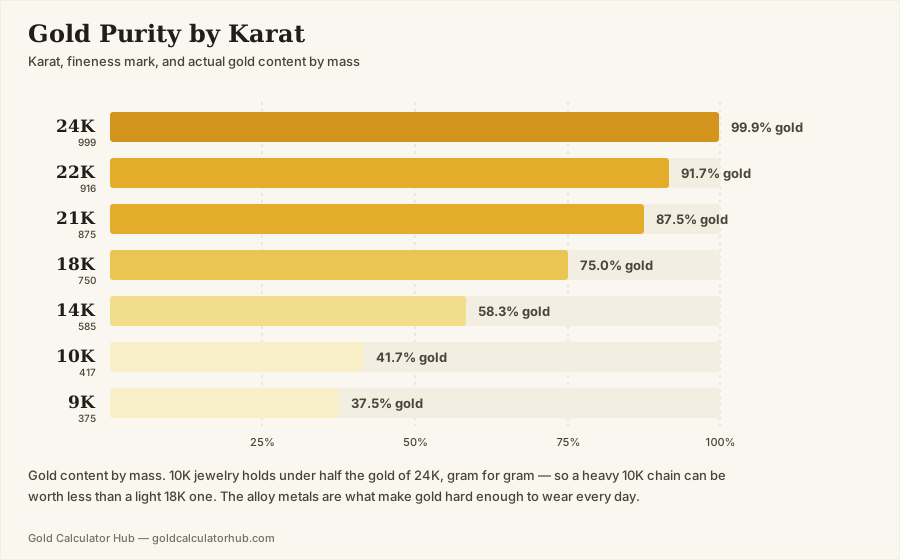
Three notations, one underlying fact. Here they are side by side for the seven standards that cover almost everything:
| Karat | Fineness stamp | Gold % | Melt value per gram |
|---|---|---|---|
| 24K | 999 | 99.9% | $141.32 |
| 22K | 917 (916 in India) | 91.67% | $129.68 |
| 21K | 875 | 87.5% | $123.78 |
| 18K | 750 | 75% | $106.10 |
| 14K | 585 (sometimes 583) | 58.33% | $82.51 |
| 10K | 417 | 41.67% | $58.95 |
| 9K | 375 | 37.5% | $53.05 |
Values assume $4,400 per troy ounce, or $141.46 per gram of pure gold. Purity percentages are permanent; the dollar column moves daily, with recent prices running near $4,300–$4,500 per troy ounce.
One notation quirk deserves a note, because it generates its own steady stream of confused searches. Fourteen karat is mathematically 583.3 parts per thousand, and older European pieces are stamped 583 accordingly. American manufacturers standardized on 585 — alloying a hair rich so that a stamped piece would never assay *under* its mark. Both stamps mean 14K and both are worth the same money. Similarly, India's BIS system rounds 22K down to 916 while most other markets round to 917. The World Gold Council maintains market and standards references at gold.org if you want to go deeper on how national hallmarking systems diverged.
For a fuller treatment of each standard, including which regions use which and why, the gold purity chart runs the same data forward instead of backward.
When the Percentage Is Describing a Coating
There's one scenario where a gold percentage to karat chart fails completely, and it's worth flagging because the arithmetic gives you a confident, wrong answer.
Gold plating and gold fill are thin layers of real karat gold over a base metal. A gold-filled chain marked "1/20 14K GF" has a genuine 14K skin — 58.33% gold *in that skin* — bonded over brass. Run a surface tester across it and you may well read something in the fifties, because the tester is reading the skin. Convert that to karat and you'll conclude you have a 14K chain. You have a brass chain with a gold coat, worth a small fraction of solid.
Signals that a percentage is describing a coating rather than a body:
- A letter suffix on the stamp. GF, GP, GEP, RGP, HGE, or a fraction like 1/20 or 1/10 in front of the karat.
- Wear-through. Check the highest-friction spots — clasp edges, ring shanks, the underside of a bangle. Base metal showing through as a duller, redder, or grayer color is decisive.
- A magnet reacts. Gold isn't magnetic and neither is brass, but plenty of plated costume jewelry has a steel core that will grab a magnet immediately.
- The number moves depending on where you test. A solid alloy tests the same everywhere. Plating doesn't.
For anything you plan to sell, the reliable move is a test that reaches past the surface — an acid test on a filed notch, or a density measurement, both covered on the how to tell real gold from fake page. And once you have a purity you trust, how much is a gram of gold worth converts it straight into dollars.
The Matching Exercise, Answered
A steady share of the traffic for this topic is students working through a homework problem that asks them to match each gold karat to its correct gold content percentage. Here's the answer key, plus the reasoning, since the reasoning is the part worth keeping.
| Karat | Correct gold content |
|---|---|
| 24K | 99.9% (treated as 100% for classroom purposes) |
| 22K | 91.67% |
| 21K | 87.5% |
| 18K | 75% |
| 14K | 58.33% |
| 10K | 41.67% |
| 9K | 37.5% |
Every one of these is karat ÷ 24. Twenty-two divided by twenty-four is 0.9167. Eighteen divided by twenty-four is 0.75. Ten divided by twenty-four is 0.4167. If you memorize nothing else, memorize the divisor: 24. Every other number falls out of it.
The one asterisk is 24K itself. Mathematically 24/24 = 100%, and textbooks usually accept 100%. Commercially, absolute purity doesn't exist — refined bullion is sold as 999 (three nines) or 9999 (four nines) fine, which is 99.9% or 99.99%. That trailing tenth of a percent is why this site uses 99.9% for 24K in every calculation: it's the honest number for physical metal, and on a kilogram bar the difference is a gram of gold you either have or don't. In the classroom, write 100%. At the counter, expect 999.
Frequently Asked Questions
What karat is 60 percent gold?
Mathematically, 60% works out to 14.4 karat — a value nobody stamps or sells. In practice a 60% reading almost always means 14K, which is 58.33%, either rounded off in conversation or read slightly high off a surface-enriched finish. The remaining possibility is an off-standard alloy from a market without strict hallmarking. Before accepting 60% as real, ask whether the number came from a stamp, a surface scan, or an actual assay — those three have very different reliability.
Is 89 percent gold a real karat?
No. Multiply 89 by 0.24 and you get 21.36 karat, which sits between 21K (87.5%) and 22K (91.67%). Nearly every 89% reading in the wild is a 21K piece — the Gulf-state standard — measured a little high by an XRF or electronic tester picking up the gold-enriched outer surface. Price it as 21K, because that's what a buyer will assay it at. If it genuinely tests 89% through a melted sample, you have an unusual alloy worth a second opinion.
How do I convert gold fineness to a percentage?
Divide the three-digit fineness by 10. A 750 stamp is 75.0% gold, 585 is 58.5% (the American rounding of 14K's true 58.33%), 417 is 41.7%, and 999 is 99.9%. To go the other way, multiply the percentage by 10. Fineness is parts per thousand, which makes it the cleanest of the three notations — no fractions, no divisor to remember. Karat, percentage, and fineness all describe exactly the same thing in different dialects.
Does an 800 stamp mean 80 percent gold?
Almost certainly not. 800 is a long-standing European silver fineness standard — 80% silver — used heavily on German and Italian flatware, serving pieces, and jewelry. There is no 19.2 karat gold, which is what 80% would convert to. If a gold-colored item carries an 800 mark, the likeliest explanations are 800 silver, gold-plated 800 silver (vermeil), or a mark from a system you'd need a hallmark reference to decode. Check for a companion maker's mark or assay office stamp.
Why do some 14K pieces test above 58.33 percent?
Because surface finishing processes can leach a little copper and silver out of the outermost layer of the metal, leaving a skin marginally richer in gold than the body underneath. XRF guns and electronic testers read that skin, not the core, so readings of 59–61% on honest 14K are routine. Refiners avoid the problem entirely by melting a lot, homogenizing it, and assaying a sample of the melt. It's also why a surface test is a screening tool, not a settlement number.
What is the lowest percentage of gold that can legally be called gold?
It depends on the country. In the United States, the FTC's current Jewelry Guides set no karat floor for solid gold — "9 Karat Gold" is one of their own example markings — although 10K (41.67%) is the lowest karat American stores commonly sell. The United Kingdom, Ireland, and Australia allow 9K (37.5%). Germany, Austria, and parts of Scandinavia go down to 8K (33.3%). So an identical alloy can be sold as everyday gold jewelry in Berlin and barely seen in Boston. This matters when valuing inherited or imported pieces, which often carry perfectly genuine sub-10K marks.
Can gold be exactly 100 percent pure?
Not in physical form. Refined investment gold is sold as 999 fine (99.9%) or 9999 fine (99.99%), and even the latter carries trace impurities measured in parts per million. That's why this site treats 24K as 99.9% rather than 100% — it's the number that matches actual metal you can hold. On small jewelry the difference is invisible; on a kilo bar it's a full gram of gold. Textbooks use 100% for 24K, and for classroom purposes that's fine.
My mixed scrap lot tested at 65 percent. What does that mean?
That your lot is mixed, and the tester averaged it. Sixty-five percent converts to 15.6 karat, which is not a standard anywhere. Throw a few 18K bands in with a pile of 14K chain and the aggregate reading drifts into the sixties — perfectly explainable, and financially costly if you let it stand. Sort every piece by its stamp before testing or quoting. Buyers who see a mixed pan have every incentive to price the whole thing at the lowest karat present.

Written by Sukie Gao
Sukie Gao holds a master's degree from a business school, where she picked up the markets-and-pricing toolkit she now applies to the consumer gold trade. She created Gold Calculator Hub to give people an independent, data-driven way to find out what their gold is really worth.
Published August 20, 2026 · Updated October 16, 2026