Gold Price Today: Live Rates by Karat, Updated Every 10 Minutes
 By Sukie Gao · September 16, 2026
The gold price today is a single number — the spot price of one troy ounce of pure gold — and almost nobody searching for it actually wants that number. What people want is the price of *their* gold today: 14K, not 24K; in grams, not troy ounces; and ideally with some sense of whether the figure on screen is what a buyer will hand them. Those are three separate translations, and skipping any one of them is how someone arrives at a counter expecting $1,900 and leaves with $1,100.
This page does all three. The live spot price sits at the top, pulled from the market every ten minutes with the timestamp shown so you can judge how fresh it is. Below it, that price is converted into per-gram, per-pennyweight and per-ounce figures for every common karat. Below that comes the part most price pages leave out: what a real buyer pays as a share of it.
One framing worth adopting before you read another number. Today's gold price is not a fact about your jewelry. It is one of three inputs — the other two being what your item weighs and how pure it is — and it is the only one you cannot influence. The other two are entirely in your control, and they are where the money is actually won or lost.
What "the gold price" actually refers to
When a news ticker says gold is at a certain level, it is quoting the spot price: the price for immediate delivery of one troy ounce of 99.5%-or-better gold, in US dollars, in the wholesale market. Three details in that sentence do real work.
Troy ounce. 31.1035 grams, not the 28.3495 g ounce on your kitchen scale. About 9.7% heavier.
Pure gold. The quote is for essentially pure metal. Your 14K chain is 58.3% gold, so its per-gram value is 58.3% of the pure per-gram figure — before anything else happens.
Wholesale, immediate delivery. Spot assumes already-refined, assayed metal sitting in a recognised vault, traded in large lots. Your jewelry is none of those things yet, which is the structural reason no consumer ever sells at spot.
So the gold price today is a genuine, meaningful number — it is just three conversions away from your jewelry box, and each conversion moves the figure downward.
The benchmark used to settle most institutional gold contracts is the LBMA Gold Price, administered by the London Bullion Market Association; the World Gold Council publishes long-run price series if you want to see where today sits historically.
How today's price becomes your item's value
One line does the whole job:
weight in grams × purity × price per gram = melt value
Say the spot price works out to $143 per gram of pure gold. A 30 g 14K bracelet contains 30 × 0.5833 = 17.5 g of pure gold, so its melt value is about $2,502. A 30 g 10K bracelet contains 30 × 0.4167 = 12.5 g and is worth about $1,788 — the same weight, the same day, $714 apart.
That gap is the most useful thing on this page. People routinely assume a heavier piece is a more valuable piece. Karat beats weight far more often than intuition suggests, and a mixed jewelry box sorted by karat rather than by size will surprise most people who have never done it.
Today's price by karat, per gram
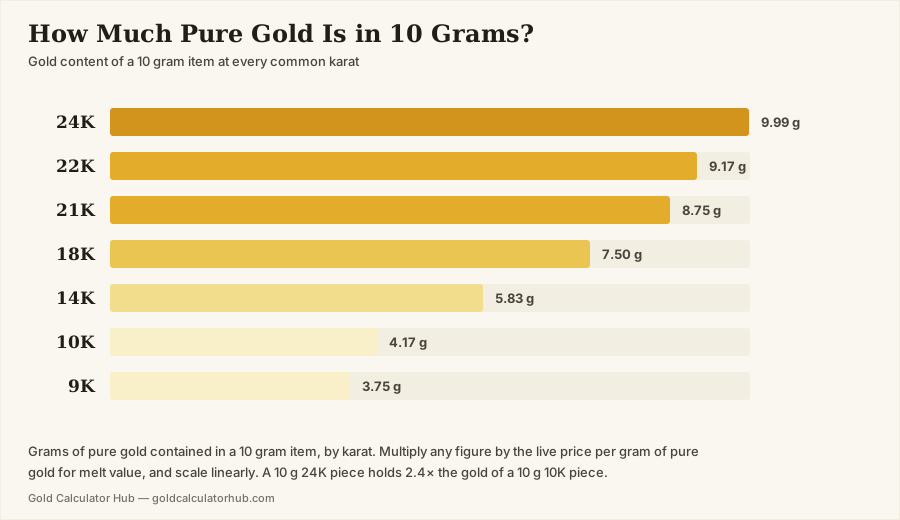
The calculator above is populated with the live figure, but the shape of the relationship is worth carrying in your head. Every karat's per-gram value is simply the pure per-gram price multiplied by its purity:
| Karat | Purity | Per gram | Per dwt | Per troy oz |
|---|---|---|---|---|
| 24K | 99.9% | 0.999 × spot/g | × 1.555 | ≈ spot |
| 22K | 91.7% | 0.917 × spot/g | × 1.555 | 0.917 × spot |
| 18K | 75.0% | 0.750 × spot/g | × 1.555 | 0.750 × spot |
| 14K | 58.3% | 0.583 × spot/g | × 1.555 | 0.583 × spot |
| 10K | 41.7% | 0.417 × spot/g | × 1.555 | 0.417 × spot |
A pennyweight is 1.55517 grams, so any per-gram figure multiplied by 1.555 gives the per-dwt figure — useful because US jewelers quote in dwt and the larger-looking number can make a mediocre offer sound generous.
Notice that every row is the same arithmetic. Once you know the pure per-gram price, you can do any karat in your head to within a few percent. 14K is a bit over half; 18K is three quarters; 22K is a bit over nine tenths.
Why our price may differ slightly from another site's
Small differences between honest sources are normal and have boring explanations.
Refresh interval. This site updates every ten minutes. Many comparable sites cache for an hour or a day. In a quiet week that is invisible; in a volatile one it is a real gap, and the stale source is not lying — it is just old.
Spot versus futures. News outlets sometimes quote the front-month futures contract rather than spot. Futures typically trade slightly above spot because they price in carrying cost to a future delivery date.
Bid, ask, or mid. The market has a bid and an ask; sites variously publish one or the midpoint. The spread on gold is thin but non-zero.
Currency. Gold is quoted globally in US dollars. Every non-USD figure is a conversion, so it moves with the exchange rate as well as with gold.
If two sources differ by a fraction of a percent, both are probably fine. If they differ by several percent, one is stale or quoting a different instrument.
The price you see is not the price you get
This is the section that separates this page from a ticker.
No consumer sells gold at spot. Between your bracelet and the spot price sit assay, refining, process loss, insured shipping, the buyer's capital being tied up, and margin. The result is a predictable ladder:
| Buyer | Share of melt |
|---|---|
| Online refiner | 70–90% |
| Coin / bullion dealer | 65–85% |
| Jewelry store | 50–75% |
| Pawn shop | 40–60% |
| Mail-in / TV service | 20–50% |
So a bracelet with $2,502 of melt at today's price realistically sells for $1,750–$2,250 to a good refiner, or $1,000–$1,500 at a pawn counter. Both of those are the real price today. They are just the prices of different transactions.
The practical move is to convert every offer into a percentage of melt before you evaluate it. "$1,400" means nothing on its own. "$1,400, which is 56% of melt" means you are being quoted pawn rates and can almost certainly do better.
When today's price actually matters — and when it doesn't
Gold moves perhaps one or two percent in an ordinary week. The spread between the best and worst buyer for the same jewelry is twenty to forty percent. That ratio should govern how much attention you give to timing.
If you are selling scrap jewelry, today's price is a reference point and the buyer is the variable. Getting one more quote is worth more than waiting a month for a better market.
If you are selling bullion — a recognised coin or a stamped bar — the calculus flips. Bullion trades close to spot, so the spread you give away is small and the price genuinely is most of the outcome. That is the one case where watching the market is rational rather than a distraction.
And if you are buying, the same logic runs in reverse: premiums over spot on small bullion products vary far more between dealers than gold moves in a week.
Reading a price chart without fooling yourself
Two habits keep price history useful rather than misleading.
Look at a long window before a short one. A one-day chart makes every wiggle look like a trend. A five-year chart shows you where today actually sits. If your question is "should I sell," the five-year view answers it better.
Distinguish the price from your position. Gold trading near a record does not mean it will fall, and it does not mean it will rise. What it does mean, concretely, is that a seller today is receiving historically strong prices for scrap — which is a fact about your opportunity, not a forecast.
Nobody reliably times this market. Institutions with research desks do not manage it consistently, and a consumer with a jewelry box will not either. What a consumer *can* control is the spread given to a buyer, and that is a larger number than most price moves.
Getting your own number right
Three inputs, in order of how often people get them wrong.
Purity. Find the hallmark — inside a ring shank, on the tag by a chain clasp, on the back of a pendant. If there is no mark, test it before you calculate anything. And check for GF, RGP, HGE, GP or vermeil: those are surface layers, not solid gold, and applying today's price to their full weight overstates them roughly twentyfold.
Weight. Grams, on a scale that reads to 0.1 g. A $15 pocket scale pays for itself the first time you use it. Weigh each karat separately — never one mixed pile, because you will be paid on the lowest karat present.
Price. The live figure on this page, or any source you have checked is current. This is the input that needs the least of your attention, which is exactly the opposite of how most people allocate it.
A worked example, start to finish
Suppose you have three items and today's pure gold price is $143 per gram.
- An 18K ring, 6.2 g → 6.2 × 0.75 = 4.65 g pure → $665
- A 14K chain, 21.4 g → 21.4 × 0.5833 = 12.48 g pure → $1,785
- A 10K bracelet, 15.0 g → 15.0 × 0.4167 = 6.25 g pure → $894
Total melt: $3,344.
Now the realistic outcomes. A good online refiner at 82% pays about $2,742. A local coin dealer at 75% pays about $2,508. A pawn shop at 50% pays about $1,672.
That spread — $1,070 between the top and bottom offer, on the same three items, on the same day — is the entire argument for spending twenty minutes on quotes. It dwarfs anything the market is likely to do while you decide.
Frequently Asked Questions
What is the gold price today per gram?
The live figure appears in the calculator at the top of this page and refreshes every ten minutes with a visible timestamp. To get it yourself from any spot quote: divide the per-troy-ounce price by 31.1035. That gives the price of one gram of pure 24K gold. For your own jewelry, multiply that by the purity — 0.583 for 14K, 0.75 for 18K, 0.417 for 10K.
Why is the 14K gold price today lower than the gold price I see on the news?
Because they are prices for different metal. News quotes are for pure gold, and 14K is 58.3% gold by mass — the remaining 41.7% is copper, silver and zinc, which have real but comparatively negligible value. So 14K is worth about 58.3% of the pure price, gram for gram, before any buyer's margin. A quoted price is also per troy ounce (31.1 g), which is a larger unit than most people picture.
How often does this page update the gold price?
Every ten minutes, from a live market feed, with the exact time shown next to the figure so you can see how fresh it is. That is meaningfully more current than the daily refresh many comparable pages run on. If the feed is briefly unreachable, the page labels the value it is showing as approximate rather than presenting a stale number as live.
Does the gold price change on weekends?
Barely. The spot market runs roughly Sunday evening through Friday evening New York time, so the price is effectively static from Friday's close until Sunday's open. A figure you see on a Saturday is Friday's closing level. Prices can gap at the Sunday open if something significant happened over the weekend, which is worth knowing if you are planning a Monday sale.
Can I sell my gold at today's price?
No, and no consumer anywhere can — but the reason is structural rather than unfair. Spot is the price for large lots of already-refined, assayed gold held in a recognised vault. Your jewelry has to be tested, refined, and turned into that form first, and each step costs money that comes out of the gap. Expect 70–90% of melt from a good online refiner, less from a local shop, and much less from a pawn counter or mail-in service.
Is the gold price the same in every country?
Yes in substance, no in the number you see. Gold trades globally in US dollars per troy ounce, and arbitrage keeps that single price consistent everywhere. Local prices differ because of currency conversion, import duties, local taxes and dealer premiums. In India, for example, the widely quoted 22K per-gram rate includes duty and local market factors on top of the international price, which is why it does not simply equal the USD spot converted at the day's exchange rate.
Should I wait for the gold price to go up before selling?
Only if you have a reason beyond hope, and almost nobody does. Gold typically moves one to two percent in a week; the difference between the best and worst buyer for the same jewelry is twenty to forty percent. You control the second number entirely and the first not at all. If you are selling scrap, spend your effort on quotes rather than timing. If you are selling recognised bullion, where the spread is thin, price genuinely matters more.
What does the gold price mean for 10K gold today?
10K is 41.7% gold, so its per-gram value is 0.417 times the pure per-gram price. That is under half of 24K, which surprises people holding a substantial-feeling 10K piece. 10K is the US legal minimum purity that can be sold as gold; it is harder and more scratch-resistant than higher karats, which is a genuine advantage for daily wear, but it carries correspondingly less metal value.
Why do different websites show slightly different gold prices?
Refresh timing is the usual cause — a site caching for an hour or a day will lag a site refreshing every ten minutes. Beyond that, some sites quote front-month futures rather than spot (futures usually run slightly higher), and some publish the bid, the ask, or the midpoint of a narrow spread. Differences under a fraction of a percent are normal. Differences of several percent mean one source is stale or quoting a different instrument.
How do I convert today's gold price to pennyweight?
Multiply the per-gram price by 1.55517, since one pennyweight is 1.55517 grams. Twenty pennyweight make a troy ounce, so you can also divide the per-troy-ounce price by 20. This matters at US jewelry counters, which still quote in dwt: a per-dwt rate looks about 55% larger than the equivalent per-gram rate, which can make an ordinary offer sound generous until you convert it.
Does today's price apply to gold-filled or gold-plated items?
Not to their full weight, and the error is enormous. Gold filled — marked GF, or something like 1/20 12K GF — is a bonded layer that is typically one twentieth of the item's weight, so a 20 g piece holds around 0.5 g of pure gold. Gold plated (GP, HGE, RGP, vermeil) is microns thick and its recoverable value rounds to nothing. Applying today's per-gram price to the whole weight of such an item overstates it by roughly twentyfold or more.

Written by Sukie Gao
Sukie Gao holds a master's degree from a business school, where she picked up the markets-and-pricing toolkit she now applies to the consumer gold trade. She created Gold Calculator Hub to give people an independent, data-driven way to find out what their gold is really worth.
Published September 16, 2026