Melt Value of Gold Coins: Every Major Coin Compared
 By Sukie Gao · September 8, 2026
The melt value of gold coins is the dollar value of the metal inside them, stripped of design, date, mint mark, condition, and every other thing a collector cares about. It is the floor beneath a coin, never the ceiling — and that distinction is where most of the money in this topic hides. Bullion coins routinely trade above their metal content, and pre-1933 US gold can trade far above it. Sell one at melt and you may have handed a dealer a healthy margin without noticing.
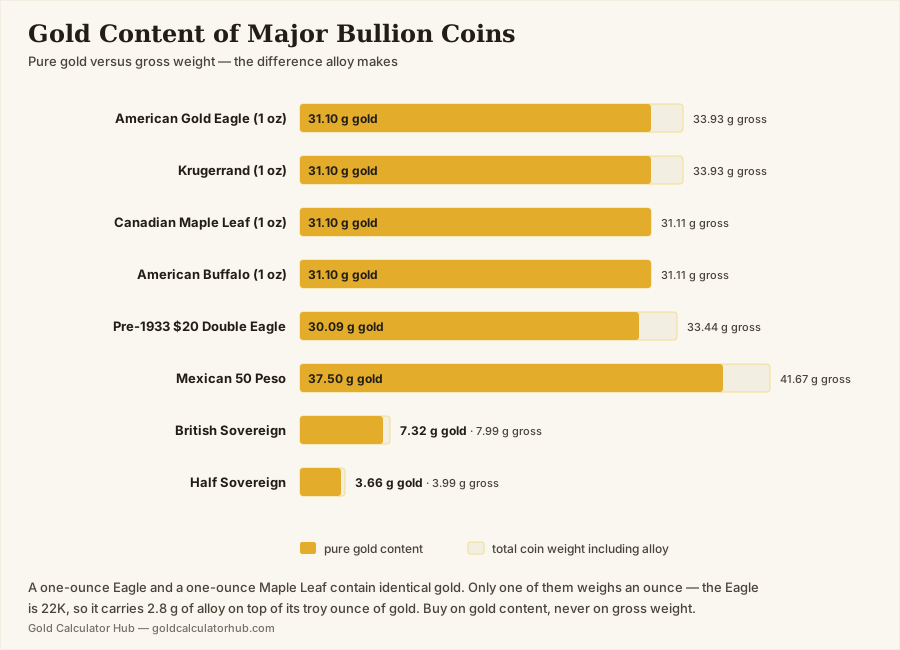
Still, the floor is worth knowing precisely, because it's the number that tells you whether an offer is serious. The calculator above will price any coin the moment you enter its gold content, but the arithmetic itself has one trap that catches almost everyone: melt runs on gold content, not on the weight stamped on the coin or shown on your scale. A 1 oz American Gold Eagle weighs 33.93 grams. It contains 31.10 grams of gold. The 2.83 g difference is copper and silver, worth roughly nothing. Below is every major coin's real number.
Gross Weight and Gold Content Are Two Different Numbers
Put a 1 oz American Gold Eagle on a scale and it reads 33.93 g. Put a 1 oz Canadian Maple Leaf beside it and that one reads 31.105 g. Both are sold as one-ounce coins, and both are honestly labeled — they each contain one troy ounce of pure gold. The Eagle simply carries a jacket of copper and silver on top of its gold, which makes it more durable and heavier overall.
So the formula for melt is:
Gold content (g) = gross weight (g) × fineness
Melt value = gold content (g) × gold price per gram
And the gold price per gram comes from the spot price per troy ounce divided by 31.103. At an assumed $4,400 per troy ounce, that's $141.46 per gram.
Run the Eagle: 33.93 × 0.9167 = 31.10 g of gold. Times $141.46 = $4,399. Which is, as designed, one troy ounce of gold. Anyone who instead multiplies the coin's 33.93 g gross weight by the gold price gets $4,800 — about 9% too high — and then feels cheated when a dealer quotes something lower. That mistake, plus the troy ounce vs ounce confusion, accounts for most of the arguments that break out at coin shop counters.
Every Major Coin, Weighed and Priced
All figures below assume gold at $4,400 per troy ounce, which is $141.46 per gram. Recent prices have run near $4,300–$4,500 per troy ounce, so scale these numbers proportionally — a 2% move in spot moves every row by 2%.
| Coin | Gross weight | Fineness | Gold content (g) | Gold content (ozt) | Melt at $4,400/oz |
|---|---|---|---|---|---|
| American Gold Eagle 1 oz | 33.93 g | .9167 (22K) | 31.10 g | 1.0000 | $4,400 |
| American Gold Eagle 1/2 oz | 16.97 g | .9167 | 15.56 g | 0.5002 | $2,201 |
| American Gold Eagle 1/4 oz | 8.48 g | .9167 | 7.77 g | 0.2500 | $1,100 |
| American Gold Eagle 1/10 oz | 3.39 g | .9167 | 3.11 g | 0.0999 | $440 |
| American Buffalo 1 oz | 31.108 g | .9999 (24K) | 31.10 g | 1.0000 | $4,400 |
| Canadian Maple Leaf 1 oz | 31.105 g | .9999 (24K) | 31.10 g | 1.0000 | $4,400 |
| Krugerrand 1 oz | 33.93 g | .9167 (22K) | 31.10 g | 1.0000 | $4,400 |
| British Sovereign | 7.99 g | .9167 (22K) | 7.32 g | 0.2355 | $1,036 |
| Pre-1933 $20 Double Eagle | 33.44 g | .900 (21.6K) | 30.10 g | 0.9676 | $4,257 |
| Mexican 50 Peso | 41.67 g | .900 (21.6K) | 37.50 g | 1.2058 | $5,305 |
Two things stand out once the melt value of gold coins is laid side by side like this. Four of them — the Eagle, Buffalo, Maple, and Krugerrand — land on exactly the same melt value despite gross weights ranging from 31.105 g to 33.93 g. That is not a coincidence; it is the entire point of how modern bullion coins are specified. The three outliers are the ones that were never designed as bullion at all: the Sovereign and Double Eagle were circulating currency, and the 50 Peso was struck to a weight convenient for Mexican monetary reserves rather than for a round ounce.
The Krugerrand, Since Everyone Asks
The Krugerrand generates more melt-value questions than any other coin, largely because of a persistent belief that it's somehow less pure and therefore worth less. It isn't.
A 1 oz Krugerrand weighs 33.93 g and is .9167 fine — 22 karat, the same alloy specification as the American Gold Eagle, with copper giving it a slightly ruddy tone. Its gold content is 33.93 × 0.9167 = 31.10 g, which is one full troy ounce. At $4,400 per ounce its melt value is $4,400, identical to a Maple Leaf that weighs nearly three grams less on your kitchen scale.
The practical implication: never compare coins by scale weight. Compare by gold content. If a buyer offers you less for a Krugerrand than for a Maple on purity grounds, they are either confused or counting on you being confused.
Krugerrands were the first modern bullion coin and were minted in enormous quantities, which is precisely why they carry modest premiums — a large, liquid, well-known supply. That makes them among the easiest coins to sell near melt, and among the least likely to hide a collector premium you'd regret cashing out. When a buyer needs metal rather than rarity, a Krugerrand is exactly the product they want.
The Fractional Penalty Nobody Mentions
Look at the quarter-ounce Eagle: 7.77 g of gold, $1,100 of melt. Four of them contain the same gold as one 1 oz Eagle. So four quarters should cost the same as one whole, right?
They don't, in either direction. Fractional coins cost meaningfully more per ounce to buy, because minting a 1/10 oz coin involves nearly as much labor, packaging, and distribution as minting a full ounce while spreading it over a tenth of the metal. That premium is real when you're buying and it mostly evaporates when you're selling — dealers know the next buyer wants a discount too.
What fractionals genuinely buy you is divisibility. Selling a 1/10 oz Eagle for around $440 of metal is a much finer-grained decision than being forced to liquidate $4,400 in one go. Whether that flexibility is worth paying a higher premium for is a personal call, not a math one.
One thing worth checking on any fractional coin: weigh it. The tenth-ounce Eagle should read 3.39 g gross, and a coin that reads 3.1 or 3.6 has a story to tell. Small coins are the easiest to counterfeit convincingly by eye, and the weight check takes four seconds — see how to tell real gold from fake for the rest of the verification sequence.
Where Melt Math Stops Being the Right Answer
Melt value is what a coin is worth to a refinery. It is frequently not what the coin is worth to a person.
That gap can be enormous, and it concentrates in a few places.
Pre-1933 US gold. A $20 Double Eagle carries 30.10 g of gold, $4,257 of metal at our assumed price. Common-date examples in circulated condition often trade modestly above that. But dates, mint marks, and grade can multiply the figure many times over for scarce issues in high grade — and no scale, calculator, or refiner can see the difference. The same coin, same weight, wildly different value.
Anything with a story. Proof issues, low-mintage years, early strikes, coins in graded holders from recognized services, and pieces with genuine numismatic scarcity all trade on rarity rather than metal.
Sovereigns. At $1,036 of melt, a common modern Sovereign is essentially a bullion product. Victorian and Edwardian pieces, and certain branch-mint issues, are collector items.
The rule that follows is simple and non-negotiable: do not melt, and do not sell to a scrap buyer, any coin you haven't had appraised. Melting is irreversible. A refiner pays for metal and asks no questions about a mint mark. If you have inherited coins, take them to a coin dealer or two before anyone with a torch sees them — and if the coins came with an estate, our guide to selling inherited gold jewelry covers the cost-basis side of that transaction. None of this is tax advice; talk to a professional about your specific situation, and see the IRS's collectibles guidance for how gains on physical gold are categorized.
What Dealers Actually Pay for Coins
Now the practical question: given a melt figure, what shows up on the check?
Coins are the best-treated item in the entire secondhand gold market. A local coin or bullion dealer typically pays 65–85% of melt across their business, but recognizable bullion coins sit at the very top of that band and often above it — a dealer buying a Krugerrand or Maple Leaf isn't buying scrap, they're buying inventory they can resell within the week at a premium. It is entirely normal for a clean, common bullion coin to fetch 95% of melt or better from a competitive dealer, because their margin comes from the resale premium rather than from squeezing you.
Jewelry gets no such treatment. The same dealer buying a 14K chain is buying raw material that must be refined, and the honest ranges there run 50–75% at a jewelry store and 40–60% at a pawn shop. That structural difference — inventory versus feedstock — is the single biggest reason coins outperform jewelry when you sell. Our page on where to sell gold ranks every venue, and how much below spot to sell gold explains the spread itself.
A note on pawn shops specifically: many will price a bullion coin as if it were scrap metal. If a pawn broker quotes you 50% of melt on an Eagle, that's not a market price, that's an opening position.
For an item-level breakdown of any coin at today's live gold price, the gold coin melt value calculator handles the per-coin math, while the calculator on this page is set up for mixed lots by weight and purity. For anything that isn't a coin at all, start from the gold calculator on our homepage.
Worked Example: A Drawer of Nine Coins
Suppose an estate produces the following, and you want a defensible number before anyone makes an offer. Assume gold at $4,400 per troy ounce, $141.46 per gram.
- Three 1 oz Krugerrands: 3 × 31.10 g = 93.30 g of gold
- Two 1/4 oz American Gold Eagles: 2 × 7.77 g = 15.54 g
- One pre-1933 $20 Double Eagle: 30.10 g
- Three British Sovereigns: 3 × 7.32 g = 21.96 g
Total pure gold: 93.30 + 15.54 + 30.10 + 21.96 = 160.90 g, or 5.174 troy ounces. Multiply by $141.46 and the lot's melt value is $22,761.
Now read that number correctly. The three Krugerrands and two fractional Eagles are straightforward bullion; a competitive dealer should pay close to their $15,397 combined melt (108.84 g of gold), and possibly a little above it. The three Sovereigns, worth about $3,107 in metal, are probably worth somewhat more as coins. The Double Eagle is the unknown — its $4,257 of metal is a floor and the coin could be worth a multiple of that depending on date, mint mark, and grade.
So the honest summary is: this lot is worth at least $22,761 of metal, and the correct next step is to have the Double Eagle and the Sovereigns looked at by a coin dealer before selling anything. Walking in with the melt figure already computed changes the conversation entirely — you are no longer asking what it's worth, you're asking what they'll pay above a number you already know. The World Gold Council publishes market background if you want context on where spot has been trading.
Frequently Asked Questions
What is the melt value of a 1 oz Krugerrand?
Exactly one troy ounce of gold, so it tracks the spot price directly. The coin weighs 33.93 g gross and is .9167 fine, giving 33.93 × 0.9167 = 31.10 g of pure gold. At an assumed $4,400 per troy ounce that's $4,400 of metal. Do not multiply the coin's 33.93 g gross weight by the gold price — that yields about $4,800 and is wrong by roughly 9%, because the extra weight is copper and silver alloy, not gold.
Do bullion coins sell for more than their melt value?
Almost always, yes. Bullion coins carry a premium over metal content because they're recognizable, easy to authenticate, easy to resell, and cost money to mint and distribute. Dealers buy them as inventory rather than as scrap, so buy-back offers on common coins like Eagles, Maples, and Krugerrands frequently reach or exceed 95% of melt and sometimes carry a small premium of their own. Melt is the number that tells you an offer is too low, not the number you should aim for.
Why do a Maple Leaf and an Eagle have the same melt value at different weights?
Because both are specified to contain one troy ounce of pure gold, and they get there differently. The Maple Leaf is .9999 fine, so it needs to weigh only 31.105 g in total. The Eagle is .9167 fine — 22 karat, alloyed with copper and silver for durability — so it must weigh 33.93 g gross to hold that same ounce of gold. Their scale weights differ by nearly three grams. Their gold content is identical, and so is their melt value.
Should I ever melt down a gold coin?
Practically never as an individual. Melting destroys any collector value permanently, costs money in refining fees, and produces a bar that's harder to sell than the coin was. There is essentially no scenario where a consumer nets more by melting a coin than by selling it intact to a dealer who wants it. If a buyer's offer is framed around melting your coins, get a second opinion from a numismatic dealer first — especially for anything struck before 1933.
How do I calculate melt value if I only know the coin's face value?
You can't reliably, because face value and gold content have almost no relationship on modern bullion. A 1 oz American Gold Eagle carries a $50 face value while containing $4,400 of gold at recent prices; a $20 Double Eagle holds about $4,257 of metal. Face value on bullion coins is a legal-tender formality, not a valuation. Look up the coin's official gross weight and fineness instead, multiply them together, and price the resulting gold content per gram.
Is a Mexican 50 Peso really worth more than an American Eagle?
In pure metal terms, yes. The 50 Peso weighs 41.67 g at .900 fineness, giving 37.50 g of gold — about 1.206 troy ounces, roughly 20% more gold than a 1 oz Eagle. At an assumed $4,400 per ounce that's $5,305 of melt versus $4,400. It's simply a bigger coin. Premiums tell a different story though: 50 Pesos usually trade at thinner premiums than US coins in American markets, which makes them a common choice for buyers who care only about metal.

Written by Sukie Gao
Sukie Gao holds a master's degree from a business school, where she picked up the markets-and-pricing toolkit she now applies to the consumer gold trade. She created Gold Calculator Hub to give people an independent, data-driven way to find out what their gold is really worth.
Published September 8, 2026