Sell Gold Online or Locally? Payouts Compared Honestly
 By Sukie Gao · Updated July 21, 2026
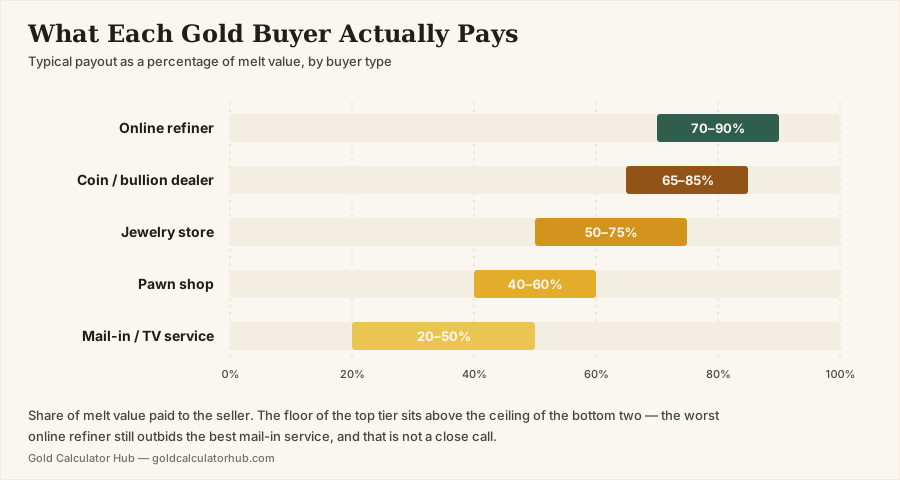
If you sell gold online to a reputable refiner, you'll typically collect 70–90% of your gold's melt value — the best percentage available anywhere in the scrap market. Sell the same items locally and the range slides: 65–85% at a coin or bullion dealer, 50–75% at a jewelry store, 40–60% at a pawn counter. So the spreadsheet says mail it. And yet plenty of smart sellers still choose local, because the spreadsheet doesn't capture everything: handing a stranger's courier $3,000 of jewelry takes a leap of trust, local cash arrives today instead of next week, and certain pieces deserve an expert's eyes before any melt-value sale. This page compares both routes the way we'd want them compared for our own gold — payout, speed, safety, and effort, with real numbers throughout. Gold Calculator Hub doesn't buy or sell gold; we have no kit to mail you and no counter to lure you to, which makes this an easy page to write honestly. The one non-negotiable, whichever route you pick: know your melt value before anyone quotes you. The gold calculator handles that in under a minute. What follows assumes you've done that — every dollar figure below is a percentage of a melt value you already know.
How Selling Gold Online Actually Works
When you sell gold online, the process is more boring than people fear — which is a compliment in this industry. Step by step:
1. Request a kit. You fill out a form; the buyer mails you a padded envelope or small box with a prepaid, insured shipping label. Legitimate kits are free with no obligation.
2. Pack and ship. You photograph your items, seal them in, and drop the package with the carrier — keeping the tracking number. The label's insurance covers transit, up to a stated limit you should confirm before shipping anything substantial.
3. They test and weigh. On arrival, the buyer verifies karat and weight — better operations photograph or video the unboxing — and emails an itemized offer, typically within a day or two of receipt.
4. Accept or return. Accept, and payment goes out by check, ACH, or PayPal, usually within 24–48 hours. Decline, and a reputable buyer ships everything back free of charge, insured, no questions.
The accept/return step is where the good and bad operators separate. A buyer confident in its rates has no problem returning your gold; a buyer whose model depends on lowballing will make returning feel like a part-time job. That distinction — not the mail itself — is the actual risk in selling gold by post.
Why Online Payouts Run Higher
Online buyers don't pay more out of generosity. Three structural reasons:
Lower overhead. No retail storefront, no showcase staff, no mall rent. A warehouse, testers, and shipping accounts cost a fraction of a Main Street presence, and scrap buying is a margin business — lower costs flow directly into higher offers.
National competition. A local pawn shop competes with whatever's within a 20-minute drive. An online refiner competes with every other refiner in the country, one browser tab away. That pressure forces payout percentages up and keeps them up.
Published rates. The best online buyers post their per-gram payouts by karat, updated against the live spot price. A published rate is a public promise — you can check it against your own math before mailing anything, and hold them to it after. Almost no walk-in venue will commit to a number before your gold is on their counter.
Volume matters too: a refiner processing kilos per day hits refinery minimums effortlessly and keeps per-transaction costs tiny. None of this means every online buyer pays well — the mail-in TV operations are technically "online" and pay 20–50% of melt. The high payouts belong to the refiner-style buyers with published rates, and finding them is what the vetting section below is for.
The Numbers Side by Side
Here's the whole decision in one table, using the site-standard payout ranges and recent prices near $4,300–$4,500 per troy ounce:
| Route | Typical payout (% of melt) | Speed to cash | Safety profile | Effort |
|---|---|---|---|---|
| Online refiner | 70–90% | 4–10 days total | Insured transit; vet the buyer first | Low — pack, ship, click |
| Local coin/bullion dealer | 65–85% | Same day | Face-to-face; carry gold to the shop | Medium — visit, watch testing |
| Local jewelry store | 50–75% | Same day | Face-to-face; store-credit pressure | Medium — visit, decline upsells |
| Pawn shop | 40–60% | Under an hour | Face-to-face; lowest offers | Low — walk in, walk out |
A concrete example: a 15-gram 14K bracelet. At $4,400/oz, pure gold runs $4,400 ÷ 31.103 = $141.46 per gram, and 14K is 58.33% gold, so melt value is 15 × 0.5833 × $141.46 ≈ $1,238. Typical mid-range offers: an online refiner at 85% pays $1,052; a coin dealer at 75% pays $928; a jewelry store at 65% pays $805; a pawn shop at 50% pays $619.
The online route beats the best local option by $124 and the pawn counter by $433 — on a single bracelet. The bigger the lot, the more those percentages matter in absolute dollars, and the stronger the case for the route with the higher ceiling. Run your own numbers in the gold melt calculator and the table stops being abstract.
How to Vet an Online Buyer Before You Ship
Everything good about the decision to sell gold online assumes you picked a trustworthy buyer. The checklist:
Published per-gram rates. This is the first filter and it eliminates most of the bad actors instantly. If a buyer won't tell you what they pay per gram of 14K before receiving your gold, you're not getting a price — you're getting whatever they decide after your leverage is in their warehouse.
A real return guarantee. Free, insured return shipping if you decline the offer, stated plainly in the terms. Read for tricks: "return processing fees," or checks that count as acceptance if cashed.
Insurance limits that cover your lot. Standard kit insurance often caps at $1,000–$5,000. Shipping a $8,000 lot under a $1,000 cap means the gap is your risk. Reputable buyers let you declare higher values for a fee or split shipments.
Track record. Years in business, a physical address, BBB profile and rating, and a body of independent reviews that's consistent over time — not a wall of five-star reviews posted the same month. The Federal Trade Commission's advice on selling gold jewelry is blunt on this point: research the buyer and understand return and reimbursement policies before mailing anything.
Offer transparency. The offer should be itemized — weights and karats per group, not one mystery number. You weighed everything at home, so you'll know instantly whether their scale agrees with yours.
Ten minutes of vetting separates the 85%-of-melt experience from the 30%-of-melt experience. It's the best-paid ten minutes in the whole transaction.
When Selling Locally Wins
The online route has a higher ceiling, but local is genuinely the right call in several situations:
You need the money today. No mail-in process pays same-day. A coin dealer can hand you hundreds or thousands in cash this afternoon at 65–85% of melt — a strong number for instant liquidity. If today matters, local wins by default.
The lot is large and you want eyes on it. Mailing $15,000 of gold means trusting carriers, insurance caps, and a distant counterparty all at once. Plenty of sellers with big lots prefer to stand at a dealer's counter, watch the testing, and leave with payment — and with a lot that size, a local dealer competing for the business will often sharpen its percentage anyway. Get two local quotes and the gap to online narrows fast.
The piece might be worth more than melt. Signed designer jewelry, antique craftsmanship, gemstones, collectible coins — a refiner's offer values none of it, but a sharp local jeweler or coin dealer can spot above-melt value in person and pay for it. If you suspect a piece is special, identify it before any scrap sale; how much pawn shops pay for gold shows what happens when resale-worthy items get priced as mere metal.
You'd simply rather not mail gold. That's a legitimate preference, not a failure of nerve. The decision framework across every venue type — including auction and private-sale routes — is laid out in where to sell gold.
One hybrid nobody mentions: get a local quote first, then use it as your floor when you compare published online rates. It costs an afternoon, commits you to nothing, and turns the online decision from a leap into a comparison.
Realistic Timelines, Day by Day
Sellers consistently underestimate the local route's speed advantage and overestimate the online route's slowness. Here's what each actually looks like:
Online refiner: Day 1, request the kit. Days 2–4, kit arrives. Day 5, you ship. Days 6–8, package arrives and is processed; offer lands in your inbox. Day 8, you accept. Days 9–10, payment arrives by ACH or PayPal (checks add mail time). Call it 7–10 days door to door — faster if you skip the kit and print your own insured label, slower over holidays.
Local dealer or pawn shop: Drive over, wait for testing, negotiate, get paid. One to two hours, including the trip.
The honest framing: the online premium on a $1,238-melt bracelet was about $124 over the best local offer in our example above. Spread over the extra week, that's roughly $17 per waiting day — for doing nothing. For most sellers without an urgent need, that's easy money. For someone facing a rent deadline, the calculus flips completely, and that's fine too. Just make the choice with the per-day number in view rather than a vague sense that mailing gold takes forever.
The Paper Trail an Online Sale Leaves
Mailing gold produces something a cash counter sale often doesn't: a complete written record. That's a feature, not a hazard, and it's worth understanding before you're surprised by it.
What you'll end up holding is an itemized offer listing weights and karats by group, an electronic payment record, and shipping documentation with tracking. Keep all three. Together they establish what you sold, when, and for how much — which matters if a dispute arises and matters again at tax time.
On taxes: the IRS treats physical gold as a collectible. If you sell for more than your cost basis, the gain is taxable, and long-term collectible gains are capped at a 28% rate rather than the lower rates that apply to stocks. Buyers file Form 1099-B for certain bullion transactions but generally not for ordinary scrap jewelry — the obligation to report a gain is yours regardless of whether a form is issued.
A quick worked case. You inherit a 14K chain; its appraised value on the date of death was $900, which becomes your stepped-up basis. Two years later an online refiner pays you $1,050. Your taxable gain is $1,050 − $900 = $150, not the full $1,050 — a distinction that costs people real money when they assume otherwise. Losses on personal-use property, meanwhile, generally aren't deductible.
The IRS guidance on capital gains and collectibles is the starting point, and a tax professional is the finishing one. This isn't tax advice, and inherited-property basis in particular is worth ten minutes of a real accountant's time.
Packing and Shipping Gold Safely
If you go the online route, ten careful minutes at the kitchen table removes most of what can go wrong:
Document everything first. Weigh each karat group on your own scale and write the numbers down. Photograph every item, and the open package just before sealing. If a dispute ever arises over what you sent, this is your evidence — and it also means you'll spot instantly if the buyer's reported weights drift from yours.
Pack tight and anonymous. Items in a zip bag, bag wrapped so nothing shifts or rattles, inside a plain box or padded envelope. Nothing on the outside should hint at contents — no "jewelry," no business names with "gold" in them on the return address.
Confirm the insurance before it ships. Know the declared value on the label and how it compares to your melt number. Underinsured? Pay to raise the declared value, or split the lot into two shipments. Get a receipt with a tracking number when you hand the package over rather than dropping it in a box.
Track it. Signature confirmation on arrival is standard with reputable buyers; note the delivery date and expect an offer within their stated window.
Millions of insured precious-metal packages cross the country uneventfully every year — the carriers are good at this. The rare horror stories almost always trace to skipped documentation, no tracking, or an unvetted buyer, and you've now ruled out all three.
Frequently Asked Questions
Is it actually safe to mail gold to an online buyer?
With a vetted buyer and an insured label, yes — this is routine logistics, not a gamble. Reputable online refiners move serious volume through USPS, FedEx, and UPS every day with insured, trackable packages. Your job is the part the carrier can't do: confirm the insurance limit covers your lot's value, photograph and weigh everything before sealing, ship plain packaging with no contents clues, and keep the tracking number. The genuine risk in mail-in selling is choosing a bad buyer, not losing the package.
What happens if my gold package is lost in the mail?
You file an insurance claim with the carrier or through the buyer, depending on whose label and policy covered the shipment — and you're reimbursed up to the declared value. This is exactly why two pre-shipping steps matter: confirming the declared value actually matches your gold's worth, and documenting weights and photos as proof of contents. If your lot exceeds the kit's standard insurance cap, pay to raise the declared value or split the shipment. An underinsured package is the one genuinely avoidable mail-in mistake.
What if I don't like the offer after mailing my gold in?
Decline it, and a reputable buyer returns your items free, insured, and intact — that return guarantee is something to verify in writing before you ship, not after. Watch for the traps: "return shipping and handling" fees, offers that expire in hours, or payment checks that legally count as acceptance once cashed. A buyer who makes declining easy is confident in its rates; a buyer who makes returning your own property feel like a chore was counting on friction to close the deal.
How fast do online gold buyers actually pay?
Once you accept the offer, payment typically goes out within 24–48 hours — ACH and PayPal arrive fastest, paper checks add mail time. The full cycle from requesting a kit to money in your account usually runs 7–10 days, with shipping legs consuming most of it. You can compress the front end by printing your own insured label instead of waiting for a kit. No mail-in route matches a local counter's same-day cash; the online route's compensation is the higher percentage.
Do online gold buyers pay more for large lots?
Often, yes. Many published rate tables step up with weight — better per-gram rates above 50 or 100 grams — and buyers will frequently negotiate custom rates on substantial lots if you ask before shipping. Volume costs them almost nothing extra to process, so they can share the margin to win the business. With a large lot, get rate commitments from two or three online buyers in writing first, and weigh that against a local dealer who may sharpen their own offer for the same reason.
Should I clean or repair my gold before selling it online?
No to repairs, and mostly no to cleaning. A scrap buyer pays on weight and karat; a broken clasp doesn't reduce gold content, and repair costs nearly never come back in the offer. Light cleaning does no harm, but skip anything abrasive — and if a piece might be worth more than melt (designer signature, antique work, untested age), leave it exactly as found, since patina and originality can matter to a resale or auction buyer. Spend the prep time weighing and photographing instead; that's what protects your payout.
Can I send gold coins or bullion to an online scrap buyer?
You can, but you often shouldn't. Scrap refiners price coins as metal, and many gold coins are worth more than metal — pre-1933 US issues, older world coins, and anything in collectible condition carry a numismatic premium that a melt-based offer ignores entirely. Modern bullion coins like Eagles and Maple Leafs also trade at a premium over spot and are better sold to a bullion dealer, who competes on a tight spread over the market price rather than a percentage of melt. Identify what you have before mailing it; melting is permanent and premiums are not recoverable.

Written by Sukie Gao
Sukie Gao holds a master's degree from a business school, where she picked up the markets-and-pricing toolkit she now applies to the consumer gold trade. She created Gold Calculator Hub to give people an independent, data-driven way to find out what their gold is really worth.
Published June 6, 2026 · Updated July 21, 2026