How to Calculate Gold Price: The Formula With Examples
 By Sukie Gao · Updated October 16, 2026
Knowing how to calculate gold price by hand is the difference between checking a number and trusting one. The entire skill is a single line of arithmetic — weight × purity × spot price ÷ 31.103 — and once you can run it on a napkin, no calculator, dealer, or late-night TV gold buyer can tell you anything you can't verify in thirty seconds. The calculator above does the arithmetic with a live spot price whenever you want speed; this page teaches you what it's doing, because the manual version is where the leverage lives. You'll learn where the spot price actually comes from and what it represents, the unit conversions that quietly wreck most home calculations (troy ounces are not the ounces on your kitchen scale), how to turn any karat stamp into a decimal, and the genuinely useful trick almost nobody is taught: running the formula backwards to expose what percentage of melt value a buyer's offer really represents. Worked examples are woven through the sections, reference tables cover every common karat, weight, and one-division shortcut, and three practice problems at the end let you prove to yourself that you've got it.
One Formula Does Everything
Here is the entire trade secret of the gold business:
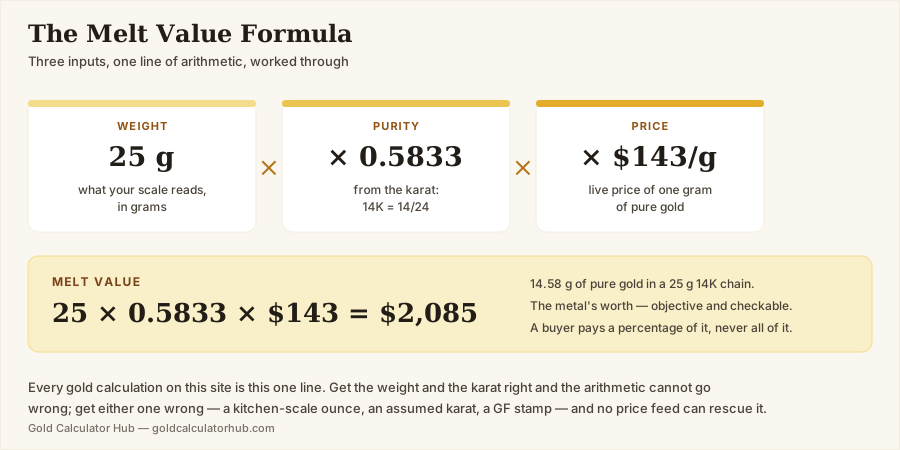
Value = weight (g) × purity (decimal) × spot price ($/troy oz) ÷ 31.103
The division by 31.103 converts the spot price — always quoted per troy ounce of pure gold — into a price per gram. Multiply by your item's weight in grams, scale it by the fraction of the item that is actually gold, and you're done.
Worked example 1: a 10 g 18K pendant, with gold assumed at $4,400 per troy ounce. Step one: $4,400 ÷ 31.103 = $141.47 per gram of pure gold. Step two: 18K is 75% gold, so $141.47 × 0.75 = $106.10 per gram of 18K. Step three: $106.10 × 10 g = $1,061. That figure is the pendant's melt value — the market value of its gold content, before any buyer's margin.
Every gold valuation on earth, from a refinery in Switzerland to a pawn counter in Tulsa, is this formula wearing different clothes. Some quote per pennyweight, some per tola, some work in fineness instead of karat — but it's all weight times purity times spot. Learn it once and you can audit anyone. The gold calculator on our homepage runs the same math with a live price feed, which makes it the fastest way to check your hand work.
Spot Price: What It Is and Where to Find It
The spot price is the going rate for one troy ounce of pure (99.9%+) gold for immediate delivery in the global wholesale market. It is discovered continuously through over-the-counter trading and futures markets, and benchmarked twice each business day by the LBMA Gold Price auction in London — the reference number that refiners, central banks, and serious dealers settle against. The LBMA publishes these benchmarks, and any major financial site carries a live spot feed within pennies of the real market.
Three things to understand about the number. First, it's for pure gold — your 14K chain is priced off 58.33% of it, never the headline figure. Second, it's a wholesale price for large, exchange-deliverable bars; nobody hands a walk-in seller 100% of spot for jewelry, because refining and margin sit between you and that market. Third, it moves constantly — recent trading has been in the $4,300–$4,500 per troy ounce range, but intraday swings of 1–2% are routine, which is why written quotes from buyers usually expire the same day.
For hand calculations, the practice this site uses is the honest one: grab the current spot, state it in your math ("assume $4,400/oz"), and remember your answer ages as fast as the market moves.
Unit Traps That Quietly Wreck the Math
More home gold calculations die on units than on arithmetic. The dangerous part is that every wrong answer looks plausible.
The troy ounce trap. Spot is quoted per troy ounce = 31.103 g. The ounce on a kitchen scale is the avoirdupois ounce = 28.350 g — about 9.7% lighter. Weigh a bar at "1 ounce" on a kitchen scale, multiply by spot, and you've overvalued it: 28.350 g is only 0.9115 troy oz, worth 0.9115 × $4,400 = $4,011 of pure gold, not $4,400. That 10% gap has soured a lot of transactions, and it's why troy ounce vs ounce gets its own page on this site.
The pennyweight (dwt) trap. Many US jewelry buyers quote in pennyweights: 1 dwt = 1.555 g, so 20 dwt = 1 troy oz. Per-dwt prices sound small and innocent — always convert to grams before comparing offers.
The tola, for international readers. Across South Asia and the Gulf, gold trades per tola = 11.664 g, often in 22K. One 22K tola at $4,400 spot: 11.664 × 0.9167 × $141.47 ≈ $1,513.
The defensive habit: convert everything to grams, always. The formula never fails; the units feeding it do.
Turning Karats Into Decimals
Purity enters the formula as a decimal, and karat stamps convert with one division: karat ÷ 24. Pure gold is 24K, so 14K = 14 ÷ 24 = 58.33%, written as 0.5833 in the formula.
The standard ladder: 24K = 99.9%, 22K = 91.67%, 21K = 87.5%, 18K = 75%, 14K = 58.33%, 10K = 41.67%, and 9K = 37.5% (common on British and Irish pieces, rare in US stores, where 10K is the usual bottom of the range).
Much of the world skips karats and stamps millesimal fineness — parts per thousand — directly on the piece: 999, 917, 875, 750, 585 (sometimes 583 on older Russian and Soviet-era gold), 417, 375. These are even friendlier to the formula: just put a decimal point in front. A "750" stamp means multiply by 0.750; a "585" means 0.585. If you find a stamp that fits neither system — and inherited or imported pieces produce them regularly — our gold purity chart maps every karat, fineness mark, and percentage in one table.
One caution: a stamp is a claim, not a guarantee. Counterfeit stamps exist, and worn or re-shanked rings sometimes carry no stamp at all. When real money rides on the purity, verify with an acid or electronic test before you trust the math.
The One-Division Shortcut for Napkin Math
The full formula has three operations, which is two too many to do in your head at a counter. Fold the purity and the troy-ounce conversion into a single divisor and every karat becomes one division:
Price per gram = spot price ÷ divisor
| Karat | Exact divisor (31.103 ÷ purity) | Round it to |
|---|---|---|
| 24K | 31.13 | 31 |
| 22K | 33.93 | 34 |
| 21K | 35.55 | 35.5 |
| 18K | 41.47 | 41.5 |
| 14K | 53.32 | 53 |
| 10K | 74.64 | 75 |
| 9K | 82.94 | 83 |
The rounded column is accurate to within about half a percent — far inside the noise of a moving market. At $4,400 spot, 14K is $4,400 ÷ 53 = $83 a gram against the exact $82.52. Close enough to know instantly whether an offer is serious.
Two divisors are worth simply memorizing if you deal mostly in American jewelry: 53 for 14K and 75 for 10K. With those two numbers and today's headline gold price, you can value most of what passes through a US jewelry box without touching a keypad. And there's a pleasing sanity check built in — 20 dwt is one troy ounce, so a per-dwt quote times 20 should land near the per-ounce value of that karat.
The Formula Across Karats and Weights
Once you've run the formula a few times, patterns emerge — and a reference table beats re-deriving them. Everything below assumes gold at $4,400 per troy ounce, so pure gold at $141.47 per gram. To adjust for the live price, recompute the per-gram column from current spot or use our gold price per gram calculator, which maintains this entire table with a live feed.
| Karat | Purity | Price per gram | 5 g | 10 g | 20 g |
|---|---|---|---|---|---|
| 24K | 99.9% | $141.32 | $707 | $1,413 | $2,826 |
| 22K | 91.67% | $129.69 | $648 | $1,297 | $2,594 |
| 18K | 75% | $106.10 | $531 | $1,061 | $2,122 |
| 14K | 58.33% | $82.52 | $413 | $825 | $1,650 |
| 10K | 41.67% | $58.95 | $295 | $589 | $1,179 |
Worked example 2 — a pennyweight quote. A dealer offers to buy "8 dwt of 14K." Convert: 8 × 1.555 = 12.44 g. Melt value: 12.44 × $82.52 = $1,027. Two multiplications, and a quote designed to sound abstract becomes a concrete number you can negotiate against.
Notice how linear it all is: double the weight, double the value; 10K is always exactly five-sevenths the per-gram value of 14K. Buyers count on sellers not seeing these relationships. Now you do.
Mixed Lots: One Karat at a Time, Always
The formula assumes a single purity, so a drawer of assorted jewelry has to be split before it can be calculated. Skipping that step is the most expensive shortcut in the whole exercise.
Say you're valuing three groups at $4,400 spot: 12 g of 10K, 9 g of 14K, and 5 g of 18K.
- 10K: 12 × $58.95 = $707.40
- 14K: 9 × $82.52 = $742.68
- 18K: 5 × $106.10 = $530.50
Total melt: $1,980.58, call it $1,981.
Now the version where you hand the whole 26-gram pile over unsorted and it gets weighed as one lot at the lowest karat present: 26 × $58.95 = $1,532.70. The difference is $448 — nearly a quarter of the lot's value — and no arithmetic was falsified to produce it. The pile was simply priced at its weakest member.
This is why the sorting step comes before the math and not after. Group by stamp, weigh each group on its own, calculate each group, then present them as separate lots and ask for a per-gram quote on each. A buyer who insists on weighing mixed karats together is either saving themselves ninety seconds or counting on you not to notice; either way, the fix is the same.
Run It Backwards: What a Buyer's Quote Really Says
Here's the move that turns this from trivia into money, and it's just the same formula reversed:
Offer ÷ melt value = the percentage of melt the buyer is actually paying.
Every serious comparison of gold buyers happens in that percentage, because dollar offers can't be compared across items but percentages can be compared across anything.
Worked example 3: a buyer offers $620 for your 12.5 g 14K bracelet. Melt value at $4,400 spot: 12.5 × $82.52 = $1,031. Implied payout: $620 ÷ $1,031 = 60% of melt. Now you know exactly where this offer sits in the market: at the very top of the pawn-shop range (40–60%) and below what local coin dealers (65–85%) or online refiners (70–90%) typically pay. The buyer hasn't cheated you — they've simply made a pawn-tier offer, and you can now decline it with arithmetic instead of a feeling.
This reverse calculation is also the fastest scam detector in existence. "Best prices in town!" converts to 38% of melt. "We pay top dollar!" converts to 51%. Marketing language can claim anything; the implied percentage can't lie. Run it on every offer, ask each buyer directly what percentage of melt they pay, and watch how quickly the conversation becomes honest once it's clear you know how to calculate gold price without their help.
Fees Change the Percentage — Do the Subtraction
An advertised payout percentage is a headline, not a settlement. Refiners and mail-in buyers frequently quote a strong percentage of melt and then deduct an assay or lot fee, and you pay shipping. Fold all of it in before comparing.
Take the $1,981 mixed lot from above. An online refiner advertises 90% of melt, charges a $35 assay fee, and you spend $18 on insured shipping:
- 0.90 × $1,981 = $1,782.90
- less $35 assay = $1,747.90
- less $18 shipping = $1,729.90 in hand
Effective payout: $1,729.90 ÷ $1,981 = 87.3%, not 90%. Still excellent — but the honest number is the one after subtraction.
Now compare it to a local coin dealer offering a flat 78% with no fees: 0.78 × $1,981 = $1,545. The refiner wins by about $185 despite the deductions. Useful to know where that flips: the refiner's advertised rate would have to fall to roughly 80.7% before the fee-free local offer matches it. Below that, local wins.
Run this subtraction on every quote, and read the fee schedule before you ship — the number that matters is what lands in your account, which is the point selling gold online vs locally works through venue by venue.
How Precise Does the Answer Need to Be?
People fuss over decimals that don't matter and skip the ones that do. Here's where the precision actually lives.
Weight is worth being fussy about. Use a scale that reads to 0.1 g. On 14K at $4,400 spot, each tenth of a gram is about eight cents — trivial on a ring, but a scale that rounds to whole grams can misstate a 40-gram lot by enough to notice.
Purity barely moves. The gap between the 0.5833 karat fraction and the 0.585 millesimal stamp for 14K is about 0.3%, or roughly $6 on a $2,000 lot. Pick one and be consistent; don't lose sleep.
Per-gram rounding is noise. Carrying $141.47 instead of $141.4649 drifts about half a cent per gram — pennies on any realistic item.
Spot price swamps all of it. Gold routinely moves 1–2% intraday, which on a $2,000 lot is $20–$40 — several times larger than every rounding decision combined. That's the real argument for using a live-price tool for the final number and hand math for the sanity check.
Practical standard: weights to 0.1 g, purity to four decimals, dollars to the nearest dollar, and no pretense that an estimate made this morning is still exact this afternoon.
Why Retail Price Isn't Melt Price — Plus Practice Problems
Walk into a jewelry store and the formula seems to break: a new 10 g 14K chain with $825 of gold in it wears a $1,800–$2,500 tag. Nothing is broken — retail price stacks fabrication, design, brand, and store margin on top of metal. A machine-made chain typically retails around 2–3× its gold content, and branded or handmade pieces go far higher. The hard corollary for sellers: that markup is not resale value. The day you sell that chain for scrap, only the $825 of metal counts, and a buyer pays a percentage of it. Melt answers "what is the gold worth?"; retail answers "what does new jewelry cost?" Confusing the two is the most expensive mix-up in this hobby.
Now prove you've got the skill. Assume gold at $4,400 per troy ounce ($141.47/g pure) and check the table above:
- A 6 g 10K class ring — melt value? 6 × $58.95 = $354.
- Half a troy ounce of 22K — melt value? 0.5 × $4,400 × 0.9167 = $2,017. (No gram conversion needed when weight is already in troy ounces.)
- A buyer offers $1,400 for a 20 g 18K bracelet — what percentage of melt? Melt is 20 × $106.10 = $2,122; $1,400 ÷ $2,122 = 66% — jewelry-store territory, beatable at a coin dealer or refiner.
Got all three? Then you know how to calculate gold price better than most people standing on either side of a gold-buying counter.
Frequently Asked Questions
What is the formula for gold price per gram?
Divide the spot price by 31.103 (grams per troy ounce), then multiply by purity. At $4,400 per troy ounce, pure gold is $4,400 ÷ 31.103 = $141.47 per gram; 14K gold is $141.47 × 0.5833 = $82.52 per gram. That's the complete formula — the only inputs that ever change are the live spot price and the karat. For any other karat, swap in its decimal: 0.75 for 18K, 0.4167 for 10K, 0.9167 for 22K.
How often does the spot price of gold change?
Continuously. Gold trades nearly 24 hours a day across global markets from Sydney to London to New York, pausing only briefly around the New York close on weekdays and over the weekend. The LBMA's London auctions set widely used reference benchmarks twice each business day, but the live spot price between auctions ticks second by second. For valuing jewelry, any quote within the last few minutes is effectively current — just don't price today's sale with last month's number.
Should I use the bid price or the ask price in my calculation?
For estimating jewelry value, it barely matters — the bid-ask spread on gold is typically well under 0.1%, a rounding error next to the buyer margins of 10–60% that actually determine your payout. Technically, when you sell, the bid (what the market pays) is the right anchor, and that's what dealers price against. Use whatever headline spot number a major financial site shows, run the formula, and spend your attention on the implied percentage of melt instead.
How do I calculate the price of 14K gold specifically?
Multiply the pure-gold price per gram by 0.5833, since 14K is 58.33% gold by weight, then by your item's weight in grams. Full chain at $4,400 spot: $4,400 ÷ 31.103 = $141.47/g pure; × 0.5833 = $82.52/g for 14K; × your grams. A 15 g 14K chain is 15 × $82.52 = $1,238 of melt value. One nuance: US law allows slight tolerance, and some older '14K' tests nearer 13.5K, which is part of why refiners assay before paying top rates.
What is a pennyweight and why do gold buyers use it?
A pennyweight (dwt) is one-twentieth of a troy ounce: 1.555 g. It's a legacy unit from the old British penny's weight that survives in the US jewelry trade. The cynical-but-true observation: per-dwt prices look smaller and are harder for sellers to compare against per-gram spot math, which suits some buyers fine. The defense is one multiplication — dwt × 1.555 = grams — after which every quote lands back in the same formula as everything else.
How is gold priced in India and Dubai with tolas and 22K?
Same formula, different default units. One tola = 11.664 g, and retail gold in South Asia and the Gulf is commonly 22K (91.67%). At $4,400 spot, one 22K tola carries 11.664 × 0.9167 × $141.47 ≈ $1,513 of gold. Local quoted rates fold in import duties, taxes, and local premiums, so street prices deviate from raw spot math more than US scrap prices do — but the underlying weight × purity × spot calculation is identical everywhere on earth.
Does the calculation work the same for gold coins?
The melt calculation is identical — a 1 oz American Gold Eagle contains one troy ounce of pure gold (in a 22K alloy weighing 33.93 g total), so its melt value equals spot. But coins trade above melt: bullion coins carry a minting premium of a few percent, and rare dates carry numismatic value that can dwarf the metal. So for coins, the formula gives you the floor, not the price. Never sell a pre-1933 US gold coin at melt without a coin dealer's opinion first.
Why is my hand calculation slightly different from the calculator above?
Three usual suspects. First, spot price: the calculator uses a live feed, while your hand math used a stated assumption like $4,400 — a 1% market move shifts everything 1%. Second, rounding: carrying $82.52/g instead of $82.5168 drifts a few dollars on heavy items. Third, purity conventions: 0.5833 versus 0.585 (the millesimal stamp) for 14K differ by about 0.3%. Differences under a percent or two are arithmetic noise; differences of 10% usually mean a unit slipped — check ounces versus troy ounces first.

Written by Sukie Gao
Sukie Gao holds a master's degree from a business school, where she picked up the markets-and-pricing toolkit she now applies to the consumer gold trade. She created Gold Calculator Hub to give people an independent, data-driven way to find out what their gold is really worth.
Published June 6, 2026 · Updated October 16, 2026