Gold Price Calculator: Today's Price by Weight and Karat
 By Sukie Gao · Updated July 21, 2026
A gold price calculator translates the headline number you see on financial news — the spot price of a troy ounce of pure gold — into the number you actually need: what a specific weight of a specific karat is worth right now. The gap between those two numbers trips up almost everyone. Spot is quoted per troy ounce of 100% pure metal; your ring is some fraction of that purity, weighed in grams, on a different kind of ounce than your kitchen scale uses. The calculator above does all the conversion in one step using the live price. The rest of this page explains the machinery behind it: where spot comes from, how to convert it to per-gram and per-pennyweight figures yourself, why retail jewelry costs multiples of metal value while buyback offers come in below it, and why the exact minute you check matters less than sellers fear. Ten minutes here and you'll read any gold quote — from a dealer, a pawn shop, or a bullion site — and know immediately whether it's fair.
Where the Gold Price Actually Comes From
There is no single official price of gold — there are several closely linked ones. The figure most quotes reference is the spot price: the price for immediate delivery of one troy ounce of pure gold, derived continuously from trading on global markets, chiefly COMEX futures in New York and the London over-the-counter market. Twice each business day, the LBMA also publishes a benchmark auction price that institutions use to settle contracts.
Spot is really two numbers: the bid (what dealers will pay) and the ask (what they'll sell for), separated by a thin spread — typically under a dollar an ounce in the wholesale market.
Why does it move? Gold trades like a currency. Interest rates, inflation expectations, the strength of the dollar, central bank buying, and plain fear all push it around. None of that needs to concern a seller much; what matters is that the price is public, global, and impossible for any local buyer to fudge. When a shop tells you "gold is down today" — you can check in five seconds whether that's true.
From Spot to Per-Gram: The Only Conversion You Need
Spot is quoted per troy ounce, which is 31.103 grams — about 9% heavier than the standard ounce (28.350 g) your bathroom scale knows. Mixing those up is the most common and most expensive unit mistake in gold; the full story is at troy ounce vs ounce.
To get the pure-gold price per gram, divide spot by 31.103. To get the price for *your* karat, multiply by its purity. Dealers also love the pennyweight (dwt) — exactly 1/20 of a troy ounce, or 1.555 g — partly from tradition, partly because per-dwt quotes sound bigger and obscure comparison shopping.
Assume spot at $4,500 per troy ounce. Then pure gold runs $144.68 per gram ($4,500 ÷ 31.103) and $225.00 per dwt ($4,500 ÷ 20). For 14K, multiply both by 58.33%: $84.39/g or $131.24/dwt. Identical value, different units — and if a buyer quotes you $84 per pennyweight for 14K, you now know instantly that's a 36% lowball dressed up in an unfamiliar unit.
Today's Price by Karat, Across All Three Units
Holding our assumed spot of $4,500/oz, here's the full per-unit grid. (The gold price calculator above regenerates this with the live price; the proportions never change, only the dollars.)
| Karat (purity) | Per gram | Per dwt | Per troy oz |
|---|---|---|---|
| 24K (99.9%) | $144.54 | $224.78 | $4,495.50 |
| 22K (91.67%) | $132.63 | $206.26 | $4,125.15 |
| 18K (75%) | $108.51 | $168.75 | $3,375.00 |
| 14K (58.33%) | $84.39 | $131.24 | $2,624.85 |
| 10K (41.67%) | $60.29 | $93.76 | $1,875.15 |
Note that 24K is 99.9% fine, not a perfect 100% — refining always leaves trace metals, which is why the 24K row sits a hair under spot.
Two reading tips. First, 14K — the workhorse of American jewelry — is worth a little over half of whatever the headline price says, a handy mental shortcut. Second, the ratios are fixed forever: 18K is always exactly 75% of pure, whether gold trades at $1,800 or $4,500. The per-gram column is the one US buyers quote most — our gold price per gram calculator tracks it live for every karat.
Premium or Discount: Why Nothing Trades Exactly at Spot
Spot is a wholesale benchmark for 400-ounce bank bars. Everything you'll actually buy or sell trades at some distance from it, and the direction of that distance tells you which side of the trade you're on.
Retail jewelry: big premium. A new 14K chain with $500 of metal in it might retail for $1,200–$2,000. Design, labor, brand, and store margin all stack on top of the gold. That premium evaporates the moment you walk out — which is why jewelry is a terrible way to "invest in gold."
Bullion coins and bars: small premium. A one-ounce coin sells for roughly 2–8% over spot, covering minting and distribution. The World Gold Council publishes useful background on how the bullion market is structured.
Selling to buyers: discount. When you sell, offers come in *below* melt value: online refiners typically pay 70–90% of melt, coin and bullion dealers 65–85%, jewelry stores 50–75%, pawn shops 40–60%, and mail-in TV outfits as little as 20–50%. The discount is the buyer's margin and refining cost.
A concrete pass through the whole cycle: a 15 g 18K necklace at our assumed spot has melt value of 15 × $108.51 = $1,627.65. It might have retailed new for $4,000+. A good coin dealer offers about 80% of melt — roughly $1,302. Same necklace, three legitimate prices, depending entirely on which door it walks through.
Check Any Quote in Under a Minute
Every offer you will ever receive can be reduced to one number: what percentage of melt it represents. Once you can compute that in your head at the counter, no quote is opaque again.
Work through a real one. You have a 46.8-gram lot of sorted 14K. At our assumed $4,500 spot, 14K runs $84.39 per gram, so melt value is 46.8 × $84.39 = $3,949.45.
Offer A: "$2,450 for the lot." Divide: $2,450 ÷ $3,949.45 = 62% of melt. That lands in jewelry-store territory, below the 65–85% a decent coin dealer pays and well below a refiner's 70–90%. It is not outrageous; it is simply beatable, and now you know by roughly how much.
Offer B: "$58 a pennyweight." This sounds like a bigger number than anything Offer A said, and it is worse. Convert: $58 ÷ 1.555 = $37.30 per gram, which against $84.39 melt is 44% — pawn-shop territory. In dollars, 46.8 grams is 30.1 dwt, so the offer totals about $1,746, roughly $700 behind Offer A. The unfamiliar unit did all the work.
That is the whole drill: melt value first, then divide the offer into it. Anything a buyer says can be translated into that one percentage, and any buyer who resists being translated has told you what you needed to know.
Scales, Stones, and Solder: What the Formula Assumes About Weight
Half of a gold price calculation is the price, and everyone focuses there. The other half is the weight, and that is where quiet errors live — because the formula assumes every gram you enter is karat gold, and often it isn't.
Your scale. A 0.01-gram jeweler's scale costs $12–$25 and pays for itself on the first transaction. Calibrate it with the supplied weight; inexpensive scales drift, and a scale reading 3% light on a $4,000 lot has cost you more than it cost you. Weigh in grams only.
Stones. Gemstones and their settings weigh something and are worth nothing to a metal buyer. Convert carats directly — one carat is 0.2 grams — so a 1.5-carat stone is 0.3 g. Bulky costume or synthetic stones, like the ones in class rings, can account for a gram or more.
Non-gold hardware. Spring clasps hide steel; watch cases hide movements, crystals, and pins; charm bracelets hide base-metal jump rings. Hollow rope chains sometimes contain flux or filler.
Solder. A repaired ring or a resized band carries a small quantity of lower-karat solder at the joint. It is trivial on one piece and slightly less trivial across a repaired lot; refinery assay will find it even though your stamp-based estimate cannot.
None of this changes the arithmetic — it changes the number you feed the arithmetic. Estimate deductions honestly before a buyer estimates them generously in their own favor, and your calculated melt value stays a figure you can defend out loud.
How to Price Any Gold Item in Five Steps
The whole valuation process, compressed:
- Identify the karat. Find the stamp (14K, 585, 750…) or have unmarked pieces tested. Purity is the biggest single lever in the price.
- Weigh it in grams. Use a scale with 0.1 g resolution, and weigh karat groups separately if you have several pieces. Remove or estimate stone weights.
- Get the current spot price and divide by 31.103 for the pure per-gram figure — or skip the arithmetic and let the gold calculator do steps 3 through 5 in one shot.
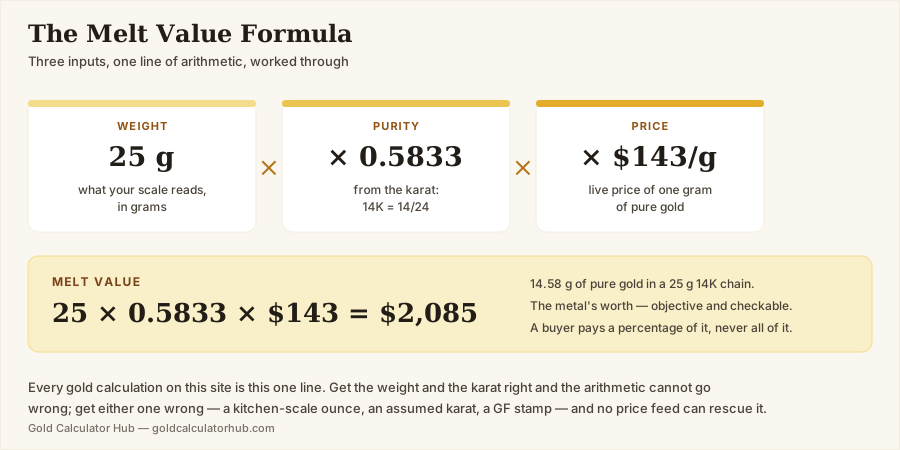
- Multiply: weight × purity × per-gram price. That's melt value, the objective anchor every offer should be measured against.
- Apply the buyer discount. Multiply melt by the payout percentage for the buyer type you're considering, and you have a realistic expectation — before you've talked to anyone.
Write down the result of step 4. In my experience that single written number changes how negotiations go more than anything else a seller can do — buyers quote differently to people who clearly know their melt value. The deeper math, with more worked examples, lives at how to calculate gold price.
Timing, Updates, and the Currency Question
Spot updates essentially continuously from Sunday evening to Friday afternoon US time, pausing only briefly each weekday and over the weekend. So which minute should you sell in?
Honestly: it barely matters. Gold's typical daily wiggle is well under 1%. On a $1,600 melt-value lot, an average day's move is a few dollars — while the difference between a pawn shop and an online refiner on that same lot can exceed $600. Sellers who agonize over intraday timing while accepting the first offer they hear have the priorities exactly backward. Pick the right buyer; don't day-trade your necklace.
On currency: gold is priced globally in US dollars, and every other currency's gold price is just a conversion. If you're comparing a price you saw in euros, pounds, or rupees, convert at the current exchange rate before concluding anything looks high or low. And double-check the unit while you're at it — some countries habitually quote per gram, per tola (11.664 g), or per 10 grams, which makes naive number-to-number comparisons meaningless. When in doubt, reduce everything to dollars per gram of pure gold; every honest quote on earth collapses to that same yardstick.
Why Two Honest Buyers Quote Different Numbers on the Same Day
It is tempting to read every gap between offers as one party cheating. Usually it is structure, and knowing the structure tells you which gap is worth chasing.
Buyers differ on how many hands sit between them and a refinery, on their fixed costs, on lot size thresholds, and on how much price risk they are carrying while your metal waits to move. An online refiner with a warehouse and a website has a thinner cost stack than a mall storefront paying retail rent. A dealer who moves a hundred lots a week can accept a smaller margin per lot than one who sees three.
Then there is the fee architecture, which is where headline percentages stop being comparable. Take the same 46.8-gram 14K lot from above, with a melt value of $3,949.45. Buyer A quotes a flat 78% of melt with no deductions: $3,080.57. Buyer B advertises 85% but charges a 2% assay fee and a $50 lot fee. That works out to $3,357.03, minus $78.99, minus $50 — $3,228.04. Buyer B still wins, by $147.47, but the advertised 7-point gap delivered under 4 points of actual money.
So compare final dollars, not percentages, and get the deductions stated in writing before shipping anything. Where the differences get genuinely indefensible is the bottom of the market — a 40%-of-melt offer is not a different cost structure, it is a bet that you never ran the numbers. Our where to sell gold breakdown ranks the categories by what they realistically pay.
What This Calculator Deliberately Leaves Out
A tool is only trustworthy if it is clear about its own edges, so here is what the number above is not.
It is not an offer, and no site can promise you one — we do not buy gold, which is the point of being an independent reference. It is not an appraisal for insurance, which values replacement cost at retail and typically lands at several times melt. It is not a numismatic valuation: a collectible coin's worth can sit far above its metal, and running a pre-1933 double eagle through a melt calculation is the classic way to lose real money. It does not account for gemstones, designer provenance, or antique value, all of which live outside the metal entirely.
It also assumes your karat stamp is accurate and your weight is clean. Both assumptions are usually fine and occasionally not — see how to test gold at home if a piece is unmarked or the stamp looks doubtful.
What it does give you is the one number the entire trade privately agrees on: the market value of the fine gold in front of you. Every professional buyer computes it before speaking to you. Computing it first is not an aggressive move; it is simply arriving at the conversation with the same information the other side already has. Start with the gold calculator on the homepage, write the figure down, and treat every quote that follows as a percentage of it.
Frequently Asked Questions
Why is the offer I got lower than the calculator shows?
Because the calculator shows melt value — the full market value of the pure gold in your item — and every buyer pays some percentage below that to cover their margin and refining costs. A fair offer from a strong buyer runs 70–90% of melt; pawn shops often pay 40–60%. If your offer is dramatically below melt, that's not "the market," that's that particular buyer. Get a second quote.
What's the difference between the bid and ask price?
The bid is what wholesale dealers will pay for gold at that instant; the ask is what they'll sell it for. The gap — the spread — is tiny in the institutional market, often under a dollar per ounce. As a retail seller you'll never trade at either number, but the bid is the more honest reference for what your metal is worth to the trade. Most consumer-facing price feeds display the midpoint, and for valuation purposes the difference is negligible.
Why does the gold rate differ from country to country?
Effectively yes. Gold trades globally in US dollars, and local prices in other currencies are conversions of the same underlying number, plus local taxes or import duties where they apply. Small regional premiums appear when physical demand spikes, but the base metal value is universal. If a price abroad looks wildly different, you're almost certainly looking at a different unit (grams, tolas, 10-gram bars) or a currency you haven't converted.
Why is 14K gold worth so much less per gram than the spot price implies?
Because 14K is only 58.33% gold — the rest is copper, silver, zinc, and nickel that gives jewelry its durability and costs almost nothing. Spot quotes pure metal, so every karat's value is just spot multiplied by its purity fraction: 75% for 18K, 58.33% for 14K, 41.67% for 10K. Nothing is being deducted or hidden; you simply own slightly more than half a gram of gold for every gram of 14K on the scale.
What time of day is the gold price highest?
There's no reliable daily pattern worth acting on. Gold trades nearly 24 hours on weekdays across Asian, European, and US sessions, and any intraday pattern is far smaller than the spread between different buyers' payouts. A seller obsessing over the hour while leaving 20% on the table by choosing the wrong buyer is optimizing the wrong variable. Check the price the day you sell, confirm your melt value, and spend your energy comparing offers.
Is gold priced in regular ounces or troy ounces?
Troy ounces, always. One troy ounce is 31.103 grams, versus 28.350 grams for the standard (avoirdupois) ounce — a difference of almost 10%. If you weigh gold on a postal or kitchen scale set to ounces, you're measuring standard ounces, and applying the troy-quoted price to that reading overstates your value. The safe habit: weigh everything in grams and divide spot by 31.103. Grams are unambiguous; ounces come in two flavors and one of them will cost you.
How often does the spot price update?
Continuously while markets are open — roughly Sunday 6 p.m. to Friday 5 p.m. Eastern, with a short daily pause. Consumer price sites refresh on short delays. For selling decisions, any quote from the last hour is plenty fresh; daily moves are usually fractions of a percent. The exception is genuinely turbulent days (major Fed announcements, geopolitical shocks), when buyers themselves may widen their margins to protect against swings.
Does a gold price calculator include sales tax or fees?
No — it returns raw metal value: weight × purity × current price. When you're selling, there's no sales tax on what a buyer pays you, though capital gains tax may apply to your profit (the IRS treats gold as a collectible — worth a conversation with a tax professional, not advice here). When you're buying bullion, some states charge sales tax below certain purchase thresholds, and dealers add premiums and sometimes shipping. The calculator's number is the clean metal baseline either way.
Why do some dealers quote prices per pennyweight?
Pennyweight (dwt) is a jeweler's tradition — 1/20 of a troy ounce, or 1.555 grams. It survives partly out of habit and partly because unfamiliar units make comparison harder for consumers. A quote of "$120 per dwt for 14K" sounds generous until you convert: $120 ÷ 1.555 = $77.17 per gram, which you can then compare directly against 14K melt value. Whenever you hear dwt, divide by 1.555 and re-shop the quote in grams. Honest dealers will happily re-quote in grams if asked.
Will my payout change if the price moves between quote and sale?
Usually, yes — most buyers price at the moment of the transaction, not the quote. Walk-in sales lock when you accept the offer and hand over the metal. Mail-in refiners typically price on the day they receive or assay your shipment, so a few days of market drift is possible in either direction; reputable ones state their pricing timestamp policy clearly. Given typical daily moves under 1%, this drift is rarely material — but if it worries you, sell locally where pricing is instant.
Where does the live price in this calculator come from?
From the same global wholesale market every legitimate quote traces back to — spot prices derived from COMEX and London OTC trading, the benchmarks the entire industry settles against. We're an independent valuation site; we don't buy or sell gold, so we have no incentive to shade the number in either direction. That's the point of checking your value here before talking to any buyer: the reference price has no thumb on the scale.
Can I trust the gold price a buyer shows me on their own screen?
Verify it rather than trusting it, and do so without ceremony — pull up any independent price feed on your phone while you're standing there. Spot is public and global, so a legitimate buyer has nothing to hide and won't mind. What you're checking for is a stale quote from an earlier session or a figure quoted per standard ounce rather than per troy ounce, either of which shifts the baseline several percent before any negotiation starts. If a buyer objects to you checking a public number, that reaction is more informative than the number itself.

Written by Sukie Gao
Sukie Gao holds a master's degree from a business school, where she picked up the markets-and-pricing toolkit she now applies to the consumer gold trade. She created Gold Calculator Hub to give people an independent, data-driven way to find out what their gold is really worth.
Published June 6, 2026 · Updated July 21, 2026