Zakat on Gold Calculator: Nisab and 2.5% Made Simple
 By Sukie Gao · June 6, 2026
A zakat on gold calculator has one honest job: turn the gold you own into a current dollar value, so you can check it against the nisab threshold and work out the 2.5% you owe. The calculator above handles the valuation half — enter your gold's weight and purity and it prices the metal at the live market rate, which is exactly the number scholars say to use on your zakat due date. The rest of this page handles the math around the rulings: what nisab is (85 grams of gold, with a silver-standard alternative many scholars and charities prefer), how the lunar year known as the hawl works, how lower-karat jewelry counts toward the threshold, where the schools of thought genuinely differ on jewelry that is worn rather than stored, and several fully worked examples so you can follow the arithmetic end to end.
One thing said plainly at the start: we are a gold valuation site, not a religious authority. We can make the numbers exact; we cannot rule on your situation. Where scholars differ — and on personal-use jewelry they sincerely do — we present the positions side by side and leave the ruling where it belongs. For anything beyond arithmetic, please confirm with a qualified scholar or your local mosque.
Zakat on Gold in One Paragraph
Zakat is the obligatory annual alms that purifies wealth — one of the five pillars of Islam. Gold and silver are the classic zakatable assets: if the gold you own meets or exceeds the nisab threshold, and you have held that level of wealth across a full lunar year, you owe 2.5% of its current market value, paid to eligible recipients. Three numbers govern everything: 85 grams (the gold nisab), one lunar year (the hawl), and 2.5% (the rate — exactly one fortieth).
Everything else on this page is detail and worked arithmetic around those three numbers. The valuation question — what is my gold worth today? — is where most people stall, and it is the one part a gold calculator genuinely solves: current market price, correct purity adjustment, no estimating.
The Nisab Threshold: 85 Grams of Gold (20 Mithqal)
Nisab is the minimum wealth at which zakat becomes due — below it, nothing is owed. For gold, the classical measure is 20 mithqal, which contemporary scholarship converts to 85 grams of pure gold (a few older references use 87.48 g, but 85 g is the figure most major zakat institutions and scholarly bodies work with today).
Here is what that threshold looks like at an assumed recent price of $4,300 per troy ounce — about $138.25 per gram of pure gold:
| Standard | Threshold | In troy ounces | Approx. value at $4,300/oz gold |
|---|---|---|---|
| Gold nisab | 85 g pure gold | 2.733 ozt | $11,751 |
| Silver nisab | 595 g silver | 19.13 ozt | Far lower — depends on the current silver price |
Note that the threshold is 85 grams of *pure* gold: 22K or 18K jewelry counts only by its pure content (the conversion is covered below). And since the dollar value of nisab moves with the market daily, the gram figure is the stable anchor — check the dollar equivalent on your actual due date.
The Silver-Standard Alternative: 595 Grams
Classical fiqh set two nisab measures — 20 mithqal of gold or 200 dirhams of silver, the latter converted to 595 grams of silver. In the Prophet's time the two were roughly equivalent in value; today they have diverged enormously, and the silver nisab works out to a far lower dollar threshold than the gold one.
Which should you use? Many scholars hold that someone whose zakatable wealth is purely gold measures against the gold nisab. Others — including many zakat institutions and major charities — recommend the silver standard whenever wealth is mixed (cash, savings, and gold together), reasoning that the lower threshold is the more cautious choice and benefits the poor. The practical effect is real: under the silver standard, even a modest amount of gold combined with ordinary savings usually crosses into zakatable territory.
This is a genuine difference of methodology rather than a math problem, which makes it one of the questions to settle with your scholar or mosque, not with a calculator.
Valuing Your Gold at Market Price on the Due Date
The principle is simple and widely agreed: zakat is calculated on what the gold is worth on the day zakat falls due — not what you paid for it, not an average over the year, and not its retail replacement price as finished jewelry.
Market price means the spot price of gold, quoted per troy ounce of 31.103 grams; you can check it on the World Gold Council's price pages or any major financial source. This zakat on gold calculator does the conversion and purity adjustment automatically — choose the karat, enter the grams, read the value.
Two valuation rules trip people up. Workmanship doesn't count: a bangle that retails for $3,000 but contains $1,800 of gold is valued at $1,800, because the making charges and design premium are not gold. Gemstones don't count either — they are neither gold nor silver, so subtract the stone weight or have a jeweler estimate it before you calculate. If you're unsure of any piece's true weight, our guide to weighing gold covers scales, units, and the mistakes that skew results; if you want the price math itself unpacked, see how to calculate gold price.
Step by Step: The Full Calculation
Here is the whole procedure, in order:
- Inventory your gold. Coins, bars, and — per your school of thought, see below — jewelry. Note each item's karat.
- Weigh everything in grams, ideally on a 0.1 g pocket scale, keeping the karats separate.
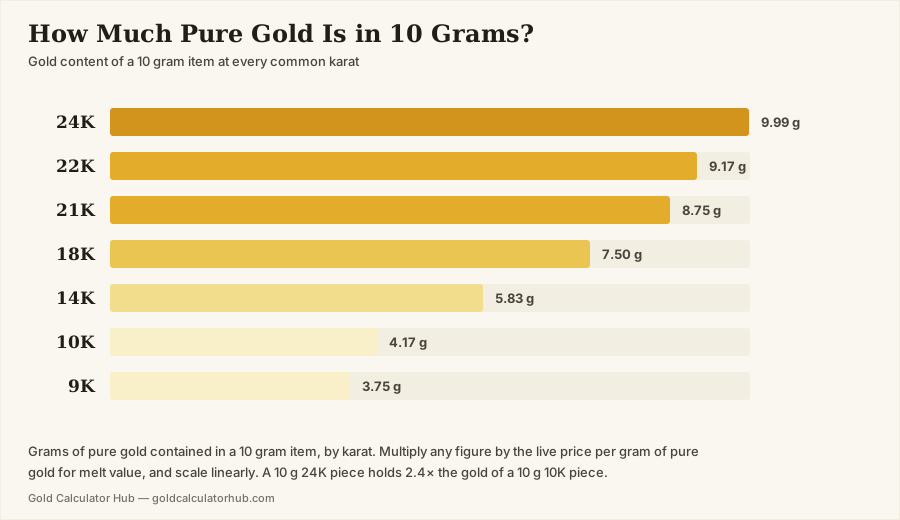
- Convert to pure gold content. Multiply each weight by its purity: 24K × 0.999, 22K × 0.9167, 21K × 0.875, 18K × 0.75, 14K × 0.5833.
- Compare total pure grams to nisab. Under 85 g of pure gold, with no other zakatable wealth? No zakat is due. At or over? Continue.
- Confirm the hawl. The wealth must have stayed with you for one full lunar year — about 354 days.
- Value the total at today's market price. Pure grams × the current price per gram of pure gold. This is the step the calculator above automates.
- Multiply by 2.5% — or divide by 40, same thing. That is your zakat due on gold.
- Pay it to eligible recipients, in cash equivalent or in gold itself.
A shortcut for step 6: with gold recently near $4,300–$4,500 per troy ounce, a gram of pure gold runs roughly $138–$145, putting the 85-gram nisab around $11,750–$12,300. Always use the live number on your due date, though — static figures go stale fast.
Worked Examples at Several Holdings
Assume gold at $4,300 per troy ounce — $138.25 per gram of pure gold — and assume in each case the holding has been owned for a full lunar year, with jewelry counted as zakatable (the Hanafi position; the next section covers the difference of opinion).
| Holding | Pure gold content | Market value | Over 85 g nisab? | Zakat due (2.5%) |
|---|---|---|---|---|
| 60 g of 24K coins | 59.9 g | $8,287 | No | $0 |
| 100 g of 24K bars | 99.9 g | $13,811 | Yes | $345.28 |
| 120 g of 22K bangles | 110.0 g | $15,208 | Yes | $380.20 |
| 200 g of 18K jewelry | 150.0 g | $20,738 | Yes | $518.44 |
Two things worth noticing. The 60-gram holder owes nothing only if gold is their entire zakatable picture — add cash savings and the calculus changes, especially under the silver-standard nisab. And the 22K and 18K rows show why purity conversion matters: 120 grams of bangles on the scale is only 110 grams of gold for nisab purposes, and 200 grams of 18K is only 150.
Jewelry You Actually Wear: Where the Schools Differ
Here is the most common real-world question, and the one with a genuine, centuries-old difference of scholarly opinion.
The Hanafi position: gold is zakatable regardless of its form or use. A bangle worn every day is treated the same as a coin in a safe — if your total gold meets nisab and the hawl has passed, 2.5% is due. Many families of South Asian and Turkish background follow this view, and it is the more encompassing of the two.
The majority position (the Maliki, Shafi'i, and Hanbali schools): jewelry kept for personal use in customary amounts is exempt, in the way one's home or car is exempt — it is a possession in use, not wealth held as wealth. Under this view, daily-wear pieces owe nothing, while gold kept as investment or savings, or held in amounts beyond customary use, remains fully zakatable.
Both positions rest on serious scholarship and are sincerely practiced today. Some who follow the majority view still choose to pay on worn jewelry voluntarily, considering it the safer and more generous course. We cannot tell you which ruling applies to you — that is between you, your school of thought, and your scholar or local imam. What we can do is make either calculation exact: the arithmetic on this page works identically whichever set of items you include.
The Lunar Year (Hawl) Requirement
Zakat is not triggered the moment you cross nisab — the wealth must remain with you for one full lunar (hijri) year, about 354 days, roughly 11 days shorter than the solar year. The workflow most people settle into: note the hijri date you first reached nisab; that date next year is your zakat due date; value everything at the market price on that day, every year thereafter.
Two wrinkles come up constantly. Fluctuation: the widely practiced position — and the Hanafi rule — checks nisab at the start and end of the hawl, so a dip in between does not reset the clock, though falling to zero does; some scholars require nisab throughout the year. Mid-year additions of the same wealth type are typically folded into the existing hawl rather than starting their own clock, though gifts and inheritance vary across schools. Both wrinkles deserve a specific question to your scholar rather than an assumption.
Many people deliberately set their zakat date in Ramadan for the added reward of giving in that month — which is fine, so long as it isn't used to delay a due date that has already arrived.
Paying It: Cash or Gold, and to Whom
Once you have the figure, you may pay zakat in cash equal to 2.5% of the gold's market value — by far the most common method — or hand over gold itself, 2.5% of the metal. Cash is usually kinder to recipients, who rarely have a good way to sell a few grams of gold at fair value; as the selling guides across this site document, small-lot sellers often net only 40–85% of melt value depending on the buyer, which means paying in metal can quietly shrink what the recipient actually receives.
If you do need to value or liquidate gold for zakat purposes, the tools here apply directly: the gold value calculator gives the honest market figure for any piece, and the gold price per gram calculator breaks the price down by karat.
Recipients are defined in the Quran (9:60) — the poor, the needy, zakat administrators, those whose hearts are to be reconciled, captives, debtors, in the cause of God, and stranded travelers — and most people pay through their mosque or a vetted zakat institution, which handles eligibility. One closing note for US readers: if you sell gold to fund zakat, capital gains rules on collectibles may apply to the sale — see the IRS guidance on collectibles and a tax professional. And once more, for the religious side: this page is arithmetic, not a fatwa. Confirm the rulings that apply to you with a qualified scholar or your local mosque.
Frequently Asked Questions
How much gold is nisab in 2026?
The nisab for gold is 85 grams of pure gold — a fixed weight, not a fixed dollar amount. Its cash value moves with the market: at recent prices around $4,300–$4,500 per troy ounce, 85 grams works out to roughly $11,750–$12,300, but the only number that counts is the market value on your zakat due date. Check the live price that day, or use a zakat on gold calculator that prices your holdings at the current rate.
Do I owe zakat on my wedding ring and everyday jewelry?
It depends on your school of thought. The Hanafi school counts all gold toward zakat regardless of use, so daily-wear jewelry is included once your total meets nisab. The Maliki, Shafi'i, and Hanbali schools exempt jewelry kept for personal use in customary amounts, while still counting gold held as savings or investment. Both views are well-established. Ask your scholar or local imam which applies to you — and note that some people pay on worn jewelry voluntarily as the safer course.
Is zakat 2.5% of everything or only the amount above nisab?
On the whole amount. Nisab is a threshold test, not a deduction: once your gold meets or exceeds 85 grams of pure content and the lunar year has passed, you owe 2.5% of the entire holding's market value, not just the portion above the threshold. Someone with 100 grams of pure gold pays 2.5% on all 100 grams. This differs from how tax brackets work, which is why it surprises people.
Do I use the price I paid for my gold or today's price?
Today's price — specifically, the market price on your zakat due date. What you originally paid is irrelevant, whether the metal has risen or fallen since. Take your total pure gold content in grams, multiply by the current price per gram of pure gold, and that market value is the base for the 2.5%. The calculator at the top of this page exists for exactly this step: it applies the live price and the purity adjustment in one pass.
How does 18K or 22K jewelry count toward the 85-gram nisab?
By pure gold content, not scale weight. The 85-gram threshold refers to pure gold, so multiply each item's weight by its purity: 22K is 91.67% gold, 21K is 87.5%, 18K is 75%, 14K is 58.33%. A hundred grams of 18K jewelry is 75 grams of pure gold — below nisab on its own. This conversion cuts both ways: it can keep a modest holding under the threshold, and it keeps you from overpaying zakat on alloy metal that isn't gold.
What if my gold dropped below nisab during the year?
Schools differ. The Hanafi position checks nisab at the start and end of the lunar year — a dip in between doesn't break the hawl, though dropping to zero does. Several other scholars require wealth to stay at or above nisab continuously, in which case a dip restarts the clock from when you next reach the threshold. If your holdings hovered near the line this year, this is worth a precise question to your scholar rather than a guess.
Do gemstones and making charges count in the value?
No, for zakat on gold you value the gold alone. Diamonds and other stones set in jewelry are not gold or silver, so their weight and value are excluded — subtract the stone weight before calculating, or have a jeweler estimate it. Likewise, the workmanship premium built into retail prices doesn't count: a bangle that would cost $3,000 to replace but contains $1,800 of metal is valued at $1,800. Weight, purity, market price — nothing else.
Can I pay zakat on gold with cash instead of gold?
Yes, and it is the standard practice. Calculate 2.5% of your gold's market value on the due date and pay that amount in cash to eligible recipients or through a zakat institution. Paying in actual gold is also valid — 2.5% of the metal itself — but cash is usually better for the recipient, who would otherwise have to sell small amounts of gold at the steep discounts small-lot sellers typically face. Either way, the valuation uses the same current market price.

Written by Sukie Gao
Sukie Gao holds a master's degree from a business school, where she picked up the markets-and-pricing toolkit she now applies to the consumer gold trade. She created Gold Calculator Hub to give people an independent, data-driven way to find out what their gold is really worth.
Published June 6, 2026