Gold Price per Gram Calculator (All Karats, Live)
 By Sukie Gao · Updated July 21, 2026
A gold price per gram calculator answers the question every seller eventually asks: what is one gram of my gold actually worth right now? Spot gold trades by the troy ounce — recently near $4,300–$4,500 — but nobody hands a buyer a full ounce of loose jewelry. Buyers weigh your items in grams (or pennyweights), multiply by a per-gram rate for the karat, and quote you a number. If you don't know the real per-gram figure for 14K or 18K before you walk in, you're negotiating blind. The calculator above does the conversion with live prices: pick a karat, enter a weight, and it returns the melt value in dollars. The rest of this page shows the math behind it — how a troy-ounce spot price becomes a per-gram price, what each karat is worth gram for gram, how much typical rings and chains weigh, and how to judge whether a per-gram quote is fair or insulting. Ten minutes here is usually worth more than an hour of haggling at the counter.
Why Buyers Quote per Gram (and You Should Too)
Gold's headline price is set by the troy ounce. Futures exchanges, the LBMA auctions in London, the ticker on financial news — all troy ounces. But the moment gold becomes a ring or a chain, the ounce stops being useful. Nobody sells exactly 31.103 grams of jewelry. So the trade works in smaller units: grams almost everywhere, and pennyweights (dwt) at many American shops.
That's not a trivial detail — it's the first place sellers get confused. A buyer who says "I'll pay $75 a gram for 14K" and one who says "I'll pay $117 a pennyweight" are quoting nearly the same rate, because a pennyweight is 1.555 grams. Sellers who don't know the conversion hear $117 and assume it's the better offer.
Thinking per gram puts you on the buyer's turf. Weigh your item — a $20 jeweler's scale or the methods in our how to weigh gold guide will do — multiply by the per-gram rate for your karat, and you know the melt value before anyone makes you an offer. That single number is your anchor for every negotiation that follows.
From Troy Ounce to Gram: The Conversion That Trips People Up
One troy ounce is 31.103 grams — not the 28.350 grams of the ounce on your kitchen scale. The troy ounce is about 9.7% heavier, a medieval holdover the precious-metals world never abandoned, and mixing the two up is one of the costlier mistakes a seller can make.
The conversion itself is one division. Assume gold at $4,400 per troy ounce:
$4,400 ÷ 31.103 = $141.47 per gram of pure gold
That figure — call it the pure-gold gram rate — is the base for everything else. It's what 24K bullion is worth gram for gram (a hair less, since 24K is 99.9% pure rather than 100%), and every lower karat is a fixed percentage of it. Doing this division with a live price is the entire job of a gold price per gram calculator; the tool above and our broader gold price calculator both handle it automatically. But knowing where the number comes from makes you much harder to mislead. A buyer quoting a "gram price" of $90 for pure gold when spot math says $141 is counting on you never having seen this division.
Three Shortcuts That Do Most of the Work
Quotes happen at counters, not at desks. You will usually be standing up, mildly rushed, with someone across a glass case waiting for an answer — which is exactly when nobody wants to open a spreadsheet. Three shortcuts cover almost every situation.
Divide spot by 31 for a fast pure-gold gram rate. The exact divisor is 31.103, so this runs about a third of a percent high, which is close enough to decide whether an offer deserves a second look. At $4,400 spot that's roughly $142 a gram against a true $141.47.
Divide spot by 53.3 for 14K, by 41.5 for 18K, by 74.6 for 10K. These fold the purity step into the division. At $4,400: $4,400 ÷ 53.3 = $82.55 for 14K, ÷ 41.5 = $106.02 for 18K, ÷ 74.6 = $58.98 for 10K. Check those against the exact table below and you're within a few cents on every one.
Multiply any gram rate by 1.555 to get the pennyweight rate. 14K at $82.52 a gram is $128.32 per dwt. Now a shop's pennyweight quote is directly comparable without converting anything of theirs — you've converted yours instead, which is faster and less error-prone.
None of these replace the tool at the top of the page. They exist so that when a number lands in front of you unexpectedly, you can tell within about five seconds whether it's in the neighborhood or nowhere near it.
What a Gram of Gold Is Worth at Every Karat
Jewelry is almost never pure. Karat tells you the fraction of gold in the metal, and per-gram value scales with it directly. Take the pure-gold rate of $141.47 (at our assumed $4,400 spot) and multiply by the purity. For 14K: $141.47 × 58.33% = $82.52 per gram.
| Karat | Gold content | Value per gram (gold at $4,400/oz) |
|---|---|---|
| 24K | 99.9% | $141.32 |
| 22K | 91.67% | $129.68 |
| 21K | 87.5% | $123.78 |
| 18K | 75% | $106.10 |
| 14K | 58.33% | $82.52 |
| 10K | 41.67% | $58.95 |
| 9K | 37.5% | $53.05 |
Two things are worth noticing. First, the gaps are large: an 18K gram is worth about 80% more than a 10K gram, so identifying the karat correctly matters as much as weighing correctly. The stamp inside a band or on a clasp usually settles it — 750 means 18K, 585 means 14K, 417 means 10K. Second, these are melt values, not offers; no buyer pays 100% of melt. If you have a mixed pile, sort and value each karat separately — our 18K gold calculator covers the karat that gets mispriced most often when it's lumped in with 14K.
Typical Gram Weights of Common Jewelry
You'll eventually want a real scale, but a rough weight estimate tells you whether you're holding $80 or $2,000 before you bother. These ranges reflect years of weighing customer pieces — individual items vary, especially hollow versus solid chains:
| Item | Typical weight |
|---|---|
| Thin women's band | 1.5–3 g |
| Women's wedding band | 3–6 g |
| Men's wedding band | 5–9 g |
| Men's class ring | 8–16 g |
| Pair of stud earrings | 1–3 g |
| Pair of medium hoops | 3–8 g |
| Pendant or charm | 2–10 g |
| Light 18-inch chain | 3–8 g |
| 20-inch rope chain | 10–20 g |
| Heavy curb or Cuban chain | 25–80 g |
| Bangle bracelet | 8–25 g |
Hollow pieces are the great deceiver here: a puffed hollow rope chain can look like 40 grams and weigh 11. Stones cut the other way — they add weight that isn't gold. A one-carat diamond adds 0.2 grams that any honest buyer will deduct before pricing. When the number actually matters, weigh the piece; when you just want to know whether the trip is worth making, the table gets you close enough.
A Worked Example: Pricing a 12.4-Gram 14K Rope Chain
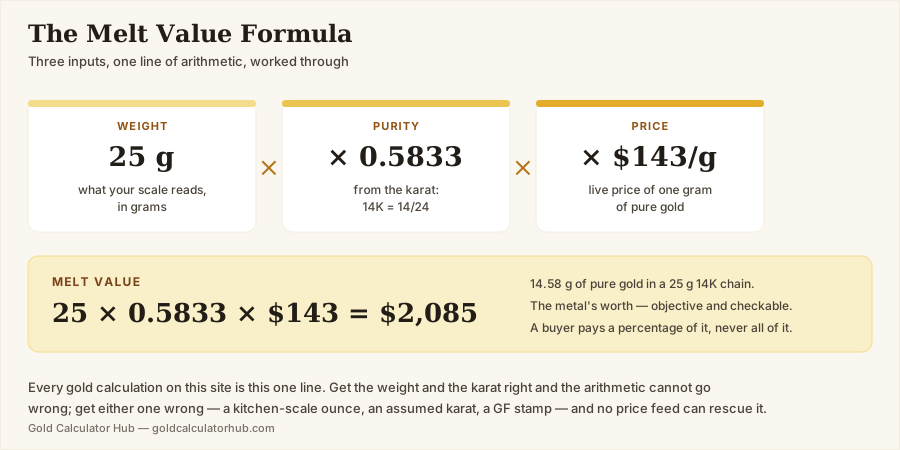
Say you've got a 20-inch 14K rope chain, stamped 585 on the clasp, and your scale reads 12.4 grams. With gold at $4,400 per troy ounce:
- Pure-gold gram rate: $4,400 ÷ 31.103 = $141.47
- 14K gram rate: $141.47 × 0.5833 = $82.52
- Melt value: 12.4 g × $82.52 = $1,023.25
That $1,023 is the chain's melt value — the market price of the gold it contains. Now layer on what each buyer type typically pays as a percentage of melt:
- Online refiner (70–90% of melt): roughly $716–$921
- Local coin or bullion dealer (65–85%): roughly $665–$870
- Jewelry store (50–75%): roughly $512–$767
- Pawn shop (40–60%): roughly $409–$614
The same chain, on the same Tuesday, can produce offers $500 apart depending on which door you walk through. This is exactly why running the numbers first matters: a $650 offer sounds generous in a vacuum and looks weak next to a $1,023 melt figure. The full step-by-step formula, with more worked examples, lives in how to calculate gold price.
Sort the Drawer Before Anyone Weighs It
Most people don't sell one chain. They sell a drawer — a tangle of single earrings, a broken clasp, two rings from a marriage that ended, a class ring nobody wore after 1998. And the single most expensive thing you can do with that drawer is hand it over as one pile.
Here's why, with numbers. Suppose the drawer sorts into three stacks, weighed on a $20 pocket scale, still at our assumed $4,400/oz gold:
| Karat | Weight | Per-gram rate | Melt value |
|---|---|---|---|
| 18K (stamped 750) | 9.6 g | $106.10 | $1,018.56 |
| 14K (stamped 585) | 21.3 g | $82.52 | $1,757.68 |
| 10K (stamped 417) | 34.1 g | $58.95 | $2,010.20 |
| Total | 65.0 g | — | $4,786.44 |
Now suppose a buyer weighs all 65 grams together and pays the 10K rate, on the reasonable-sounding grounds that they can't verify every stamp: 65.0 g × $58.95 = $3,831.75. You just donated $954.69 — about 20% of the correct melt value — for the convenience of not sorting.
This is rarely fraud. It's friction. Sorting takes a buyer time, and time is the one thing a busy counter doesn't want to spend on a walk-in. So do it at your kitchen table instead: a magnifying glass, good light, three small bowls, and twenty minutes. Group by stamp, weigh each group, and present three numbers instead of one pile. Anything unstamped goes in a fourth bowl and gets tested rather than guessed — our notes on how to test gold at home cover the cheap methods. Buyers who see a sorted, pre-weighed parcel tend to quote differently, because you've just signaled that a lowball will be noticed.
How to Judge a per-Gram Quote
A per-gram quote only means something next to the melt value, so the test is one division: offered price ÷ melt value. Above 80%, you've found a strong buyer — usually a refiner or a high-volume dealer. Between 60% and 80% is the normal, defensible range for local shops with overhead. Below 50%, you're subsidizing someone's storefront. Below 40%, walk.
A few traps to watch for. Some shops quote per pennyweight because the bigger number feels generous — divide any dwt quote by 1.555 to get the true per-gram rate before comparing. Some weigh everything together and pay your lowest karat's rate for the whole pile — insist on sorting by karat first. And some quote a healthy-sounding percentage but base it on a stale, lower spot price — ask which price they're using and check it against a live gold calculator before you agree to anything. The FTC's guidance on selling gold jewelry is short and worth reading before your first sale: get multiple quotes, watch the scale, and never let urgency set your price.
None of this requires confrontation. Buyers respect sellers who know their melt number — offers genuinely improve when it's clear you've already done the math.
Where the Missing Twenty Percent Goes
If melt value is $1,000 and the best realistic offer is around $850, it's fair to ask what happens to the other $150. Understanding the answer changes how you negotiate, because it tells you which parts of the gap are real costs and which are pure margin.
Four things sit between your jewelry and a bar of refined gold:
- Assay. Somebody has to establish what the parcel actually is. Stamps lie, plating hides, and a lot marked 14K can contain solder, steel springs, and the occasional brass fake. Testing costs money and takes time.
- Refining loss and fees. Melting mixed karat scrap doesn't recover 100% of the gold, and refiners charge a processing fee, usually structured as a percentage plus a per-lot minimum. Small lots get hit hardest by the minimum, which is a large part of why one gram of gold is proportionally harder to sell well than one hundred grams.
- Price risk. A buyer who quotes you at 10 a.m. carries the market until they hedge or deliver. That risk gets priced in, and it widens when gold is volatile.
- Overhead and profit. Rent, staff, insurance, and the security costs of keeping metal on a retail street. This is the piece that varies most between an online refiner with one facility and a jewelry store on a high-rent block, and it's essentially the whole explanation for the spread between the 70–90% and 50–75% payout bands.
The practical consequence: the levers you can actually pull are lot size, buyer type, and competition. A larger sorted parcel sold to a high-volume buyer who knows you have two other quotes lands near the top of the range. A single 3-gram ring walked into the nearest pawn shop on a Sunday lands near the bottom, and no amount of arguing about spot price changes that — the cost structure, not the buyer's mood, is doing most of the work.
Frequently Asked Questions
How much is 1 gram of gold worth right now?
It moves with the market, but with spot recently near $4,300–$4,500 per troy ounce, a gram of pure gold runs roughly $138–$145. Jewelry is worth its purity fraction of that: a gram of 14K is about 58.33% of the pure rate, a gram of 18K about 75%. The gold price per gram calculator at the top of this page uses the live spot price, so it will always beat any static number printed in an article.
Why is my jewelry's gram price lower than spot divided by 31.1?
Because jewelry isn't pure gold. Spot divided by 31.103 gives the per-gram rate for 100% pure metal. A 14K piece is only 58.33% gold — the rest is copper, silver, nickel, or zinc, which are worth essentially nothing at jewelry scale. So a 14K gram is worth 58.33% of the pure rate, an 18K gram 75%, and so on down the karat ladder. The karat stamp, not the shine, sets the rate.
What is a pennyweight, and why does my buyer use it?
A pennyweight (dwt) is 1.555 grams — there are exactly 20 to a troy ounce. It's a legacy unit of the American jewelry trade, and plenty of buyers still quote in it, partly from habit and partly because dwt prices sound bigger than gram prices. There's nothing wrong with a dwt quote as long as you convert it: divide by 1.555 and compare per-gram rates apples to apples.
Can I weigh gold on a kitchen scale?
Only for a rough estimate. Most kitchen scales resolve to a full gram, which is fine for a 50-gram chain and useless for a 2-gram ring — a rounding error of half a gram on 14K is about $40 at recent prices. A pocket jeweler's scale with 0.01 g resolution costs $15–$25 and pays for itself the first time you use it. Also make sure you're reading grams, not ounces.
Do buyers actually pay the full per-gram melt value?
No — every buyer pays a percentage of melt and keeps the spread as their margin. Online refiners typically run 70–90% of melt, local coin and bullion dealers 65–85%, jewelry stores 50–75%, pawn shops 40–60%, and mail-in TV services as little as 20–50%. The melt value isn't what you'll receive; it's the yardstick that tells you which offers are strong and which are predatory.
Is the price of gold per gram the same in every country?
Effectively yes, before local costs. Gold trades on a global market priced in US dollars, so the underlying per-gram rate is the same everywhere at any given moment. What differs locally is everything layered on top: currency conversion, import duties, taxes, and dealer premiums or discounts. That's why gold can feel more expensive in one country than another even though the metal itself has one world price.
Do gemstones count toward the gram weight?
They shouldn't. Diamonds and other stones aren't gold, and a fair buyer either removes them or estimates and deducts their weight before pricing the metal. A one-carat diamond weighs 0.2 grams; small accent stones add up too. Watch for buyers who weigh a stone-set ring whole and pay the gold rate on the total — on a heavily set piece, that quietly inflates the weight they appear to be paying for while they pocket the stones.
How often does the per-gram price change?
Continuously. Gold trades nearly 24 hours a day on weekdays across global markets, so the per-gram rate moves with it — usually fractions of a percent in a day, occasionally much more. For sellers, the practical takeaway is to check the live price the day you sell, not the day you researched. A quote that was fair last Tuesday can be stale today, and shops don't always update their posted rates promptly when spot rises.
Why do two shops quote different per-gram prices on the same afternoon?
Three reasons, in descending order of how often they're the real one. First, payout percentage: one shop works at 80% of melt and the other at 55%, and neither will volunteer that number. Second, the spot price each one is using — some post a rate in the morning and leave it, so a rising market makes their quote stale by lunch. Third, honest disagreement about your gold, usually over karat on unstamped pieces or how much stone weight to deduct. Ask each buyer which spot price they're working from and what percentage of melt they're paying; the ones who answer plainly are usually the ones worth selling to.
Should I sell a piece by the gram or try to sell it as jewelry?
Weigh it, price the melt, then ask what the piece would fetch intact. Scrap pricing ignores design entirely, so anything with a recognizable brand, a hallmark from a known maker, real craftsmanship, or genuine gemstones is often worth more whole. Generic, broken, or badly dated pieces are the opposite — melt is the honest number and no resale market is waiting. The melt figure is what makes the comparison possible at all: it's the floor beneath every other option, and if a consignment or private-sale offer doesn't clear it comfortably, selling by the gram is the better deal.

Written by Sukie Gao
Sukie Gao holds a master's degree from a business school, where she picked up the markets-and-pricing toolkit she now applies to the consumer gold trade. She created Gold Calculator Hub to give people an independent, data-driven way to find out what their gold is really worth.
Published June 6, 2026 · Updated July 21, 2026