Gold Filled Calculator: How Much Gold Is in GF Items?
 By Sukie Gao · Updated July 21, 2026
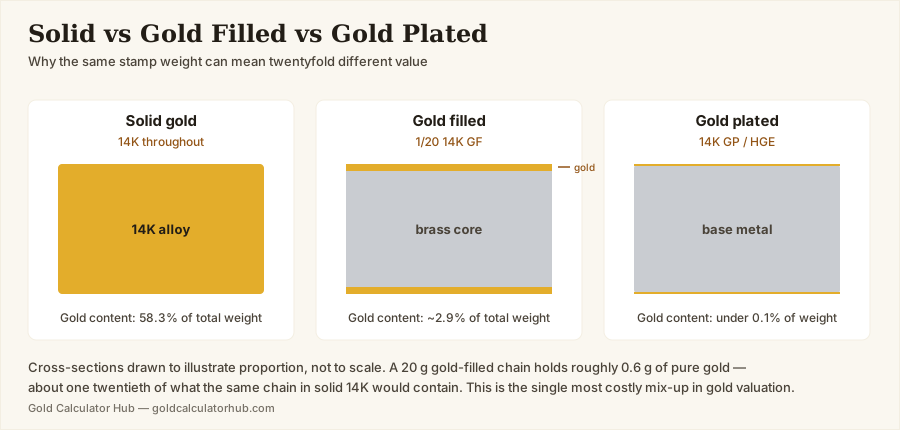
A gold filled calculator works differently from every other tool on this site, and that difference is the whole story. You'll notice there's no calculator embedded on this page — that's deliberate. Our standard calculators assume an item is solid karat gold all the way through, and running a gold-filled chain through one would overstate its value by twenty to forty times. Gold-filled (GF) jewelry is a thick layer of real karat gold mechanically bonded over a brass core, and by US rule the gold layer must be at least 1/20 — five percent — of the item's total weight. Real gold, honestly disclosed, but a small fraction of what the scale implies. The good news: the stamp on a GF item tells you *exactly* how much gold it contains, down to a clean percentage, and the math takes about thirty seconds once you know how to read it. This page is that math. We'll decode every common GF mark, work the fractions precisely, separate gold-filled from plated and vermeil, and finish with the honest answer to the question that brings most people here: is a box of gold-filled chains actually worth selling? (Short version: individually no, in bulk sometimes yes.)
Most people land here holding one of three things: an estate lot of chains and watch bands that a pawn shop just handed back, a vintage watch case stamped with a fraction they can't parse, or a single piece they're trying to work out is solid or not before they sell it as scrap. All three questions come down to the same two-number multiplication, so start with the mark, finish with the math, and skip anyone who wants to quote you a price before either.
What "Gold Filled" Actually Means
The name misleads in both directions — a gold-filled item is neither filled with gold nor merely "gold colored." The manufacturing process bonds a sheet of genuine karat gold to a base-metal core (almost always brass) under heat and pressure, then rolls or draws the bonded billet into wire, sheet, or tubing. The result is a gold layer hundreds of times thicker than electroplating, mechanically fused rather than deposited, which is why good GF jewelry can survive decades of daily wear without exposing the brass underneath.
The legal definition matters because it's what makes the math on this page possible. Under the FTC's jewelry marketing rules, an item marked "gold filled" must carry a gold layer that is at least 1/20 — 5% — of the item's total weight, and the mark must state both the fraction and the karat of the layer, which is how you get stamps like 1/20 12K GF. Anything with a thinner gold layer can't legally use the GF name; from 1/40 down you'll see "rolled gold plate" (RGP) instead. The FTC's guidance on gold jewelry covers how these markings are meant to protect buyers.
So a GF stamp is a little recipe card: it tells you what fraction of the item is gold layer, and what purity that layer is. Two numbers, multiplied together, give you the item's true fine-gold content — which is the entire calculation.
The Fraction Math, Step by Step
Here's the complete method for valuing any marked gold-filled item. We'll run 1/20 12K GF — the most common vintage mark, decoded stamp-by-stamp in the 1/20 12K GF guide — as the live example; the rest of the gold basics guides cover the marks that mean full metal value.
- Read the weight fraction. The "1/20" means the gold layer makes up 1/20 of the item's total weight: 5%.
- Read the layer's purity. The "12K" means that layer is 12-karat gold — 12/24 = 50% pure gold.
- Multiply the two. 5% × 50% = 2.5%. That's the item's true fine-gold content: a 100-gram lot of 1/20 12K GF chain contains 2.5 grams of pure gold.
- Weigh the item and apply the percentage. A 15-gram GF bangle: 15 × 0.025 = 0.375 g of fine gold.
- Multiply by the gold price per gram. Assume gold at $4,400 per troy ounce, so $4,400 ÷ 31.103 = $141.46/g. That bangle's contained gold: 0.375 × $141.46 ≈ $53.
Step 5's result is contained value, not sale value — no buyer pays full contained value on GF, for reasons covered below. But the method is exact, and it explains the twenty-to-forty-times warning in the intro: run that same 15-gram bangle through a standard gold calculator as if it were solid 12K and you'd get 15 × 0.50 × $141.46 ≈ $1,061. The fraction is the difference between $53 and $1,061 — which is why a working gold filled calculator is this five-step routine, not a karat-and-weight tool.
GF Marks Decoded: True Gold Content and Value per Gram
Every common mark, run through the same multiplication — the gold filled calculator in lookup form. Per-gram values assume gold at $4,400/ozt ($141.46 per gram of pure gold):
| Mark | Layer purity | Layer weight | True fine gold | Gold value per gram of item |
|---|---|---|---|---|
| 1/10 14K GF | 58.33% | 10% | 5.83% | $8.25 |
| 1/10 12K GF | 50% | 10% | 5.00% | $7.07 |
| 1/20 14K GF | 58.33% | 5% | 2.92% | $4.13 |
| 1/20 12K GF | 50% | 5% | 2.50% | $3.54 |
| 1/20 10K GF | 41.67% | 5% | 2.08% | $2.95 |
| 1/40 14K RGP | 58.33% | 2.5% | 1.46% | $2.06 |
Reading the table: the heaviest common spec, 1/10 14K GF (typical of quality vintage watch cases and better jewelry), carries under six percent actual gold. The lightest, rolled gold plate, is under a percent and a half. For perspective, solid 10K — the *least* pure solid gold sold in the US — is 41.67% gold, roughly seven times richer than the best gold-filled spec.
If a piece carries a fraction-style mark you don't see here, the same two-step multiplication handles it. And if the mark looks like plain "14K" with no fraction and no GF, you may be holding solid gold — our gold hallmarks guide walks through every stamp format before you assume either way.
When the Stamp Doesn't Match the Table
Real stamps are messier than reference charts. Here's how to handle the ones that don't sit neatly in the table above.
Punctuation and spacing vary freely. "1/20 12K GF," "1/20 12KT G.F.," "1/20-12K-GF," and "GOLD FILLED 1/20 12K" are the same specification. Read the numbers, ignore the typography.
A karat with no fraction. Marks like "12K GF" or plain "GOLD FILLED" name the layer's purity but not its share of the weight. Since 1/20 is the legal minimum for the GF name and by far the most common spec, assume 1/20 and treat anything better as a bonus. On a 12K layer that's 2.5% fine gold; refiners buying by the pound make the same conservative assumption, so your estimate and their quote start from the same place.
Marks that are not gold filled at all. "HGE" (heavy gold electroplate), "GEP," "GP," and "18KT HGE" are plating, no matter how substantial the word "heavy" sounds — plating carries essentially no recoverable gold. "RGP" is rolled gold plate, a genuine bonded layer but thinner than the GF minimum, typically 1/40 or less.
European equivalents. British pieces often read "ROLLED GOLD" or "R.G."; French ones use "PLAQUÉ OR" or "DOUBLÉ," sometimes with a micron thickness instead of a weight fraction. Micron figures describe layer depth, not weight share, so they can't be converted to a percentage without knowing the item's surface area — treat those pieces as "probably GF-grade at best" and let a refiner assay decide.
Where to look. Clasps, the inside of a bangle's terminal, the back of a watch case, and the underside of a brooch pin — and remember a replacement clasp may carry a mark that describes only itself.
Gold Filled vs. Gold Plated vs. Vermeil
Three names, three wildly different amounts of gold — and they get confused constantly, including by sellers writing listings.
Gold filled is the heavyweight: a bonded layer that's legally at least 5% of the item's weight. Real recoverable gold, with a real (if modest) scrap market.
Gold plated is an electroplated film, typically a fraction of a micron to a few microns thick. As a share of the item's weight it's commonly on the order of five-hundredths of a percent — fifty times less than GF — which rounds to zero for any practical valuation. Plated jewelry is costume jewelry; no refiner will pay for the gold because recovering it costs more than it yields.
Vermeil is gold plating's respectable cousin: a gold layer of at least 10K fineness and a minimum thickness (2.5 microns under the US standard) over a *sterling silver* base rather than brass. The gold content is still negligible — vermeil's resale value, such as it is, lives mostly in the silver underneath.
The ranking for scrap purposes: solid gold is worth real money, gold filled is worth modest money in bulk, vermeil is worth its silver, and plated is worth nothing. Every step down that ladder is roughly an order of magnitude, which is why correctly identifying which rung you're on — the subject of the next section — matters more than any other part of the valuation.
Telling Gold Filled From Solid Gold
The stamp is the first and best evidence — "GF," "RGP," a weight fraction, or "1/20" anywhere in the mark settles it. But stamps wear off, clasps get replaced, and vintage pieces sometimes carry no legible mark at all. When the stamp can't testify, here's what actually works and what doesn't.
The magnet test has limited power here. Both gold and brass are non-magnetic, so unlike with steel-core fakes, a magnet usually can't distinguish GF from solid gold. Worth doing (a magnetic response proves a steel core and rules out both solid gold and honest GF), but a pass proves little.
Wear points tell the truth. GF reveals itself where friction lives: clasp edges, ring shanks, chain links that rub. Look for a subtly different color showing through at high-wear spots — exposed brass reads slightly yellower-green or duller than the gold layer. On old GF pieces this is often visible to the naked eye; a loupe makes it conclusive.
Destructive certainty: the deep-scratch acid test. A surface acid test will read GF as gold, because the surface *is* gold. Testing the core requires filing a small notch in an inconspicuous spot deep enough to pass the layer, then applying acid there. Green fizzing means brass. This is the standard refiner's check and the reason refiners always verify before paying — full methods are at how to test gold at home.
When real doubt remains on a piece heavy enough to matter, an XRF reading at a jeweler or refiner answers it without damage.
A Pound of GF Chains: The Honest Worked Example
Here's the scenario that brings most people to this page: a tin of old gold-filled chains, watch bands, and odd findings — say a full pound of it, all marked 1/20 12K GF. What is it actually worth?
The contained-gold math first. One pound = 453.6 grams. True gold content at the 1/20 12K spec: 453.6 × 0.025 = 11.34 grams of fine gold. At our assumed $4,400/ozt ($141.46/g), that's 11.34 × $141.46 ≈ $1,604 of contained gold in the pound.
Now the honest part: nobody will hand you $1,604 for it. Recovering 11 grams of gold dispersed across 450 grams of brass requires industrial-scale chemical refining, and the economics only work in volume. Local buyers reflect this bluntly — most pawn shops and jewelry stores refuse GF outright, and those that take it pay scrap-brass-adjacent prices. The real market is specialty refiners that buy gold-filled scrap by the pound, quoting per-pound rates that track the gold price. Expect their quotes to land well below the contained-gold figure — the refiner's chemistry, labor, and margin all come out of that $1,604 — but well above the zero a pawn counter offers.
Three rules for selling GF: accumulate until you have at least a pound or two, since per-pound rates and shipping both punish small lots; sort by mark, because 1/10 14K material is worth more than double 1/20 12K and deserves separate pricing; and pull anything that might be solid gold first — one misidentified solid 14K bracelet in the tin can be worth more than the entire remaining pound. Sort with the gold purity chart open before anything ships.
The Economics of Recovery — and Why Small Lots Get Refused
Sellers are often baffled that a material demonstrably containing gold can be met with a shrug. The refusal is economic, and once you see the cost structure it stops feeling personal.
Recovering gold from GF scrap means separating a few grams of gold from roughly twenty times its weight in brass. In practice that's a chemical process — dissolving the base metal, filtering and precipitating the gold, then neutralizing and disposing of the spent solution under environmental rules that cost real money to comply with. Almost all of those costs are fixed per batch, not per gram: the lot setup, the assay, the labor, the permitted waste handling. Run a five-pound lot and the fixed cost spreads thin. Run a four-ounce lot and it swallows the gold.
There's a second problem: a mixed tin of GF is heterogeneous. A refiner can't assay a representative sample of a jumble of watch bands, spectacle frames, and chains the way they can sample a homogeneous melt. Their options are to process it and find out, or to price it at the weakest plausible mark. Small lots aren't worth the first option, so they get the second — or a decline.
Worked example of a lot that doesn't clear the bar. Say you have 4 ounces of 1/20 12K GF — 113.4 grams. Fine gold: 113.4 × 0.025 = 2.835 g. At an assumed $4,400 per troy ounce ($141.46 per gram), that's about $401 of contained gold. Now subtract the realities: insured shipping both ways, a refiner's minimum-lot fee, and a payout percentage that reflects the recovery cost. Many refiners simply set a one- or two-pound minimum and won't quote at all below it — which is why the advice on this page is to accumulate rather than transact.
A reasonable rule of thumb: if shipping and fees would exceed roughly a tenth of your contained-gold figure, the lot is too small. Put the tin back in the closet, keep adding to it, and revisit when it's heavy enough to be worth a chemist's afternoon. When it is, get the per-pound rate and the mark being priced in writing before anything ships, and compare your options against the venues ranked at where to sell gold.
Frequently Asked Questions
Is gold filled jewelry worth any money?
Some, in bulk. A gold-filled item is legally at least 5% genuine karat gold by weight, which works out to roughly 2.5–5.8% pure gold depending on the mark — real but modest. Individual pieces rarely justify a transaction: a 10-gram 1/20 12K GF chain contains about $35 of gold at recent prices, less than most buyers' handling cost. Accumulated by the pound and sold to a specialty refiner that processes GF scrap, the same material has a genuine, payable market.
What does 1/20 14K GF stamped on my jewelry mean?
It's a recipe: the gold layer is 1/20 (5%) of the item's total weight, and that layer is 14-karat gold (58.33% pure). Multiply the two and the item is 2.92% fine gold overall. So a 20-gram bracelet with that mark contains 20 × 0.0292 = 0.58 grams of pure gold — about $83 worth at an assumed $4,400 per troy ounce. The fraction-times-purity multiplication works the same way for any GF mark you encounter.
Why can't I use a regular gold calculator for gold filled items?
Because standard calculators assume the item is solid karat gold throughout, and GF items are 95% brass. Enter a 15-gram chain as "12K" and the calculator prices 7.5 grams of pure gold; if that chain is actually 1/20 12K GF, it contains 0.375 grams — a twenty-fold overstatement. For gold filled, you must first convert to true gold content using the stamped fraction (weight × fraction × layer purity), and only then apply the per-gram gold price.
Will a pawn shop buy gold filled jewelry?
Usually not, and the few that do pay very little. Pawn shops monetize gold by reselling to refiners, and standard refiners price solid karat scrap — gold-filled material needs specialized processing that local channels don't handle. A counter that tests your chain and finds brass under the surface will typically hand it back. Your realistic buyers are specialty refiners who advertise per-pound GF scrap rates, online marketplaces for wearable vintage pieces, and crafters who buy GF chain for jewelry making.
How can I tell gold filled from solid gold without damaging the piece?
Start with the stamp: "GF," "RGP," or any fraction like 1/20 means gold filled; a bare karat mark like "14K" suggests solid. Then inspect wear points — clasp edges, ring shanks, link contact spots — under magnification for a duller brassy color showing through, which is GF's signature. Weight feel is unreliable since brass and gold alloys aren't far apart in density at jewelry sizes. For certainty without damage, an XRF scan at a jeweler or refiner reads through the surface in seconds.
Does gold filled jewelry tarnish or wear through?
Eventually, yes — but slowly. The bonded gold layer is genuinely thick by plating standards, so quality GF jewelry commonly survives decades of regular wear before brass shows at friction points; plenty of mid-century GF watch cases still look fine today. The gold layer itself doesn't tarnish, though exposed brass at worn spots can dull and may turn some skin green. That longevity is GF's real value proposition: it's excellent *wearable* jewelry. Its scrap value is the afterthought, not the point.
My chain is stamped 12K GF with no fraction — what do I assume?
Assume 1/20. That's the legal minimum gold-layer weight for anything sold as gold filled in the US, and it's also the most common spec by a wide margin, so it's both the safe assumption and usually the correct one. With a 12K layer at 1/20, the item is 5% × 50% = 2.5% fine gold — a 30-gram chain holds 0.75 g of pure gold, roughly $106 contained at an assumed $4,400 per troy ounce. If the piece turns out to be 1/10, you'll be pleasantly surprised; refiners buying by the pound make the same conservative assumption you should.
Is 1/10 14K GF worth twice as much as 1/20 12K GF?
More than twice — about 2.3 times, per gram of item. Run both: 1/10 14K GF is 10% × 58.33% = 5.83% fine gold, while 1/20 12K GF is 5% × 50% = 2.50%. Divide and you get 2.33×. In dollars at $141.46 per gram of pure gold, that's roughly $8.25 versus $3.54 of contained gold per gram of item. This is exactly why sorting a mixed GF tin by mark before selling pays: dumping heavy 1/10 14K material into a lot priced at the weakest mark hands the refiner the difference.
How much is a pound of gold filled scrap actually worth?
Contained gold first: a pound (453.6 g) of 1/20 12K GF holds 11.34 grams of pure gold — about $1,604 at an assumed $4,400 per troy ounce. What you'll be paid is meaningfully less: specialty refiners quote per-pound rates that net out the chemical-recovery costs of pulling a few grams of gold from a pound of brass. Quotes move with the gold price and vary by refiner, so get two or three current per-pound bids, confirm the mark they're pricing, and ship only after the rate is in writing.

Written by Sukie Gao
Sukie Gao holds a master's degree from a business school, where she picked up the markets-and-pricing toolkit she now applies to the consumer gold trade. She created Gold Calculator Hub to give people an independent, data-driven way to find out what their gold is really worth.
Published July 3, 2026 · Updated July 21, 2026