Cash for Gold Scams: The Tactics and How to Beat Them
 By Sukie Gao · June 6, 2026
Cash for gold scams rarely look like crimes. Nobody snatches your chain and runs; instead, a friendly buyer weighs your jewelry on a scale you can't quite see, sighs that the 14K stamp "tests more like 10K," bundles everything into one lump price, and mentions that the offer is only good today. Each move shaves a percentage, the percentages stack, and you leave having been paid a third of what your gold was worth — legally, with a receipt and a handshake. That's what makes this corner of the gold trade so effective: most of its tricks live in the gray zone between hard fraud and aggressive lowballing, and they all exploit the same gap — the buyer knows your gold's melt value and you don't. This page closes the gap. Below are the classic tactics laid out one by one, the math showing exactly what each one costs you, the short list of defenses that defeats all of them at once, and what to do if you've already been burned. We don't buy or sell gold here, so nothing on this page is angling for your business. Five minutes with a scale and a gold calculator before you seek offers will do more for your payout than anything a buyer ever says.
Why Gold Buying Breeds Scams
Three ingredients keep cash for gold scams in business, year after year.
Information asymmetry. The buyer prices gold all day; the seller does this maybe twice in a lifetime. Most sellers walking up to a counter don't know their items' weight, can't convert karat to purity, and have never heard of a pennyweight. Every tactic on this page is a way of monetizing that gap.
No standard price tag. A used phone has comparable listings everywhere; a used 14K chain has a melt value that takes arithmetic to find — weight × purity × the day's spot price. Skip the arithmetic and any number the buyer says sounds plausible, whether it's 80% of melt or 30%.
Urgency, real and manufactured. People often sell gold under financial pressure, and buyers know it. Layer manufactured urgency on top — expiring offers, "the price drops tomorrow" — and deliberation, the one thing that protects sellers, gets squeezed out.
None of this means most gold buyers are crooks; plenty pay fairly and test honestly. It means the *structure* rewards whoever holds the knowledge, and the fix is to hold it yourself. With recent gold prices near $4,300–$4,500 per troy ounce, even a small lot of jewelry is worth real money — which makes the stakes of each trick worth taking seriously.
The Eight Classic Tactics
Nearly every bad gold-buying experience traces back to one or more of these moves:
- Lot bundling at the lowest karat. Your 10K, 14K, and 18K pieces get swept onto the scale together and priced as one lump — at the 10K rate. The most expensive trick on the list, and it looks like efficiency.
- The unit shuffle. Quoting in pennyweight (dwt) when you think in grams, or vice versa. 1 dwt = 1.555 grams, so a per-dwt price sounds over 50% richer than the same money per gram.
- Rigged or uncertified scales. A scale reading a few percent light skims that percentage off every transaction, invisibly. Legitimate buyers use certified, inspected scales with the readout facing you.
- Stone-weight games. Weighing gemstone-set jewelry whole, then paying the gold rate on the full weight while "deducting" generously for stones — or paying nothing for stones that have real value.
- "Today only" pressure. The offer expires when you leave, the spot price is "about to drop," the manager who approved this number leaves at five. Urgency exists to stop you from comparison shopping.
- Karat downgrading. Your hallmarked 14K "tests at 10K," knocking roughly 29% off the price. Sometimes a fake hallmark genuinely fails a test; suspiciously often, the downgrade just happens to favor the buyer.
- Mail-in lowball-and-stall. A far-below-melt check arrives; getting your gold back instead requires phone trees and patience, and in the worst versions the check is written to expire or to count as acceptance once cashed.
- Bait-and-switch rates. The advertised "up to $130/gram!" applies only to 24K — which almost nobody mails in — while your 14K is quoted at a fraction of the implied rate.
The pattern across all eight: each one attacks a number you didn't verify yourself — the weight, the unit, the karat, or the rate.
Lot Bundling and Karat Games, With the Math
The two most expensive tactics deserve numbers. Assume gold at $4,400 per troy ounce — that's $4,400 ÷ 31.103 = $141.46 per gram of pure gold — and a lot of three pieces, 10 grams each: one 10K (41.67% gold), one 14K (58.33%), one 18K (75%).
Honest melt math, piece by piece:
- 10 g of 10K: 10 × 0.4167 × $141.46 = $589
- 10 g of 14K: 10 × 0.5833 × $141.46 = $825
- 10 g of 18K: 10 × 0.75 × $141.46 = $1,061
True melt value: $2,476. At a fair 60%-of-melt offer, you'd be paid about $1,485.
Now the bundle: all 30 grams priced "as 10K" — 30 × 0.4167 × $141.46 = $1,769 of supposed melt. The same 60% rate now produces $1,061. The offer *percentage* never changed; the bundling alone moved $424 from your pocket to the buyer's, and the receipt looks perfectly clean.
Karat downgrading runs the same play on one piece: call your hallmarked 14K chain "10K" and its melt basis drops by about 29% before any offer is made. This is why hallmarks matter — and why you should read yours before any buyer does. Sort your pieces by karat at home, calculate each group with the scrap gold calculator, and insist on per-karat pricing at the counter. A buyer who refuses to price karats separately has told you everything you need to know.
The Unit Shuffle: Pennyweight vs. Gram
The pennyweight is a legitimate, old jeweler's unit — 1 dwt = 1.555 grams — and most sellers have never heard of it, which makes it a perfect fog machine.
The trick comes in two flavors. Flavor one: the impressive-sounding rate. "I'll pay you $75 per pennyweight for 14K" sounds dramatically better than the equivalent $48.23 per gram. Sellers who priced other offers in grams hear a bigger number and think they've found the generous buyer, when the offers are nearly identical — or worse.
Flavor two: the silent unit swap. Your chain weighs 31.1 grams. The buyer's scale is set to pennyweight mode, reads "20.0," and the offer gets computed as if those were grams — paying you on 20 units instead of 31.1. That single mode switch erases 36% of your weight, and unless you weighed the chain at home, you'll never see it happen.
The defense is almost embarrassingly simple: weigh everything at home in grams, write the numbers down, and bring them. If a counter scale reading doesn't match your note, say so out loud — "my scale says 31 grams" — and watch how quickly modes get checked. Ask any buyer quoting "per dwt" to restate the price per gram; honest ones convert without blinking. The full unit landscape, including the troy-vs-standard-ounce trap, is covered in how to weigh gold.
Mail-In Traps: Lowball, Stall, and the Expiring Check
Mail-in selling is legitimate when done with reputable refiners — the trouble is a specific subspecies of operator whose business model is friction.
It works like this: your gold arrives at their facility and your leverage arrives with it. The offer comes in at 20–40% of melt, often as a physical check rather than an emailed quote. Now the friction machinery engages. Want your gold back instead? That's a phone call, then a hold, then a callback window, then "processing." Meanwhile the check sits on your kitchen counter, and the terms — printed somewhere — may say cashing it constitutes acceptance, or that you have a short window to reject the offer before it's deemed accepted, or both. Some checks are simply written to expire, converting your indecision into their deadline.
Every element is designed so that the path of least resistance is taking the lowball. The Federal Trade Commission's guidance on selling gold jewelry urges sellers to confirm a mail-in buyer's return policy, reimbursement terms, and payment timing *before* shipping — exactly the questions this model depends on you never asking.
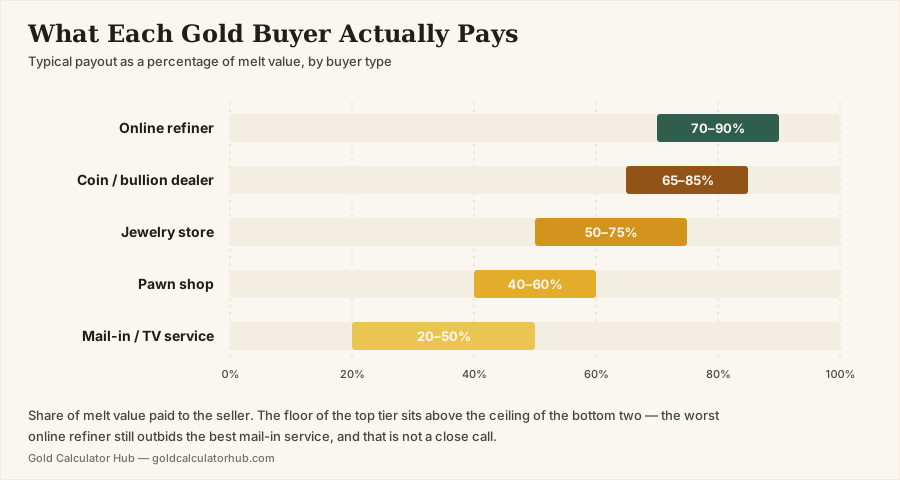
Before mailing gold anywhere: read the return terms in full, confirm returns are free and insured, check the insurance cap against your lot's value, photograph and weigh everything, and never cash a check you haven't decided to accept. The honest mail-in route — and it genuinely exists, at 70–90% of melt — is detailed in selling gold online vs. locally.
The Defense Checklist
Here's the encouraging part about cash for gold scams: you don't need a separate counter-move for each tactic. A handful of habits defeats all of them simultaneously, because every trick depends on a number you didn't verify.
Never accept a price for gold you haven't priced yourself.
That's the whole doctrine. In practice:
Know your melt value before any quote. Weight × purity × spot price, per karat group. This single number converts every offer from a verdict into a percentage — and buyers can tell within seconds which sellers have it.
Weigh at home first, in grams. A $15 pocket scale neutralizes rigged scales and unit shuffles in one stroke. Write the weights down and bring the note.
Sort by karat and demand per-karat pricing. Lot bundling dies the moment your pieces arrive pre-sorted in labeled bags. Read your hallmarks first so downgrades have to argue with the stamp.
Get offers in writing, per item or karat group. Written, itemized offers make comparison possible and shenanigans visible. A buyer who won't write a number down is reserving the right to change it.
Collect at least two quotes — and never sell under a deadline. "Today only" is the tell, not the deal. Any offer that can't survive 24 hours and one competitor's counter was never a good offer.
Sellers who do these five things consistently land in the top of every payout range, not because they out-negotiate anyone, but because they're no longer the customer the tricks were built for.
What to Do If You've Been Scammed
If you've already taken a bad deal — or had gold disappear into a mail-in black hole — act quickly and put everything on the record.
Report it to the FTC at ReportFraud.ftc.gov. The Federal Trade Commission collects fraud reports, shares them with law enforcement, and pattern-matches across complaints; your report may be the one that establishes a pattern against a repeat operator.
File with your state attorney general. State AG consumer-protection offices handle precious-metals complaints directly and can pursue licensed buyers under state law — pawn shops and gold buyers are licensed in most states, and license-threatening complaints get attention that angry phone calls don't.
Use the channel that matches the medium. Gold mailed and never returned, or a check that bounced, may constitute mail fraud — report it to the US Postal Inspection Service. Paid by a check that failed? Your bank. If anyone pushed you from selling physical gold into "investing" in metals contracts or storage schemes, that's a different and bigger animal: see the CFTC's precious metals fraud advisory and report it to the CFTC.
Preserve everything. Photos, weights, receipts, mailers, the check, call logs. Disputes over gold are disputes over documentation, and the side with the paper usually wins.
Be realistic: recovering money from a legal-but-ugly lowball is unlikely — you accepted an offer. Recovery is most plausible where actual deception occurred: rigged scales, misrepresented karat, unreturned property. Either way, the report costs you twenty minutes and helps the next seller.
What Legitimate Buyers Look Like
After seven sections of tactics, balance demands the other portrait, because honest buyers are common and recognizably different.
A legitimate buyer weighs your gold in front of you on a certified scale with the display turned toward you, and tells you the unit without being asked. They test openly — acid kit or electronic tester on the counter, results explained, and they don't act wounded when you watch closely. They price each karat group separately and will happily quote per gram. They put offers in writing and expect you to shop them; the confident ones say "get other quotes" out loud, because they know their number holds up. They handle paperwork properly — ID, receipt, license on the wall where state law requires one.
Above all, a legitimate buyer is unbothered by an informed seller. When you mention your chain weighs 31 grams and melts at about $1,240, a fair buyer nods and talks percentages; only someone whose margin depended on your ignorance gets cagey.
Your job is simply to be that informed seller. Weigh your pieces, read the hallmarks, run the numbers through how much is my gold worth, and walk in knowing your figure. Every tactic on this page was built for a seller who didn't — and stops working on one who did.
Frequently Asked Questions
Are cash-for-gold businesses legitimate at all?
Most are — buying scrap gold is a normal, usually licensed business, and plenty of shops pay fair percentages and test honestly in front of you. The industry's problem is a wide legal gray zone: lowballing, bundling, and pressure tactics aren't crimes, so bad operators thrive alongside good ones with identical signage. The reliable separator isn't the storefront; it's behavior — visible certified scales, per-karat pricing, written offers, and comfort with comparison shopping. Verify those four and the legitimate majority becomes easy to find.
How can I tell if a gold buyer's scale is rigged?
You mostly can't by looking — which is why the practical defense is bringing your own numbers. Weigh everything at home on a pocket scale first; at the counter, confirm the display faces you, note the unit (grams vs. pennyweight — 1 dwt is 1.555 grams), and compare against your note. Many states require commercial scales to carry a current weights-and-measures inspection seal, so look for the sticker. If the counter reading differs meaningfully from your home reading, say so and watch the reaction — that moment tells you everything.
Can I get my gold back after mailing it to a buyer?
From a reputable buyer, yes — declining the offer triggers free, insured return shipping, and your items come back intact. That right is exactly what to verify in the terms before shipping, because the bad operators engineer the return path to exhaust you: fees, short rejection windows, checks that count as acceptance once cashed. If you're currently stuck in a stall, put your rejection in writing immediately, don't cash anything, document every contact, and escalate to the FTC and your state attorney general if the gold doesn't move.
Is it illegal for a gold buyer to offer way below melt value?
No. A lowball offer is legal; you're free to refuse it, and the law generally treats an accepted price as a done deal. Illegality starts at deception: rigged or falsely certified scales, misrepresenting test results or karat, refusing to return mailed property, bounced payment. That line is why the defenses on this page focus on verification rather than outrage — you can't sue someone for offering 30% of melt, but you can make sure you never accept it, and you can report the ones who cross into actual fraud.
Where do I report a gold-buying scam?
Start with the FTC at ReportFraud.ftc.gov and your state attorney general's consumer-protection office — the AG matters because gold buyers are state-licensed in most places and complaints threaten the license. Add the US Postal Inspection Service if gold was mailed and never returned or paid for, your bank for bad checks, and the CFTC if the pitch drifted into precious-metals investment contracts or storage schemes. File with documentation: photos, home weights, receipts, mailers, and correspondence. Reports take minutes and build the pattern that regulators act on.

Written by Sukie Gao
Sukie Gao holds a master's degree from a business school, where she picked up the markets-and-pricing toolkit she now applies to the consumer gold trade. She created Gold Calculator Hub to give people an independent, data-driven way to find out what their gold is really worth.
Published June 6, 2026