14K Gold Calculator: Value per Gram, Ounce and dwt
 By Sukie Gao · Updated October 16, 2026
A 14K gold calculator does one job: tell you what 14 karat gold — the metal in most American jewelry boxes — is worth at today's price. Enter a weight in grams, pennyweights, or ounces into the calculator above and it applies the two numbers that matter: the live spot price and 14K's purity of 58.33%. That second number is the one people miss. A 14K chain is a little over half gold by weight; the rest is copper, silver, nickel, or zinc, worth practically nothing at the scale. Price a 14K piece as if it were pure and you'll overvalue it by more than 70%. This page lays out the full 14K math — per gram, per pennyweight, per troy ounce — with tables you can check any offer against, plus what real buyers pay for 14K specifically, how to spot a fake 585 stamp, and why white, rose, and yellow 14K all melt down to exactly the same dollar figure.
If you only want the number, here it is in the three units buyers actually quote. At a spot price of $4,500 per troy ounce, 14 karat gold is worth $84.39 per gram, $131.23 per pennyweight, and $2,624.85 per troy ounce of finished 14K metal. Those figures move with the market — the live tool above is the one to trust on the day you sell — but they show the shape of the answer and let you sanity-check a quote in your head. A 26-gram chain carries about $2,194 of gold. A 3-gram wedding band, about $253. What a buyer hands you is a percentage of that number, and the percentage is where most of the money is won or lost.
What 14K Gold Actually Is (and Why America Settled on It)
Karat is a 24-point purity scale: 14K means 14 parts gold out of 24, which works out to 58.33% pure. The matching millesimal stamps are 585 and the older 583 — same standard, with 585 being the modern convention (many European makers alloy fractionally above the line to be safe). If a piece is stamped 14K, 14KT, 585, or 583, it's all the same metal for valuation purposes.
America standardized on 14K for practical reasons. Pure gold is too soft for daily wear; 18K is noticeably softer and pricier than 14K; 10K — the lowest karat common in US stores — saves money but loses some richness of color. At 58.33%, 14K holds the middle: durable enough for rings that get banged on desks for decades, gold enough to keep its warmth and resist tarnish, affordable enough for the mass market. Jewelry demand patterns tracked by the World Gold Council show different countries settling at different purities — much of Asia prefers 22K, Europe leans 18K — but in the United States, 14K is the overwhelming default. Open a random American jewelry box and most of what you'll find is 14K, which is exactly why buyers handle more of it than any other karat.
The Core Math: 14K per Gram, per Pennyweight, per Ounce
All 14K pricing comes from one chain of multiplication. Assume gold at $4,500 per troy ounce to keep the numbers clean:
- Pure-gold gram rate: $4,500 ÷ 31.103 = $144.68
- 14K gram rate: $144.68 × 0.5833 = $84.39
- 14K pennyweight rate: $84.39 × 1.555 = $131.23 (a pennyweight, or dwt, is 1.555 g)
- 14K troy-ounce rate: $4,500 × 0.5833 = $2,624.85
One more unit deserves a row of its own because it causes real losses: the standard ounce on a kitchen or postal scale is 28.350 grams, not the troy ounce's 31.103. At our assumed price, 14K is worth $2,392.46 per standard ounce ($84.39 × 28.350) versus $2,624.85 per troy ounce — a 9.7% gap. If a buyer weighs in one unit and quotes in the other, that gap lands in their pocket.
This is the entire engine inside a 14K gold calculator: live spot, divided into grams, multiplied by 0.5833 and by your weight. The version at the top of this page does it with the current price; the worked numbers here use $4,500 so you can follow every step and re-run them at whatever spot is doing today — the 14K gold price today page tracks the live per-gram figure, and how much is 14K gold worth has the full weight lookup table.
The 14K Rate at Different Spot Prices
People search for a "14K gold exchange rate," and what they mean is sensible: a conversion factor from weight of 14K metal into dollars. There is one, but it is a moving factor, because it inherits every tick of the world gold price. Here is that factor across the band gold has recently traded in — roughly $4,300 to $4,500 per troy ounce, with a row on either side so you can see the slope:
| Spot per troy oz | Pure gold per gram | 14K per gram | 14K per dwt | 14K per troy oz |
|---|---|---|---|---|
| $4,200 | $135.04 | $78.77 | $122.48 | $2,449.86 |
| $4,300 | $138.25 | $80.64 | $125.40 | $2,508.19 |
| $4,400 | $141.47 | $82.52 | $128.31 | $2,566.52 |
| $4,500 | $144.68 | $84.39 | $131.23 | $2,624.85 |
| $4,600 | $147.90 | $86.27 | $134.15 | $2,683.18 |
Read across the bottom and top rows and you can see the whole stake in the market's mood: 14K swings from $78.77 to $86.27 per gram across a $400 move in spot, a spread of about 9.5%. On a 26-gram chain that is the difference between roughly $2,048 and $2,243 of melt value — about $195.
Hold that $195 next to the buyer spread further down this page, where the same chain draws offers ranging from about $878 to about $1,975 depending on who is doing the buying. The market decides one of those numbers for you. You decide the other. Sellers spend a great deal of energy watching the first and almost none on the second, which is precisely backwards.
14K Value at Common Weights
Here's the math pre-run at weights that match real jewelry, again assuming $4,500 per troy ounce (figures rounded to the cent — re-check against the live calculator before you sell):
| Weight | Typical item at this weight | 14K melt value |
|---|---|---|
| 1 g | a very thin band | $84.39 |
| 1.555 g (1 dwt) | a pair of small studs | $131.23 |
| 3.1 g | a women's wedding band | $261.62 |
| 5 g | a light 18-inch chain | $421.96 |
| 10 g | a small men's class ring | $843.92 |
| 15.55 g (10 dwt) | a substantial bracelet | $1,312.30 |
| 20 g | a heavy rope chain | $1,687.84 |
| 31.103 g (1 troy oz) | — | $2,624.85 |
The table makes one point louder than any paragraph could: weight is everything. A 20-gram chain is worth twenty times a 1-gram band, no matter which one looks more impressive in the display case. Before estimating your own pieces against these rows, weigh them properly — stones, hollow links, and non-gold clasps all throw off eyeball estimates, usually in the direction that disappoints.
Getting an Honest Weight Before You Get an Honest Quote
Every figure above assumes the weight you enter is the weight of actual 14K metal, and on jewelry that assumption fails constantly.
Stones do not weigh much, but they do not pay either. Gemstones are measured in carats, and a carat is 0.2 grams — so a one-carat diamond adds a fifth of a gram to the scale. The problem is not the weight; it is that a scrap buyer values the stone at approximately nothing and still has to deduct its mass. Expect the deduction, and don't expect the diamond to earn its keep at a melt counter.
Hollow pieces lie about their size. Hollow rope and herringbone chains are engineered to look substantial while using as little gold as possible. A hollow chain and a solid one of the same visual heft can differ by a factor of two or three in weight, and only the scale knows.
Findings are often not 14K. Spring rings, lobster clasps, jump rings, watch pins, earring backs, and safety chains are frequently base metal or a lower karat, even on an otherwise solid 14K piece.
Work one case through. A chunky stone-set ring reads 20.0 g on the scale, and 20 g of 14K at our assumed $4,500 spot is $1,687.84. Strip out the center stone, four accent stones, and a steel post, and the gold weight is 16.0 g — melt value $1,350.28. That $338 gap is not a buyer cheating you; it is the difference between weighing a ring and weighing gold. Sort out which one you are doing before the conversation starts, and read how to weigh gold if your scale is a kitchen scale.
14K Against Every Other Karat
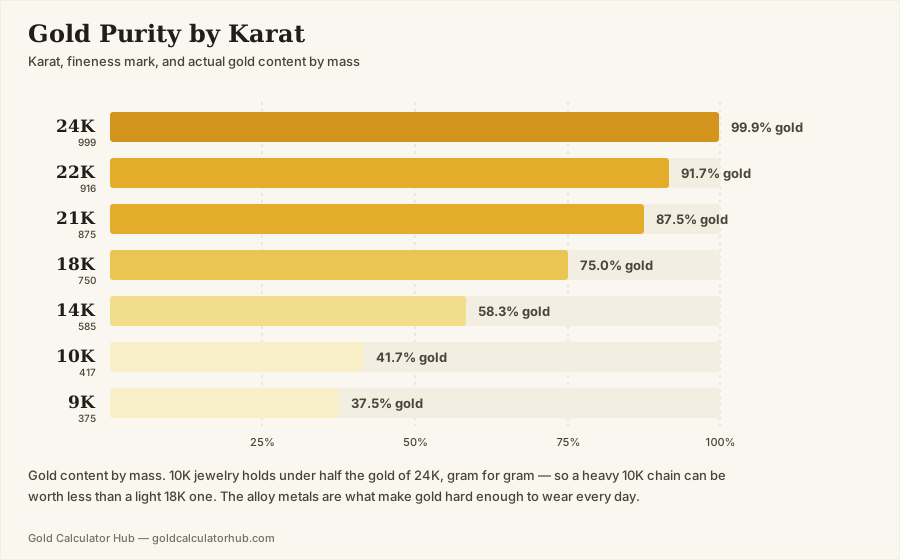
Where does 14K sit on the ladder? Per gram at our assumed $4,500 spot:
| Karat | Purity | Stamp | Per gram | vs. 14K |
|---|---|---|---|---|
| 24K | 99.9% | 999 | $144.54 | +71% |
| 22K | 91.67% | 917 | $132.63 | +57% |
| 18K | 75% | 750 | $108.51 | +29% |
| 14K | 58.33% | 585/583 | $84.39 | — |
| 10K | 41.67% | 417 | $60.29 | −29% |
The practical lesson is about sorting. If you're selling a mixed batch, never let a buyer weigh it as one pile — a pile priced "as 14K" that includes 18K pieces underpays you 29% on those items, and it's the most common soft trick in the trade. Sort by stamp first, value each group separately, and check anything unstamped before accepting a karat assignment. The full ladder, including unusual karats like 21K and 9K, lives on our gold purity chart, and the 10K gold calculator covers the budget karat that often hides in older class rings and chains.
Style Is Irrelevant to the Scale
Here is the rule that surprises almost every first-time seller: two 14K items of equal weight always have equal melt value, no matter what they look like. An 8-gram 14K class ring from 1987 and an 8-gram 14K herringbone chain both contain 8 × 0.5833 = 4.67 grams of pure gold, and at our assumed $4,500 spot both melt to 8 × $84.39 = $675.12. The refiner's furnace doesn't grade craftsmanship — everything becomes the same liquid.
That cuts both ways. It means an ugly, broken, single-earring pile of 14K is worth exactly as much per gram as a pristine bracelet — don't let a buyer discount for "condition" on scrap, because there's no such thing. It also means melt is only the floor, not always the right price. A signed designer piece, a desirable antique, or fine workmanship can be worth more sold as jewelry than as metal — sometimes several times more. The decision tree is simple: anything ordinary sells at scrap-relative prices, so maximize the percentage of melt you're offered; anything potentially special deserves a resale-market check before it goes anywhere near a furnace. Our gold value calculator walks through pricing both paths.
What Buyers Really Pay for 14K
Because 14K is the most common karat in American scrap, every buyer has a well-practiced number for it. Work one example end to end: a 21.4-gram 14K Cuban-link bracelet at our assumed $4,500 spot has a melt value of 21.4 × $84.39 = $1,805.95. Typical offers, as a percentage of that melt:
- Online refiners (70–90% of melt): about $1,264–$1,625
- Local coin and bullion dealers (65–85%): about $1,174–$1,535
- Jewelry stores (50–75%): about $903–$1,354
- Pawn shops (40–60%): about $722–$1,084
The spread between the best and worst likely outcome is roughly $900 — on the same bracelet, in the same week. Three habits capture most of that spread: know your melt number before anyone weighs the piece, get at least two or three quotes, and ask each buyer what percentage of melt their offer represents (the question alone signals you can't be lowballed casually). The FTC's selling gold jewelry guidance adds the consumer-protection basics — certified scales, shopping around, and reading the fine print on mail-in services before your gold leaves your hands.
Six Real Pieces, Weighed and Priced Out
Generic tables are useful; specific items are convincing. Everything below is priced at our assumed $4,500 per troy ounce, which puts 14K at $84.39 per gram, and each figure is just weight × that rate:
- A 1.9 g pair of small hoop earrings → 1.11 g of pure gold, $160 of melt. Below the threshold where shipping to a refiner makes sense; this is a walk-in item or a keep item.
- A 3.2 g women's wedding band → $270. Same conclusion, and the sentimental math usually wins anyway.
- An 8.4 g class ring → 4.90 g of pure gold, $709. Now the venue matters: a pawn counter at 45% offers about $319; an online refiner at 80% pays about $567.
- A 15.5 g link bracelet → $1,308 of melt. Refiner range $916–$1,177; pawn range $523–$785.
- A 26.0 g rope chain → 15.17 g of pure gold, $2,194 of melt. This is the weight people search for most often, and it is worth spelling out completely. Online refiners at 70–90% would offer roughly $1,536–$1,975. Local coin and bullion dealers at 65–85%: $1,426–$1,865. Jewelry stores at 50–75%: $1,097–$1,646. Pawn shops at 40–60%: $878–$1,317.
- A whole box: 62.4 g of assorted 14K → $5,266 of melt. At a refiner paying 80%, about $4,213. At a pawn shop paying 45%, about $2,370.
Cross-check the chain a second way to prove the units agree: 26.0 g ÷ 1.555 = 16.72 dwt, and 16.72 × $131.23 = $2,194. Grams and pennyweights are the same money wearing different clothes — which is exactly why a buyer quoting in the unit you didn't do your homework in is a buyer worth slowing down.
Notice the pattern down the list. Small items barely justify effort, and the effort pays enormously on large ones: the box swings $1,843 on the venue decision alone.
Fake 585 Stamps, White Gold, Rose Gold: What Changes the Number (and What Doesn't)
A stamp is a claim, not a guarantee. Counterfeit 14K and 585 marks turn up regularly on gold-plated brass, especially on online-marketplace chains, and a few checks sort most of them out. Real 14K is never magnetic — a strong fridge magnet that grabs the piece ends the conversation (though passing the magnet test alone proves nothing). Look for honest qualifiers next to the stamp: 14K GF means gold-filled and 14K HGE means heavy gold electroplate — both are a thin gold layer over base metal worth a tiny fraction of solid 14K. Worn plating at high-rub points like clasp edges shows base metal underneath. For certainty, any serious buyer will run an acid or electronic test in front of you, and refiners verify everything by assay regardless of stamps. Our gold hallmarks guide decodes the full range of stamps you'll encounter, including purity marks, maker's marks, and the misleading ones.
Color, on the other hand, changes nothing. White 14K is 58.33% gold alloyed with white metals (often nickel or palladium) and usually rhodium-plated; rose 14K simply carries more copper. Gram for gram, white, rose, and yellow 14K contain identical gold and carry identical melt value — a buyer who discounts "because it's white gold" is inventing a reason to pay less.
Turning a Drawer of Odds and Ends Into One Defensible Number
Most people don't have a 14K item. They have a drawer: mismatched earrings, a broken chain, a dead watch, two class rings, and something with a stone in it. Here is the sequence that turns that into a figure you can defend across a counter.
- Pull out everything that isn't solid gold. Anything marked GF, HGE, GP, RGP, or with a fraction like 1/20 is plated or filled, and belongs in a separate bag. Gold-tone costume pieces go in the same bag. You are not throwing them away; you are keeping them from contaminating a weight.
- Sort the rest by stamp. 10K, 14K, 18K, 22K, unmarked. This is the single highest-value ten minutes in the whole process, because every gram that gets priced one karat too low is money that quietly disappears.
- Deal with the unmarked pile separately. Unstamped does not mean fake — plenty of older and imported pieces were never marked — but it does mean untested, and a buyer will price it conservatively until proven otherwise. Get it tested before you get it quoted.
- Remove stones and non-gold findings, or note them so you can subtract a realistic allowance.
- Weigh each karat group on a 0.01 g scale and run the groups through the gold calculator one at a time. Add the melt values for a total.
- Set anything potentially special aside — signed designer work, genuine antiques, meaningful gemstones — and price it as jewelry before it goes anywhere near a furnace, using the gold value calculator.
- Collect three quotes on the remainder, and convert each one into a percentage of your melt total before comparing. A quote that isn't expressed as a percentage of melt isn't a quote you can evaluate.
That entire process takes an evening and routinely moves the outcome by more than any market move you could have waited for. The scrap gold calculator handles mixed lots if you'd rather total everything in one place.
Frequently Asked Questions
How much is a gram of 14K gold worth today?
Take the live spot price, divide by 31.103 to get the pure-gold gram rate, and multiply by 0.5833. With spot recently near $4,300–$4,500 per troy ounce, that puts a gram of 14K roughly in the $80–$85 range. The 14K gold calculator at the top of this page does the same math with the current price, which is the number to trust on the day you actually sell.
What does the 585 stamp mean, and is 583 different?
Both mark 14K gold. The millesimal system expresses purity in parts per thousand: 14/24 works out to 583.3, so older pieces are sometimes stamped 583, while the modern convention is 585 — many manufacturers alloy slightly above the minimum to stay safely on the right side of the standard. For valuation purposes, treat 14K, 14KT, 585, and 583 as the same metal at 58.33% purity.
How much more is 14K worth than 10K?
Exactly in proportion to purity: 14K is 58.33% gold and 10K is 41.67%, so 14K is worth about 40% more per gram. At an assumed $4,500 spot, that's $84.39 per gram against $60.29. This is why sorting a mixed pile matters so much — letting a buyer pay the 10K rate on a batch that includes 14K pieces silently costs you that entire 40% gap on every misgraded gram.
Are 14K white gold and yellow gold worth the same?
Yes, gram for gram. Both are 58.33% pure gold; only the non-gold alloy differs — white metals like nickel or palladium in white gold, extra copper in rose gold. The rhodium plating on white gold is too thin to add measurable value, and refiners pay purely on assayed gold content. If a buyer offers less per gram for white or rose 14K than for yellow, that's a negotiating tactic, not metallurgy.
How much will a pawn shop give me for 14K gold?
Typically 40–60% of melt value. For a 10-gram 14K item with melt around $844 at an assumed $4,500 spot, that's roughly $338–$506. Pawn shops sit at the low end of the buyer spectrum because gold buying is a sideline with high overhead and resale risk. If timing allows, an online refiner (70–90% of melt) or a local bullion dealer (65–85%) usually pays meaningfully more for the same piece.
How can I tell if a 14K stamp is fake?
Start cheap: a strong magnet should not attract real gold; check for wear spots showing a different metal underneath; look for qualifiers like GF, HGE, GP, or 1/20 near the stamp, which mean plated or filled rather than solid. Suspiciously light weight for the size is another tell, since gold is very dense. For certainty, a jeweler's acid test or a dealer's electronic tester settles it in minutes, usually free or for a few dollars.
What is a pennyweight, and why do buyers quote 14K in it?
A pennyweight (dwt) is 1.555 grams, with exactly 20 pennyweights to a troy ounce. It's the traditional unit of the American jewelry trade, and many buyers still quote in it — partly habit, partly because a per-dwt figure sounds more generous than the same rate per gram. Convert before comparing: divide any pennyweight quote by 1.555. A quote of $90 per dwt for 14K is only about $57.88 per gram.
Is 14K gold-filled jewelry worth anything?
Very little as gold. A 14K GF (gold-filled) piece carries a bonded layer of 14K that's typically a twentieth or less of the item's total weight — the 1/20 in marks like "1/20 14K GF" says exactly that. Most scrap buyers refuse gold-filled outright or pay a token amount, since recovering the thin layer barely justifies refining. Electroplated marks (HGE, GP) hold even less. Solid 14K and filled 14K are different products entirely.
Should I sell 14K jewelry as jewelry or for scrap?
Ordinary, unbranded 14K almost always does best sold for melt-relative prices to a refiner or dealer — the resale market for generic used jewelry is weak, and consignment fees eat what little premium exists. The exceptions are signed designer pieces, genuine antiques, and items with significant gemstones, which can sell well above melt to the right buyer. Get the melt number first either way; it's the floor any other offer has to beat.
Do I owe taxes when I sell 14K gold?
Possibly. The IRS treats gold as a collectible, and selling for more than your cost basis can create a capital gain — the IRS's collectibles guidance covers the rates, and inherited jewelry generally takes a stepped-up basis at the date of death, which often shrinks the taxable gain. Losses on personal-use jewelry usually aren't deductible. This isn't tax advice; a quick conversation with a tax professional before a large sale is money well spent.
What is 26 grams of 14K gold worth?
26 grams of 14K contains 26 × 0.5833 = 15.17 grams of pure gold. At an assumed spot price of $4,500 per troy ounce, 14K runs $84.39 per gram, so the melt value is about $2,194. With spot in the recent $4,300–$4,500 range, 26 grams has been worth roughly $2,097 to $2,194 of metal. Actual offers land below that: expect around $1,536–$1,975 from an online refiner and $878–$1,317 at a pawn counter for the same piece.
What is 14K gold worth per pennyweight?
Multiply the 14K per-gram rate by 1.555, since one pennyweight is 1.555 grams. At an assumed $4,500 per troy ounce, 14K is $84.39 per gram, so it is $131.23 per pennyweight, and there are exactly 20 dwt in a troy ounce. Many American jewelry buyers still quote in pennyweight because the number sounds larger than the same money per gram — a $110-per-dwt offer is only $70.74 per gram. Always convert before comparing two quotes.
Why does my 14K gold change in value from day to day?
Because the only variable is the world gold price, and it trades nearly around the clock. Your item's weight and its 58.33% purity never move; spot does. Across a $400 swing in spot — say $4,200 to $4,600 per troy ounce — the 14K rate travels from about $78.77 to $86.27 per gram, roughly 9.5%. On most individual pieces that is tens of dollars, which is why choosing a better-paying buyer almost always beats waiting for a better day.

Written by Sukie Gao
Sukie Gao holds a master's degree from a business school, where she picked up the markets-and-pricing toolkit she now applies to the consumer gold trade. She created Gold Calculator Hub to give people an independent, data-driven way to find out what their gold is really worth.
Published June 6, 2026 · Updated October 16, 2026