Gold Hallmarks: How to Read Every Stamp on Your Jewelry
 By Sukie Gao · Updated October 16, 2026
Gold hallmarks are the jewelry trade's shorthand, pressed into the metal in characters so small that most owners have never actually read them — and a surprising number have never noticed them at all. Yet those few millimeters of stamping usually answer the two questions that decide what a piece is worth: is it solid gold, and how pure? A clasp that says 750 is three-quarters gold by weight. A clasp that says 1/20 12K GF is roughly 97.5% brass wearing a gold jacket. Same color, same shine, wildly different money. Reading the marks costs nothing and takes a minute with a phone camera, which makes it the single best first move with any inherited box, estate find, or flea-market gamble. This guide covers where the stamps hide, how to translate karat marks and fineness numbers, what the plating codes actually admit, the international marks you'll meet on foreign pieces, what to do when there's no mark at all — and why a stamp, however legible, is a claim rather than a guarantee. Once you've decoded a piece, the gold calculator turns purity and weight into a dollar figure in seconds.
Where the Marks Hide
Stamps go where they won't spoil the look, which means you need to know the hiding spots:
- Chains and bracelets: on the clasp itself, on the small flat tag (jump-ring tab) next to the clasp, or on the last link.
- Rings: inside the band (the shank), sometimes worn faint by decades of fingers.
- Earrings: on the post, or on the back of the setting — the smallest and hardest stamps to read.
- Pendants and charms: on the bail (the loop the chain runs through) or the flat back.
- Watches: inside the case back, which may require opening; case and bracelet can be different metals.
- Pins and brooches: on the catch mechanism or the back plate.
Use a 10x loupe, or do what works just as well: photograph the spot with your phone and zoom in. Angle light across the surface rather than straight on — a raking light throws shadows into the engraving and makes faint marks legible. Clean grime out of the area with a soft cloth first; half of "unmarked" jewelry is just unwashed jewelry.
One piece can carry several stamps in a row: a purity mark, a maker's mark, sometimes a country or assay mark. Read all of them before concluding anything — the most informative stamp is often the second one.
Karat Stamps vs Fineness Numbers
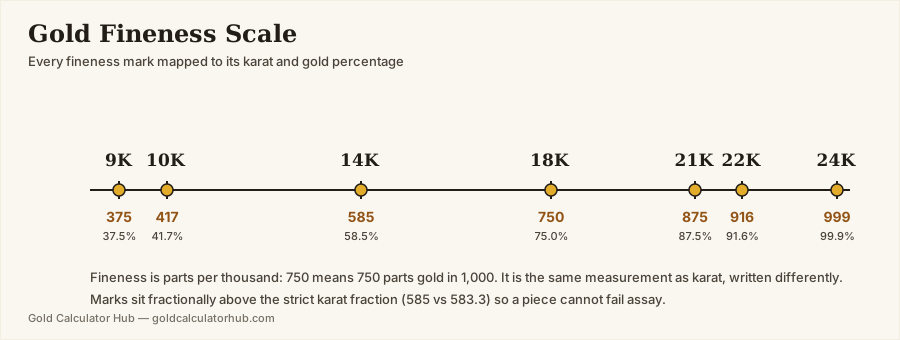
American jewelry talks in karats: 10K, 14K, 18K, sometimes with variations like 14KT or 585 alongside. European and most international jewelry talks in millesimal fineness: a three-digit number giving parts of gold per thousand. They're the same information in two dialects — 14K and 585 both mean 58.33% gold; 18K and 750 both mean 75%.
A few wrinkles worth knowing. 14KP means 14 karat plumb — "plumb" as in exact, a 1970s-era American assurance that the piece assays at a full 14K and not the slightly-under that older tolerances allowed. It does not mean plated; this one trips people constantly. A karat mark with a letter prefix like "18K HGE" is the opposite situation — the karat number describes only the microscopic plating, and the HGE is the confession. Always read the whole stamp, not just the number that catches your eye.
Numbers you'll actually encounter: 999 (24K), 916 or 917 (22K), 875 (21K), 750 (18K), 585 or 583 (14K), 417 (10K), 375 (9K). The full percentage-and-value breakdown for each lives in the gold purity chart. Anything outside that family — 800, 900, 925 — is almost certainly a silver fineness mark, no matter how golden the piece looks.
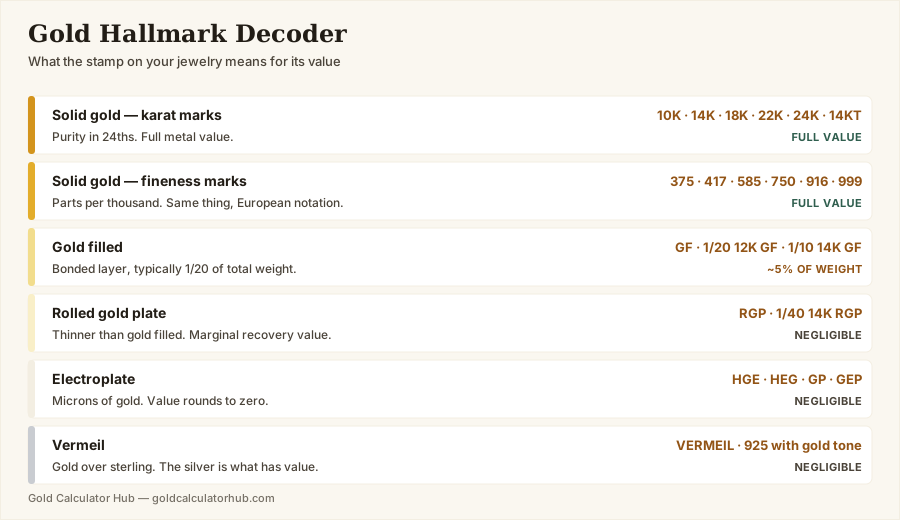
The Decoder Table
Every common stamp, sorted from best news to worst:
| Stamp | Meaning | Solid gold? | Approx. gold content |
|---|---|---|---|
| 999, 24K | Pure gold | Yes | 99.9% |
| 916, 917, 22K | 22 karat | Yes | 91.67% |
| 875, 21K | 21 karat | Yes | 87.5% |
| 750, 18K, 18KT | 18 karat | Yes | 75% |
| 585, 583, 14K, 14KT | 14 karat | Yes | 58.33% |
| 14KP, 18KP | Karat plumb (exact purity, NOT plated) | Yes | As marked |
| 417, 10K | 10 karat — lowest karat common in US jewelry | Yes | 41.67% |
| 375, 9K | 9 karat (UK/Australia standard) | Yes | 37.5% |
| GF, 1/20 14K GF | Gold-filled: bonded gold sheet over brass | No | ~2–3% by weight |
| RGP | Rolled gold plate — thinner than gold-filled | No | ~1% or less |
| GP, GEP, EP | Gold-plated / electroplated | No | Trace |
| HGE | Heavy gold electroplate (still microns thin) | No | Trace |
| 925, Sterling, STER | Sterling silver; gold-toned = vermeil/plated | No | 0% (92.5% silver) |
| Vermeil | Gold plating over sterling silver | No | Trace gold, silver core |
| Maker's marks (e.g., initials, logos, "JCM") | Manufacturer ID, not purity | — | None implied |
The pattern to internalize: a bare karat number or fineness number is good news; that same number followed by letters (GF, GP, HGE, RGP) is a disclosure that the gold is a coating. And a maker's mark alone — initials in a box, a brand logo — tells you who made the piece but nothing about what it's made of; look for the purity stamp beside it.
The Plated Codes, With the Math Done
Gold-filled deserves its own arithmetic, because the stamp literally is the recipe. 1/20 12K GF decodes as: the gold layer constitutes 1/20th of the item's total weight, and that layer is 12K (50% pure gold). So in a 10-gram gold-filled bangle: 10 g ÷ 20 = 0.5 g of 12K alloy, and 0.5 g × 50% = 0.25 grams of pure gold — 2.5% of the piece by weight. At an assumed $4,400 per troy ounce ($141.46/g pure), that's about $35 of gold spread over the whole bangle. A solid 14K bangle of identical 10 g weight carries about $825 of gold. Same look on the wrist; twenty-three times the metal value.
In practice even that $35 is mostly theoretical: separating a fraction of a gram of gold from brass costs refiners real work, so gold-filled only gets bought in bulk lots at modest per-pound prices. Single gold-filled pieces are worth more as wearable vintage jewelry than as scrap — sell the look, not the metal.
Plated marks go downhill from there. Standard electroplate (GP, GEP) is measured in fractions of a micron; HGE — "heavy" gold electroplate — sounds reassuring and isn't, since the industry's idea of heavy is a coating still thinner than a soap bubble. RGP (rolled gold plate) uses the gold-filled process with less gold. Vermeil is the aristocrat of the category — real sterling silver under a thicker-than-usual gold plate — and prices as silver plus craftsmanship. None of them have meaningful gold melt value, which is the polite, persistent message of those little letters.
International Marks: A Field Guide
Inherited and travel-bought jewelry brings foreign gold hallmarks to American kitchen tables daily. The quick translations:
United Kingdom: the world's oldest consumer-protection scheme, running for over 700 years. A full UK hallmark is a row of tiny pictorial punches: a maker's (sponsor's) mark in a shield, a millesimal fineness number (375, 585, 750), and an assay office symbol — a leopard's head for London, an anchor for Birmingham, a rose for Sheffield, a castle for Edinburgh. Older pieces add a date letter that specialists use to year a piece precisely. A genuine UK hallmark is strong evidence; the metal was independently tested at an assay office by law before sale.
Continental Europe: typically fineness numbers (750 is everywhere in Italy and France), often with national symbols — France's eagle head for 18K is the famous one. Italian pieces frequently add a star-and-number maker code identifying the workshop.
Middle East and South Asia: high-karat fineness numbers — 875 (21K) across the Gulf, 916 with the BIS triangle in India, 999 on Chinese pieces sold as "chuk kam" (pure gold).
Russia and Eastern Europe: Soviet-era pieces often carry 583 with a star punch; modern Russian gold uses 585 with a woman's-head profile (the kokoshnik mark).
The unifying rule: a three-digit number from the standard family means the same purity everywhere on Earth. The decorations around it tell you where and when; the number tells you what it's worth.
No Mark? Worn Mark? Here's the Playbook
An unmarked piece is not a fake piece — context matters enormously. The United States only required purity marking alongside a maker's trademark relatively recently in jewelry history: the National Gold and Silver Stamping Act of 1906 regulated the accuracy of marks but didn't force anyone to stamp at all, so plenty of genuine American gold made before the mid-20th century — and essentially all of it before 1906 — carries no purity mark whatsoever. Handmade pieces, resized rings (resizing can cut the stamp out of the band), and heavily polished heirlooms round out the innocent explanations. Antique unmarked gold is, if anything, a category where pleasant surprises cluster.
The playbook when the shank is blank or the stamp is too worn to read:
- Photograph and zoom anyway — marks that look gone to the naked eye often survive in a raking-light photo.
- Check every component: clasp, tag, bail, post. Multi-part pieces get stamped in one place only.
- Run the free physical tests — magnet, density — and then an acid test at the likely karat, per our walkthrough of how to test gold at home.
- For anything promising or sentimental, get a free XRF scan at a coin or bullion dealer; it reads exact composition in seconds without touching the surface.
Buyers price unmarked, untested gold pessimistically — assume-the-worst is their default. Showing up with test results, or simply knowing them yourself, removes that discount from the conversation. This matters double for estates, where unmarked pieces are most common; our guide to selling inherited gold jewelry covers the valuation order of operations.
Fake Stamps on Fake Gold
Here is the uncomfortable truth that keeps this entire topic honest: a stamp is a claim, and claims can be counterfeited with a $30 punch set. Fake chains stamped 18K and 750 circulate in volume — tourist markets, online marketplaces, and the classic street hustle of the "stranded traveler" selling a stamped gold rope chain at a too-good price. The stamp is part of the costume. Counterfeiters know exactly how much trust those little characters carry, which is why they apply them generously.
Red flags that a mark is lying: purity stamps on pieces that feel too light for their size (gold is dramatically denser than brass), stamps that are unusually large, crooked, or freshly sharp on an allegedly old piece, fineness numbers that don't exist in the standard family (a stamp reading 770 or 460 was punched by someone improvising), and sellers whose price implies they don't believe their own stamp. The Federal Trade Commission's jewelry guides make misrepresenting purity illegal in US commerce — the FTC's advice on selling gold jewelry is equally useful in reverse, as a checklist of what honest marking looks like — but laws govern sellers who expect to be findable tomorrow. A flea-market vendor with a folding table operates under different incentives.
The defense never changes: the stamp tells you what to test for, and the test tells you whether the stamp told the truth. Magnet, density, acid, XRF — in that order of effort. Gold hallmarks read with a skeptic's eye are a superpower; read with pure faith, they're the most efficient scam-delivery mechanism ever pressed into metal.
Reading a Real Piece, End to End
Let's run the whole method on a typical estate-box find: a yellow chain with a tiny tag by the clasp.
Under the phone camera at full zoom, the tag shows two punches: 585 and a boxed "M&Co". Translation: millesimal fineness 585 — solid 14K, 58.33% gold — plus a maker's mark identifying the manufacturer. No GF, no GP, no HGE anywhere on tag, clasp, or end links. The magnet ignores it (the clasp pulls faintly — steel spring, normal). The pocket scale says 31.0 g.
Now the money math, assuming spot gold at $4,400 per troy ounce, i.e., $141.46 per gram pure:
- Pure gold content: 31.0 g × 58.33% = 18.08 g
- Melt value: 18.08 g × $141.46 = $2,557.60
- Realistic offers against that melt: a local coin or bullion dealer at 65–85% pays $1,662–$2,174; a jewelry store at 50–75% pays $1,279–$1,918; a pawn shop at 40–60% pays $1,023–$1,535.
Ten minutes of reading and weighing turned "grandma's chain, probably gold?" into a defensible number and a ranked list of places to sell it. Had the tag read 1/20 14K GF instead, the same ten minutes would have saved a wasted trip and reframed the chain as vintage costume jewelry. Either way the marks did their job — they're the cheapest expertise in the gold world, sitting in plain sight on the back of the clasp, waiting for someone to finally look.
Frequently Asked Questions
What do the numbers 750, 585, and 417 mean on gold?
They're millesimal fineness marks — parts of pure gold per thousand parts of metal. 750 means 75% gold, the same thing as 18K. 585 means 58.33% gold, equivalent to 14K. 417 means 41.67%, which is 10K — the lowest karat common in American jewelry. The system is the metric counterpart to karat stamps, standard across Europe and increasingly common on American jewelry alongside or instead of the K-mark.
Does a 14KP stamp mean the gold is plated?
No — the opposite of what most people guess. The P stands for "plumb," an older American trade term meaning the piece assays at exactly 14K or better, with no rounding down. It was a quality assurance stamp, common from the 1970s onward after US tolerance rules tightened. Plated pieces use different letters entirely: GP, GEP, EP, or HGE. A 14KP piece is solid 14 karat gold and prices exactly like any other 14K.
Is gold-filled jewelry worth anything?
A little, and rarely as scrap. The stamp does the math for you: 1/20 14K GF means the bonded gold layer is one-twentieth of total weight at 58.33% purity — so a 10-gram piece holds roughly 0.29 g of pure gold, around $41 at an assumed $4,400/oz spot. Refiners only buy gold-filled in bulk lots because recovery costs eat single pieces. Well-made vintage gold-filled jewelry usually sells for more as wearable fashion than its metal would ever fetch.
Why does my gold-colored chain say 925?
Because it's sterling silver underneath. 925 is the fineness mark for sterling — 92.5% silver — and a gold-toned piece carrying it is gold-plated silver, properly called vermeil when the plating meets thickness standards. It's legitimate jewelry with real (silver) metal value, but it prices like silver plus workmanship, not like gold. The mark is doing you a favor: without it you might have paid, or expected to receive, solid-gold money for a silver piece.
What are the symbols in a British gold hallmark?
A full UK hallmark stacks several punches: the sponsor's (maker's) mark in initials, a millesimal fineness number like 375 or 750, and the assay office's pictorial symbol — London's leopard head, Birmingham's anchor, Sheffield's rose, or Edinburgh's castle. Many pieces add a date letter identifying the assay year. Unlike a self-applied American karat stamp, a UK hallmark certifies independent testing at a government-sanctioned assay office, which is why collectors and buyers treat it as unusually strong evidence.
My ring has no stamp at all — is it fake?
Not necessarily. US law has never required jewelry to be stamped; the 1906 Stamping Act only required that any mark applied be accurate, so pre-1906 American gold is essentially never marked and plenty of later handmade pieces aren't either. Resizing can also remove the stamped section of a band, and decades of wear polish shallow marks away. Treat an unmarked piece as unknown rather than fake: magnet and density tests cost nothing, and a dealer's XRF scan settles it definitively in seconds.
Can fake gold have a real-looking hallmark?
Yes, routinely — punches are cheap and counterfeiters use them precisely because people trust stamps more than they trust testing. Fake 18K and 750 marks on brass chains are a staple of tourist-market and online-marketplace fraud. Warning signs include a piece that feels light for its bulk, oversized or crooked stamps, nonstandard numbers, and prices far below melt value. The stamp should be treated as a testable claim: verify with a magnet, a density check, acid, or a free dealer XRF before money moves.
Do maker's marks tell me anything about gold purity?
Directly, nothing — a maker's mark identifies the manufacturer or sponsoring firm, not the metal. Indirectly, sometimes plenty: a recognizable maker (Tiffany, Cartier, or a documented regional workshop) supports authenticity, helps date the piece, and can add collectible value well above melt. Significantly branded jewelry deserves an appraisal before any scrap sale, because melting a signed piece can destroy most of its worth. For purity itself, look for the karat or fineness stamp that should sit alongside the maker's punch.

Written by Sukie Gao
Sukie Gao holds a master's degree from a business school, where she picked up the markets-and-pricing toolkit she now applies to the consumer gold trade. She created Gold Calculator Hub to give people an independent, data-driven way to find out what their gold is really worth.
Published June 6, 2026 · Updated October 16, 2026