Gold Cost Calculator: Work Out the Cost of Gold by Weight
 By Sukie Gao · Updated July 21, 2026
A gold cost calculator flips the usual question around. Most tools on this site work out what your gold is worth when you sell; this one helps you understand what gold costs to buy — and why the answer is always more than the spot price quoted on the news. Spot gold has recently traded near $4,300–$4,500 per troy ounce, but try to buy a one-ounce coin at spot and you'll find it simply isn't offered. Bullion dealers add a premium over spot. Jewelers add fabrication, brand, and retail margin — often multiplying the metal value three or four times. And in much of the world, gold jewelry is priced by an explicit formula: gold weight times the daily rate, plus a stated making charge. The calculator above gives you the metal baseline — enter any weight and purity and it returns the raw gold value at the live price. This page covers the rest: what bars, coins, and jewelry actually cost relative to that baseline, where each markup comes from, and the uncomfortable gap between what gold costs you on the way in and what it pays on the way out. If you're buying gold in any form, that gap is the single most useful number you can know.
Spot Price Is the Starting Line, Not the Sticker Price
The spot price is a wholesale benchmark — it's what enormous institutional bars trade for between banks and refiners, not what any retail buyer pays. Everything you can actually purchase sits somewhere above it, and the structure of every gold purchase reduces to one formula:
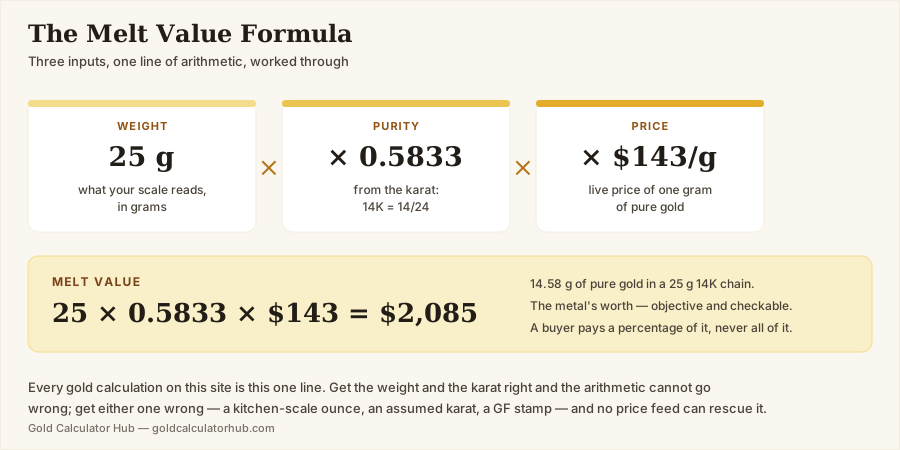
cost = (weight × purity × spot rate) + premium or markup
The first half of that formula is pure arithmetic, and it's what the calculator above and any gold calculator on this site computes from the live price. The second half — the premium — is where products differ wildly. On a one-ounce bullion bar the premium might be 2%; on a branded fashion pendant it can exceed 300% of the metal value. Same metal, radically different cost per gram of actual gold.
One unit warning before the math: gold is priced per troy ounce of 31.103 grams, not the familiar 28.350-gram ounce. The two differ by nearly 10%, and the confusion is common enough that we keep a dedicated troy ounce vs ounce page on it. Every figure on this page uses troy. That's why a gold cost calculator is worth using before any purchase — it pins down what the metal itself is worth, so you can see exactly what you're being asked to pay above it.
The Cost of Bullion: Bars, Coins, and Premiums
Bullion is the cheapest way to own gold, and even bullion never sells at spot. Dealers charge a premium that covers minting, distribution, and margin, and it follows a consistent pattern: the smaller the piece, the more you pay per ounce of actual gold.
| Form | Typical premium over spot | Cost at $4,300 spot |
|---|---|---|
| 1 oz bar, recognized refiner | ~2–5% | about $4,386–$4,515 |
| 1 oz sovereign coin (Eagle, Maple Leaf, Britannia) | ~3–8% | about $4,429–$4,644 |
| 1/4 oz coin | ~6–12% | about $1,140–$1,204 |
| 1/10 oz coin | ~10–18% | about $473–$507 |
Coins cost more than bars because you're paying for government minting, legal-tender status, and easier resale recognition. Fractional coins cost the most per ounce because minting costs don't shrink with the coin. One detail that surprises buyers: the American Gold Eagle is 22K (91.67% pure) but still contains a full troy ounce of gold — the coin simply weighs more than an ounce to make room for the alloy. The US Mint publishes exact specifications for its bullion coins, which is worth a look before a first purchase. Premiums also breathe with demand: in calm markets they compress, and when retail buying surges they can double.
Why a $400-Melt Chain Retails for $1,200
Walk into a mall jeweler and the math changes completely. Consider a 5-gram 14K chain with gold at $4,300 per troy ounce. The pure-gold gram rate is $4,300 ÷ 31.103 = $138.25, the 14K rate is $138.25 × 0.5833 = $80.64 per gram, and the chain's melt value is 5 × $80.64 = $403.20. That chain will routinely carry a $1,100–$1,300 price tag. Where does the other $800 go?
- Gold content — about $403 at our assumed spot; the only component you can resell at metal value
- Fabrication and labor — drawing the wire, forming and soldering the links, polishing; intricate link styles cost more
- Design and brand — anywhere from modest to enormous; a designer name can double the tag by itself
- Retail overhead — rent, staff, insurance, display cases, the velvet box
- Retailer margin — jewelry is a high-markup category by long tradition; doubling wholesale is normal
None of this is a scam — it's what fabricated goods cost. It becomes a problem only when buyers assume a $1,200 price tag represents $1,200 of gold. It represents roughly $400 of gold wearing $800 of manufacturing, branding, and retail. Reading the karat stamp and checking it against a gold purity chart is how you separate the metal from the markup before you pay.
Making Charges: The Gold-Pricing Math Most of the World Uses
In India, the Gulf states, and much of Asia, jewelry pricing is refreshingly transparent: the tag is built from the day's gold rate plus a disclosed fabrication fee, rather than a single opaque number. The formula is:
final price = (weight × purity × daily gold rate) + making charge (+ tax)
The making charge is quoted either as a percentage of the gold value — commonly somewhere around 6–15%, more for elaborate handwork — or as a flat amount per gram. Run one example: a 10-gram 22K bangle with gold at $4,300 per troy ounce. The pure rate is $138.25 per gram, so 22K runs $138.25 × 0.9167 = $126.73 per gram. The gold value is 10 × $126.73 = $1,267.30. Add a 12% making charge ($152.08) and the bangle costs $1,419.38 before tax.
Compare that with the American mall model, where a piece holding $1,267 of gold might be tagged $3,000 with no breakdown offered at all. The making-charge system keeps the cost-versus-metal gap visible right at the counter — one reason gold jewelry doubles as a savings vehicle in those markets. Shoppers there check the day's rate before leaving the house, which is precisely the habit the calculator above is built to support.
One wrinkle worth knowing, because it decides which quoting style you should prefer. A making charge stated as a flat amount per gram behaves very differently from one stated as a percentage, and the difference tracks karat. At $4,300 spot, a flat $9 per gram is 7.1% of the gold value on 22K (which runs $126.73 a gram), 8.7% on 18K ($103.69 a gram), but 11.2% on 14K ($80.64 a gram) — because the labor charge stays fixed while the metal underneath it gets cheaper. So on high-karat work, ask for a flat per-gram figure; on lower-karat work, a percentage usually favors you.
Run it on a real piece: a 15-gram 18K necklace holds 15 × $103.69 = $1,555.35 of gold. Quoted at a flat $9 per gram, the making charge is $135 and the necklace costs $1,690.35. Quoted at 12%, the charge is $186.64 and the necklace costs $1,741.99 — $51.64 more for identical metal and identical work. Making charges are also the negotiable component in most of these markets, which is exactly why the good shops state them separately and the weaker ones bury them.
Two Ways to Spend $5,000 on Gold
Nothing clarifies the cost question like watching the same budget go two directions. Assume spot at $4,300 per troy ounce, which puts pure gold at $138.25 per gram.
Route one: bullion. You buy a one-ounce bar from a recognized refiner at a 3.5% premium — $4,450.50 — and put the remainder toward a 1/10 oz sovereign coin at a 14% premium, which costs $490.20. Total spent: $4,940.70. Total gold owned: 1.1 troy ounces, whose metal value at spot is $4,730. Your cost sits $210.70 above the metal, or about 4.5%. Sell it back to a dealer bidding a point or two under spot and you recover roughly $4,659 — about 94% of what you spent, on a same-week round trip.
Route two: the jewelry counter. Five thousand dollars at a mall jeweler buys, very typically, a 21-gram 14K chain. Run the metal: 14K is $138.25 × 0.5833 = $80.64 per gram, so the chain holds $1,693.44 of gold. The tag is just under three times its melt value, which is entirely normal retail pricing and not a scandal. But resale is scrap resale: online refiners at 70–90% of melt would pay $1,185.41–$1,524.10, a pawn shop at 40–60% would pay $677.38–$1,016.06.
So: $4,941 spent returns about $4,659, or $5,000 spent returns about $1,185–$1,524. Same metal, same market, same week. The chain is not a bad purchase — it is simply a purchase, the way a sofa is a purchase, with a metal salvage value attached. The mistake is only ever in calling it an investment. Before either transaction, pin down the metal baseline with the calculator above so you can see precisely what you are paying on top of it.
Cost vs. Value: The Gap That Decides Your Resale Outcome
Everything above describes cost — what you pay going in. Value is what the market hands back when you sell, and the spread between the two depends almost entirely on the form your gold takes.
Bullion resells closest to its cost. A recognized one-ounce bar or sovereign coin typically sells back to a dealer within a few percent of spot, so the full round trip might cost 5–8%. Jewelry is the other extreme. That $1,200 chain with $403 of melt value resells, as scrap, at a percentage of melt: online refiners typically pay 70–90% of it, local coin and bullion dealers 65–85%, jewelry stores 50–75%, and pawn shops 40–60%. Realistically that's $280–$360 back on a $1,200 purchase — the fabrication, brand, and retail margin evaporate the moment you leave the store.
That doesn't make jewelry a mistake; it makes it a consumption good with residual metal value rather than an investment. If your goal is gold exposure, buy the form with the smallest cost-to-value gap. If a dealer's pitch sounds dramatically better than the math on this page — "no premium," guaranteed buybacks, pressure to wire money today — the CFTC's precious metals fraud advisory covers the standard schemes. And before selling anything you already own, run it through our gold value calculator so you know the melt number cold. None of this is investment advice — for portfolio decisions, talk to a licensed professional.
Run These Checks Before You Hand Over Money
Buying gold badly is rarely a matter of picking the wrong product. It is a matter of not converting the quote into a comparable number before paying. Six checks, in the order they matter:
- Convert every quote to a percentage over spot. Take the dealer's price, divide by the current spot value of the gold content, subtract one. A one-ounce coin at $4,644 with spot at $4,300 is 8.0% over. Now you can compare it against any other coin, bar, or dealer on earth in one number.
- Compare the total delivered cost, not the headline. Shipping, insurance, credit-card surcharges, and state sales tax routinely add 3–5%. A dealer 1% cheaper on the product and 4% more expensive at checkout is not cheaper.
- Ask the buyback price in the same conversation. A dealer who sells at 5% over spot and buys back at 2% under has a 7% round trip. One who sells at 4% over and buys at 6% under has a worse deal that looks better on the shelf.
- Stick to recognized products. Sovereign coins and bars from well-known refiners resell on sight. Obscure private rounds save a percent going in and cost several coming out, because the next buyer has to verify them.
- Verify the dealer, not just the price. Length of time in business, a real street address, published buy and sell prices that both move with the market, and no pressure to decide today. The CFTC's precious metals fraud advisory catalogs the standard pitches, and "we'll store it for you" deserves particular suspicion.
- Never buy on a phone call you did not initiate. The premium quoted to inbound leads is usually the fairest price a dealer offers; the premium quoted to cold-called buyers frequently is not.
The underlying discipline is the same one sellers need in reverse: know the metal value first, then evaluate everything stacked on top of it. That is the job the gold price calculator and the tool above are both built to do in about ten seconds.
Frequently Asked Questions
What does it cost to buy 1 ounce of gold right now?
Spot plus a premium. With spot recently near $4,300–$4,500 per troy ounce, expect to pay roughly 2–5% over for a one-ounce bar from a recognized refiner and 3–8% over for a sovereign coin like an Eagle or Maple Leaf — call it $4,400–$4,850 depending on the day and the product. The calculator above gives you the live metal value so you can see exactly what premium any dealer is asking.
Why do gold coins cost more than gold bars?
You're paying for minting, legal-tender status, and recognizability. Government mints strike coins to exact published specifications, which makes them instantly trusted — a coin shop can buy an American Eagle on sight, while a bar may invite more scrutiny. That trust costs a few extra percent up front and usually earns some of it back at resale, where recognized coins often fetch slightly stronger bids than generic bars.
What is a making charge on gold jewelry?
It's the disclosed fabrication fee used in gold-jewelry pricing across India, the Middle East, and much of Asia. The price is built openly: gold weight times the day's rate, plus the making charge — quoted either as a percentage of the gold value (often somewhere in the 6–15% range) or as a flat fee per gram. It's the same labor cost American jewelers charge; the difference is you can see it, and often negotiate it.
Is buying jewelry a good way to invest in gold?
Generally no, if pure gold exposure is the goal. Mass-market jewelry costs two to four times its melt value, and resale recovers only a fraction of melt — the markup is consumed, not invested. The partial exception is high-purity (22K–24K) jewelry bought at low making charges in markets where that's standard, which tracks metal value far more closely. For investment purposes, bullion's small premium beats jewelry's large one. Not financial advice — consider a professional for portfolio questions.
Do I pay sales tax when buying gold?
It depends on what and where. Many US states exempt investment bullion — sometimes only above a purchase threshold — while others tax it like any retail good, and jewelry is taxable almost everywhere. The category your purchase falls into can change the cost by several percent, which dwarfs the premium difference between two competing dealers. Check your state's current rules before buying; tax treatment is also a reason many buyers prefer recognized bullion products.
What's the cheapest way to buy physical gold per ounce?
Larger bars from recognized refiners, bought from high-volume dealers, carry the lowest premiums — often just 2–5% over spot for one-ounce bars, and less per ounce as bars get bigger. The trade-off is divisibility and liquidity: a single large bar can't be sold in pieces, and some buyers scrutinize bars more than government coins. For most people, one-ounce bars or sovereign coins hit the sensible middle ground between cost and ease of resale.
If I buy a gold chain today, what could I sell it for tomorrow?
As scrap, a percentage of its melt value — not of its purchase price. A chain bought retail for $1,200 might hold $400 of gold; online refiners would typically pay 70–90% of that melt figure, dealers 65–85%, pawn shops 40–60%. So $280–$360 is a realistic next-day outcome on a $1,200 purchase. Bullion behaves completely differently: a $4,500 coin typically resells within a few percent of the metal price the same week.
Why did the premium on the coin I want jump this month?
Premiums are a separate market from spot, and they respond to retail demand and mint supply rather than to the gold price itself. When buying surges, dealer inventory thins and premiums widen, sometimes doubling on popular one-ounce coins; when the rush passes they compress again. Mint production schedules and shipping constraints push them around too. The practical response is to compare several products the same day: if one coin's premium has spiked, a bar or a different sovereign coin often still sits near its normal range.
Are bars from unknown refiners cheaper for a reason?
Yes, and the saving usually reverses at resale. A bar from a widely recognized refiner carries an assay card, a serial number, and a name any dealer will buy on sight. An obscure private bar might cost one or two percent less, but the next buyer has to verify it — which means testing, delay, or a lower bid to cover their risk. You typically pay that back several times over when you sell. Unless you are buying in industrial quantity, stick to recognized refiners and government mints.

Written by Sukie Gao
Sukie Gao holds a master's degree from a business school, where she picked up the markets-and-pricing toolkit she now applies to the consumer gold trade. She created Gold Calculator Hub to give people an independent, data-driven way to find out what their gold is really worth.
Published June 6, 2026 · Updated July 21, 2026