Gold and Silver Calculator: Melt Value of Both Metals
 By Sukie Gao · Updated July 21, 2026
Most people reach for a gold and silver calculator after opening the same drawer: a tangle of chains and rings, a felt roll of flatware, a coffee can of old coins — one inherited lot, two different metals, and no idea what any of it adds up to. Here is the honest way to handle it. Gold and silver are valued with the identical formula — weight × purity × the metal's spot price — but they are different markets with different purity systems and very different per-gram stakes, so the worst thing you can do is let anyone price the pile as one blended lump. Use the calculator above for every gold piece: sort by karat stamp, weigh each group, and it returns live melt value plus what each type of buyer realistically pays. Then work the silver side with the purity table and shortcuts below — sterling, coin silver, junk silver coins, and the silverplate that is worth nothing at all. By the end you will have a line-item number for the whole lot, which is exactly the position a seller wants to negotiate from.
One Drawer, Two Metals: Split the Job Before You Price It
Start by physically sorting the lot into three piles: gold, silver, and "not sure." The stamps do most of the work. Gold carries karat marks (10K, 14K, 18K, 22K) or millesimal numbers (417, 585, 750, 916). Silver says STERLING, 925, 900, 800, or — on coins — needs a date check rather than a stamp. Anything marked EP, EPNS, SILVERPLATE, or carrying a plating brand goes straight to the "not metal value" pile, and the genuinely unmarked pieces go to "not sure" for closer inspection; our guide to gold hallmarks covers the obscure stamps, and a jeweler's acid test settles the rest for a few dollars.
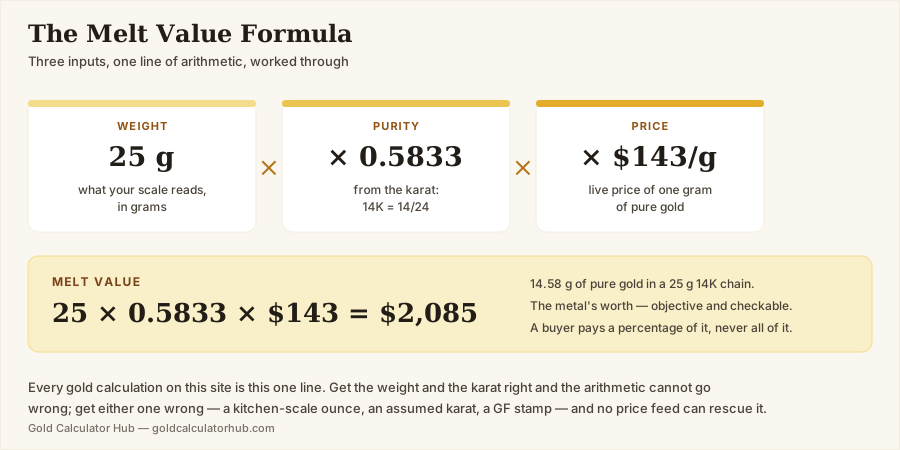
The gold pile is the easy half, because the calculator above does it live: enter each karat group's weight and it applies the purity fraction to the current spot price. If you want to understand the machinery — or check the math by hand — the scrap gold calculator walks through every step.
The silver pile needs about ten minutes of arithmetic, and that is what the rest of this page is for. One framing note before the numbers: at recent prices near $4,300–$4,500 per troy ounce for gold and around $52 for silver, a gram of pure gold is worth roughly 85 grams of pure silver. That ratio means your instincts about "a big heavy box of silver" need recalibrating — a single 14K chain can outvalue an entire flatware service.
Silver Purity Standards and What Each Is Worth per Gram
Silver uses fineness marks rather than karats, and four standards cover nearly everything you will find in an American household. Assume silver at $52 per troy ounce for the values below — that is $52 ÷ 31.103 = $1.67 per pure gram, stated here so you can rescale when the price moves.
| Standard | Fineness | Where you see it | Value per gram at $52/oz |
|---|---|---|---|
| Fine silver | .999 | Bullion bars, rounds, American Silver Eagles | $1.67 |
| Sterling | .925 | Flatware, jewelry, British and American holloware | $1.55 |
| Coin silver | .900 | Pre-1965 US coins, antique American flatware | $1.50 |
| European silver | .800 | German, Italian, and other continental pieces | $1.34 |
The formula is the same one gold uses: weight in grams × fineness × per-gram spot. A 480 g set of sterling forks and spoons holds 480 × 0.925 = 444 g of pure silver, worth 480 × $1.55 = about $744 at our assumed price.
Two cautions from the trade. First, weigh silver yourself on a gram scale — flatware lots get eyeballed constantly, and eyeballing favors the buyer. Second, watch for weighted sterling: candlesticks and trophy bases marked "sterling weighted" are a thin silver skin over cement or pitch, and only the skin counts. A buyer cuts one open before paying; you should price it skeptically before selling.
Sterling or Silverplate? The Mark Decides Everything
This is the single most expensive confusion in the silver drawer. Sterling is solid 92.5% silver all the way through. Silverplate is a base-metal body — usually copper, brass, or nickel silver — wearing a silver layer measured in microns. Melt value of plate: effectively zero. A refiner cannot economically recover a coating that thin, so plated trays, tea sets, and flatware sell as used tableware or not at all, regardless of how heavy and impressive they feel in the hand. Weight tells you nothing here; the marks tell you everything.
Plate marks to memorize: EP (electroplate), EPNS (electroplated nickel silver), EPBM, Silver on Copper, A1 or AA, Triple Plate, Quadruple Plate, and brand lines like Community and Wm. Rogers. Any of these means tableware value only — no melt value.
Solid silver announces itself: STERLING, STER, 925, 900, 800, or — on British pieces — the lion passant hallmark. American pieces made before roughly 1860 may say COIN or simply carry a maker's name; those are worth a closer look. If a piece is unmarked and you genuinely cannot tell, a jeweler or coin shop can acid-test it in seconds, usually free or for a couple of dollars.
One estate-sale heartbreak worth preventing: families routinely treat the gleaming plated tea service as the treasure and the dull, dinged sterling baby cups as junk. The marks, not the shine, carry the money.
The Weight That Isn't Silver: Knives, Candlesticks, and Filled Bases
Suppose the sterling pile clears the mark test. You are still not ready to multiply, because a meaningful share of what your scale is reading may not be silver at all. Three categories account for almost every unpleasant surprise at the counter.
Hollow-handled knives. A sterling dinner knife is not a solid silver object. The handle is a thin sterling shell filled with pitch, cement, or resin to give it heft and balance, and the blade itself is stainless steel — which is why the blades never tarnish while the handles do. A refiner recovers only the shell. Run the illustration: twelve sterling-handled knives weighing 75 g each put 900 g on your scale, and priced naively as sterling at $1.55 per gram that reads as $1,395. If only about 30 g per knife is actual silver, the real content is 360 g, worth $558. That is an $837 gap created entirely by weighing filler. Weigh knives as their own group and expect a steep, legitimate deduction.
Weighted holloware. Candlesticks, compotes, trophy cups, and dresser sets marked "sterling weighted" or "reinforced" follow the same logic at a larger scale — a silver skin over a cement or plaster core, sometimes with a steel rod up the middle. A pair of impressive-looking weighted candlesticks can put over a kilogram on the scale and contain a small fraction of that in recoverable metal.
Everything attached that isn't metal. Wooden handles, felt bases, ivory or bone spacers, mirror backs, glass liners on salt cellars and butter dishes. All of it weighs something; none of it pays.
The working rule is simple: sort by construction, not just by mark. Solid flatware — forks, spoons, serving pieces — goes in one group and prices cleanly at fineness. Knives go in a second. Weighted and composite pieces go in a third and get priced conservatively or set aside for a specialist. A buyer who lets you weigh all three together and quotes one number per gram is either sloppy or counting on you being sloppy, and neither is a reason to hand them the box.
Junk Silver: The Face-Value Shortcut for Pre-1965 Coins
Before 1965, US dimes, quarters, and half dollars were struck in 90% silver — what dealers affectionately call junk silver, meaning no collector premium, just metal. These coins have a beautiful property: silver content scales exactly with face value, so you can price a whole jar with one multiplication and never touch a scale.
The constant: every $1 of face value in circulated pre-1965 dimes, quarters, or halves contains about 0.715 troy ounces of pure silver (freshly minted it was 0.7234 oz; 0.715 allows for circulation wear). At our assumed $52 silver, $1 face = 0.715 × $52 = $37.18.
Worked example: a tube of forty pre-1965 Washington quarters is $10 face value, so 10 × 0.715 × $52 = $371.80 in silver. A few related cases: 1965–1970 Kennedy half dollars are 40% silver (about 0.295 oz per $1 face — check dates carefully, they look identical to the 90% 1964 halves), wartime 1942–1945 Jefferson nickels are 35% silver, and anything 1965 or later in dimes and quarters is copper-nickel clad worth exactly face value. Dealers buy and sell junk silver at a quoted multiple of face value all day, so this is one corner of the precious-metals world where your number and theirs should land within a few percent of each other. No gold and silver calculator required — just the face value and the multiplier.
Recognized Bullion Is a Different Product From Scrap
The pile most people undervalue is the small one: a few Silver Eagles in plastic flips, a couple of one-ounce rounds, maybe a ten-ounce bar with a refiner's logo stamped on it. These are not scrap, and pricing them like scrap costs you money.
The difference is verification cost. When a dealer buys your sterling gravy boat, they are buying an unknown — it has to be tested, sorted, weighed, accumulated, shipped, and refined before anyone knows exactly what came out. When they buy a sealed American Silver Eagle, they are buying a known: a US government product of stated weight and fineness that they can resell across the counter in an hour without touching a torch. That certainty is worth real basis points, and it flows back to the seller as a tighter spread.
Practical consequences:
- Recognized bullion trades near spot. A one-ounce .999 round holds $51.95 of silver at our assumed $52, and a dealer's buy price for common rounds and bars typically sits within a modest discount of that, with government coins like Eagles and Maple Leafs doing better still.
- Scrap sterling takes the deeper haircut, because the dealer is pricing in all that sorting and refining work.
- Keep bullion in its packaging. Original tubes, mint boxes, and assay cards support the "known quantity" premise. Scratched, toned, or loose pieces get looked at harder.
- Do not clean anything. Polishing silver bullion or coins removes metal and, on collectible dates, destroys value outright. Tarnish is not damage.
One more sorting step worth ninety seconds: pull out anything that might be numismatic rather than bullion — early dates, mint marks, uncirculated condition, proof sets. Melt value is the floor for those, not the answer. A coin worth $40 of silver and $300 to a collector should never be sold by the gram.
Pricing a Full Estate Lot — and Refusing the Blend
Here is a complete worked example — the kind of mixed lot a gold and silver calculator exists for, straight out of a real estate clean-out. Assumptions stated plainly: gold at $4,400 per troy ounce ($141.46 per pure gram) and silver at $52 ($1.67 per pure gram).
| Item | Metal and purity | Weight | Math | Melt value |
|---|---|---|---|---|
| 14K curb chain | Gold, 58.33% | 22 g | 22 × $82.52 | $1,815.44 |
| 18K wedding band | Gold, 75% | 6 g | 6 × $106.10 | $636.60 |
| Sterling flatware | Silver, 92.5% | 480 g | 480 × $1.55 | $744.00 |
| Pre-1965 quarters | Silver, 90% | $5 face | 5 × 0.715 × $52 | $185.90 |
| Silver round, .999 | Silver, 99.9% | 1 troy oz | 52 × 0.999 | $51.95 |
| Lot total | $3,433.89 |
Notice the shape of the money: the two gold pieces — 28 grams you could hide in a fist — carry $2,452, about 71% of the lot, while several pounds of silver carry the rest. This is why the cardinal rule of selling mixed lots is never let a buyer blend the math. "I'll give you $2,800 for everything" sounds close to fair against $3,434 of melt — until you realize a fair scrap offer might be 80% on the gold, a junk-silver multiple within a few percent on the coins, and a steeper discount only on the flatware. Price each line against the right channel using the payout ranges in our gold calculator guides, and check the FTC's advice on getting multiple offers before you sell anything (FTC: selling gold jewelry). Inherited lots also raise cost-basis and tax questions — see selling inherited gold jewelry, and for anything substantial, talk to a tax professional; this is not tax advice.
Send Each Pile Through the Door That Pays Best for It
A blended offer is bad because a mixed lot has no single right buyer. Once you have line-item numbers, the sorting continues — this time by destination.
Karat gold scrap does best with online refiners (70–90% of melt) and reputable local coin and bullion dealers (65–85%). Jewelry stores run 50–75%, pawn shops 40–60%, and mail-in TV services can drop to 20–50%. On the $2,452 of gold in the lot above, that spread is the difference between roughly $2,207 and under $600 for the identical metal.
Junk silver coins belong at a coin shop or bullion dealer, full stop. It is the most liquid item in the box, priced off a published multiple of face value, and there is no reason to accept a scrap-style discount on it.
Recognized bullion goes to the same place, on the same logic.
Sterling flatware has two possible doors, and it is worth checking both. The melt door is a refiner or a dealer buying by the gram. The other door is a replacement-pattern dealer — businesses that resell discontinued flatware patterns by the piece to people completing or repairing a family service. A complete or near-complete set in a sought-after pattern can be worth more intact than melted, and once it goes in the crucible that option is gone forever. Get one quote from each side before deciding.
Plated items and weighted pieces go to an estate sale, a consignment shop, a local auction, or a donation bin. They are housewares.
Two warnings while you are choosing doors. First, be wary of anyone who quotes a wonderful price by phone or mail and then "revises" it after your package arrives — the CFTC maintains useful background on precious metals fraud tactics. Second, insist on watching the scale, and on getting your items back intact and promptly if you decline the offer. A buyer who separates you from your metal before agreeing on a price has changed the negotiation in their favor, and they know it.
Order of Operations for a Mixed Lot
Everything above, compressed into the sequence I would actually follow with a box on the kitchen table. It takes an evening.
- Dump and sort by mark, not by looks: gold, silver, plate, unknown.
- Photograph the whole lot before anything leaves the house — one overview shot and close-ups of every mark. This is your record if a mail-in buyer's description of what arrived differs from what you sent.
- Sub-sort the gold by karat. 10K with 10K, 14K with 14K. Never mix, because a buyer pricing a mixed handful will price it all at the lowest karat present.
- Sub-sort the silver by construction: solid flatware, hollow-handled knives, weighted or composite pieces, coins, bullion.
- Pull out anything that might beat melt — signed jewelry, gemstones, complete flatware patterns, collectible coins — and set it aside for a specialist opinion.
- Weigh each group in grams on a scale with 0.1 g resolution. Write the numbers down.
- Run the gold through the calculator above for live melt value per karat group.
- Run the silver by hand: grams × fineness × per-gram spot, and face value × 0.715 × spot for pre-1965 coins.
- Write the line-item total, the way the estate table above is laid out. This single sheet of paper is your entire negotiating position.
- Get two or three offers per category, ask each buyer what percentage of melt they are paying, and compare percentages rather than dollars.
One closing observation about human nature. The step people skip is number nine — writing it all down before talking to anyone. It feels like busywork. It is the whole thing. A seller holding an itemized sheet is having a conversation about percentages; a seller holding a shoebox is having a conversation about whatever the person behind the counter decides to talk about.
Frequently Asked Questions
How do I calculate the melt value of silver?
Same formula as gold: weight in grams × fineness × (silver spot price ÷ 31.103). Example at $52 per troy ounce: a 170 g sterling bowl holds 170 × 0.925 = 157.25 g of pure silver, and 157.25 × $1.67 = about $263. The only difference from gold math is the purity system — silver uses .999, .925, .900, and .800 fineness marks instead of karats. Weigh on a gram scale, never a bathroom scale.
Is silver-plated flatware worth anything?
As metal, essentially nothing. The silver layer on plated pieces is microns thick — far too little for a refiner to recover economically — so marks like EP, EPNS, Silver on Copper, or Community mean zero melt value no matter how heavy the piece feels. Plated items do sometimes have modest resale value as tableware, especially complete sets in good condition or sought-after patterns, but that is a used-housewares market, not a precious-metals one.
How much silver is in pre-1965 US coins?
Dimes, quarters, and half dollars dated 1964 and earlier are 90% silver, and every $1 of face value contains about 0.715 troy ounces of pure silver after average circulation wear. At $52 silver, that is roughly $37 per $1 face — so a single silver quarter carries about $9.30 of metal. Related dates worth checking: 1965–1970 Kennedy halves are 40% silver, and 1942–1945 nickels with a large mintmark over Monticello are 35% silver.
What is the gold-to-silver ratio?
It is simply the gold price divided by the silver price — how many ounces of silver buy one ounce of gold. At our assumed $4,400 gold and $52 silver, the ratio is about 85:1. Traders watch it as a rough gauge of which metal is historically expensive relative to the other; the ratio has swung enormously over the decades. For a seller, it is context rather than strategy — and nothing here is investment advice. Its practical lesson: gold carries the value density, silver carries the weight.
Should I sell my gold and silver to the same buyer?
Often yes for convenience — coin shops and bullion dealers handle both — but always price them separately first. The classic trap is the blended offer: one round number for the whole box, which hides a weak silver price behind a fair gold price or vice versa. Walk in knowing your gold melt by karat and your silver melt by fineness, ask for an itemized offer, and get at least two or three quotes. Buyers who refuse to itemize are telling you something.
How can I tell sterling from plate if the marks have worn off?
Look at the wear points first — edges, handle backs, high spots. Plate that has worn through shows a different colored base metal (coppery or gray-yellow) peeking out; sterling stays silver-white all the way down. Construction offers hints too: plated holloware often feels suspiciously light or oddly heavy for its size. But the only definitive home-free answer is professional: a jeweler or coin dealer can acid-test or XRF-scan a piece in under a minute, usually for free or a token fee.
Do buyers pay the same percentage of melt for silver as for gold?
Usually not — silver generally takes the deeper haircut. A pile of sterling flatware is bulky, must be sorted for weighted pieces and stainless knife blades, and yields modest dollars per pound, so dealers price in their handling and refining costs. Recognized silver bullion and 90% junk silver coins do much better, typically trading at quoted prices within a few percent of melt, because they need no assay. Gold's value density is exactly why it earns the tighter spread — sort, weigh, and negotiate the metals separately.

Written by Sukie Gao
Sukie Gao holds a master's degree from a business school, where she picked up the markets-and-pricing toolkit she now applies to the consumer gold trade. She created Gold Calculator Hub to give people an independent, data-driven way to find out what their gold is really worth.
Published July 15, 2026 · Updated July 21, 2026