Gold Spot Price Calculator: From Spot to Your Item's Value
 By Sukie Gao · Updated July 21, 2026
A gold spot price calculator does one job: it takes the headline number you see on financial sites — the spot price of gold — and turns it into something useful for your specific situation, whether that's a 14K bracelet in a drawer or a one-ounce coin in a safe. The calculator above pulls the live spot price and runs the conversion for any weight and karat instantly. But the spot price itself is widely misunderstood, and that misunderstanding costs people money in both directions. Buyers are surprised they can't buy at spot. Sellers are insulted they can't sell at spot. Both reactions come from treating spot as a retail price when it's actually a wholesale benchmark — the price at which enormous quantities of refined gold change hands between institutions, right now, for immediate delivery. Your gold sits at some distance from that benchmark, and the distance is predictable once you understand it. This page explains what spot technically is, who sets it and how, and exactly how to walk from the number on the screen to the number a buyer will put in your hand.
What the Spot Price Technically Is
The spot price is the current market price for one troy ounce of pure gold, for immediate settlement — "on the spot," which is where the name comes from. It's distinct from a futures price, which is an agreement to trade gold at a set price on a future date.
In practice, the spot price you see quoted is derived from a blend of sources: the enormous over-the-counter market centered in London, and futures trading on COMEX in New York, where the nearest active contract trades so closely with the physical market that data providers use it to compute a live spot figure. That's why two websites can show spot prices a dollar or two apart at the same moment — they're sampling slightly different feeds at slightly different instants, not disagreeing about reality.
Three properties of spot matter for your math. It's quoted per troy ounce (31.103 grams — not the 28.35-gram kitchen ounce, a trap we unpack in troy ounce vs ounce). It's quoted for pure gold, 999 fine, so every karat below 24K is worth proportionally less. And it's quoted in US dollars as the global convention, with other currencies converted from there. Every gold valuation on this site, and every honest dealer quote you'll ever get, starts from this number.
Spot vs Futures vs the Price on a Jewelry Tag
Three prices get casually called "the gold price," and confusing them creates expensive misunderstandings.
Spot is the wholesale benchmark for immediate delivery of pure bullion, described above. Futures prices are what traders on COMEX agree to pay for delivery months out; they usually run slightly above spot, reflecting interest and storage costs over the contract period. When a news anchor says "gold closed at..." they're often quoting a futures settlement, which is why it won't exactly match the spot figure on your screen. For valuing your items, ignore futures entirely.
Retail prices are what you pay in a store, and they sit far above the metal value. A new 14K gold chain might retail for two to four times its melt value, because you're paying for manufacturing, design, brand, and retail margin — none of which survive the trip to a buyer's scale. This is the brutal asymmetry of gold jewelry: you buy at retail, you sell at melt-minus-margin. The spot price governs only the metal.
The one retail market that hugs spot closely is bullion — government coins and bars bought for their metal content. Even there, a premium of a few percent over spot is normal on the way in, which brings us to the spread.
Nobody Trades at Spot: The Two-Way Spread
Here is the rule that explains every quote you'll ever receive: spot is the middle of the market, and you are never in the middle. Dealers buy below spot and sell above it; the gap is the spread, and it's how the physical gold trade earns its living. The size of the spread depends on what you're trading and with whom:
| Transaction | Typical price relative to spot |
|---|---|
| Buying a 1 oz government bullion coin | A few percent above spot |
| Buying small bars or fractional coins | Several percent above spot (premiums rise as size shrinks) |
| Buying new gold jewelry at retail | Often 2–4× the metal's melt value |
| Selling bullion back to a dealer | At or slightly below spot |
| Selling scrap jewelry to an online refiner | 70–90% of melt value |
| Selling scrap jewelry to a jewelry store | 50–75% of melt value |
| Selling scrap jewelry to a pawn shop | 40–60% of melt value |
Notice the asymmetry: bullion trades within a few percent of spot in both directions, while jewelry — once it becomes "scrap" in a buyer's eyes — trades at a steep discount. The metal is identical; the market for it isn't. Bullion is instantly resellable as-is, while jewelry must be tested, melted, and refined before its gold re-enters the market, and every step of that pipeline takes a cut. When an offer disappoints you, check it against this table before assuming bad faith: a refiner offering 85% of melt is paying you generously, even though it's 15% "below the gold price."
From Spot to Your Item's Value, Step by Step
The full conversion from the headline spot price to a realistic offer on your item takes five steps. The gold calculator automates all of them, but doing it once by hand makes you permanently harder to lowball.
- Get the current spot price per troy ounce. Any major financial site works. For this example, assume a clean $4,300/oz.
- Convert to price per gram. Divide by 31.103: $4,300 ÷ 31.103 = $138.25 per gram of pure gold. (Per-gram is the unit US buyers quote in; see the gold price per gram calculator for live figures by karat.)
- Adjust for purity. Multiply by your karat's gold fraction: 18K is 75% gold, so $138.25 × 0.75 = $103.69 per gram of 18K.
- Multiply by your item's weight. A 20-gram 18K ring: 20 × $103.69 = $2,073.75 melt value — call it $2,074.
- Apply the buyer's payout percentage. A solid online refiner paying 80% of melt would offer about $1,659 for that ring. A pawn shop at 50% would offer about $1,037.
Steps 1–4 are arithmetic; the entire negotiation lives in step 5. The formula and more worked cases get a full treatment in how to calculate gold price.
Two Auctions a Day: How the Benchmark Gets Set
Alongside the continuously moving spot price, there's a second, more formal number: the LBMA Gold Price, administered under the oversight of the London Bullion Market Association. Twice each business day — at 10:30 a.m. and 3:00 p.m. London time — an electronic auction matches buy and sell orders from participating banks until they balance, and the clearing price becomes the official benchmark for that session.
Why two prices? They serve different masters. The continuous spot price serves traders, who need a live number every second the market breathes — and it does breathe nearly around the clock, trading from Sunday evening to Friday afternoon US time as Asian, European, and American sessions hand off to each other. The twice-daily LBMA price serves contracts: mining royalties, central bank transactions, ETF valuations, and refiner settlements that need one agreed, auditable number rather than a moving target.
For you as a seller, the distinction is mostly trivia with one practical edge: some refiners settle mail-in lots against a specific LBMA fix rather than the live spot at the moment of processing. If your settlement terms mention "the PM fix" or "second London fix," that's what they mean — and it's a legitimate, transparent basis for payment, arguably more transparent than "our price at time of processing," which is whatever the buyer says it was.
The Forces Behind the Number on the Screen
Spot does not move for mysterious reasons. A handful of forces explain most of what it does, and knowing them at least keeps you from reading a headline as a signal.
The opportunity cost of holding metal. Gold pays no interest, no dividend, and no rent. When safe yields — particularly yields after inflation — are high, holding a non-yielding asset costs you something real, and demand softens. When those real yields fall, the cost of holding gold shrinks and the metal gets more attractive. This relationship explains more ordinary day-to-day movement than any dramatic news story does.
The dollar. Gold is quoted in US dollars globally, so a stronger dollar mechanically makes gold more expensive for anyone holding another currency, which damps their demand. The reverse is also true. It is why gold priced in euros or pounds can move meaningfully on a day the dollar price barely twitches — and why, if you are outside the US, you should use the currency selector in the calculator above rather than converting a dollar figure by hand.
Central bank reserves. Central banks hold gold as reserves and have been substantial net buyers in recent years; the World Gold Council publishes the demand data. This buying is large, slow, and largely indifferent to price, which supports the market in a way speculative flows never do.
Investment demand. Gold-backed funds, bars, and coins absorb and release metal as sentiment shifts. Fear does real work here: banking stress, currency doubts, inflation scares, and geopolitical shocks all send money into gold quickly and out of it slowly.
Jewelry demand and recycled supply. Jewelry is the largest single consumer use of gold, and it is price-sensitive in both directions. High prices suppress buying in the big jewelry markets and simultaneously pull more old gold out of drawers and into refineries. That second half is you: every person reading this page and deciding to sell is part of gold's supply, which is a quietly humbling thing to notice.
What none of this gives you is a forecast. It gives you context — enough to understand why the number moved, and not nearly enough to know where it goes next.
Timing the Market vs Choosing the Buyer
Because spot moves every minute, sellers naturally wonder whether to wait for a better price. Here's the honest math on that instinct.
Gold's day-to-day moves are usually fractions of a percent; even a strong week might move the price low single digits. Suppose you hold that 20-gram 18K ring ($2,074 melt at our assumed price) and the market obliges with a 3% rally — you've gained about $62 of melt value, some of which the buyer's percentage absorbs anyway. Now compare the buyer decision: moving the same ring from a pawn shop paying 50% ($1,037) to a refiner paying 80% ($1,659) gains you $622. The buyer choice is worth roughly ten times the lucky week, and it requires no luck at all.
That's not an argument that timing is meaningless — recent prices near $4,300–$4,500 per troy ounce are historically extraordinary, and selling into strength beats selling into weakness. If gold has just spiked, that's a genuinely good week to ship a lot. But waiting months for a hoped-for spike is speculation, and the spread you pay by choosing a convenient buyer over a good one is certainty. Optimize the certainty first. Run your items through the gold spot price calculator above, anchor on the melt value, and spend your effort on step five of the conversion — the payout percentage — where the real money moves.
Three Expensive Ways to Misread the Number
The stories that end with a seller feeling cheated almost always trace back to one of three errors — and all three happen at the kitchen table, before a buyer is anywhere near the transaction.
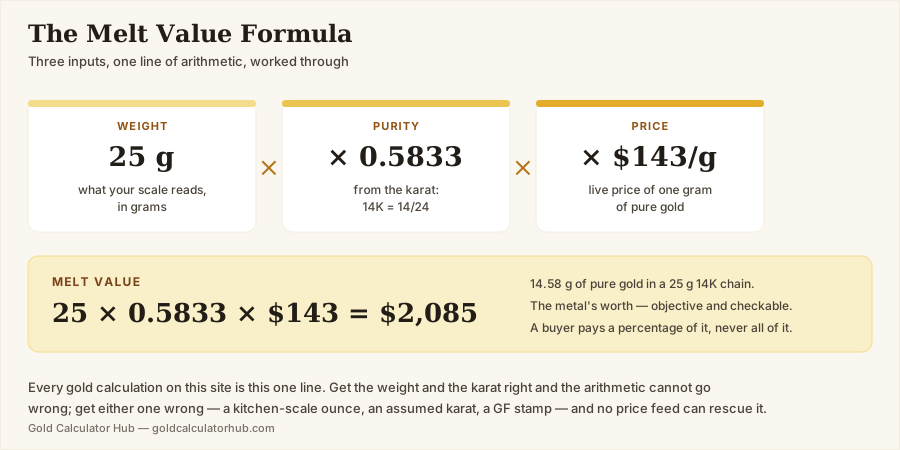
Misreading one: multiplying total weight by the full spot price. This is the big one, and it produces a fantasy figure that ruins every subsequent conversation. Take a 33-gram 14K chain with spot at an assumed $4,300 per troy ounce. The naive calculation — 33 ÷ 31.103 = 1.061 troy ounces, times $4,300 — says $4,562. The real calculation subtracts what isn't gold: 33 × $138.25 × 0.5833 = $2,661 of melt value. Sell that chain to a refiner paying 75% and you receive about $1,996. The fantasy number is roughly 2.3 times the check, and a seller anchored to $4,562 will turn down every honest offer in town while looking for a dishonest one.
Misreading two: mixing up the ounces. Spot is quoted per troy ounce of 31.103 grams. Your kitchen or postal scale reports standard ounces of 28.350 grams — about 9.7% lighter. Do the math in one unit and the quote in the other and you have lost a tenth of the value before negotiating. It helps to keep the same price expressed several ways. At our assumed $4,300 per troy ounce, pure gold is worth:
- $138.25 per gram
- $214.98 per pennyweight (1.555 g)
- $3,919.40 per standard ounce (28.350 g)
- $1,612.55 per tola (11.664 g)
- $138,250 per kilogram
Misreading three: treating spot as a price you can transact at. It isn't one, in either direction. No dealer will hand you spot for a used chain, and — more dangerously — nobody legitimate will sell you physical gold at or below spot. An offer priced under the benchmark is the oldest setup in the business: the counterfeit-bar pitch and the prepayment-that-never-ships pitch both open with an unbeatable price. If a deal makes the spread run backwards, the deal is the problem.
Avoiding all three costs nothing. Weigh in grams, apply your karat's fraction, and treat the resulting melt value as the anchor for every conversation that follows.
Frequently Asked Questions
Is the gold spot price the same everywhere in the world?
Effectively yes. Gold is quoted globally in US dollars per troy ounce, and arbitrage keeps prices in different trading centers within a hair of each other — if London and New York drifted apart, traders would instantly buy the cheap one and sell the dear one until they converged. Local prices in other currencies are just the dollar spot price converted at the current exchange rate, sometimes plus local taxes or import premiums in certain markets.
Why do different websites show slightly different spot prices?
They sample different data feeds at different instants. One site may derive spot from COMEX futures, another from an aggregated over-the-counter feed, and each refreshes on its own cycle — every second, every ten seconds, every minute. In a market that moves continuously, that's enough to produce small discrepancies. Differences of a few dollars per ounce are normal noise; a price wildly different from the consensus means a stale quote or a currency mix-up, not a bargain.
Can I buy gold at the spot price?
Practically, no. Spot is the institutional wholesale price for large transactions of refined gold; retail buyers pay a premium over it. Common bullion coins carry a premium of a few percent, and the smaller the item, the bigger the percentage — fractional coins and tiny bars cost proportionally more to make. Anyone offering to sell you physical gold at or below spot deserves immediate suspicion: it's a classic setup for counterfeit bars and prepayment scams.
Does the spot price include dealer fees or shipping?
No. Spot is the pure benchmark — no premiums, commissions, shipping, insurance, or taxes. Every real-world transaction adds costs on top (buying) or subtracts margin underneath (selling). That's why the spot price functions like the sticker on a mirror: useful as a reference, never the figure on the receipt. When comparing dealers in either direction, compare their all-in price against the same moment's spot to see who's actually closest to the benchmark.
How often does the spot price change?
Continuously — it ticks moment to moment from Sunday evening through Friday afternoon US time, as global trading sessions hand off around the clock. The market pauses briefly each weekday and closes for the weekend. Separately, the LBMA auction sets an official benchmark twice each London business day. For valuing jewelry you intend to sell this week, intraday wiggles are immaterial; the per-gram rate your buyer offers matters far more than catching a particular hour's price.
Is the spot price quoted for pure gold only?
Yes — spot always refers to 999-fine pure gold. Every karat below 24K is worth its gold fraction of spot: 18K is 75% pure, 14K is 58.33%, 10K is 41.67%. That's the single most common mistake people make when eyeballing their jewelry's value: multiplying weight by the full spot price. A 10-gram 14K ring contains only 5.83 grams of actual gold, so its melt value is 58.33% of what a naive spot calculation suggests.
Does the calculator on this page use the live spot price?
Yes. The gold spot price calculator above pulls the current market spot price, converts it to per-gram, adjusts for the karat you select, and multiplies by your weight — the same five-step chain explained on this page, computed live. Because we're an independent valuation site and not a buyer, the result is the neutral melt value with no margin baked in. To translate it into expected offers, apply the payout ranges by buyer type: roughly 70–90% from refiners down to 40–60% at pawn shops.
What is the gold spot price per gram and per kilogram?
Divide the per-troy-ounce quote by 31.103 to get the per-gram figure, then multiply by 1,000 for the kilogram. At an assumed $4,300 per troy ounce, that is $138.25 per gram of pure gold and $138,250 per kilogram, with a pennyweight at $214.98. Every one of those figures is for 999-fine gold, so scale it down by your karat's fraction before applying it to jewelry — 14K would be 58.33% of the per-gram rate, or about $80.64.

Written by Sukie Gao
Sukie Gao holds a master's degree from a business school, where she picked up the markets-and-pricing toolkit she now applies to the consumer gold trade. She created Gold Calculator Hub to give people an independent, data-driven way to find out what their gold is really worth.
Published June 14, 2026 · Updated July 21, 2026