Gold Calculators: Every Tool, and Which One You Actually Need
 By Sukie Gao · September 5, 2026
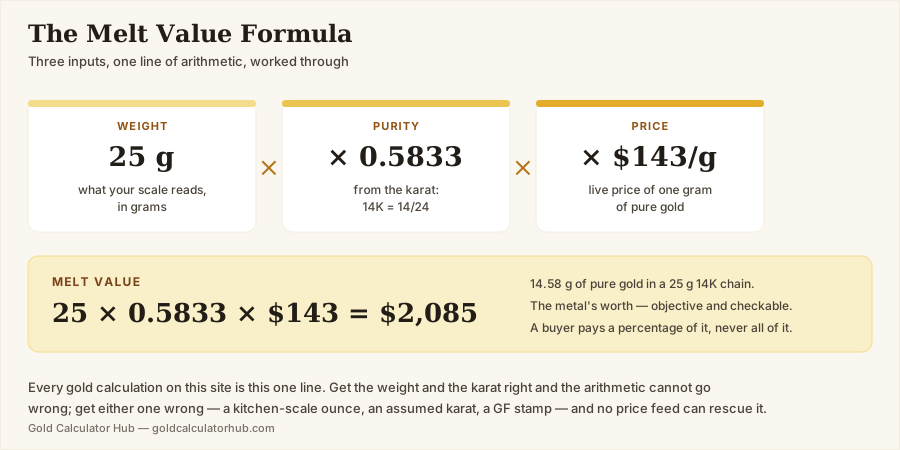
Gold calculators all run the same three-line arithmetic — weight × purity × spot price — and yet people arrive here having got four different numbers from four different tools for the same necklace. That is not because the math is contested. It is because the four tools quietly disagreed about *which* weight, *which* purity, and *which* price they were using, and none of them said so.
This page is the index to the twenty-seven calculators on this site, but it is more useful as a decision guide than as a list. Nearly every wrong gold valuation traces back to picking the wrong tool for the object in your hand: running a gold-filled watch case through a solid-gold calculator, weighing a stone-set ring and treating the whole mass as metal, or reading a per-troy-ounce price against a kitchen scale's ounces. Pick correctly and the number is exact. Pick carelessly and you can be out by a factor of twenty.
So: start with what you are holding, not with what you want to know.
Start From the Object, Not the Question
The single most reliable way to choose a calculator is to classify the item first. Four questions, in this order, resolve almost every case.
Is it solid gold, or gold over something else? This is the fork that matters most, because the two branches differ by orders of magnitude. A solid 14K chain and a 14K gold-filled chain of identical weight are not in the same universe of value — gold-filled is a bonded layer that is typically 1/20th of the item's weight, so the gold content is roughly 5% of the mass rather than 58%. Gold-plated is thinner still, usually a few microns, and its recoverable value rounds to nothing. If the stamp reads GF, 1/20, RGP, HGE, GP, or vermeil, you are not on the solid-gold branch.
Do you know the karat? If a hallmark tells you 14K, 585, 750, or 916, you can go straight to a karat-specific tool. If there is no mark, or the mark is worn, confirm purity before you calculate anything — an assumed karat is an assumed answer.
Is the whole item metal? Stones, clasps of a different alloy, spring bars, watch movements, glass, and enamel all add mass that is not gold. Weigh what you can separate; estimate conservatively for what you cannot.
Is it worth more than melt? Coins, designer pieces, antique work, and anything with a maker's mark can carry a premium above metal content. Melt value is the floor for those items, not the answer.
Only once you have those four answers does the choice of calculator become obvious — and at that point almost any of them will give you the same number, because you have already done the part that was actually hard.
Why Two Honest Calculators Can Disagree
Assume both tools are working correctly and are not trying to buy your gold. They can still return different figures, for reasons worth knowing:
- Purity convention. 14K is nominally 14/24 = 58.33%, and most calculators use that. Some use 58.5% (the European 585 mark), some use 58.7% to reflect the slight over-karating manufacturers apply to guarantee the stamp. On a 30 g chain that spread is real but small — under one percent.
- Which ounce. Gold trades in troy ounces of 31.1035 g. A standard avoirdupois ounce is 28.3495 g. Feeding kitchen-scale ounces into a troy-ounce price overstates your gold by about 9.7%. This is the most common single error in consumer gold math, and it always errs in the direction that disappoints you later.
- Price staleness. A calculator that caches the spot price for a day can be meaningfully out of step in a volatile week. This site refreshes every ten minutes and stamps the time so you can see for yourself.
- Melt versus offer. Some tools quietly show you a *buy price* — what a specific buyer would pay — and label it "value." That is not the same number, and the gap is the entire business model of the site showing it to you.
The last one is the reason this site exists. Every calculator here reports melt value first, plainly, and then shows what each buyer type actually pays as a percentage of it. Those are two different facts and they deserve two different lines.
The purity conventions these tools rely on are the international standards maintained by the London Bullion Market Association and reflected in the US FTC Jewelry Guides.
Units: the Part Everyone Gets Wrong
Gold is quoted per troy ounce, jewelers work in pennyweight, scrap buyers quote per gram, and your bathroom scale thinks in pounds. Getting fluent in the conversions is worth more than any single calculator.
| Unit | Grams | Notes |
|---|---|---|
| Troy ounce (ozt) | 31.1035 | The unit every quoted gold price uses |
| Standard ounce (oz) | 28.3495 | ~9.7% lighter — the classic costly mix-up |
| Pennyweight (dwt) | 1.55517 | 20 dwt = 1 troy ounce; common at US jewelers |
| Gram (g) | 1 | What most scrap buyers and refiners quote |
| Kilogram (kg) | 1,000 | Bullion bars; 1 kg ≈ 32.15 troy oz |
| Grain | 0.06480 | 480 grains = 1 troy ounce; rare outside assay work |
A practical habit: convert everything to grams first, do the purity math in grams, and only convert back at the end if someone has quoted you per dwt or per ounce. Grams are the fewest-steps path and the easiest to sanity-check, because a gram of pure gold is a number you will quickly memorise.
All the Gold Calculators
Grouped roughly by what you are holding. Every one of these uses the same live spot price and shows melt value before payout estimates.
- Gold Bracelet Value Calculator: Bangles, Links and CuffsBracelets and bangles, solid versus hollow, and the 22K savings case.
- Gold Ring Value Calculator: Melt Value Minus the StonesRings, with stone weight subtracted and a check on whether it's worth more intact.
- Gold Chain Value Calculator: What Your Chain Is Really WorthChains and necklaces — including how to spot hollow and gold-filled construction.
- 916 Gold Price Calculator: What 22K Gold Is Worth per Gram22K at 916 fineness, with making charges and the tola and sovereign units.
- Gold Price per Ounce Calculator: Troy vs Standard OuncesPer-ounce values, with the troy-versus-standard distinction handled properly.
- Gold Price Today: Live Rates by Karat, Updated Every 10 MinutesToday's live rate translated into every karat, per gram, dwt and ounce.
- Melt Value of Gold Coins: Every Major Coin ComparedMelt values compared across every major bullion coin.
- How Much Is a Gram of Gold Worth? By Karat, TodayA gram of gold by karat, from 9K through 24K.
- 10K Gold Price per Gram Today (Live Value)Live 10K per-gram value, updated with the market.
- How Much Is 18K Gold Worth? Real Melt Value TodayWhat 18K really fetches, and why offers land below the melt figure.
- Karat Gold Calculator: Value by Karat and WeightPick a karat, enter a weight, get the value — with a purity reference alongside.
- Gold Price per Pennyweight Calculator (dwt) by KaratPennyweight (dwt) values — the unit most US jewelers use at the counter.
- 14K Gold Price Today: What a Gram Is Actually WorthWhat a gram of 14K is actually worth right now.
- How Much Is 14K Gold Worth? Per Gram, dwt and Ounce14K value per gram, dwt and ounce, with worked examples.
- Gold to USD Calculator: Convert Gold Weight to DollarsStraight weight-to-dollars conversion for any karat.
- Gold and Silver Calculator: Melt Value of Both MetalsMixed lots — runs both metals so you can total a whole jewelry box.
- 24K Gold Calculator: Pure Gold Value by WeightEffectively pure gold, used for bullion rather than wearable jewelry.
- 22K Gold Calculator: Value of 22 Karat Gold per Gram91.67% gold, marked 916. Dominant across South Asia and the Gulf.
- Gold Filled Calculator: How Much Gold Is in GF Items?Gold-filled is a bonded layer, not solid gold — this works out the real content.
- Gold Coin Melt Value Calculator: Eagles, Krugerrands & MoreEagles, Krugerrands, Maples and Sovereigns by actual gold content.
- Dental Gold Value Calculator: Crowns, Bridges and FillingsCrowns and bridges, where alloy content varies far more than jewelry.
- Gold Weight Calculator: Convert Grams, Ounces, dwt and MoreConvert between grams, troy ounces, standard ounces, dwt and grains.
- Gold Spot Price Calculator: From Spot to Your Item's ValueBridges the quoted spot price and your item, which is where most confusion lives.
- Zakat on Gold Calculator: Nisab and 2.5% Made SimpleNisab thresholds and the 2.5% calculation for zakat on gold holdings.
- Scrap Gold Calculator: What Your Scrap Gold Is Worth TodayFor mixed lots of broken chain, odd earrings and unwearable pieces sold by weight.
- Gold Value Calculator: Find Your Gold's Real ValueThe general-purpose starting point when you know weight and karat and just want the number.
- Gold Price per Gram Calculator (All Karats, Live)Per-gram values for every karat, the unit refiners and scrap buyers quote in.
- Gold Price Calculator: Today's Price by Weight and KaratToday's price applied to your weight and karat, with the formula shown step by step.
- Gold Melt Calculator: Melt Value by Karat and WeightMelt value specifically — the metal's intrinsic worth before any buyer's margin.
- Gold Cost Calculator: Work Out the Cost of Gold by WeightWorks the other direction too: what a given weight of gold costs to buy.
- 18K Gold Calculator: What 18 Karat Gold Is Worth Today75% gold — standard for finer jewelry and most European pieces marked 750.
- 14K Gold Calculator: Value per Gram, Ounce and dwtThe most common US jewelry karat at 58.3% gold.
- 10K Gold Calculator: Real Value of 10 Karat Gold10K is 41.7% gold, the lowest karat common in US jewelry. Values run lower than people expect.
What No Gold Calculator Can Tell You
Three things sit permanently outside the arithmetic, and it is worth naming them so you do not go looking for a tool that provides them.
Collector or design premium. A calculator values metal. It cannot see that your coin is a scarce date, that the bracelet is signed, or that the piece would sell intact for triple its melt on a secondary market. If an item is old, marked, unusual, or simply beautiful, get an opinion before you weigh it — melted gold cannot be un-melted.
What a specific buyer will offer you today. Payout percentages on this site are ranges built from published refiner rates and consistent patterns in consumer reporting. They tell you whether an offer is in the normal band or out of it. They cannot predict one shop's mood on one afternoon.
Sentimental value. Obvious, and still worth saying, because the most common regret in this whole category is not a mispriced gram. It is selling something during a stressful month that could not be replaced afterwards.
What the calculators *can* do is remove the information gap that makes a lowball offer hard to recognise. That is a narrow job, and it is worth doing precisely.
A Sensible Order of Operations
- Confirm purity. Read the hallmark; if there isn't one, test it.
- Weigh accurately, in grams, on a scale that resolves to 0.1 g. Weighing method matters more than most people assume.
- Separate by karat — never average a mixed pile, because you will be paid on the lowest assumption.
- Calculate melt value with the right tool from the list above.
- Convert offers to percentages of that melt figure. This is the step that changes outcomes.
- Get at least three quotes. Across the buyer types, not three of the same kind.
Steps 5 and 6 routinely swing the final result by twenty to forty percent — far more than the difference between any two calculators, and far more than a week of price movement.
Questions About Calculators
Which gold calculator should I use if I don't know the karat?
None of them yet — purity is an input, not an output, and guessing it guesses your answer. Look for a hallmark first (inside a ring band, on a chain clasp tag, on the back of a pendant). If there is no readable mark, an acid test kit costs about $15 and settles it in a minute; a jeweler will usually test for free while you wait. Only then pick a calculator.
Why does this site's number differ from the calculator on a gold buyer's website?
Because they are usually reporting different things. Most buyer-hosted calculators show what that buyer would pay, which already has their margin subtracted, while presenting it as your gold's "value." This site shows melt value first — the metal's market worth — and then separately shows what each buyer type typically pays as a percentage of it. If a buyer's tool shows 60% of the figure you get here, that is not a contradiction. That is their spread, made visible.
Are these calculators free, and do they store what I enter?
Free, with no sign-up, no limits, and no account. The calculation runs in your browser; the weights, karats and values you enter are not sent to a server or stored by this site. Gold Calculator Hub is an independent informational site funded by advertising — we do not buy gold, sell gold, or pass leads to anyone who does.
How often does the gold price update?
Every ten minutes, from a live market feed, with the timestamp shown on each calculator. That is meaningfully fresher than the once-a-day refresh many comparable sites run on, which matters in a volatile week. If a feed is briefly unreachable, the calculator clearly labels the value it is using as approximate rather than silently showing a stale number as live.
Can I use these for gold in a currency other than US dollars?
Yes — the calculators support GBP, EUR, CAD, AUD and CHF alongside USD, converted from daily European Central Bank reference rates. Spot gold is quoted globally in US dollars per troy ounce, so every other currency figure is that USD price converted, which is exactly how bullion dealers price internationally too.
Do these calculators work for gold bars and bullion?
For metal content, yes: enter the weight and fineness and you get the gold value. But recognised bullion — a stamped bar from a known refiner, or a common bullion coin — usually trades close to spot rather than at scrap discounts, and sometimes slightly above it. Bullion is the one category where you should expect a much better percentage of melt than jewelry, so treat the melt figure as a realistic target rather than a ceiling.
What if my item is part gold and part something else?
Weigh and value only the gold. For a stone-set ring, ask the jeweler to weigh it with stones excluded, or estimate the stone mass and subtract it. For a watch, the case and bracelet may be gold while the movement, crystal and clasp pins are not. For gold-filled or plated items, the gold is a surface layer and needs the gold-filled calculator rather than a solid-gold one — the difference is roughly twentyfold, not marginal.

Written by Sukie Gao
Sukie Gao holds a master's degree from a business school, where she picked up the markets-and-pricing toolkit she now applies to the consumer gold trade. She created Gold Calculator Hub to give people an independent, data-driven way to find out what their gold is really worth.
Published September 5, 2026