Gold Basics: Karat, Purity, Hallmarks and Weight Explained
 By Sukie Gao · September 5, 2026
Gold basics come down to three facts, and every valuation, hallmark, test and quoted price is built on them. Purity is what fraction of an object is actually gold. Weight is how much of the object there is. Spot price is what a troy ounce of pure gold trades for right now. Multiply those three and you have melt value; everything else on this site is either a shortcut through that multiplication or a warning about a way people get one of the three wrong.
What makes gold confusing is not the arithmetic. It is that the trade carries four centuries of legacy vocabulary — karats measured in twenty-fourths, a special ounce that is heavier than an ounce, a pennyweight that has nothing to do with pennies, fineness expressed in parts per thousand, and a hallmarking system that differs by country and century. None of it is hard once someone lays it out. Almost nobody lays it out.
This section does. Below: what karat actually measures, how to read the stamps on your own jewelry, the unit trap that costs sellers about 10%, and how to tell real gold from something that merely looks like it.
Karat, Fineness, and Percentage Are Three Names for One Thing
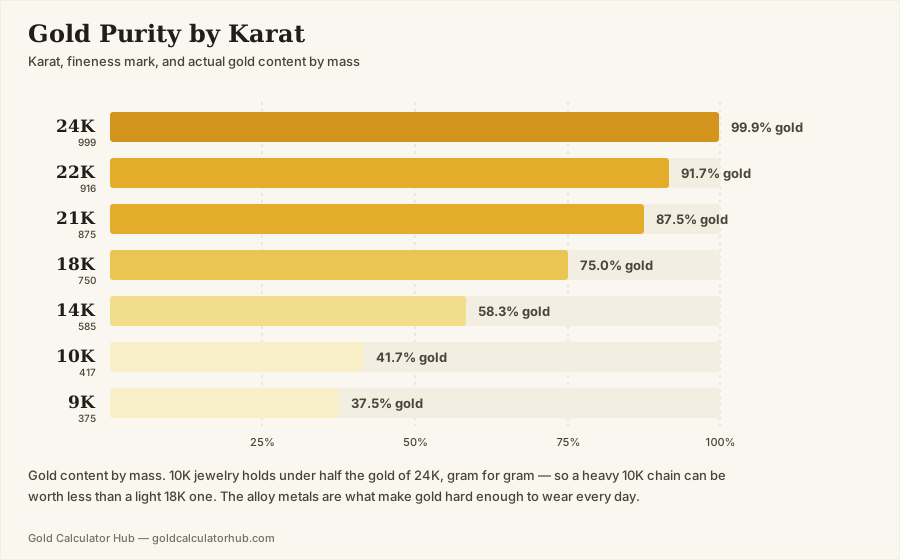
Karat measures gold purity in twenty-fourths. 24K would be entirely gold; 18K is 18 parts gold and 6 parts other metals, so 75%. That is the whole system, and the rest is notation.
European and modern international marking uses fineness instead — parts per thousand. 18K becomes 750. 14K becomes 585. 22K becomes 916. Same alloys, different stamp, and if you have jewelry from more than one country you will meet both.
| Karat | Fineness | Gold content | Where you'll meet it |
|---|---|---|---|
| 24K | 999 / 9999 | 99.9%+ | Bullion bars and coins; too soft for daily wear |
| 22K | 916 | 91.7% | South Asia, the Gulf, Sovereign coins |
| 21K | 875 | 87.5% | Middle East jewelry |
| 18K | 750 | 75.0% | Fine jewelry worldwide |
| 14K | 585 | 58.3% | The default US jewelry karat |
| 10K | 417 | 41.7% | Lowest karat common in US jewelry |
| 9K | 375 | 37.5% | UK legal minimum |
Two things worth internalising from that table. First, the drop is steeper than intuition suggests: 10K jewelry contains less than half the gold of 24K, gram for gram, so a heavy 10K chain can be worth less than a light 18K one. Second, the alloy metals are not filler in any pejorative sense — pure gold is soft enough to deform in a pocket, and the copper, silver and zinc in 14K are what let a ring survive being worn every day. Colour comes from the same place: rose gold is copper-heavy, white gold is alloyed with palladium or nickel and usually rhodium-plated on top.
The Unit Trap
Gold is priced per troy ounce, which weighs 31.1035 grams. A standard (avoirdupois) ounce — the one on your kitchen scale, the one in a pound of coffee — weighs 28.3495 grams. The troy ounce is about 9.7% heavier.
That difference is small enough to look like a rounding error and large enough to matter every time. If you weigh gold in ordinary ounces and multiply by the quoted per-troy-ounce price, you overstate your gold by roughly a tenth. People do this constantly, discover the shortfall at the counter, and conclude they were cheated when the arithmetic simply drifted.
The defence is to work in grams. Grams are unambiguous, every scale reads them, refiners quote in them, and the conversions out to other units are one multiplication when you actually need them:
- 1 troy ounce = 31.1035 g
- 1 standard ounce = 28.3495 g
- 1 pennyweight (dwt) = 1.55517 g — and 20 dwt = 1 troy ounce
- 1 kilogram = 32.1507 troy ounces
Pennyweight deserves a note because US jewelers still use it and almost nobody else does. If a counter quote is "per dwt," that is per 1.555 grams, so a dwt rate looks reassuringly larger than a gram rate for the same money. It is not a trick, but it is worth converting before you compare two quotes given in different units.
The troy and avoirdupois systems are both legally defined units maintained by the NIST Office of Weights and Measures, and UK purity marks are regulated by the British Hallmarking Council.
The Reference Guides
Guides covering purity, marks, testing and measurement — the inputs every calculation depends on.
- How Much Is an Ounce of Gold Worth? From 1/10 oz to 100 ozWhat one ounce of pure gold is worth from 1/10 oz to 100 oz, what sellers are actually paid, and why an ounce of jewelry holds less.
- 1/20 12K GF: What the Stamp Means and What It Is WorthThe commonest gold-filled stamp decoded: fraction × karat = 2.5% fine gold, and what that is actually worth.
- Gold Fineness Chart: Every Mark From 375 to 999Every fineness mark from 375 to 999, mapped to karat and gold percentage.
- How to Tell Real Gold From Fake: Spot the Type Before You TestSeven tests ranked by reliability, including the ones that produce false confidence.
- Gold Percentage to Karat Chart: Reverse LookupReverse lookup: you know the percentage, find the karat.
- Troy Ounce vs Ounce: The 10% Difference That Costs SellersThe 9.7% gap, why it exists, and where it bites sellers.
- How to Weigh Gold: Scales, Units, and Costly MistakesScales, units, and the weighing mistakes that quietly cost money.
- How to Test Gold at Home: Methods From Free to $25Methods from free to about $25, with what each one can and can't prove.
- How to Calculate Gold Price: The Formula With ExamplesThe formula itself, worked through with real numbers step by step.
- Gold Purity Chart: Every Karat, Fineness Mark and PercentageEvery karat with its fineness mark, percentage, and per-gram value at the live price.
- Gold Hallmarks: How to Read Every Stamp on Your JewelryHow to read every stamp — karat marks, fineness numbers, maker's marks, assay offices, plating codes.
Reading the Stamps on Your Own Jewelry
Most jewelry carries its purity somewhere, usually somewhere awkward: inside a ring shank, on the flat tag beside a chain clasp, on the reverse of a pendant bail, on the underside of an earring post. A loupe or a phone camera at maximum zoom will usually find it.
What you will see falls into a few families. Karat marks — 10K, 14K, 18K, sometimes written 14KT or 585. Fineness numbers — three digits, occasionally four. Maker's marks, which are initials or a symbol and tell you who made it, not what it is. Assay office marks in the UK and parts of Europe, which are a genuine third-party guarantee. And the family that matters most for valuation: plating and bonding codes.
- GF or 1/20 12K GF — gold filled: a bonded layer, typically 1/20th of total weight
- RGP — rolled gold plate: thinner than gold filled
- HGE or HEG — heavy gold electroplate: microns
- GP — gold plated: thinner still
- Vermeil — gold over sterling silver; the silver has value, the gold layer barely does
If you see any of those, the item is not solid gold and a solid-gold calculator will overstate it by roughly twentyfold. That single distinction is the most valuable thing on this page.
What a Test Can and Cannot Prove
Home testing runs a spectrum from free to laboratory-grade, and each rung answers a narrower question than people assume.
The magnet test is free and only rules things out — gold is not magnetic, but neither is copper, brass, aluminium or lead, so passing proves very little. The hallmark is strong evidence in a hallmarking jurisdiction and weaker evidence elsewhere, since stamps can be forged. An acid test kit, about $15, is the first method that genuinely distinguishes karats, by seeing which acid strength dissolves a scratch of the metal — it is destructive in a tiny way and needs care. Specific gravity testing is non-destructive and surprisingly good, using nothing but a scale and a cup of water, but it is confused by hollow items and stones. XRF — the handheld gun a serious buyer will point at your item — is fast, accurate and non-destructive, and is the only one on this list that reads the actual alloy composition.
A practical rule: use the free tests to screen, buy the $15 kit if you have more than a couple of items, and let the buyer's XRF confirm before money changes hands. Ask to see the reading.
Then Do the Arithmetic
Once purity and weight are settled, the rest is one line:
grams × purity × price per gram = melt value
A worked example. A 14K chain weighing 25 g contains 25 × 0.5833 = 14.58 g of pure gold. At a spot price of $143 per gram, that is about $2,085 of gold.
That figure is the metal's intrinsic worth — objective, checkable, and independent of anybody's opinion. It is not what a buyer will hand you; every buyer takes a spread, and what each type pays is a separate question with its own honest answer. But melt value is the number that turns every offer into a percentage, and a percentage is something you can compare. Run yours on the gold calculator and the whole conversation changes shape.
Questions About Gold Basics
What exactly does a karat measure?
Karat measures gold purity in twenty-fourths of the total mass. 24K is pure gold, 18K is 18/24 = 75% gold, 14K is 58.3%, and 10K is 41.7%. The remainder is alloy metals — copper, silver, zinc, sometimes palladium or nickel — that make the metal hard enough to wear. Note the spelling difference: karat (K) is purity, carat (ct) is the weight of a gemstone. Outside the US, "carat" is often used for both, which is a recurring source of confusion.
What is the difference between karat and fineness?
They express the same thing on different scales. Karat uses twenty-fourths; fineness uses parts per thousand. 18K and 750 are the same alloy, as are 14K and 585, and 22K and 916. Fineness is the modern international convention and what you will see on most European and Asian pieces; karat marks dominate in the US. Neither is more accurate — they are two notations for one measurement.
Does 10K really count as gold?
Yes, legally and materially — 10K is 41.7% gold, and 10K is the minimum purity that can be sold as "gold" in the United States. But it is worth understanding what that means for value: 10K contains less than half the gold of 24K by weight, so a chunky 10K bracelet can be worth less than a delicate 18K one. It is also harder and more scratch-resistant than higher karats, which is a genuine advantage for something worn daily, and it is more prone to tarnish because of the higher copper content.
How can I tell if gold is real at home?
Start by finding the hallmark, then screen with free tests: gold is not magnetic, does not tarnish green, and is notably dense for its size. None of those prove authenticity on their own. The first genuinely conclusive home method is an acid test kit at around $15, which distinguishes karats by which acid strength dissolves a scratch of the metal. Specific gravity testing — weighing the item dry, then submerged — is non-destructive and quite accurate for solid items without stones. For certainty, a jeweler's XRF analyser reads the actual alloy in seconds and most will do it free.
Why is a troy ounce different from a regular ounce?
They come from different medieval weight systems that never merged. The troy system survived in precious metals and gemstones; the avoirdupois system became the everyday ounce. A troy ounce is 31.1035 g and a standard ounce is 28.3495 g, so the troy ounce is about 9.7% heavier. Every quoted gold price uses the troy ounce, which means weighing gold on a kitchen scale in ounces and applying the gold price to that number overstates your gold by roughly a tenth.
My jewelry is stamped 585 — what does that tell me?
585 is a fineness mark meaning 58.5% gold — the European stamp for what Americans call 14K. Similarly 750 is 18K, 916 is 22K, 417 is 10K and 375 is 9K. The tiny discrepancy between 585 and the strict 14/24 = 58.33% is deliberate: manufacturers alloy slightly over the nominal figure so the piece cannot fail an assay. For valuation the difference is under a percent and does not change any practical decision.
Does gold-filled jewelry have real gold in it?
Yes, but as a bonded surface layer rather than throughout. A mark like "1/20 12K GF" means the gold layer is 1/20th of the item's total weight and that layer is 12K. So a 20 g gold-filled piece holds about 1 g of 12K gold — roughly 0.5 g of pure gold. That is real, it is more substantial than plating, and it is roughly twenty times less than a solid piece of the same weight. Refiners generally will not buy gold-filled scrap in small quantities because recovery costs exceed the yield.
Does white gold contain less gold than yellow gold?
No — a 14K white gold ring and a 14K yellow gold ring both contain 58.3% gold and have the same melt value per gram. The difference is in the other 41.7%: white gold is alloyed with palladium, nickel or silver instead of copper, and is usually rhodium-plated for brightness. That plating wears and needs redoing every few years, which is a maintenance cost, not a purity difference. Rose gold likewise is the same karat with a copper-heavy alloy.
Do I need a special scale to weigh gold?
Not special, but you do need resolution. A kitchen scale reading in whole grams is fine for a rough estimate on heavy items and useless on small ones — a 1 g rounding error on a 3 g earring is a third of its value. A pocket jewelry scale with 0.1 g resolution costs $15–25 and turns your estimate into a number you can negotiate with. Weigh in grams, weigh each karat group separately, and calibrate with the small weight that ships with the scale before you trust the first reading.

Written by Sukie Gao
Sukie Gao holds a master's degree from a business school, where she picked up the markets-and-pricing toolkit she now applies to the consumer gold trade. She created Gold Calculator Hub to give people an independent, data-driven way to find out what their gold is really worth.
Published September 5, 2026