Gold Bracelet Value Calculator: Bangles, Links and Cuffs
 By Sukie Gao · October 15, 2026
A gold bracelet value calculator turns two facts — weight and karat — into the melt value of the metal on your wrist. Enter them above and the live gold price does the rest.
Bracelets are worth their own page because they sit at an awkward intersection. They are heavy enough that the numbers get large fast, which makes errors expensive. They come in solid, hollow and tube-formed constructions that look identical and differ threefold in weight. And in 22K markets the bangle is the default form that gold savings take, which means a great many people own several and have never once worked out what they hold.
A worked example to anchor the rest of the page, because it is the exact question people ask: an 8.519 g 22K bangle contains 8.519 × 0.9167 = 7.81 grams of pure gold. At a pure gold price of $143 per gram, that is $1,117 of melt value. Whether you would receive that is a separate question, and the last third of this page is about the gap.
Solid, hollow, or tube — and why it matters most here
Bracelets are the jewelry category where construction has the biggest effect on value, because the forms are large and the differences are invisible.
Solid. Metal throughout. A solid 22K bangle of decent width is genuinely heavy — you feel it when you pick it up.
Hollow / tube. Formed from sheet or tube with air inside. Extremely common in larger bangles and link bracelets, particularly in 18K and 22K where solid construction of that size would be prohibitively expensive. Still real gold at the marked purity; there is simply much less of it.
Filled with something. Some large bangles are filled with lac, resin or cement to give heft and rigidity. This is traditional rather than deceptive in some markets, but it means gross weight badly overstates gold content, and a buyer will drill or cut to check.
Gold filled / plated. Marked GF, RGP, HGE, GP or with a fraction. Gold content is a tiny fraction of weight.
A quick field test: a hollow bangle sounds different when tapped and is noticeably light for its size. A filled one is heavy but does not feel like solid metal — the density is wrong. If a bangle's weight and size seem mismatched in either direction, ask before you calculate.
Reading the mark on a bracelet
Bracelet hallmarks live in a few predictable spots.
On link bracelets, look at the clasp tag or the underside of the clasp — the same convention as chains.
On bangles, look on the inner surface, often near the hinge or the opening. Hinged bangles frequently carry the mark beside the hinge box.
On cuffs, look on the inside of the terminals.
In 916 markets, a hallmarked piece under the Indian BIS scheme carries the BIS logo, "22K916," and a six-digit HUID identifying the individual item — a stronger guarantee than an unverified manufacturer stamp.
Because bracelets take heavy wear against desks, doors and sleeves, marks wear faster here than on rings. An illegible mark on a bracelet is common and means testing rather than guessing.
In India, the hallmark you are looking for is issued under the Bureau of Indian Standards scheme, which mandates the BIS mark, the purity grade and a unique item identifier on hallmarked jewelry.
The calculation across realistic bracelet weights
At a pure gold price of $143 per gram:
| Bracelet | Weight | Karat | Pure gold | Melt |
|---|---|---|---|---|
| Thin 22K bangle | 8.52 g | 22K | 7.81 g | $1,117 |
| Pair of 22K bangles | 21.0 g | 22K | 19.25 g | $2,753 |
| 18K mesh bracelet | 1.10 g | 18K | 0.83 g | $118 |
| 14K link bracelet, 7.5" | 14.6 g | 14K | 8.51 g | $1,217 |
| 10K tennis-style bracelet mount | 9.8 g | 10K | 4.08 g | $584 |
| Heavy 18K woven cuff | 42.0 g | 18K | 31.5 g | $4,505 |
| Hollow 14K Cuban bracelet | 11.2 g | 14K | 6.53 g | $934 |
The 18K mesh row is there deliberately. A 1.10 g mesh bracelet holds about $118 of gold — a genuine answer that often disappoints, because mesh and woven constructions look substantial and weigh almost nothing. Weight, not appearance, is what the market pays for.
Bangles as savings: the 22K case
Across India, Bangladesh, Pakistan and the Gulf, gold bangles function as a savings instrument that happens to be wearable. That changes how they should be valued and sold.
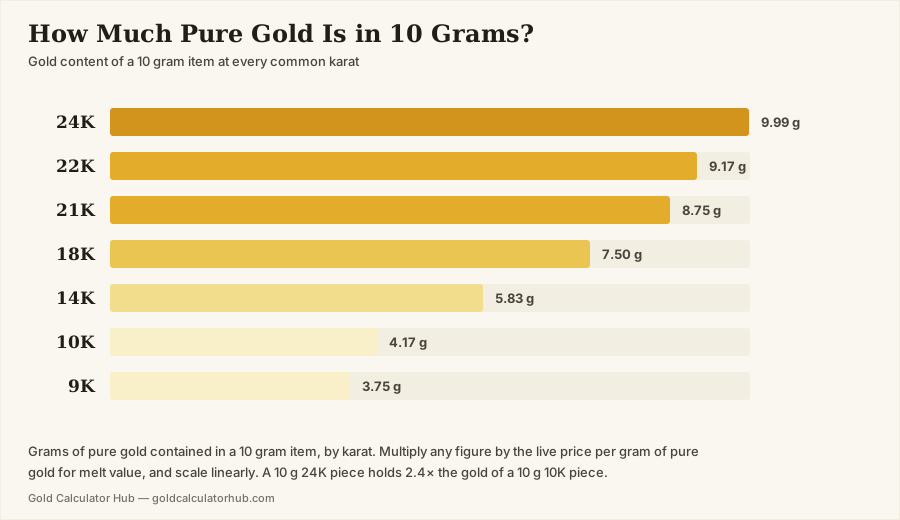
They are usually 916 (22K), so they carry far more metal per gram than Western 14K — about 57% more. A 20 g 22K bangle holds as much gold as a 31 g 14K one.
They were bought with making charges attached. Typically 8–25% for labour plus 2–10% wastage. Those do not come back on sale, so the round trip on an intricate bangle costs real money. Plain bangles hold value far better than heavily worked ones for exactly this reason.
Exchange usually beats a cash sale. Most jewelers in these markets offer better terms for exchanging old gold toward a new piece than for buying it outright, because they recover margin on the sale. If you were going to buy anyway, that is the better arithmetic.
Hallmarking matters more than elsewhere. A hallmarked 916 bangle should test at 91.6% and be paid accordingly. An unmarked one will be assayed and may test lower, and the buyer will pay on the measurement rather than the assumption.
Bracelets with stones and mixed components
Tennis bracelets, gem-set bangles and charm bracelets all need decomposing before the metal can be valued.
Tennis bracelets are mostly stone by count and often 30%+ stone by weight. The mount is what you are valuing for melt; the stones are a separate market. A tennis bracelet with real diamonds is nearly always worth more intact than scrapped.
Charm bracelets are the awkward case: charms are frequently a different karat from the bracelet, and some are plated or base metal despite hanging from solid gold. Weigh and assess separately, and check whether individual charms are collectible — some vintage charms sell for well above their gold.
Gem-set bangles need the stone mass subtracted. One carat is 0.2 g.
Spring bars, clasps and safety chains are sometimes base metal even on solid gold pieces.
The conservative approach applies throughout: assume less gold rather than more, so a real quote surprises you upward rather than down.
What buyers pay, and who to approach
| Buyer | Share of melt |
|---|---|
| Online refiner | 70–90% |
| Coin / bullion dealer | 65–85% |
| Jewelry store | 50–75% |
| Pawn shop | 40–60% |
| Mail-in / TV service | 20–50% |
So the 42 g 18K cuff above, at $4,505 of melt, realistically fetches $3,150–$4,050 from a strong refiner and $1,800–$2,700 at a pawn counter. On a piece that size, the difference between the best and worst route is over $2,000 — which is a very good return on an afternoon of phone calls.
Two bracelet-specific notes. Refiners are the right call for plain heavy pieces, where the whole value is metal. And a jeweler may beat everyone for an attractive, wearable, current-style bracelet, because they can resell it as an object rather than melt it. Those are different transactions and it is worth trying both.
In 916 markets, the equivalent is: reputable jewelers typically pay around 90–95% of metal value on hallmarked pieces for cash, and better on exchange.
When a bracelet is worth more intact
The signals are the same as for other jewelry, and bracelets carry them fairly often.
Signed work from a recognised house. Photograph any maker's mark and search it.
Period pieces — Victorian gate bracelets, Art Deco link bracelets, mid-century Italian goldwork — trade well above melt among collectors.
Italian goldwork specifically: certain twentieth-century Italian makers are actively collected, and their pieces are often marked with a maker's number and province code.
Bangles with meaningful stones, or matched pairs and sets, which are worth more together than separately.
Enamel or unusual technique, which cannot be recovered from melted metal.
Melting is irreversible. A bracelet that has sat unworn for a decade is not going anywhere in the next week, and a single dealer opinion costs nothing.
A worked walkthrough, end to end
Take the 10 g 22K bangle case, since it is asked often enough to deserve the full sequence.
Step 1 — confirm purity. Look inside near the hinge for 916 or 22K. In India, check for the BIS mark and HUID.
Step 2 — confirm construction. Solid or hollow? A 10 g bangle of substantial diameter is very likely hollow, because solid 22K at that size would weigh considerably more.
Step 3 — weigh in grams. 10.00 g on a calibrated 0.1 g scale.
Step 4 — compute gold content. 10.00 × 0.9167 = 9.17 g of pure gold.
Step 5 — compute melt. 9.17 × $143 = $1,311.
Step 6 — apply a realistic payout. A reputable jeweler on hallmarked 916 might pay 90–95% for cash: $1,180–$1,245. A Western scrap refiner treating it as generic 22K scrap: 80–88%, or $1,049–$1,154.
Step 7 — check for exchange terms if you intend to buy anything, since exchange typically beats cash.
The whole sequence takes ten minutes and the number it produces is one you can defend at a counter.
Buying a bracelet with the same knowledge
Running the logic in reverse protects you at purchase.
Ask solid or hollow in writing. On bangles this is the single largest determinant of what you are getting, and the appearance difference is nil.
Ask for making charges as a separate line. A single all-in per-gram price is designed to prevent comparison. Two jewelers quoting the same metal rate can differ by 15% on making.
Check weight against melt. A bracelet priced near or below its melt value is hollow, plated, or not what it claims. Melt is a hard floor on what solid gold can honestly cost.
Prefer plain over intricate if any part of the purchase is savings. The round-trip cost on a heavily worked bangle is 20–30%; on a plain one it is far less.
Weigh it yourself if you can, or watch the scale. Weight is the number everything else is derived from.
Frequently Asked Questions
How much is a 22K gold bangle worth?
Multiply the weight in grams by 0.9167, then by the current price per gram of pure gold. A 10 g 22K bangle holds 9.17 g of pure gold, worth about $1,311 at $143 per gram. An 8.519 g bangle holds 7.81 g, worth about $1,117. That is melt value — a reputable jeweler buying hallmarked 916 typically pays 90–95% of it for cash, and often better on exchange toward a new piece.
How can I tell if my gold bangle is hollow?
Weight relative to size is the clearest signal — a solid bangle of any real width is noticeably heavy, and a hollow one feels light for how substantial it looks. Tapping produces a different, thinner sound. Some large bangles are also filled with lac or resin to add heft and rigidity, which makes them heavy without adding gold; those feel dense but not metallic. If weight and appearance seem mismatched in either direction, ask the seller or have it checked before calculating.
Is a gold bracelet worth more than its melt value?
Sometimes, and it is worth checking before scrapping. Signed pieces from recognised houses, Victorian gate bracelets, Art Deco link bracelets and collected twentieth-century Italian goldwork all trade above melt. So do tennis bracelets with real diamonds, where the stones usually exceed the gold value. Plain modern bracelets in current styles generally sell at melt-based prices, since they are effectively a commodity form.
How much do pawn shops pay for a gold bracelet?
Typically 40–60% of melt value for an outright sale. On a 14.6 g 14K link bracelet with about $1,217 of melt, that is roughly $490–$730. An online refiner would pay $850–$1,095 for the same metal. Pawn shops make sense for speed or when you plan to redeem the item through a loan, not as a way to get a competitive price.
Do making charges come back when I sell a gold bangle?
No. Making charges and wastage are the jeweler's labour and allowance for fabrication loss, added when you buy and never returned when you sell. This is why the buy-sell round trip on intricate bangles costs 20–30%, and why plain pieces hold their value far better if any part of the purchase is meant as savings. Exchange schemes toward a new piece usually give better terms than a cash sale, because the jeweler recovers margin on what you buy next.

Written by Sukie Gao
Sukie Gao holds a master's degree from a business school, where she picked up the markets-and-pricing toolkit she now applies to the consumer gold trade. She created Gold Calculator Hub to give people an independent, data-driven way to find out what their gold is really worth.
Published October 15, 2026