Gold Price per Ounce Calculator: Troy vs Standard Ounces
 By Sukie Gao · September 25, 2026
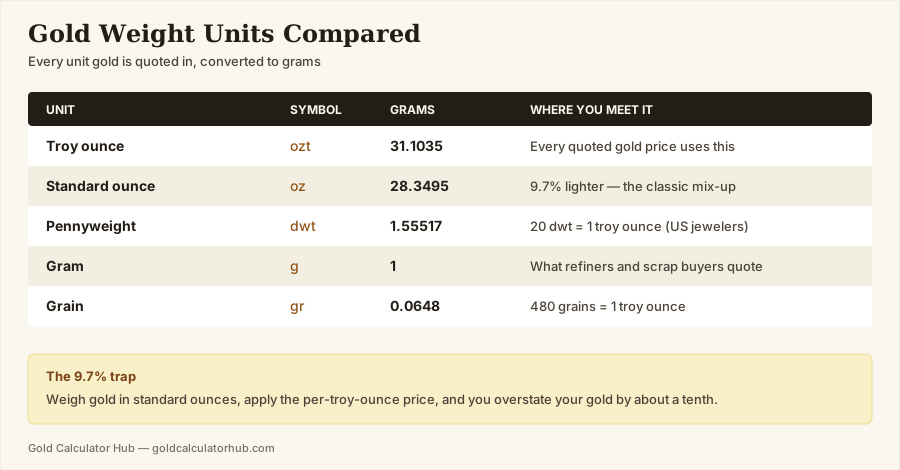
A gold price per ounce calculator has one job that sounds trivial and is not: deciding which ounce you mean. Gold is quoted per troy ounce — 31.1035 grams. Your kitchen scale, your postal scale, and the ounce in a pound of coffee are all the avoirdupois ounce — 28.3495 grams. The troy ounce is about 9.7% heavier, and every year a large number of people weigh gold in the wrong ounce, multiply by the right price, and walk into a shop expecting roughly a tenth more money than their gold contains.
The calculator on this page handles both, alongside grams and pennyweight, so the unit question is settled before the arithmetic starts. What follows is the reasoning underneath it: why two ounces exist at all, what a per-ounce figure means for 14K rather than pure gold, and when thinking in ounces helps versus when it quietly misleads you.
Short version if you only read one line: for jewelry, work in grams. Ounces are how the market quotes and how bullion is sold. Grams are how your item is actually going to be weighed and paid for.
The two ounces, and why both survive
The troy system takes its name from Troyes in France, a major medieval trade fair town, and it survived into the modern era for precious metals and gemstones. The avoirdupois system — literally "goods of weight" — became the everyday standard for everything else. The two never merged, so we ended up with two ounces of different size that share a name.
| Grams | Grains | Relationship | |
|---|---|---|---|
| Troy ounce (ozt) | 31.1035 | 480 | 12 troy oz = 1 troy pound |
| Standard ounce (oz) | 28.3495 | 437.5 | 16 oz = 1 pound |
A troy ounce is 1.09714 standard ounces — about 9.7% heavier. Note the second oddity: a troy *pound* is twelve troy ounces and is actually lighter than a standard pound, because the ounces being counted are fewer. This is why nobody in the trade ever uses troy pounds.
Every gold price you will ever see quoted is per troy ounce. There is no ambiguity in the market itself — only at the point where a consumer puts jewelry on a household scale.
Both ounces are legally defined units in the US: the NIST Office of Weights and Measures maintains the troy and avoirdupois systems and the exact conversions between them.
What the 9.7% error actually costs
Suppose pure gold is $4,450 per troy ounce, and you have a bullion coin containing exactly one troy ounce of gold.
You put it on a kitchen scale, which reads 1.097 oz. If you now think "1.097 ounces × $4,450" you get $4,882 — you have overstated by $432 by counting the same metal in the smaller unit and then pricing it in the larger one.
The error runs the other way just as easily. Weigh a 5 standard-ounce lot of scrap, treat it as 5 troy ounces, and you expect $22,250 of pure-gold equivalent when you actually hold 4.56 troy ounces worth $20,290. Nearly $2,000 of disappointment, entirely manufactured by a unit.
The defence is dull and effective: weigh in grams. Every scale reads grams, refiners quote grams, and grams have no evil twin. Convert to ounces only at the end, and only if someone has quoted you in them.
Per-ounce values by karat
A per-troy-ounce quote is for pure gold. Your jewelry is not pure, so its per-ounce value is the pure figure scaled by purity:
| Karat | Purity | Value per troy oz | Value per standard oz |
|---|---|---|---|
| 24K | 99.9% | 0.999 × spot | 0.911 × spot |
| 22K | 91.7% | 0.917 × spot | 0.836 × spot |
| 18K | 75.0% | 0.750 × spot | 0.684 × spot |
| 14K | 58.3% | 0.583 × spot | 0.531 × spot |
| 10K | 41.7% | 0.417 × spot | 0.380 × spot |
The last column is the one nobody publishes and plenty of people need, because it answers "what is an ounce of my 14K worth on the scale I actually own." Each figure is the troy-ounce value multiplied by 0.9115, the ratio of a standard ounce to a troy ounce.
A worked example at $4,450 spot: a troy ounce of 14K is worth about $2,594; a standard ounce of the same 14K is worth about $2,364. Same alloy, same day, $230 apart, purely because of which ounce was on the scale.
When ounces are the right unit
Ounces are not always the wrong choice — they are the natural unit in three situations.
Bullion. Coins and bars are specified in troy ounces: a one-ounce Eagle, a ten-ounce bar, a tenth-ounce fractional. Comparing dealer premiums is far easier per ounce than per gram, because the products are denominated that way.
Comparing against the market. Every quote, chart and headline is per troy ounce. If you want to know whether a dealer's price is fair, converting your item to troy ounces puts it in the same units as the benchmark.
Large lots. Once you are past a few hundred grams, ounces produce more readable numbers and refiner quotes for substantial lots are sometimes given per ounce.
For everything else — a chain, a handful of earrings, a broken bracelet — grams are better. They are what the scale reads, what the buyer will quote, and what the calculation wants.
Converting between every unit
Four conversions cover essentially all gold arithmetic. It is worth being able to do them without looking anything up.
- Troy ounce → grams: × 31.1035
- Standard ounce → grams: × 28.3495
- Pennyweight → grams: × 1.55517
- Grams → troy ounces: ÷ 31.1035
And two shortcuts that are close enough for a mental check at a counter:
- A troy ounce is roughly 31 grams, so a 31 g chain is about a troy ounce of *metal* (not of gold, unless it is 24K).
- A pennyweight is roughly 1.55 grams, and there are 20 to the troy ounce.
The pennyweight shortcut matters at US jewelry counters, which still quote in dwt. A per-dwt rate is about 55% larger than the equivalent per-gram rate for the same money, which makes an ordinary offer sound better than it is until you convert.
Reading a per-ounce offer correctly
If a buyer quotes you per ounce, three questions turn the number into something comparable.
Which ounce? If they say troy, fine. If they just say "ounce" and the item goes on their scale reading standard ounces, the arithmetic needs care. Most professional buyers use troy and grams; be more careful with informal ones.
Which purity is the price for? "Ninety percent of the ounce price" is meaningless unless you know whether the ounce price refers to pure gold or to your 14K. The honest framing is a percentage of *your item's* melt value.
What is the weight they are using? Ask to see the scale reading. Ask for each karat group to be weighed separately. A single lot weight quoted at a single rate is how mixed 18K quietly gets paid at 10K rates.
Bullion is where per-ounce thinking pays off
For recognised bullion, the per-ounce frame is genuinely the right one, and the economics are completely different from scrap.
A common-date one-ounce Gold Eagle or Maple Leaf trades near spot — dealers typically buy a few percent under and sell a few percent over, because the metal is already refined, assayed and instantly resaleable. There is no refining cost to recover, which is exactly why the spread collapses.
That has a practical consequence people miss: do not sell recognised bullion to a scrap buyer. A cash-for-gold counter that pays 60% of melt for jewelry will happily apply something close to the same logic to a Krugerrand if you let them. Take bullion to a coin or bullion dealer, where the competitive price is near spot rather than a scrap discount.
It also means premiums matter when buying. On a one-ounce coin the premium is typically low single digits; on a tenth-ounce coin it can be ten percent or more, because the minting cost per ounce of gold is far higher on small pieces.
Common per-ounce questions the calculator answers
The tool above handles all of these directly, but the shapes are worth recognising:
- "How much is an ounce of 14K worth?" — 58.3% of the pure per-ounce price, and then specify which ounce.
- "How many grams in an ounce of gold?" — 31.1035 if troy, 28.3495 if standard.
- "What is a half ounce of gold worth?" — half the troy-ounce figure, times purity if it is not pure.
- "My scale says 3.2 oz — what is that in gold?" — those are standard ounces: 3.2 × 28.3495 = 90.7 g, then apply purity.
The pattern in all four is the same: settle the unit, settle the purity, then multiply. The unit comes first because getting it wrong invalidates everything downstream.
A sanity check worth memorising
One number will save you from most unit disasters: a troy ounce of pure gold is about 31 grams.
If someone tells you a chain is "about an ounce" and it weighs 18 grams, it is not an ounce of anything. If a bar is described as one ounce and weighs 31.1 g, it checks out. If a coin is sold as a one-ounce Eagle and weighs 33.9 g, that is also correct — Eagles are 22K, so the coin is heavier than an ounce because only 91.67% of it is gold, and the gold content is exactly one troy ounce.
That last case is the elegant one and it catches people out: a one-ounce Eagle contains one troy ounce of *gold*, not one troy ounce of *coin*. A one-ounce Maple Leaf, being 99.99% pure, weighs almost exactly 31.1 g. Both contain the same gold. Only one weighs an ounce.
Then convert to what the buyer will pay
Per-ounce melt value is the benchmark, not the outcome. Whatever unit you calculate in, the last step is the same: express any offer as a percentage of melt.
A good online refiner pays 70–90%. A coin or bullion dealer 65–85% on scrap, and much closer to spot on recognised bullion. A jewelry store 50–75%. A pawn shop 40–60%. Mail-in services 20–50%.
So a lot with three troy ounces of pure-gold equivalent — roughly $13,350 at $4,450 spot — realistically sells for $9,300 to $12,000 to a strong refiner, and perhaps $5,300 to $8,000 at a pawn counter. Those figures come from the same ounce, priced by different businesses.
Which means the unit question, having been settled, stops being the interesting one. Who you sell to is worth several times more than any conversion on this page.
Frequently Asked Questions
How many grams are in an ounce of gold?
31.1035 grams if you mean a troy ounce, which is what every quoted gold price uses. 28.3495 grams if you mean the standard avoirdupois ounce, which is what a kitchen or postal scale weighs in. The troy ounce is about 9.7% heavier, and confusing the two is the most common unit error in consumer gold valuation.
How much is an ounce of 14K gold worth?
About 58.3% of the pure gold price per ounce, since 14K is 58.3% gold by mass. At a spot price of $4,450 per troy ounce, a troy ounce of 14K holds roughly $2,594 of gold. If you weighed on a household scale in standard ounces, the same figure is about $2,364, because a standard ounce is a smaller unit.
Why is gold priced per troy ounce instead of grams?
Convention and continuity. The troy system was the medieval standard for precious metals and simply never got replaced in that one domain, while everyday commerce moved to avoirdupois. Because centuries of contracts, futures specifications and market data are denominated in troy ounces, changing would break comparability for no real benefit. Most of the physical world outside bullion markets works in grams, which is why consumers meet the mismatch.
Is a one ounce gold coin exactly one ounce?
It contains exactly one troy ounce of gold, but may weigh more than that. An American Gold Eagle is 22K, so it weighs 33.93 g gross to hold 31.1 g of pure gold — the extra mass is copper and silver alloy. A Canadian Maple Leaf at 99.99% purity weighs almost exactly 31.1 g. Both contain identical gold; only one weighs a troy ounce on the scale.
How do I convert grams to troy ounces?
Divide by 31.1035. So 50 g is 1.607 troy ounces, and 100 g is 3.215 troy ounces. Going the other way, multiply troy ounces by 31.1035. For a rough mental check, treat a troy ounce as 31 grams — close enough to catch an order-of-magnitude mistake at a counter.
Should I weigh my gold in ounces or grams?
Grams, in almost every case. Grams have no ambiguous twin unit, every scale reads them, and refiners and scrap buyers quote per gram. Ounces are the right unit for bullion, where products are denominated in troy ounces, and for comparing against market quotes. For jewelry and scrap, weigh in grams and convert only if someone quotes you otherwise.

Written by Sukie Gao
Sukie Gao holds a master's degree from a business school, where she picked up the markets-and-pricing toolkit she now applies to the consumer gold trade. She created Gold Calculator Hub to give people an independent, data-driven way to find out what their gold is really worth.
Published September 25, 2026