21K Gold Price per Gram: Value per Gram, 10 Grams and Tola
 By Sukie Gao · November 22, 2026
Quick answer
21K gold is 87.5% pure, so a gram of it holds 0.875 g of gold. At an assumed $4,000 per troy ounce ($128.60 per gram of pure gold), one gram of 21K is worth $112.53 in melt value, ten grams $1,125.25 and one tola (11.6638 g) $1,312.47. A US buyer pays a share of that figure; the calculator above shows it at the live price.
21K Gold Price per Gram: Value per Gram, 10 Grams and Tola
Live gold price: $3,617.40/ozt · Nov 22, 8:29 PM EST · updates every 10 min
Melt value of 10 g of 21K gold
$1,017.64
Pure gold content: 8.75 g × $116.30/g
| Where you sell | Typical offer | % of melt |
|---|---|---|
| Online gold refiner | $712.35 – $915.88 | 70–90% |
| Local coin / bullion dealer | $661.47 – $865.00 | 65–85% |
| Jewelry store | $508.82 – $763.23 | 50–75% |
| Pawn shop | $407.06 – $610.59 | 40–60% |
| Mail-in 'cash for gold' TV services | $203.53 – $508.82 | 20–50% |
Ranges reflect typical published buy rates and consumer-test results. We are not a buyer — these numbers exist so you can judge any offer you receive.
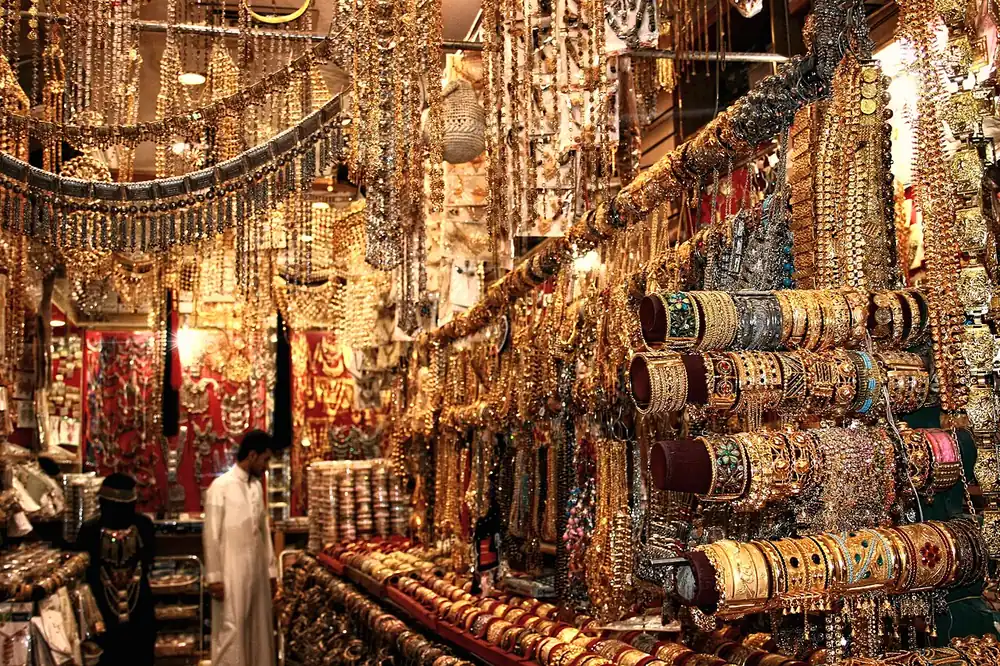
Picture four bangles bought by weight in a Jeddah or Cairo gold market, worn for years and now sitting on a kitchen scale in Texas, where the first thing their owner searches for is the 21K gold price per gram. The old receipt, if it survived, shows a gold rate per gram plus a making charge. The karat calculators she finds online mostly default to 14K, 18K and 24K.
That gap is what this page closes. 21K is 87.5% gold, the karat that BullionStar's guide to 21K gold calls "the dominant gold standard across much of the Middle East and North Africa", and in the US it is valued like any other karat: weight times purity times the price of pure gold. The calculator above is preset to 21K and uses the live price. The tables below assume $4,000 per troy ounce so every figure can be checked by hand.
What a gram of 21K holds, in grams, 10-gram units and tolas
The purity is plain arithmetic: 21 parts gold out of 24, so 21 ÷ 24 = 0.875. That is why 21K jewelry is stamped 875, the millesimal mark for 875 parts per thousand. BullionStar notes that 21K is "widely traded and sold by weight in the souks and jewelry markets of Saudi Arabia, Egypt, and the UAE", so the units that matter are the ones those markets quote: the gram, the 10-gram unit, and the tola of 11.6638 grams.
The assumption used throughout: gold at $4,000 per troy ounce. One troy ounce is 31.1035 grams, so pure gold costs 4,000 ÷ 31.1035 = $128.60 per gram. This is a round number chosen so the math is easy to follow, not a quote. Multiply each karat's purity by $128.60 and you get the melt value of one gram, which is what a 21K gold price per gram really is: a share of the pure-gold price.
| Karat (mark) | Purity | Per gram | Per 10 grams | Per tola (11.6638 g) |
|---|---|---|---|---|
| 18K (750) | 75% | $96.45 | $964.50 | $1,124.97 |
| 21K (875) | 87.5% | $112.53 | $1,125.25 | $1,312.47 |
| 22K (916/917) | 91.67% | $117.89 | $1,178.88 | $1,375.02 |
| 24K (999) | 99.9% | $128.47 | $1,284.71 | $1,498.46 |
The per-10-gram column is the per-gram figure times ten before rounding, which is why it can differ by a cent or two from simply moving the decimal point. Values are linear, so 30 grams of 21K is three times the 10-gram row: $3,375.75.
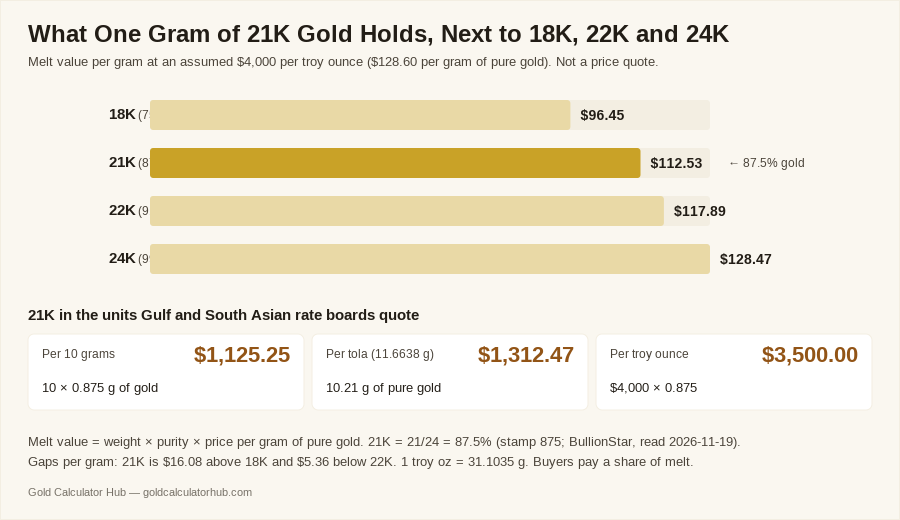
Two gaps in the chart are worth remembering. 21K sits only $5.36 per gram below 22K, so the two are close cousins in value. It sits $16.08 per gram above 18K, which is a large difference once a piece weighs 50 grams or more. If you think in tolas, the gold price per tola calculator converts any karat directly.
Worked example: four 21K bangles weighing 62 grams
Take an illustrative set of four solid 21K bangles with a combined weight of 62 grams on an accurate gram scale, no stones and no clasps. Here is the full path from scale to offer at the assumed $4,000 per troy ounce.
- Pure gold content: 62 g × 0.875 = 54.25 g of pure gold.
- Melt value: 54.25 g × $128.60 = $6,976.55.
- Per bangle: about 15.5 g each, or roughly $1,744 of gold per bangle.
Melt value is the ceiling, not the offer. Every buyer takes a margin for testing, refining and profit. Using the site's typical payout ranges (editorial estimates, not measured data), the same 62 grams would bring:
| Buyer type | Typical share of melt | Offer on $6,976.55 of gold |
|---|---|---|
| Online refiner | 70–90% | $4,883.59 – $6,278.90 |
| Local coin or bullion dealer | 65–85% | $4,534.76 – $5,930.07 |
| Jewelry store | 50–75% | $3,488.28 – $5,232.41 |
| Pawn shop | 40–60% | $2,790.62 – $4,185.93 |
| Mail-in TV service | 20–50% | $1,395.31 – $3,488.28 |
The spread between the best and worst outcome here is close to $4,900, on the same metal. That is the strongest argument for getting at least two written quotes before selling.
There is a second, quieter way to lose money on 21K, and it has nothing to do with the buyer's percentage. If a counter has no 21K row on its price board and someone quotes the bangles at the 18K rate, the melt figure drops to 62 × 0.75 × $128.60 = $5,979.90. That is $996.65 less before any margin is applied, because 18K holds about 14.3% less gold than 21K (0.75 ÷ 0.875 = 0.857). Ask the buyer to write down which karat and which per-gram rate they used.
Mixed lots need separate weighing. Suppose one of the four bangles turns out to be 18K, at 15.5 g. Priced correctly, the three 21K bangles (46.5 g) hold $5,232.41 of gold and the 18K one holds 15.5 × 0.75 × $128.60 = $1,494.98, for $6,727.39 in total. Weigh each karat on its own, so the 18K piece is not used as an excuse to price the whole set at the lower rate, and so a 21K piece is not quietly averaged down.
Hollow bangles change the weight, not the method. A hollow bangle can look as heavy as a solid one and weigh a fraction as much, so always price from the scale, never from the size.
Why a Gulf shop price and a US scrap offer never match
Many owners of 21K jewelry compare a US offer with what they paid in the souk and conclude they are being cheated. Usually the two numbers were never measuring the same thing.
How a Gulf jewelry shop builds a retail price. The shop starts with that day's posted gold rate per gram for the karat, quoted in local currency (riyals, dirhams or Egyptian pounds). It then adds a making charge for the craftsmanship, either per gram or per piece, which varies with the design and the shop. The receipt therefore shows weight × (gold rate + making charge), not weight × gold rate.
How a US scrap buyer builds an offer. A US buyer starts from the international spot price in dollars per troy ounce, converts it to a per-gram price for pure gold, multiplies by weight and purity, and then pays a percentage of that melt value. The making charge plays no part. Neither does the design, unless the buyer intends to resell the piece as jewelry rather than refine it.
Three practical consequences follow:
- The making charge is a sunk cost. It paid for the work, and almost no buyer refunds it. A fair comparison is the original gold rate per gram against today's melt value, not the receipt total against today's offer.
- Currency moves too. A rate paid in riyals or Egyptian pounds has to be converted at today's exchange rate before it means anything in dollars.
- Selling back in the souk is a different deal. Buy-back and exchange terms are set shop by shop, so no single percentage applies.
The neutral yardstick on both sides is the melt value. Work it out first with the gold calculator, then judge any offer, in any country, as a share of that number.
Will an American buyer recognize and test 21K?
Usually yes, though 21K is less familiar at a US counter than 10K or 14K, so it pays to make the karat explicit rather than let the buyer assume.
Marks to look for. 21K is stamped 875 (BullionStar) and may also read 21K or 21KT, often on the inside of a bangle or on a small tag near a clasp. The millesimal system is explained in the gold purity chart. In the US, how karat gold may be marked and described is governed by the FTC's Jewelry Guides, 16 CFR Part 23. A foreign stamp is not a guarantee, but it is the buyer's starting point for testing.
How buyers check it. Two common methods:
- Acid testing. The tester scratches the piece on a stone and applies acids calibrated to known karats.
- XRF analysis. An X-ray fluorescence analyzer reads the surface composition and reports the gold percentage directly. It is fast, does not mark the piece, and is the better tool for an in-between karat like 21K. Because it reads the surface, a buyer may still file or acid-test a hidden spot on anything suspicious.
What to do as the seller.
- Tell the buyer the piece is 21K and ask them to confirm it with their test in front of you.
- Ask for the per-gram rate they are paying for 21K specifically, not a single number for the whole lot.
- If the test reads lower than the stamp, ask what it read. A piece stamped 875 that tests as 18K is either a mismarked alloy or plated, and both deserve a second opinion before you accept.
- Separate anything unmarked. Unstamped pieces are priced at whatever the test shows, and they can drag down an offer on the whole lot if weighed together.
Before you sell: a five-step check for 21K pieces
The extra karats in 21K are real money, so they are worth protecting at the counter. A buyer who quotes the right 21K gold price per gram but the wrong karat still underpays. Compared with neighbouring karats at the assumed price:
| Comparison | Gap per gram | Gap on 62 grams |
|---|---|---|
| 21K vs 18K | $16.08 | $996.96 |
| 22K vs 21K | $5.36 | $332.32 |
| 24K vs 21K | $15.94 | $988.28 |
The per-gram gaps are the differences between the rounded per-gram values in the first table, so the 62-gram column can differ by a few cents from a calculation that skips the rounding (the bangle example's exact 18K shortfall is $996.65). If you also own 22K pieces, the 22K gold calculator prices them the same way.
Then run this check before accepting any offer:
- Weigh at home in grams. Use a scale that reads to 0.1 g or better, and write the weight down before you leave.
- Calculate the melt value. Weight × 0.875 × the live price of a gram of pure gold. That number is your ceiling.
- Set a floor. Decide in advance what share of melt you will accept. Typical ranges put refiners at 70–90% and dealers at 65–85%; an offer well below that deserves a walk-out.
- Get two written quotes. Each should state the weight, the karat they tested and the rate per gram. Quotes that hide the per-gram rate are hard to compare and easy to shade.
- Keep sentimental or decorative pieces aside. A hand-worked bangle may be worth more sold as jewelry than as scrap. Melt value is a floor for those, not the target.
The point of the exercise is simple: once you know that a gram of 21K is worth 87.5% of a gram of pure gold, every offer becomes a percentage you can judge, not a number you have to trust.
Frequently Asked Questions
Is 21K gold solid gold or plated?
Genuine 21K is a solid alloy that is 87.5% gold all the way through, with the remaining 12.5% made up of other metals such as copper or silver. A stamp of 875 or 21K describes that solid alloy. Plated jewelry has only a thin gold surface over a base metal and is marked differently in markets that follow marking rules. If a stamped piece tests far below 21K, treat it as possibly plated or mismarked and get a second test, ideally by XRF, before selling.

Written by Sukie Gao
Sukie Gao holds a master's degree from a business school, where she picked up the markets-and-pricing toolkit she now applies to the consumer gold trade. She created Gold Calculator Hub to give people an independent, data-driven way to find out what their gold is really worth.
Published November 22, 2026