Gold Silver Ratio Calculator: Ounces of Silver per Ounce of Gold
 By Sukie Gao · November 14, 2026
Quick answer
The ratio is the gold price per troy ounce divided by the silver price per troy ounce, which gives the number of ounces of silver that buy one ounce of gold. With gold assumed at $4,000 and silver at $50, it is 80:1, so 100 ounces of silver converts to 1.25 ounces of gold at spot. A gold silver ratio calculator gives that spot figure. A real dealer swap returns less, because you pay a spread once selling the silver and again buying the gold.
Gold-to-silver ratio calculator
Live gold price: $3,887.60/ozt · updates every 10 min
Gold-to-silver ratio
79.9 : 1
ounces of silver per ounce of gold
Gold you could buy
0.125 ozt
3.9 g, before dealer premiums
Value either side
$486.50
spot value, no premiums
Prices start at today's spot and can be edited. Real swaps cost more: dealers sell above spot and buy below it on both legs.
A gold silver ratio calculator is built around one question: how many ounces of silver it takes to buy one ounce of gold. At an assumed $4,000 per troy ounce for gold and $50 for silver, the ratio is 80:1, so about 80 troy ounces of silver buy 1 troy ounce of gold, and 100 ounces of silver would buy 1.25 ounces of gold before any dealer takes a cut.
This page assumes gold at $4,072 and silver at $52.07 per troy ounce (a ratio of about 78.2:1), and the tool above uses live prices, so its figure will differ slightly from the round numbers on this page. Type an amount of silver and it returns the gold it is worth, or switch the direction to see how much silver an ounce of gold would buy. You can also overwrite either price to test a scenario.
Below are the arithmetic, a swap table, the costs that shrink a real swap, and why 14K jewelry trades at about 50 grams of sterling per gram, not 80. This is math, not a recommendation to buy or sell either metal.
What the gold-to-silver ratio measures, and what it does not
The gold-to-silver ratio is the price of one troy ounce of gold divided by the price of one troy ounce of silver. It has no unit, because the ounces cancel out: 80:1 means one ounce of gold costs the same as 80 ounces of silver, and equally that one gram of gold costs the same as 80 grams of silver. That second reading answers the question people often type as "silver to gold weight ratio". The ratio is a ratio of value, so at 80:1 the silver that matches a piece of gold in value weighs 80 times as much.
Both prices behind the ratio come from the wholesale market for fine metal. In London, the LBMA Gold Price is set twice each business day in US dollars per fine troy ounce, and the LBMA Silver Price once a day, at noon London time, in US dollars per fine ounce (LBMA OTC guide, read November 2026). Between auctions, dealers quote a moving spot price, so any ratio is only as current as its two prices; the calculator above recomputes it from live quotes.
Three things the ratio does not tell you:
- How much your items are worth. It compares fine metal to fine metal. A sterling bracelet or a 14K ring holds less than its full weight in precious metal, so the ratio between two pieces of jewelry is different (see the scrap section below).
- Whether either metal is cheap. A high ratio can come from gold rising, silver falling, or both moving at different speeds.
- What a dealer will pay you. Spot prices are wholesale. Every retail trade happens at a spread above or below spot, on each metal separately.
The unit matters too. The ratio uses troy ounces on both sides, 31.1034768 grams each (NIST Guide to the SI, Appendix B.9 lists the troy ounce as 3.110 348 × 10⁻² kg). If you weigh silver on a kitchen scale in ordinary ounces, convert first; the troy ounce vs ounce guide shows why the 9.7% gap between the two units matters.
The arithmetic: 100 ounces of silver at four different ratios
The calculation behind the tool is two divisions. Here it is with the page's assumed prices, as an illustrative worked example rather than a quote.
Illustrative example: converting 100 troy ounces of silver into gold at 80:1
- Ratio: $4,000 ÷ $50 = 80.
- Value of the silver at spot: 100 oz × $50 = $5,000.
- Gold that $5,000 buys at spot: $5,000 ÷ $4,000 = 1.25 troy ounces.
- The shortcut: 100 oz ÷ 80 = 1.25 oz. You only need the ratio, not the dollar prices, to convert one metal into the other.
In grams, 1.25 troy ounces is 38.88 g of fine gold, and the 100 ounces of silver weigh 3,110.35 g. The reverse direction works the same way: one ounce of gold × 80 = 80 ounces of silver, or 2,488.28 g. So the direct answer to "how many ounces of silver to buy an ounce of gold" is simply the ratio itself, whatever it is on the day you ask.
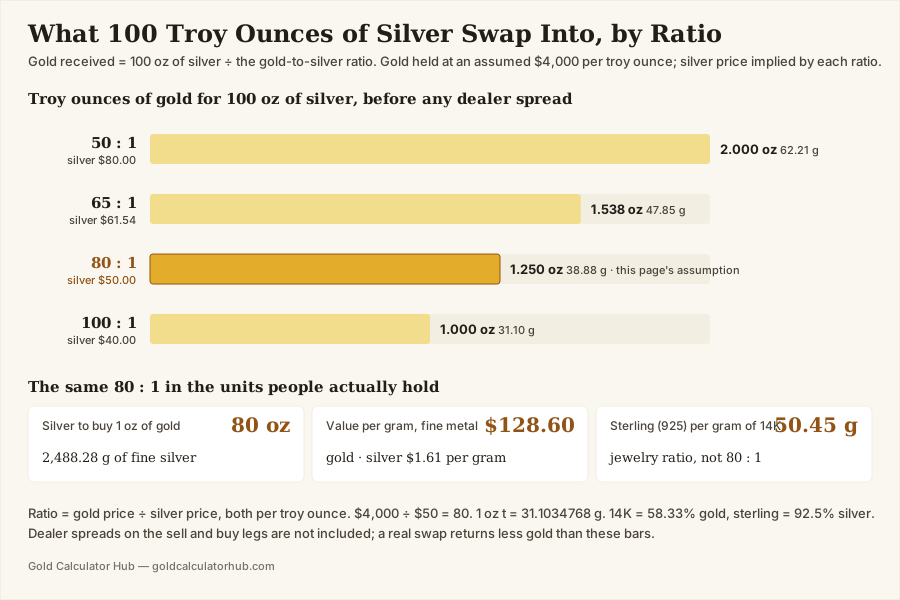
The chart shows how much the answer moves. Gold is held at $4,000 in every bar, so a lower ratio means silver is dearer, and the same 100 ounces buys more gold.
The same numbers as a table you can read across:
| Ratio | Silver price at gold $4,000 | Silver to buy 1 oz gold | Gold for 100 oz silver | Gold in grams | Spot value of 100 oz silver |
|---|---|---|---|---|---|
| 50:1 | $80.00 | 50 oz | 2.000 oz | 62.21 g | $8,000.00 |
| 65:1 | $61.54 | 65 oz | 1.538 oz | 47.85 g | $6,153.85 |
| 80:1 | $50.00 | 80 oz | 1.250 oz | 38.88 g | $5,000.00 |
| 100:1 | $40.00 | 100 oz | 1.000 oz | 31.10 g | $4,000.00 |
Moving from 80:1 to 100:1 cuts the gold that 100 ounces of silver buys by 20%, from 1.25 to 1.00 ounce. Moving from 80:1 to 50:1 raises it by 60%, to 2.00 ounces. Both results follow from dividing by the ratio. For the gold side in dollars, the gold spot price calculator turns any number of ounces into a value at the live price.
Why the ratio moves, and the one time it was fixed by law
The ratio is a quotient, so it changes whenever gold and silver do not move by the same percentage. If gold rises 10% while silver is flat, an 80:1 ratio becomes 88:1. If silver rises 10% while gold is flat, it falls to 72.7:1. If both rise 10%, it does not move at all, even though both metals are dearer. That is the main reason to read the ratio next to the two prices, never instead of them; the gold price calculator shows the live gold side.
The two metals are not bought for exactly the same reasons, which is one reason they do not always move together. The Silver Institute's supply and demand summary lists silver's industrial uses (electronics and electrical, photovoltaics, automotive and grid infrastructure) alongside jewelry, silverware, photography and physical investment, and reports that industrial demand had another record year in 2024 while total demand fell 3% to 1.16 billion ounces (Silver Institute, read November 2026). Demand tied to manufacturing can respond to the economy in ways that demand for bars and coins does not, so a shift in factory orders can move silver without moving gold, and the ratio changes as a result.
None of this lets you predict the next move. It explains why the ratio wanders instead of staying fixed.
It was once fixed by law. The US Coinage Act of 2 April 1792 set "the proportional value of gold to silver in all coins" at "fifteen to one, according to quantity in weight, of pure gold or pure silver" (Section 11, reproduced by the World Gold Council, read November 2026). That was a legal rate for coinage, not a market price, and markets have long since stopped respecting it. It is useful mainly as a reminder that any "normal" ratio is a choice someone makes, not a constant of nature.
Dealer spreads: why a real swap returns less gold than the formula
The formula assumes you can sell silver and buy gold at the same spot prices. Retail trades never work that way. A dealer buys from you below spot and sells to you above it, and in a swap you pay that spread twice: once when the silver is sold and again when the gold is bought.
Illustrative example: the same 100-ounce swap with a spread on each leg. The 3% figures are made up for the arithmetic, not a quote from any dealer; spreads vary by product, quantity and shop.
- Sell 100 oz of silver at 3% under $50: $48.50 × 100 = $4,850.
- Buy gold at 3% over $4,000: $4,120 per ounce.
- Gold received: $4,850 ÷ $4,120 = 1.1772 oz, not 1.25.
- The effective ratio you traded at: $4,120 ÷ $48.50 = 84.95:1, not 80:1.
The two small percentages compound into a loss of 0.0728 oz, or 5.8% of the gold the formula promised. The same logic applies to any swap in the other direction. Before treating a ratio quote as the price of a trade, ask for the actual buy price of your silver and the actual sell price of the gold product you want, and divide one by the other. That number is your real ratio.
A few other costs can widen the gap further:
- Product premiums. Small bars and popular coins usually sell further above spot than large bars, on both metals.
- Condition and form. Scrap silver, cutlery and jewelry are bought at a refining value, not as bullion; see how much below spot to sell gold for how payouts are set on the gold side.
- Shipping, insurance and storage. Silver is bulky. At 80:1, matching one ounce of gold takes about 2.5 kg of silver, which costs more to ship and store than the gold does.
- Taxes. Sales tax on bullion and the treatment of gains depend on where you live.
Scrap jewelry owners: 14K against sterling is about 50:1, not 80:1
If you are sorting an inherited drawer rather than trading bars, the 80:1 ratio will overstate what your silver buys. Jewelry and flatware are alloys, and the two common standards are far apart. Under the FTC's jewelry guides, items called "sterling" should be at least 925/1,000 pure silver, and "coin silver" at least 900/1,000 (16 CFR § 23.5, via Cornell LII, read November 2026). Gold jewelry runs from 41.67% pure (10K) to 75% (18K).
At the page's assumed prices, a gram of fine gold is worth $128.60 and a gram of fine silver $1.61 ($4,000 and $50 each divided by 31.1034768). Applying the purities:
- Sterling silver: $1.61 × 0.925 = $1.49 per gram.
- 10K gold: $53.58 per gram, equal to 36.04 g of sterling.
- 14K gold: $75.02 per gram, equal to 50.45 g of sterling.
- 18K gold: $96.45 per gram, equal to 64.86 g of sterling.
So for jewelry, the useful ratio is the metal ratio multiplied by the ratio of the purities. For 14K against sterling that is 80 × (0.5833 ÷ 0.925) = 50.45, and it does not depend on the dollar prices at all, only on the 80:1 ratio. A 10-gram 14K chain is worth about the same as half a kilogram (504.5 g) of sterling at these prices.
That is also why it pays to weigh and price the two metals separately rather than as one lot. The gold and silver calculator handles both metals by purity and weight, and for the gold pieces alone the main gold calculator returns melt value by karat at the live price.
Limits of the ratio as a signal
Because a gold silver ratio calculator gives a single clean number, it is easy to read more into it than it holds. Some limits worth keeping in mind:
- It is relative, not absolute. A ratio of 80 is the same at $4,000/$50 and at $2,000/$25. It says nothing about whether either price is high.
- There is no official "fair" level. The 15:1 in the 1792 Act was a legal rate for coinage. Any long-run average you see quoted depends on the start date, the data source and whether it is a mean or a median, so ask for the series before trusting the figure. This page does not cite one because the authoritative sources reviewed do not publish a single agreed number.
- It ignores what you actually hold. Scrap, jewelry, coins and bars each trade at their own spreads, so a portfolio of real items has a different effective ratio from spot.
- It assumes free conversion. Every swap has two spreads, possible taxes and shipping, so a "signal" has to be large enough to survive about 5–6% of friction in the illustrative example above before the arithmetic even breaks even.
As a measuring tool the ratio is genuinely useful: it converts one metal into the other in a single division and lets you check a dealer's swap quote. As a forecast, it is only one number. For anything beyond the arithmetic, a licensed financial professional is the right person to ask.
Frequently Asked Questions
How many ounces of silver does it take to buy an ounce of gold?
Exactly the gold-to-silver ratio. At an assumed $4,000 gold and $50 silver the ratio is 80:1, so 80 troy ounces of silver have the same spot value as 1 troy ounce of gold. At the assumed $4,072 and $52.07 it is about 78.2 ounces. Dealer spreads mean a real trade needs somewhat more silver than the spot figure.
What is the silver to gold weight ratio?
In value terms it is the same number as the price ratio, because both metals are priced per troy ounce. At 80:1, 80 grams of fine silver are worth 1 gram of fine gold, and 1 kilogram of silver (32.15 troy ounces) is worth 0.402 ounces of gold. For jewelry the purities change it: a gram of 14K gold is worth about 50.45 grams of sterling at 80:1.
Gold vs silver: which is worth more per gram?
Gold, by the ratio. At $4,000 and $50 per troy ounce, fine gold is $128.60 a gram and fine silver $1.61 a gram. Sterling (92.5% silver) works out to $1.49 a gram, and 14K gold to $75.02 a gram. Which metal suits a buyer is a separate question the ratio does not answer.
Does the calculator use live prices?
Yes. The tool loads current gold and silver spot prices per troy ounce and recomputes the ratio from them, so it will show a slightly different figure from the round $4,000 and $50 used in this page's examples. You can overwrite either price to test what a swap would look like at a different ratio.
Why did my dealer's swap quote come out at a higher ratio than spot?
Because a swap has two spreads. The dealer buys your silver below spot and sells you gold above it. In an illustrative case with 3% on each leg, an 80:1 spot ratio becomes 84.95:1, and 100 ounces of silver buy 1.1772 ounces of gold instead of 1.25. Divide the gold's sell price by your silver's buy price to see the ratio you are actually trading at.

Written by Sukie Gao
Sukie Gao holds a master's degree from a business school, where she picked up the markets-and-pricing toolkit she now applies to the consumer gold trade. She created Gold Calculator Hub to give people an independent, data-driven way to find out what their gold is really worth.
Published November 14, 2026