Gold Karat Conversion Calculator: Change 24K, 22K, 18K or 14K Into Another Karat
 By Sukie Gao · Updated November 14, 2026
Quick answer
Changing karat changes the alloy around the gold, never the gold itself. A gold karat conversion calculator works out the alloy to add as weight × (old purity − new purity) ÷ new purity: 10 g of 24K plus 0.90 g of alloy gives 10.90 g of 22K. Raising karat means adding .999 gold.
Gold karat conversion calculator
Live gold price: $3,887.60/ozt · updates every 10 min
Alloy metal to add
0.898 g
silver/copper/zinc mix, no gold
Finished weight
10.898 g
22K gold
Pure gold content
9.99 g
worth $1,248.64 at spot
Mass-balance arithmetic using the site's karat purities (24K = .999). It ignores melting loss, which jewelers usually put at a fraction of a percent, and it cannot tell you the alloy recipe for a colour.
A gold karat conversion calculator tells you how much metal to add to turn a weight of one karat into another. Example: 10 g of 24K becomes 10.90 g of 22K once you mix in 0.90 g of alloy containing no gold. The finished piece still holds the same 9.99 g of pure gold, worth $1,284.74 at an assumed $4,000 per troy ounce.
The calculator above runs the same arithmetic at the live gold price. Enter a weight, pick the karat you have and the karat you want, and it returns three numbers: the metal to add, the finished weight, and the pure gold inside with its spot value. Going down in karat adds alloy only. Going up adds .999 fine gold, which you have to buy, and the tool prices it.
This page covers the formulas behind both directions, a lowering table and a raising table for 10 g lots, a price comparison across karats (what 10 g of 24K is worth once it is 22K), the federal marking tolerance a converted piece must meet, and why none of this makes your gold worth more.
Converting karat moves the alloy, never the gold
A karat is one twenty-fourth part. 22K gold is 22 parts gold in 24, 18K is 18 in 24, and so on down. NIST's precious-metals conversion sheet puts it plainly: an item marked 24 k is 99.9% gold, 18 k is 75% and 12 k is 50%. This site uses the same scale: 24K .999, 22K .9167, 21K .875, 18K .75, 14K .5833, 10K .4167 and 9K .375. If you only need to turn a percentage into a karat name, the reverse lookup in the gold purity chart does that. This page answers a different question: what happens to the weight when you change the karat of real metal?
A gold karat conversion calculator answers it with a mass balance. Melting does not create or destroy gold, so the grams of pure gold before and after are equal. Only the other metal changes:
- Lowering karat (24K to 22K, 14K to 10K). You add alloy with no gold in it. The finished weight goes up and the share of gold goes down, but the gold grams stay put. Formula: alloy to add = weight × (from purity − to purity) ÷ to purity.
- Raising karat (18K to 22K, 10K to 14K). You cannot remove alloy by mixing, so you dilute it with fine gold instead. The calculator assumes the added gold is .999. Formula: fine gold to add = weight × (to purity − from purity) ÷ (0.999 − to purity).
Both formulas come from the same idea: total gold divided by total weight must equal the target purity. Raising to 24K is the one case that has no answer. Mixing anything into .999 gold lowers it, so taking alloyed gold back to 24K needs refining, which chemically strips out the other metals. The calculator says "Not possible" for that reason.
How do you convert 24 karat gold to 22 karat?
Add alloy equal to about 9% of the 24K weight. Here is the full working for an illustrative 10 g of 24K gold, which is the conversion people search for most:
- Pure gold in the starting metal: 10 g × 0.999 = 9.99 g.
- Weight that 9.99 g must fill at 22K: 9.99 ÷ 0.9167 = 10.898 g.
- Alloy to add: 10.898 − 10 = 0.898 g, or the formula directly: 10 × (0.999 − 0.9167) ÷ 0.9167 = 0.898 g.
- Check: 9.99 g gold ÷ 10.898 g total = 0.9167, which is 22K.
So 10 g of 24K becomes roughly 10.90 g of 22K. The same proportion works at any weight: 50 g of 24K needs 4.49 g of alloy and finishes at 54.49 g; 100 g needs 8.98 g and finishes at 108.98 g. Use the calculator above for your exact weight.
How precise does this need to be? Not very, for a ring, but the margin is small. Under the federal tolerance discussed further down, a solder-free 22K piece can sit no more than 3 parts per thousand below its stamp, which is about 0.9137. With 9.99 g of gold, that floor is reached at a total weight of 10.934 g. Overshoot the alloy by just 36 milligrams and the metal no longer honestly carries a 22K mark. That is why the calculator shows three decimal places. The 22K gold calculator values the finished metal once you know its weight.
Lowering karat: alloy needed for every common step
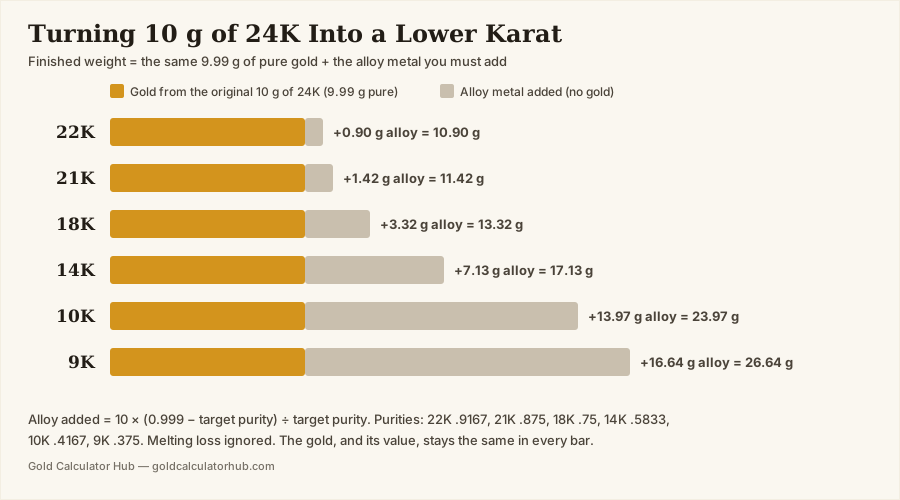
The further down you go, the faster the alloy grows: 24K to 22K adds under a gram per 10 g, while 10K more than doubles the weight, because its 41.67% gold share spreads the 9.99 g across almost 24 g of metal.
The table covers the common downward steps, all for a starting weight of 10 g. The "gold inside" column never changes between the before and after state; that is the whole point.
| Convert 10 g of | To | Alloy to add | Finished weight | Pure gold inside | Gold value at $4,000/oz |
|---|---|---|---|---|---|
| 24K | 22K | 0.898 g | 10.898 g | 9.990 g | $1,284.74 |
| 24K | 21K | 1.417 g | 11.417 g | 9.990 g | $1,284.74 |
| 24K | 18K | 3.320 g | 13.320 g | 9.990 g | $1,284.74 |
| 24K | 14K | 7.127 g | 17.127 g | 9.990 g | $1,284.74 |
| 24K | 10K | 13.974 g | 23.974 g | 9.990 g | $1,284.74 |
| 22K | 21K | 0.477 g | 10.477 g | 9.167 g | $1,178.90 |
| 22K | 18K | 2.223 g | 12.223 g | 9.167 g | $1,178.90 |
| 18K | 14K | 2.858 g | 12.858 g | 7.500 g | $964.52 |
| 14K | 10K | 3.998 g | 13.998 g | 5.833 g | $750.14 |
The 14K to 10K row answers a common search directly: 10 g of 14K gold plus about 4.00 g of alloy gives 14.00 g of 10K, and the gold in it is still worth $750.14 at the assumed price. The calculator does not choose the alloy recipe. Which metals go into that added portion decides the colour and working properties of the result, and that is the jeweler's call, not the arithmetic's.
Can you raise the karat of gold?
Yes, by adding fine gold, but it costs far more than people expect, because every gram of alloy already in the piece has to be diluted. The worst case is a big jump from a low karat. Converting 18 carat gold to 22 carat, a frequent search, needs twice the starting weight in .999 gold.
Again for a 10 g starting lot, with the added gold priced at an assumed $4,000 per troy ounce ($128.60 per gram of pure gold):
| Convert 10 g of | To | .999 gold to add | Finished weight | Cost of added gold | Gold value after |
|---|---|---|---|---|---|
| 9K | 10K | 0.716 g | 10.716 g | $92.00 | $574.27 |
| 10K | 14K | 4.008 g | 14.008 g | $514.89 | $1,050.78 |
| 14K | 18K | 6.695 g | 16.695 g | $860.11 | $1,610.25 |
| 18K | 21K | 10.081 g | 20.081 g | $1,295.10 | $2,259.63 |
| 21K | 22K | 5.067 g | 15.067 g | $650.96 | $1,776.23 |
| 18K | 22K | 20.255 g | 30.255 g | $2,602.27 | $3,566.79 |
| 14K | 22K | 40.510 g | 50.510 g | $5,204.54 | $5,954.68 |
Read the 18K to 22K row as a worked example. 10 g of 18K holds 7.5 g of gold and 2.5 g of alloy. At 22K, alloy may be only 8.33% of the weight, so those 2.5 g of alloy require a total of about 30.26 g of metal. You add 20.255 g of fine gold, spend about $2,602 on it, and end with 30.255 g of 22K. The gold value rises from $964.52 to $3,566.79, which is exactly the starting value plus the gold you paid for.
The raising formula divides by 0.999 minus the target purity, only 0.0823 for 22K, which is why high targets need so much gold. People who want a lot of 22K from old 14K or 18K jewelry usually sell the scrap for its gold content and buy 22K, rather than alloy it up.
Comparing prices across karats: what 10 g of 24K is worth as 22K
The price of a gram of any karat is the price of a gram of pure gold times that karat's purity. At an assumed $4,000 per troy ounce, a gram of pure gold is $4,000 ÷ 31.1034768 = $128.60, using the troy-ounce factor NIST publishes. From there:
- 24K (.999): $128.47 per gram
- 22K (.9167): $117.89 per gram
- 21K (.875): $112.53 per gram
- 18K (.75): $96.45 per gram
- 14K (.5833): $75.01 per gram
- 10K (.4167): $53.59 per gram
So 10 g of 24K gold is worth $1,284.74 and 10 g of 22K is worth $1,178.90. That gap, $105.84, is what people mean when they ask for a 24 carat to 22 carat price calculator. The ratio is 0.9167 ÷ 0.999 = 0.9176, so a quick way to turn a 24K price per gram into a 22K price is to multiply by 0.9176. If the 24K price you are quoting from is for gold treated as 1.000 fine, multiply by 0.9167 instead. The 916 gold price calculator works from 22K rate cards directly.
Now the conversion question. Take the 10 g of 24K, turn it into 10.898 g of 22K, and price it at the 22K rate: 10.898 × $117.89 = $1,284.74. Same number. The 22K metal is cheaper per gram, but there is more of it, and the two effects cancel exactly. The 24K gold calculator and the gold price calculator let you check any weight at today's price.
Why a conversion never makes your gold worth more
Every buyer of scrap or bullion pays for the pure gold content and nothing else. NIST's guidance for precious-metal sales notes that prices offered by buyers reflect reductions based on an item's karat content and deductions for other factors. The alloy you add to lower a karat is worth essentially nothing at the counter, and the fine gold you add to raise one is worth exactly what you paid for it, before the buyer's margin.
That gives three practical rules:
- Lowering karat adds weight, not value. 10 g of 24K and 23.97 g of 10K made from it are both worth $1,284.74 in gold.
- Raising karat costs at least the gold you add. Plus whatever the jeweler charges to melt, alloy and assay. The new value is the old value plus the purchased gold, never more.
- Each melt costs something. Fees and any metal lost in handling come out of your side of the ledger. The calculator ignores melting loss, so treat its figures as the best case.
Convert for wearability or to match a set, not for profit. If the goal is cash, sell the metal as it is; the buyer payout guide shows what share of melt value each kind of buyer typically offers.
What a converted piece has to meet before it is stamped
A converted piece sold in the US must actually contain the karat it is marked with. The FTC's Jewelry Guides, at 16 CFR § 23.3, call it deceptive to misrepresent the karat fineness of gold or gold alloy in a product. They also say the word "Gold" on its own should describe only fine (24 karat) gold, and that alloyed gold should carry a correct karat designation such as "14 Karat Gold" or "14 Kt."
The same section says markings are subject to the tolerances of the National Stamping Act, and its footnote states them: gold articles or parts without solder may fall 3 parts per thousand below the marked fineness, and parts with solder may fall 7 parts per thousand below. In karat terms that is a very small margin:
- 22K (916.7 fine) without solder must assay at least about 913.7.
- 14K (583.3 fine) without solder must assay at least about 580.3.
- With solder the floors are about 909.7 and 576.3.
So if converted metal is going to carry a stamp, it makes sense to aim slightly above the target and to have the result assayed, rather than to land exactly on the number. For a full table of purities and fineness marks, see the gold purity chart.
Who should do the melting, and what to ask for
A jeweler, a casting house or a refiner, not a kitchen torch. Converting karat means melting both metals completely, mixing them and forming the result, which takes equipment and experience a home setup does not have. The calculator gives you the target numbers so you can have an informed conversation; it does not replace the bench work.
Before handing metal over, an illustrative checklist:
- Weigh it together. Agree the starting weight on their scale, in grams or pennyweights, and write it down.
- Agree the target karat and finished weight. Bring the figures from the gold karat conversion calculator above; the arithmetic is standard, so any shop can check them.
- Ask who supplies the alloy or fine gold, and at what price. For a raise, the fine gold is the main cost; ask for it to be quoted against the live spot price.
- Ask what loss and fees they apply. Melting and handling are not free, and the calculator leaves them out.
- Ask for an assay or test of the result if you plan to stamp or sell it as a specific karat.
If you started with unmarked metal, test it first. A conversion built on a wrong starting karat is wrong at every step. The gold calculator on the homepage values any weight and karat at the live price, which is a useful sanity check on both the metal you hand in and the metal you get back.
Frequently Asked Questions
How much alloy turns 14K gold into 10K?
About 0.40 g of alloy for every gram of 14K. For 10 g of 14K, add 3.998 g of alloy containing no gold to get 13.998 g of 10K: 10 × (0.5833 − 0.4167) ÷ 0.4167. The 5.833 g of pure gold inside does not change, so its value at $4,000 per troy ounce stays $750.14 either way.
How much 24K gold do I need to convert 18 carat gold to 22 carat?
Just over twice the 18K weight. For 10 g of 18K, add 20.255 g of .999 gold to reach 30.255 g of 22K. At an assumed $4,000 per troy ounce the added gold costs about $2,602. The formula is weight × (0.9167 − 0.75) ÷ (0.999 − 0.9167).
Can 22K jewelry be turned back into 24K?
Not by adding anything. Mixing any metal into gold lowers its purity, so the only way back to .999 is refining, which chemically separates the gold from the other metals. That is industrial work done by a refiner, and the usual route is to sell the 22K for its gold content and buy 24K.

Written by Sukie Gao
Sukie Gao holds a master's degree from a business school, where she picked up the markets-and-pricing toolkit she now applies to the consumer gold trade. She created Gold Calculator Hub to give people an independent, data-driven way to find out what their gold is really worth.
Published November 12, 2026 · Updated November 14, 2026