Gold Price per Kilo Calculator: What a Kilogram of Gold Is Worth
 By Sukie Gao · Updated November 14, 2026
Quick answer
One kilogram equals 32.1507 troy ounces, so multiply the spot price per troy ounce by 32.1507. At an assumed $4,450 per ounce, a kilo of pure gold is worth about $143,071, the bullion figure this gold price per kilo calculator returns. A kilo bar trades within a whisker of spot. A kilo of mixed 14K scrap holds far less gold and sells at scrap percentages.
Gold Price per Kilo Calculator: What a Kilogram of Gold Is Worth
Live gold price: $3,887.60/ozt · Nov 14, 3:21 PM EST · updates every 10 min
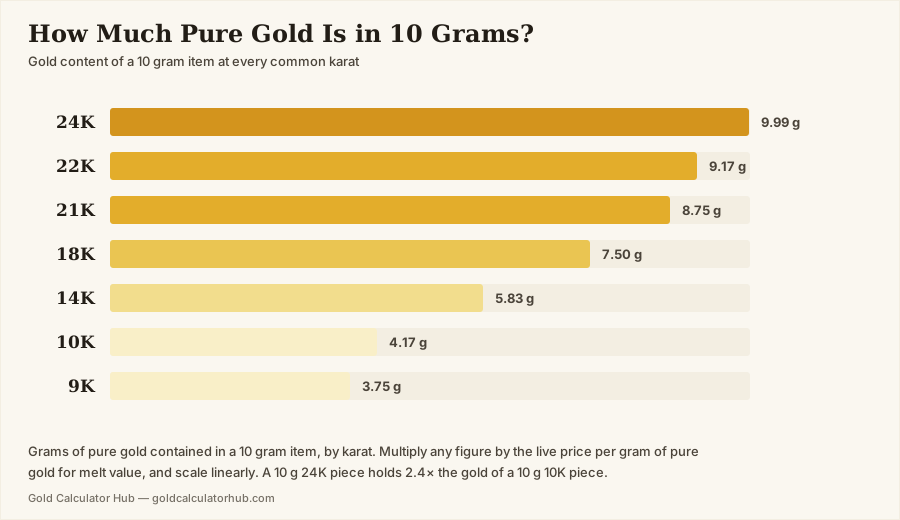
Melt value of 10 g of 14K gold
$729.06
Pure gold content: 5.83 g × $124.99/g
| Where you sell | Typical offer | % of melt |
|---|---|---|
| Online gold refiner | $510.34 – $656.16 | 70–90% |
| Local coin / bullion dealer | $473.89 – $619.70 | 65–85% |
| Jewelry store | $364.53 – $546.80 | 50–75% |
| Pawn shop | $291.62 – $437.44 | 40–60% |
| Mail-in 'cash for gold' TV services | $145.81 – $364.53 | 20–50% |
Ranges reflect typical published buy rates and consumer-test results. We are not a buyer — these numbers exist so you can judge any offer you receive.
A gold price per kilo calculator answers a question that splits into two very different situations. Either you are looking at bullion — a kilo bar, the standard institutional trading unit — or you are looking at a very large quantity of jewelry, in which case the kilogram is just a convenient way to think about a substantial pile.
The arithmetic is identical either way: 1 kilogram = 32.1507 troy ounces, so a kilo of pure gold is worth 32.1507 times the spot price per troy ounce. At $4,450 per troy ounce, that is about $143,071.
The economics are not identical at all, and that is what the rest of this page is about. Kilo bars trade within a whisker of spot because they are the wholesale standard. A kilogram of mixed 14K scrap does not — it contains less gold to begin with, and it sells at scrap percentages. Both are "a kilo of gold" in casual speech; they are several tens of thousands of dollars apart in what you would actually receive.
The conversion, and why 32.15 matters
A kilogram is 1,000 grams. A troy ounce is 31.1035 grams. So:
1 kg = 1000 ÷ 31.1035 = 32.1507 troy ounces
That number is worth memorising if you deal with bullion at all, because every quoted gold price is per troy ounce and every physical kilo bar is specified in kilograms. Converting between them is constant.
The inverse is also useful: 1 troy ounce = 0.0311 kg, and 1 kg = 2.2046 standard pounds — though nobody in the trade prices gold in pounds.
A sanity check that catches errors: a kilo bar is roughly the size of a smartphone but noticeably thicker, and it is startlingly heavy for its dimensions because gold's density is 19.3 g/cm³. A kilo of gold occupies about 51.8 cm³ — a cube roughly 3.7 cm on a side. If something described as a kilo bar looks substantially larger than that, it is not pure gold.
Value per kilo by karat
The pure figure scales directly by purity. At $4,450 per troy ounce ($143.07 per gram):
| Karat | Purity | Pure gold in 1 kg | Value per kg |
|---|---|---|---|
| 24K (999) | 99.9% | 999 g | $142,928 |
| 22K (916) | 91.67% | 917 g | $131,196 |
| 21K (875) | 87.5% | 875 g | $125,187 |
| 18K (750) | 75.0% | 750 g | $107,303 |
| 14K (585) | 58.3% | 583 g | $83,410 |
| 10K (417) | 41.7% | 417 g | $59,661 |
A kilogram of 10K jewelry contains less than half the gold of a kilogram of bullion. That is obvious stated plainly and routinely forgotten when someone describes "a kilo of gold jewelry" as though it were equivalent to a kilo bar.
For scrap purposes, the useful mental model is: a kilo of 14K holds roughly 583 grams of pure gold, which is about 18.7 troy ounces. Everything else follows from that.
Kilo bars: the wholesale standard
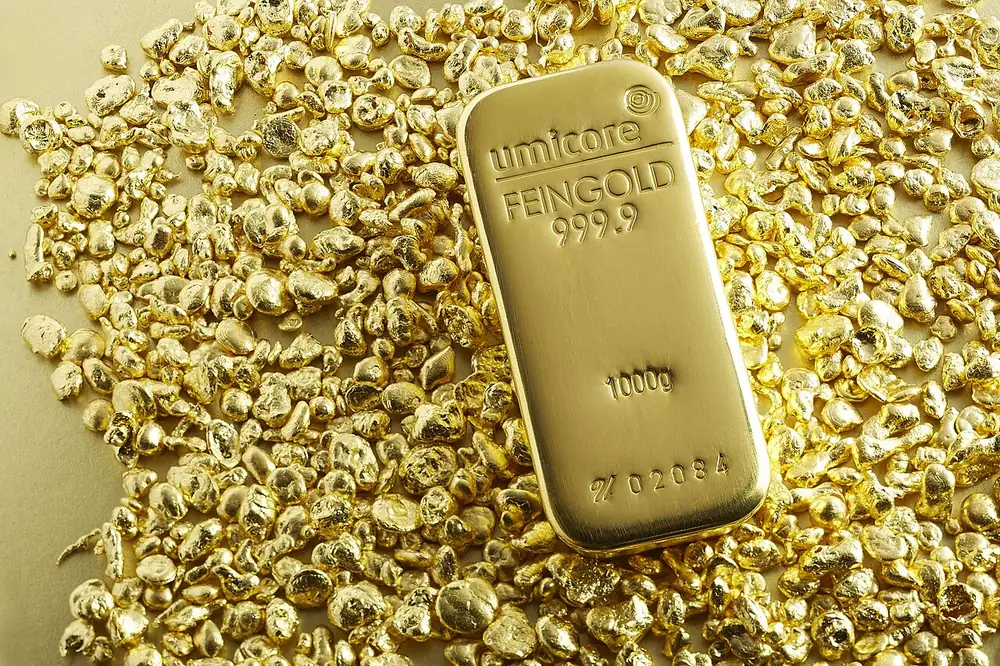
The kilo bar is the workhorse of the physical gold market — the standard unit on the Shanghai Gold Exchange, widely traded in Asia and Europe, and the size most commonly used for allocated storage by individuals with substantial holdings.
Purity is normally 999.9 (four nines), occasionally 999.
Recognised refiners include PAMP Suisse, Valcambi, Argor-Heraeus, Metalor, Perth Mint, Heraeus and Royal Canadian Mint. A bar from a refiner on the LBMA Good Delivery list is far more liquid than one from an unknown maker, because a buyer does not need to assay it.
Premiums are low. Because the kilo bar is the wholesale unit, dealer premiums are typically 1–2% over spot when buying and a similar discount when selling. Compare that with a tenth-ounce coin, where premiums can exceed 10%, and the economics of buying in size become obvious.
Assay cards matter. Modern bars ship sealed in tamper-evident packaging with a matching serial number and assay certificate. Breaking the seal reduces liquidity, because the next buyer loses the chain of assurance. If you own a sealed bar, leave it sealed.
Refiners whose bars are accepted worldwide without assay appear on the LBMA Good Delivery list, which also defines the specification for the ~400 oz institutional bar.
Why a kilo bar does not trade at exactly spot
Spot is a wholesale benchmark for large, unallocated positions. A physical bar in your hands differs in ways that carry cost.
Fabrication. Casting or minting a bar, stamping it, and certifying it costs money per unit.
Assay and provenance. A bar from a recognised refiner in sealed packaging is trusted; one without is tested, and testing costs.
Storage and insurance while the dealer holds inventory.
Dealer margin, which is small on kilo bars precisely because competition at that size is intense and buyers are sophisticated.
The result is a narrow, symmetric band: buy a couple of percent over spot, sell a couple of percent under. Over a full round trip you give up perhaps 3–4%, which for a $143,000 position is $4,000–$6,000. Not nothing, but far less proportionally than any jewelry transaction, and the reason bullion is a reasonable way to hold gold while jewelry is not.
A kilogram of scrap is a different animal
If what you have is a kilo of jewelry rather than a kilo bar, the numbers change in two ways at once.
Less gold to start with. A kilo of mixed 14K holds 583 g of pure gold — $83,410 at $143 per gram — not the $143,000 a kilo bar holds.
Scrap payout percentages apply. At refiner rates of 70–90%, that $83,410 of melt realistically returns $58,000–$75,000.
On the other hand, a kilogram is a large enough lot that you should expect the *upper* end of those percentages. The fixed costs of assay, refining and handling are the reason small lots get poor rates; spread across a kilo they are trivial. A refiner who pays 72% on 30 grams may pay 88% on a kilogram.
So if you genuinely have this quantity, two things follow. Negotiate. At this size you are a meaningful customer and the published small-lot rate is not the rate you should accept. And get a written assay, with the lot weighed and tested in front of you or with photographic documentation, because at these values the difference between 14K and 10K on a mis-sorted batch is tens of thousands of dollars.
Common per-kilo questions, answered directly
"How much is 1000 grams of gold worth?" If pure: 1000 × $143.07 = $143,071. If 14K: 583 g of pure gold, $83,410.
"How much is a kilo of 10K gold worth?" 417 g of pure gold, about $59,661 of melt — expect $42,000–$54,000 from a refiner.
"How much is a kilo of 14K gold worth?" 583 g of pure gold, about $83,410 of melt.
"How much is 2.5 kilos of gold worth?" If pure: 2.5 × $143,071 = $357,678.
"How much is 28 kg of gold worth?" If pure: 28 × $143,071 = $4,005,988. At this scale you are past consumer channels entirely and into LBMA Good Delivery bars, which weigh roughly 400 troy ounces (12.4 kg) each.
"How much is 500 kg of 24K gold bars worth?" Around $71.5 million at $4,450 per troy ounce — roughly 40 Good Delivery bars. A quantity that exists only in institutional and central bank contexts, and one where any private offer should be treated with extreme scepticism.
A note on very large quantities
Queries about tonnes and hundreds of kilos of gold turn up constantly, and it is worth being direct about what that market looks like.
Gold above the kilo-bar level moves in London Good Delivery bars of roughly 400 troy ounces (about 12.44 kg), to a specification set by the LBMA. Those bars trade between accredited institutions with continuous chain of custody, and their value derives substantially from that chain. A Good Delivery bar that leaves the vault system loses its status and must be reassayed.
Which means: offers of large quantities of gold outside that system are, essentially without exception, fraudulent. The advance-fee fraud built around "available metric tonnes of AU" is one of the oldest and most persistent scams in commodities, and it survives because the numbers are large enough to override caution.
If you are ever presented with such an offer, the tell is structural: real institutional gold does not need to find a buyer through an intermediary, and no legitimate transaction requires you to pay anything before metal is verified in a vault you or your agent can access.
Getting your own number
Whatever the quantity, the same three inputs govern.
Purity. For bars, read the stamp: 999.9, 999, or a karat mark. For scrap, sort by hallmark and test anything unmarked. A single mis-sorted kilo is a five-figure error.
Weight. For bars, verify against the stated weight — a genuine kilo bar weighs 1000 g, and any meaningful deviation is a red flag. For scrap, use a scale rated for the load; a 0.1 g pocket scale usually maxes out around 200 g, so a kilo needs a larger unit.
Price. The live figure in the calculator above, refreshed every ten minutes.
Then apply the right channel: a bullion dealer for bars, where you should expect to land within a few percent of spot, and a refiner for scrap, where a kilogram lot should command the top of the 70–90% band. Those are genuinely different businesses and using the wrong one is the most expensive mistake available at this scale.
Frequently Asked Questions
How much is a kilo of 14K gold worth?
A kilogram of 14K contains 583 grams of pure gold — 14K is 58.3% gold by mass — which is about $83,410 at $143 per gram of pure gold. That is melt value. A refiner buying a lot that size should pay near the top of the 70–90% band, so roughly $67,000–$75,000, because the fixed costs of assay and refining are trivial spread across a kilogram.
What size is a 1 kg gold bar?
Small and startlingly heavy. Gold's density is 19.3 g/cm³, so a kilogram occupies about 51.8 cm³ — a cube roughly 3.7 cm on each side. Cast kilo bars are typically around 80 × 40 × 18 mm, similar in footprint to a smartphone but far thicker and about seven times the weight. If something sold as a kilo bar is noticeably larger than that, it is not pure gold.
Are kilo gold bars a good way to buy gold?
They carry the lowest premiums of any physical form, typically 1–2% over spot compared with 5–10% or more on small coins, because the kilo bar is the wholesale trading unit. The tradeoffs are divisibility — you cannot sell a third of a bar — and the capital required, which is well over $100,000 at current prices. For large positions the low premium is compelling; for smaller ones, one-ounce coins are more practical despite costing more per ounce.
How much does a kilo of gold cost to store?
Allocated professional vault storage typically runs 0.4–1.0% of value per year, so on a $143,000 kilo bar that is roughly $570–$1,430 annually. Bank safe deposit boxes are cheaper but usually not insured for contents, meaning you would need separate insurance. Home storage has no fee and carries the obvious risks; check whether your homeowner's policy covers precious metals, as many cap coverage at a low figure.
What is a London Good Delivery bar?
The institutional standard: a bar of roughly 400 troy ounces, about 12.44 kilograms, meeting an LBMA specification for purity, shape, markings and refiner accreditation. These are what central banks and ETFs hold, and they trade between accredited institutions with an unbroken chain of custody. A Good Delivery bar that leaves the vault system loses that status and must be reassayed before re-entering, which is why they rarely circulate privately.

Written by Sukie Gao
Sukie Gao holds a master's degree from a business school, where she picked up the markets-and-pricing toolkit she now applies to the consumer gold trade. She created Gold Calculator Hub to give people an independent, data-driven way to find out what their gold is really worth.
Published November 8, 2026 · Updated November 14, 2026