Where to Sell Gold Coins: Bullion, Collector and Inherited Coins, Buyer by Buyer
 By Sukie Gao · Updated November 14, 2026
Quick answer
Bullion coins such as American Eagles, Buffalos, Maple Leafs and Krugerrands sell best to a local coin dealer or an online bullion buy-back desk, typically 95–100% of melt. Knowing where to sell gold coins starts with sorting them: pre-1933 US gold and collector coins belong with a numismatic dealer or auction house.
Where to Sell Gold Coins: Bullion, Collector and Inherited Coins, Buyer by Buyer
Live gold price: $3,887.60/ozt · Nov 14, 3:21 PM EST · updates every 10 min
Melt value of 10 g of 14K gold
$729.06
Pure gold content: 5.83 g × $124.99/g
| Where you sell | Typical offer | % of melt |
|---|---|---|
| Online gold refiner | $510.34 – $656.16 | 70–90% |
| Local coin / bullion dealer | $473.89 – $619.70 | 65–85% |
| Jewelry store | $364.53 – $546.80 | 50–75% |
| Pawn shop | $291.62 – $437.44 | 40–60% |
| Mail-in 'cash for gold' TV services | $145.81 – $364.53 | 20–50% |
Ranges reflect typical published buy rates and consumer-test results. We are not a buyer — these numbers exist so you can judge any offer you receive.
Where to sell gold coins depends on what kind of coin you hold. Modern bullion coins (American Eagles, Buffalos, Maple Leafs, Krugerrands) belong with a local coin dealer or an online bullion dealer's buy-back desk, which typically pay 95–100% of melt. Pre-1933 US gold and other collector coins belong with a numismatic dealer or auction house. Pawn shops and cash-for-gold counters price coins as scrap.
At an assumed $4,000 per troy ounce, a 1 oz American Gold Eagle holds $4,000 of gold. A dealer buying it as a coin should offer roughly $3,800 to $4,000; a counter that weighs it as scrap may offer $1,600 to $3,000 for the same coin.
The calculator above is in coin mode: pick your coin from the presets (four Eagle sizes, Buffalo, Maple Leaf, Krugerrand, British Sovereign, pre-1933 $20 Double Eagle, Mexican 50 Peso) to see its melt value at the live price.
Where to sell gold coins: match the coin to the buyer
Find the line that describes your coins.
- Common bullion coins, any quantity (Eagles, Buffalos, Maple Leafs, Krugerrands): get a bid from two or three local coin dealers and one online bullion dealer's posted buy price. Take the best. Expect 95–100% of melt.
- A large bullion lot you do not want to carry into a shop: an online bullion dealer's buy-back desk. Lock the price by phone or online, then ship insured.
- Pre-1933 US gold ($2.50, $5, $10, $20 pieces): a coin dealer who handles collector coins, before anyone else. Scarce dates go to auction.
- Coins in sealed grading-service holders, or proof coins in their original packaging: a numismatic dealer or auction house. Never sell these by weight.
- Inherited coins you cannot identify: identify first (next section), sell second.
- Cash needed today, only a pawn shop open: a repayable pawn loan keeps the coin; a pawn sale is usually the lowest bid.
Whatever the list says, where to sell gold coins comes down to one rule: the buyer who can resell your coin as a coin pays the most for it. A coin dealer pays near melt for a Krugerrand because another customer will buy it within days. A pawn shop that does not trade bullion can only sell to a refiner, so it bids as it would for a broken chain.
| Buyer type | Best for | How the offer is usually stated | Typical payout | What to watch |
|---|---|---|---|---|
| Local coin / bullion dealer | Bullion coins, common pre-1933 gold, mixed coin lots | Spot minus a dollar amount or a percentage, per coin | Bullion: 95–100% of melt. Non-coin scrap: 65–85% | Bids differ from shop to shop; ask two or three |
| Online bullion dealer buy-back | Larger bullion lots, sellers far from a good shop | A posted per-coin buy price, locked before you ship | Bullion: 95–100% of melt | Insured shipping, payment timing, what happens if your coin fails their test |
| Auction house (numismatic) | Scarce dates, graded or proof coins | An estimate before the sale; you receive the hammer price minus the seller's commission | Not tied to melt; set by collectors | Commission terms, weeks to months before payment |
| Online gold refiner | Jewelry, dental and scrap gold | Percentage of melt | 70–90% of melt | Wrong venue for a bullion coin |
| Jewelry store / cash-for-gold counter | Jewelry | A dollar figure by weight | 50–75% of melt | Prices coins as scrap |
| Pawn shop | Short-term loans | A dollar figure | 40–60% of melt | Speed, at the lowest bid |
| Mail-in "cash for gold" TV service | Nothing that is a coin | An offer after you ship | 20–50% of melt | Lowest offers; see cash for gold scams |
The scrap percentages are this site's standard ranges, explained buyer by buyer in how much below spot to sell gold; the 95–100% bullion band is the figure we give for common bullion coins at a competitive dealer.
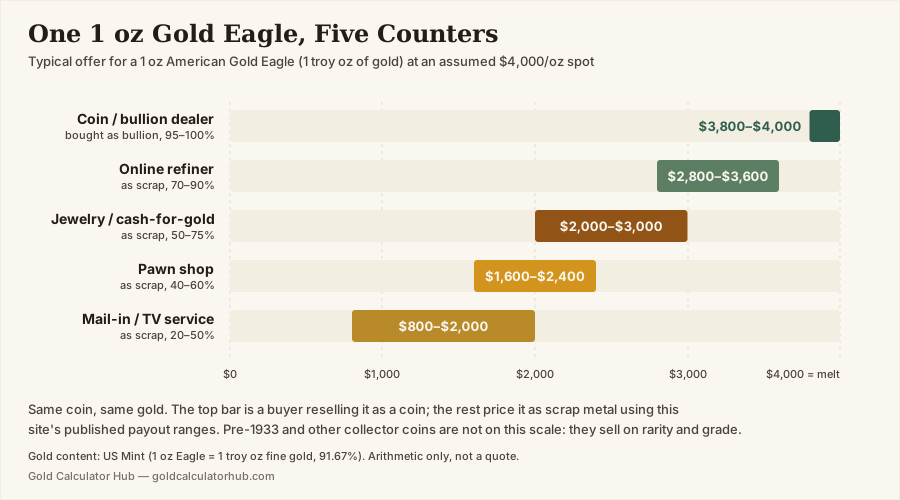
So who pays the most for gold coins? For bullion, a competitive coin dealer or online buy-back desk. For collector coins, whoever reaches the most collectors, often an auction.
Bullion coin or collector coin? Sort them before anyone bids
Before asking anyone for a price, decide whether each coin is worth its gold or worth more than its gold.
Modern bullion coins
These are minted in large numbers and priced from gold. The issuers publish their specifications:
- American Gold Eagle: 91.67% gold, 3% silver, the rest copper; the 1 oz coin weighs 1.0909 troy oz (33.931 g) and contains one troy ounce of gold, according to the US Mint's bullion coin programs page. Half, quarter and tenth-ounce sizes exist.
- American Buffalo: one troy ounce of .9999 fine (24-karat) gold, the first .9999 gold coin struck by the US Mint, per the Mint's American Buffalo page.
- Canadian Gold Maple Leaf: 99.99% pure gold, 31.11 g, per the Royal Canadian Mint.
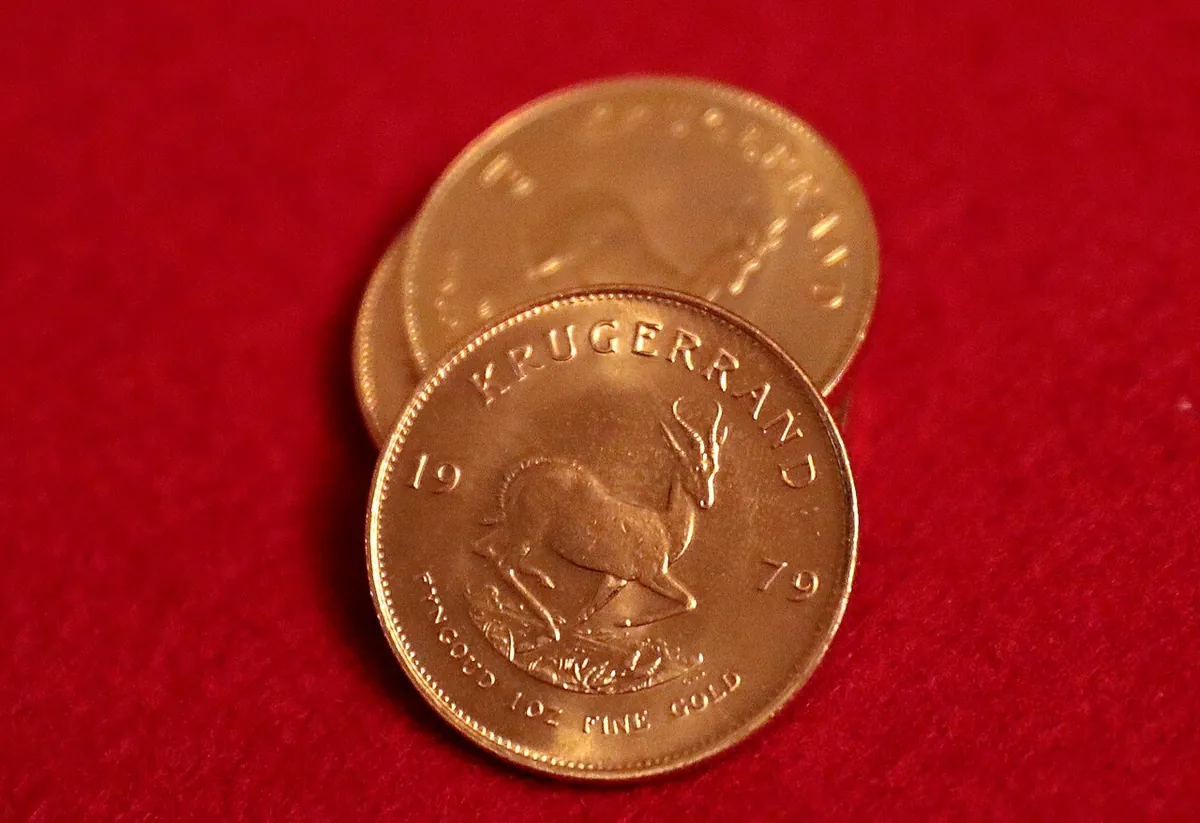
- Krugerrand: a 22-carat alloy of 91.67% gold and 8.33% copper, per Rand Refinery, which makes the blanks.
Melt runs on gold content, not on what the coin weighs, which is why an Eagle and a Maple Leaf are worth the same; the gold coin melt value calculator lists every major coin side by side.
Pre-1933 US gold and other older coins
US gold coins struck for circulation before 1933 are a different market. A common-date $20 Double Eagle carries about 30.09 g of gold (0.9675 troy oz), which is $3,870 of melt at $4,000 per ounce, and worn common dates often trade near that. Scarce dates, certain mint marks and high grades can sell for several times melt, and no scale can see the difference.
Proof coins and graded holders
A coin in a sealed grading-service holder, or a proof coin in its original box, sells to collectors. Never crack it out to weigh it.
Selling inherited gold coins
Inherited coins are where the most money is lost, because nobody knows what is in the box. A safe order:
- List every coin by country, denomination, date and mint mark (a small letter, often near the date or on the reverse).
- Separate bullion from older coins. Anything modern and listed above is bullion; anything US-issued before 1933 needs a collector check.
- Weigh, without cleaning anything. Cleaning can sharply cut a collector coin's value. Compare weights with the gold coin melt value calculator; a coin that is clearly off needs a closer look.
- Get a collector opinion on the old coins from a coin dealer who is not the one offering to buy them, or from a grading service.
- Then sell the bullion one way and the collector coins another.
Illustrative example (not a real estate): an estate holds four 1 oz Eagles and two common-date Double Eagles. At $4,000 per ounce the gold is worth $23,740. A coin dealer bidding 95–100% on the Eagles pays $15,200 to $16,000 for those four alone, and the Double Eagles are priced separately once their dates are checked. Carry the same six coins to a pawn counter paying 40–60% of melt and the whole lot fetches $9,496 to $14,244.
How coin quotes are stated, and how to check one
Coin dealers quote against spot, the wholesale price of one troy ounce of gold, rather than as a percentage of melt.
The three formats
- Spot minus a dollar amount per coin: "spot minus $80" on a 1 oz coin at $4,000 spot is $3,920.
- A percentage under spot: "2% under spot" on the same coin is also $3,920.
- Spot plus a premium: occasionally offered on popular coins when retail demand is strong, because the dealer can resell above spot at once.
Each assumes a coin holding one ounce. On anything else, convert to melt first: a Double Eagle holds 0.9675 oz, so its gold is $3,870, not $4,000. The calculator above does that for every preset.
Checking a quote in thirty seconds
- Find melt: the calculator, or gold content in ounces × spot.
- Divide the offer by melt.
- Compare with the table above. A bullion coin offered 95% or more is a normal bullion bid. One offered 60% is a scrap bid on a coin, and you should take it elsewhere.
Illustrative example: at $4,000 spot one shop bids $3,880 on a 1 oz Krugerrand (97% of melt) and another offers $2,600 (65%). The second shop is treating the coin as scrap, which makes it the wrong place to sell it.
Can you sell at spot price?
Sometimes, on common bullion coins in a strong retail market, a dealer's bid reaches spot or slightly above it. Most of the time the bid sits a little below spot, and the gap is the dealer's resale margin. Nobody buys scrap jewelry at spot; the reasons are set out in how much below spot to sell gold. Quotes also expire: an unlocked quote is re-priced when you arrive or when your package does.
Selling safely in a shop, by mail and at auction
The safest place to sell gold coins is one where you watch them being checked and leave with payment the same day, or, remotely, one that locks your price in writing before you ship.
In a shop
- Call ahead with the exact coins and ask for an indicative bid per coin.
- Keep the coins in sight while they are weighed and tested, and ask to see the scale.
- Ask for the offer per coin, not one figure for the pile.
- Expect to be asked for photo ID, and get a written receipt listing each coin and its price.
By mail to an online bullion dealer
- Lock the price first and get the confirmation in writing, with the order number.
- Read the terms on testing, rejected coins, return shipping and payment timing before you ship.
- Ship fully insured, with tracking and signature, and photograph each coin first.
In 2010 the FTC told Congress that some online gold buyers gave a quote only if asked, and some paid only after items were melted, leaving consumers little recourse. A locked written price prevents both.
At auction
An auction house earns its commission by putting a scarce coin in front of many collectors. Ask about the seller's commission, reserve, insurance and payment date. For common bullion an auction rarely beats a dealer once fees are counted.
Red flags at any buyer
- A single price for the whole bag, with no per-coin breakdown.
- A bullion bid far below spot, or pressure to decide now.
- An offer to buy older coins "for the gold" without looking at dates or mint marks.
- Scratching or acid-testing a coin before you have agreed to sell.
- A mail-in buyer who will not state a price until your coins are in its hands.
More warning signs, with examples, are on our cash for gold scams page.
Paperwork, IRS reporting and taxes in plain terms
Selling gold coins at a gain can create US tax, whatever the buyer reports. This is general information, not tax advice; for your situation, ask a tax professional.
Is the sale reported to the IRS?
Only some sales. The IRS instructions for Form 1099-B say a broker's sale of a precious metal is not reportable when the CFTC has not approved a regulated futures contract for that form of metal, or when the quantity is below what such a contract requires. The IRS's own example: a single gold coin need not be reported, because CFTC-approved gold coin contracts call for at least 25 coins. Same-customer sales within 24 hours are added together, and splitting sales to avoid reporting voids the exception.
What rate applies?
The IRS treats coins as collectibles. Its capital gains topic page says net capital gains from selling collectibles, such as coins or art, are taxed at a maximum 28% rate. What you owe depends on basis, holding period and the rest of your return.
What to keep
- The receipt from the sale, listing each coin and its price.
- Purchase records, or for inherited coins, their value at the date of death; the basis rules are explained in selling inherited gold jewelry and apply to coins too.
- The gold price on the day you sold.
Wherever you sell, start from a melt figure on the gold calculator and judge every offer against it.
Frequently Asked Questions
Where to sell gold coins near me?
A coin shop or bullion dealer, not a jewelry store or pawn shop. Call two or three with your exact coins, ask for a per-coin bid against spot, and compare with one online dealer's posted buy price.
Is it better to sell gold coins to a dealer or online?
For a few bullion coins, a local dealer is usually as good and you are paid on the spot. For a larger lot an online desk may bid slightly higher, but you take on shipping and a wait for payment. Lock the price in writing first.
Can I sell gold coins at spot price?
Sometimes, on common bullion coins when retail demand is strong. Most bids sit a little below spot; a bid far below spot on a bullion coin is a scrap bid.
Should I sell a pre-1933 gold coin for its melt value?
Not before checking its collector value. Common-date, worn coins often trade near melt, but scarce dates, mint marks and high grades can bring several times melt. Melting is irreversible.
Why did a pawn shop offer so much less for my gold coin?
Most pawn shops do not trade bullion, so they price a coin as scrap, typically 40–60% of melt. A coin dealer resells it as a coin and bids much higher.

Written by Sukie Gao
Sukie Gao holds a master's degree from a business school, where she picked up the markets-and-pricing toolkit she now applies to the consumer gold trade. She created Gold Calculator Hub to give people an independent, data-driven way to find out what their gold is really worth.
Published November 10, 2026 · Updated November 14, 2026