Gold Plated Jewelry Value: What the Stamps Mean and What You'll Get
 By Sukie Gao · Updated November 14, 2026
Quick answer
Recoverable gold in most plated pieces is worth a few cents to a couple of dollars. Plating is measured in microns, so a ring plated at 2.5 microns carries about a hundredth of a gram. Where gold plated jewelry value exists, it comes from the design, the brand, or the sterling under vermeil.
Gold plated jewelry value is a question with an uncomfortable answer, and it is better to get it stated plainly than to discover it at a counter: for almost all consumer gold-plated items, the recoverable gold value is somewhere between a few cents and a couple of dollars. Not a few percent of solid gold — a rounding error.
That is not a judgement about the jewelry. Plated pieces can be beautiful, well made and worth wearing, and some are worth real money as objects. It is purely a statement about metal content. A plating layer is measured in microns — thousandths of a millimetre — and the mass of gold in a micron-thick coating on a bracelet is measured in fractions of a gram at best.
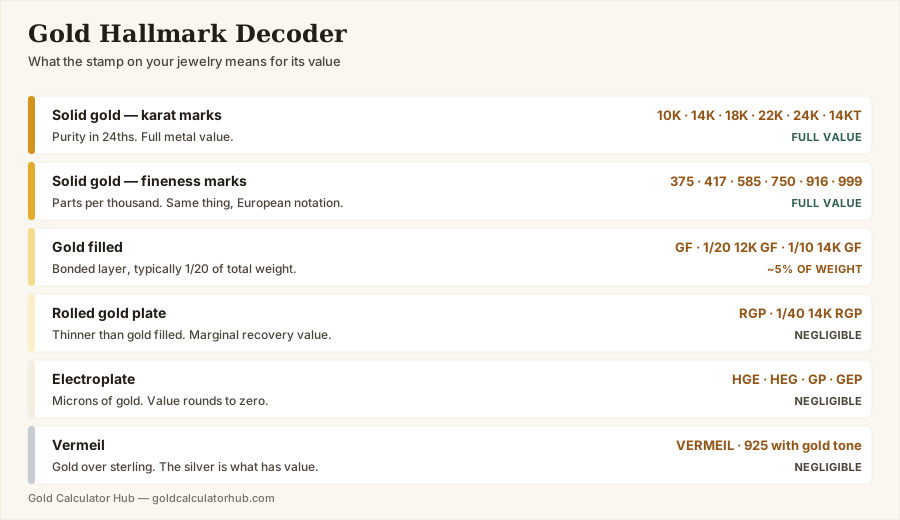
What this page does is give you the tools to sort your own pile correctly. There is a whole family of stamps — GP, GEP, HGE, RGP, GF, vermeil, micron numbers, plaqué or — and they do not all mean the same thing. One of them, gold filled, contains meaningfully more gold than the others. Knowing which mark you are looking at is the difference between a realistic expectation and a wasted trip.
The stamps, decoded
| Mark | Full name | Gold content | Realistic value |
|---|---|---|---|
| GF, 1/20 14K GF | Gold filled | ~5% of weight | Real but small; sold by the kilo |
| RGP, 1/40 12K RGP | Rolled gold plate | ~2.5% of weight | Marginal |
| HGE, HEG | Heavy gold electroplate | Microns | Negligible |
| GEP | Gold electroplate | Microns | Negligible |
| GP | Gold plate: a mechanically bonded layer of at least 10K, thinner than gold filled (the term is also used loosely for electroplate) | A small fraction of weight if bonded; microns if electroplated | Marginal if bonded; negligible if electroplated |
| 20 MICRONS, PLAQUÉ OR G20 | Plating thickness spec | 20 µm | Negligible |
| VERMEIL, 925 gold-tone | Gold over sterling silver | Microns of gold | Value is in the silver |
| GOLD TONE, GOLD FINISH | No standard meaning | Possibly none | Costume |
The critical distinction in that table is between the top two rows and everything below them. Gold filled and rolled gold plate are mechanically bonded layers with real thickness — a fraction of the item's weight, specified as a fraction in the mark. Under 16 CFR 23.3, rolled gold plate is a layer of at least 10K that makes up less than 1/20 of the weight, and "gold plate" (GP) names the same bonded construction. Everything else is electroplating (GE, GEP; HGE means at least 2.5 microns), which is measured in microns and contributes essentially nothing recoverable.
So the first question about any plated-looking piece is: does the mark contain a fraction? If it says 1/20 or 1/40, there is real gold there. If it says HGE, GEP or a micron number, there is not. A bare GP with no fraction is ambiguous, because the term is used for both kinds; treat it as electroplate until a test says otherwise.
These terms carry legal definitions in the US under the FTC Jewelry Guides, which set the minimum gold thickness and karat required before a product may be described as gold filled, gold plated or vermeil.
The arithmetic, so you can see the scale
Plating thickness is where the intuition breaks, so it is worth doing the numbers once.
Costume plating is often well under a micron. Heavy gold electroplate (HGE) must be at least 2.5 microns, and plain gold electroplate at least 0.175 microns, under the FTC Jewelry Guides (16 CFR 23.3). Some premium plating goes thicker, and European pieces may state 20 microns outright. For comparison, a sheet of paper is about 100 microns thick.
Take a bracelet with 20 cm² of surface area, plated at 2.5 microns with 18K gold. The volume of gold is 20 cm² × 0.00025 cm = 0.005 cm³. Gold's density is 19.3 g/cm³, and 18K is about 15.6 g/cm³, so that is about 0.078 grams of alloy — roughly 0.058 g of pure gold. At $143 per gram: about 8 cents.
Even at 20 microns, eight times thicker, you reach roughly 65 cents.
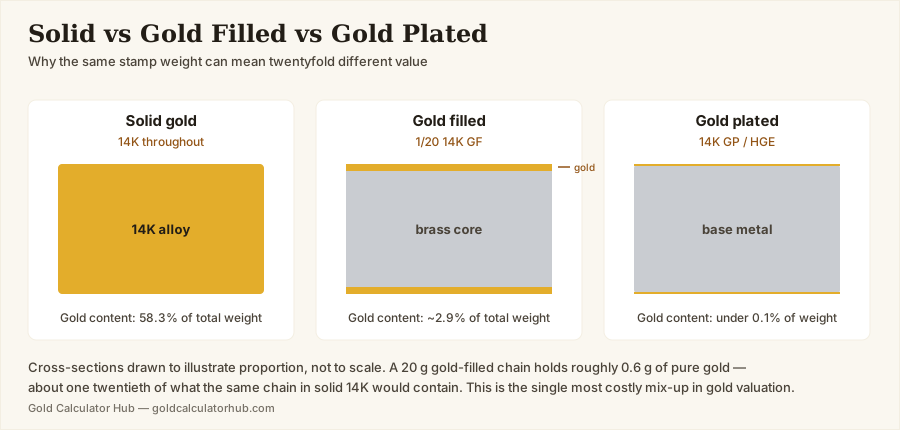
Now compare gold filled. A 20 g piece marked 1/20 14K GF has 1 g of 14K bonded to it, containing 0.58 g of pure gold — about $83. That is a thousand times more gold than the plated bracelet, from a mark that looks superficially similar.
The gap between "gold filled" and "gold plated" is the single most valuable distinction on this page.
Where the marks hide, and what confuses people
Plated items are marked in the same places as solid gold — clasp tags, inside ring shanks, case backs, the reverse of pendants — but the marks are often faint because plating is applied over a stamped base.
Two specific confusions come up constantly.
"14K HGE" is not 14K gold. The karat number describes the *plating alloy*, not the item. A 14K HGE ring is a base metal ring with a thin layer of 14K-alloy gold on it. The presence of any letters after a karat mark should stop you from applying gold prices to the weight.
"1/20 12K GF" is not 12K gold and not 1/20 of a karat. It means the bonded gold layer is one twentieth of the item's total weight, and that layer is 12 karat. So gold content is (1/20) × (12/24) = 2.5% of total mass.
A third, less common: "plating stamped parts." Manufacturers plating stamped base-metal components mark them for trade compliance rather than consumer information, and those marks sometimes end up on finished jewelry. If a mark looks like a part number or a process code rather than a purity claim, treat the item as plated until tested.
Vermeil is the exception worth knowing
Vermeil — pronounced ver-may — is gold plating over sterling silver rather than base metal. In the US, the FTC requires vermeil to be at least 2.5 microns of at least 10K gold over sterling.
That makes it the one plated category with real recoverable value, but the value is in the silver, not the gold.
A 25 g vermeil cuff is essentially 25 g of sterling silver, which is 92.5% silver — about 23 g of fine silver. Silver prices are far lower than gold, but 23 g of silver is genuinely worth something, and silver scrap buyers take sterling readily.
So the practical handling of a vermeil piece is: identify it (look for 925 alongside a gold appearance), value it as sterling silver, and ignore the gold entirely. Selling it to a gold buyer as "gold" gets you nothing; selling it to a silver buyer as sterling gets you the actual value.
A lot of designer costume jewelry is vermeil, and a lot of it is worth more as jewelry than as either metal.
Who actually buys plated scrap
Very few people, and the economics explain why.
Refiners generally decline small quantities. Recovering a fraction of a gram of gold from a base metal item requires the same chemistry as recovering ten grams. Below a substantial volume, processing costs exceed the yield.
Specialist plated-scrap buyers exist and purchase by weight at low per-pound rates. They aggregate until they have enough volume to make refining economic. This is a real market, and it is measured in dollars per pound of mixed material, not per gram of gold.
Electronic scrap processors handle gold-plated connectors and pins, where plating is thicker and the volumes are industrial. Jewelry does not fit this channel.
Gold filled is different. There is an established market for gold-filled scrap, priced per pound at a meaningful rate because 5% gold content by weight is genuinely recoverable at volume. If you have a substantial quantity of marked GF material — a kilogram or more — it is worth finding a buyer who specifically advertises gold-filled purchasing.
For a handful of plated items, the honest answer is that no buyer will pay you anything worth the trip.
When plated jewelry is worth real money anyway
Metal content is not the only source of value, and plated jewelry often has more of the other kind than solid gold does.
Designer costume jewelry is a serious collecting field. Trifari, Coro, Miriam Haskell, Schiaparelli, Kenneth Jay Lane, Napier and others made plated pieces that sell for tens to thousands of dollars. Signed pieces in original condition are the ones to look for.
Mid-century gold-filled watches from Hamilton, Elgin, Bulova and Waltham are collected and typically worth more working than scrapped.
Victorian and Edwardian rolled gold — particularly Albert chains, lockets and mourning jewelry — has a steady market as period jewelry.
Contemporary designer vermeil from recognised brands resells well on secondhand platforms.
The pattern: plated jewelry's value lives in design, signature and condition rather than in metal. That means the right question is not "what is the gold worth" but "who made this and does anyone collect it." Photograph any signature and search it before assuming a piece is worthless.
Telling plated from solid without a mark
Marks wear off, and plenty of older pieces never carried one. Four checks, cheapest first.
Look at wear points. Plating wears through at edges, clasps, and the backs of rings, revealing a different colour underneath — usually white or coppery. Solid gold wears evenly and stays gold all the way through. This is the single most reliable free test.
Check for discolouration. Plated items often show green or dark tarnish where skin contact is heaviest. Solid gold does not tarnish.
Weigh against size. Gold is very dense. A solid gold piece feels distinctly heavy for its dimensions; a plated base metal piece feels light. With practice this is surprisingly reliable.
Magnet test. Gold is not magnetic. If a piece is attracted to a strong magnet, it has a ferrous core and is definitely not solid gold. Passing this test proves little, since brass and copper are not magnetic either.
For certainty, an acid test kit at around $15 will cut through plating and read the base metal, and a jeweler's XRF reads composition instantly. Most jewelers will test free.
What to do with a box of plated jewelry
A pragmatic sorting process, in the order that finds value fastest.
- Pull out anything signed. Photograph the signature, search it. This is where the money is, if there is any.
- Pull out anything marked 925 or vermeil. That is sterling silver and has real scrap value as silver.
- Pull out anything with a fraction in the mark — 1/20, 1/40, GF, RGP. Set it aside; if you accumulate a kilogram it is worth selling to a gold-filled buyer.
- Check the remainder for missed solid gold. A worn mark on a genuinely solid piece happens more often than you would expect, and it is worth an acid test on anything unusually heavy.
- Everything left is costume. Sell it as wearable jewelry if it is attractive, donate it, or keep it. Do not spend money shipping it to a refiner.
Step 1 is the one people skip and the one that occasionally turns a shoebox into several hundred dollars.
Frequently Asked Questions
What is the difference between gold filled and gold plated?
Thickness, bonding method, and about a thousandfold in gold content. Gold filled is a layer of gold alloy mechanically bonded under heat and pressure, legally required to be at least 1/20 of the item's weight in the US — so a 20 g piece holds around 1 g of gold alloy. Gold plated is usually electroplated, from under a micron on costume pieces to the 2.5-micron legal minimum for heavy gold electroplate (some European pieces state 20 microns), contributing a fraction of a gram at most. Gold filled has real if modest scrap value at volume; gold plated does not.
How much gold is in a gold plated ring?
Typically between 0.01 and 0.1 grams, depending on plating thickness and surface area. A ring plated at 2.5 microns carries roughly a hundredth of a gram of gold — a few cents' worth. Even a thick 20-micron plating, as some European pieces state, rarely exceeds a tenth of a gram. For comparison, a solid 14K ring of the same size holds around 3 grams of pure gold, several hundred dollars' worth.
Will a pawn shop buy gold plated jewelry?
Generally not for its metal. A pawn shop buying gold pays for gold content, and plated items have effectively none. They may buy a plated piece as resaleable jewelry if it is attractive, branded or in current style, but that is a different transaction and the price reflects wearability rather than metal. Do not expect a gold-based offer on anything marked GP, GEP, HGE or with a micron number.
Can I sell gold plated jewelry to a refiner?
Not in small quantities. Recovering a fraction of a gram of gold requires the same processing as recovering ten grams, so refiners set minimum volumes that consumer quantities never meet. Specialist plated-scrap buyers do exist and purchase by the pound at low rates, aggregating until refining becomes economic. Gold filled is genuinely different — there is an established per-pound market for GF scrap, worth pursuing if you have a kilogram or more.
Does gold plating wear off?
Yes, always, and the timeline depends on thickness and wear. A 0.5 micron costume plating can wear through in months of daily use. A 2.5 micron plating on a ring might last a year or two; on earrings, which get little friction, far longer. A thick 20-micron plating, as some European pieces state, can last several years. Rings and bracelets wear fastest because they contact surfaces constantly; pendants and earrings last longest. Replating is possible and typically costs $30–80 per piece at a jeweler.

Written by Sukie Gao
Sukie Gao holds a master's degree from a business school, where she picked up the markets-and-pricing toolkit she now applies to the consumer gold trade. She created Gold Calculator Hub to give people an independent, data-driven way to find out what their gold is really worth.
Published November 2, 2026 · Updated November 14, 2026