9K Gold Calculator: What 9 Karat (375) Gold Is Worth
 By Sukie Gao · Updated November 14, 2026
Quick answer
Nine karat, stamped 375 or 9ct, is 37.5% gold. Run through the 9K gold calculator at an assumed $4,400/oz, one gram holds $53.05 of melt value and a pennyweight about $82.49.
9K Gold Calculator: What 9 Karat (375) Gold Is Worth
Live gold price: $3,887.60/ozt · Nov 14, 3:21 PM EST · updates every 10 min
Melt value of 10 g of 9K gold
$468.71
Pure gold content: 3.75 g × $124.99/g
| Where you sell | Typical offer | % of melt |
|---|---|---|
| Online gold refiner | $328.10 – $421.84 | 70–90% |
| Local coin / bullion dealer | $304.66 – $398.40 | 65–85% |
| Jewelry store | $234.35 – $351.53 | 50–75% |
| Pawn shop | $187.48 – $281.23 | 40–60% |
| Mail-in 'cash for gold' TV services | $93.74 – $234.35 | 20–50% |
Ranges reflect typical published buy rates and consumer-test results. We are not a buyer — these numbers exist so you can judge any offer you receive.
Use this 9K gold calculator when a piece is stamped 9K, 9ct or 375 and you want its melt value in dollars before anyone makes you an offer. Nine karat gold is 9 parts gold out of 24, which is 37.5% gold, and the calculator above is already set to that purity: type a weight and it multiplies by 0.375 and today's price.
If your piece came from Britain, it probably carries a UK hallmark rather than an American karat stamp. That changes how you read it, not how you price it. Below are the dollar values per unit at an assumed price, the British and American rules that apply to 9K, how big the gap to 10K really is, how to read the marks (including the stray numbers that are not gold marks at all), and a priced 9ct gate bracelet. Every figure is worked by hand, so you can check it line by line against whatever number a buyer quotes you.
9K, 9ct, 375: Three Labels for One Alloy
The three labels describe the same metal. "9K" is the American spelling of karat, "9ct" is the British spelling (carat), and 375 is the millesimal fineness: 375 parts of gold in every 1,000 parts of metal. Divide 9 by 24 and you get 0.375, so a search for "9 karat as a gold percentage" has a one-line answer: 37.5%.
The other 62.5% is alloy (commonly silver and copper), with the proportions set by the maker for color and hardness. That share does not count toward melt value. Refiners recover the gold and price the rest as near zero for a gold sale.
Here is where 9K sits among the karats you are likely to see side by side in a jewelry box:
| Karat | Fineness mark | Gold content |
|---|---|---|
| 24K | 999 | 99.9% |
| 22K | 916 or 917 | 91.67% |
| 18K | 750 | 75% |
| 14K | 585 or 583 | 58.33% |
| 10K | 417 | 41.67% |
| 9K | 375 | 37.5% |
For the full list, including stamps you will not meet on 9K, see the gold purity chart.
Dollar Value per Gram, Pennyweight and Ounce
To keep the arithmetic checkable, assume gold at $4,400 per troy ounce, which works out to $141.46 per gram of pure gold (4,400 ÷ 31.103). Treat these as illustrations. The calculator above uses the live price.
Multiply $141.46 by 0.375 and one gram of 9K holds $53.05 of gold.
| Unit | Weight | 9K melt value at $4,400/oz |
|---|---|---|
| Gram | 1 g | $53.05 |
| Pennyweight (dwt) | 1.555 g | $82.49 |
| Standard (food) ounce | 28.350 g | $1,503.90 |
| Troy ounce | 31.103 g | $1,650.00 |
The troy ounce row is simply $4,400 × 0.375. The standard ounce row exists only to show the trap: a kitchen scale reading in ounces under-reports gold weight by almost 10% compared with troy ounces, and the value falls with it. Weigh in grams, then convert.
Common weights, for a quick sense of scale: 5 g of 9K is worth $265.24 in melt, 10 g is $530.48, 20 g is $1,060.95 and 50 g is $2,652.38. A buyer pays a share of these figures, never the whole thing, which the bracelet example below works through.
The Rules Behind 9K in Britain and in the US
In the UK, 375 is the floor. The Hallmarking Act 1973, Schedule 2 lists six approved standards for gold: 375, 585, 750, 916, 990 and 999. Nothing below 375 can be hallmarked as gold, and the 1975 guidance from the Joint Committee of the Assay Offices of Great Britain states it directly: minimum fineness "for gold the standard of 375." That is why 9ct is so common in British jewelry. It is the cheapest grade that can still be legally sold as gold.
The US rule is different from what many people assume. There is a widespread belief that 10K is the American legal minimum and that 9K "isn't gold" in the US. The current FTC Jewelry Guides do not say that. 16 CFR §23.3(c)(1) says an item made throughout of a gold alloy may be described as gold if the correct karat comes immediately before the word, and its own examples include "9 Karat Gold" and "9 Kt. Gold." What the rule requires is accurate disclosure. Calling 9K just "gold" with no karat, or stamping it 10K, is the deceptive part.
The 10K threshold still appears in that regulation, but only for coatings. The gold layer on anything sold as gold filled, rolled gold plate or gold electroplate must be at least 10 karat. A 9K layer cannot be marketed under those names in the US.
One more American detail affects value. The same section points to the National Stamping Act's tolerances: an article stamped with a karat may assay up to 3 parts per thousand under its mark if it contains no solder, or 7 parts per thousand if the tested part contains solder. A soldered piece stamped 9K can therefore lawfully test at 368 rather than 375. On a 15-gram item at $141.46 per pure gram, that tolerance is worth $14.85.
How Far 9K Trails 10K, and Everything Above It
9K and 10K are only one karat apart, and on a scale they look and feel the same. The value difference is smaller than people fear and larger than they assume.
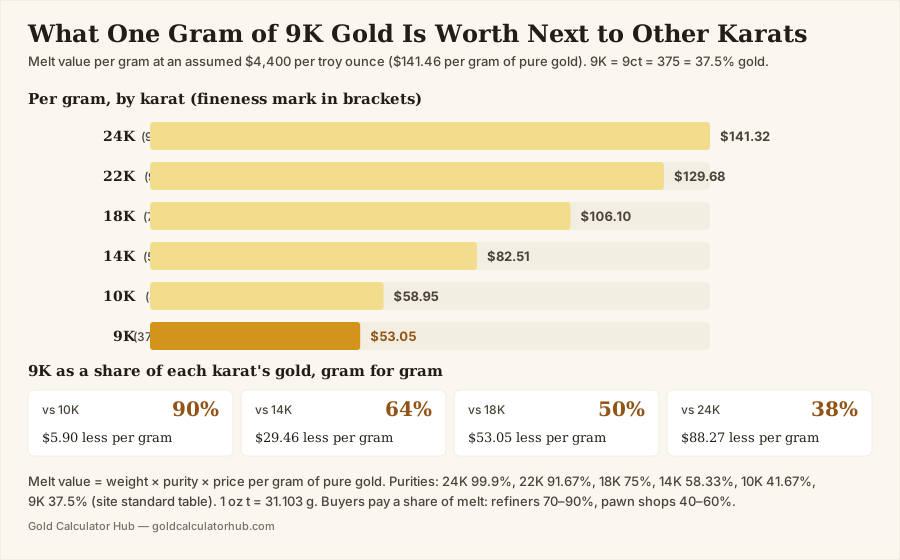
Per gram, 10K holds $58.95 of gold and 9K holds $53.05, a gap of $5.90 per gram ($9.17 per pennyweight). Put another way, 9K carries 90% of the gold that the same weight of 10K does: 0.375 ÷ 0.4167 = 0.900. If a buyer quotes the same per-gram price for both, one of the two quotes is wrong.
Further up, the gaps widen quickly:
- 9K vs 14K: 9K holds 64% of the gold in 14K. A gram is $53.05 against $82.51.
- 9K vs 18K: exactly half. 37.5% against 75%, or $53.05 against $106.10 a gram.
- 9K vs 24K: a gram of 9K holds a little over a third of what a gram of fine gold holds.
The practical point is sorting. A drawer with mixed 9ct, 10K and 14K pieces should be weighed in separate groups. If the pile goes onto the scale as one lump, the buyer gets to pick the karat, and they will not pick the highest one. The 10K gold calculator runs the neighboring tier, and the gold price calculator handles any other stamp you find.
Reading the Marks on a 9ct Piece
A full British hallmark is a set of separate marks, not a single stamp. Three are compulsory, as the Edinburgh Assay Office lists them:
- Sponsor's mark: initials in a shield identifying who sent the piece for testing.
- Fineness mark: for 9ct, the figures 375.
- Assay office mark: under the Act, a leopard's head for London, an anchor for Birmingham, a rose for Sheffield or a castle for Edinburgh.
Optional marks may appear next to them. Schedule 2 allows a traditional crown beside any gold standard (375 included), and the date letter has been voluntary since 1999. Read the number and ignore the decoration, because the number is what goes into the calculator.
Why a gate bracelet carries one hallmark, not one per link
A bracelet is hallmarked as one article. The 1975 assay offices' note on chain bracelets treats the whole bracelet or necklet as the thing that must be marked, so the hallmark goes once, on a part capable of bearing it, such as the clasp or padlock. Bare links are not expected to be marked. Very fine chain can be exempt altogether if every link and jump ring is made of wire under 0.9 mm, the jump rings are under 5 mm across, and no other part could take a mark. Separately, Schedule 1 of the Act exempts a gold article whose total metal weight is under 1 gram.
Numbers that are not gold marks
The UK fineness marks are whole numbers from that list of six. A decimal stamped near the 375, such as 0.25, is not part of the gold standard and should not be read as one. On a stone-set ring, a separate figure like this can be a stone weight in carats, but ask the seller or a jeweler instead of guessing. Either way it does not change the gold math, because the 375 is the mark that sets purity. More stamps are explained in the gold hallmarks guide.
Worked Example: A 15-Gram 9ct Gate Bracelet
Take a classic British 9ct gate bracelet with a padlock clasp. It is hallmarked 375 on the padlock and weighs 15.0 grams on a 0.01 g scale. It has no stones, so all 15 grams are metal.
- Pure gold content: 15.0 × 0.375 = 5.625 g
- Melt value at $141.46/g: 5.625 × 141.46 = $795.71
That $795.71 is the most a buyer can pay and still break even on metal. Applying the site's usual payout ranges for different kinds of buyers:
| Buyer type | Share of melt | Offer on this bracelet |
|---|---|---|
| Online refiner | 70–90% | $557.00–$716.14 |
| Local coin or bullion dealer | 65–85% | $517.21–$676.36 |
| Jewelry store | 50–75% | $397.86–$596.78 |
| Pawn shop | 40–60% | $318.29–$477.43 |
| Mail-in TV service | 20–50% | $159.14–$397.86 |
Two checks are worth doing. First, if the bracelet were 10K at the same weight, its melt would be $884.20. A buyer who tells you a 9ct piece is worth "about the same as 10K" is either rounding loosely or generously, and you should ask which. Second, a gate bracelet is full of solder joints, so under the US tolerance it could test as low as 368 and still meet its mark. That is roughly $14.85 of the melt figure on this piece. It is not a scam, but it is a reason not to expect a buyer's assay to come in above 375.
Run your own weight through the calculator above, write the melt figure down, and compare offers against it. Then the basics: get several quotes and watch the item being weighed. For everything else gold-related, start at the gold calculator home page.
Frequently Asked Questions
My jewelry says 375 and 0.25. What is the 0.25?
The 375 is the gold mark: 9 carat, 37.5% gold. The 0.25 is not a UK fineness standard. The legal gold standards are whole numbers (375, 585, 750, 916, 990, 999), so a decimal does not describe the gold. On a stone-set piece, a separate decimal can refer to a stone weight in carats, and the seller or a jeweler can confirm that. For melt value, ignore it and price the gold weight at 37.5%, after subtracting the weight of any stones.
How much is one gram of 9K gold worth?
At an assumed $4,400 per troy ounce, which is $141.46 per gram of pure gold, one gram of 9K holds $53.05 of gold (141.46 × 0.375). A pennyweight holds $82.49. Those are melt values, the ceiling on any honest offer. A buyer will pay a share of them: roughly 70–90% at an online refiner and 40–60% at a pawn counter. For today's figure rather than our example price, enter 1 gram in the calculator above.
Is there such a thing as 9K gold-filled?
Not under US rules. FTC 16 CFR §23.3(c)(2) only allows "Gold Filled," "Rolled Gold Plate" and "Gold Overlay" when the bonded layer is at least 10 karat, so a 9K layer cannot be sold under those names in the US. In the UK, unhallmarked items may be described as gold only with qualifiers such as "plated" or "rolled." Either way, a plated or rolled item holds a small fraction of the gold of a solid 9ct piece of the same weight.
Can a small 9ct item be sold as gold in the UK without a hallmark?
Sometimes. Schedule 1 of the Hallmarking Act 1973 exempts a gold article of at least minimum fineness whose total metal weight is under 1 gram, provided it contains no other materials unless it meets the Act's conditions for those. Very fine chains can also be exempt if every link and jump ring is made of wire under 0.9 mm and nothing on them can take a mark. Anything heavier, sold in the UK and described as gold, needs a hallmark.

Written by Sukie Gao
Sukie Gao holds a master's degree from a business school, where she picked up the markets-and-pricing toolkit she now applies to the consumer gold trade. She created Gold Calculator Hub to give people an independent, data-driven way to find out what their gold is really worth.
Published October 27, 2026 · Updated November 14, 2026